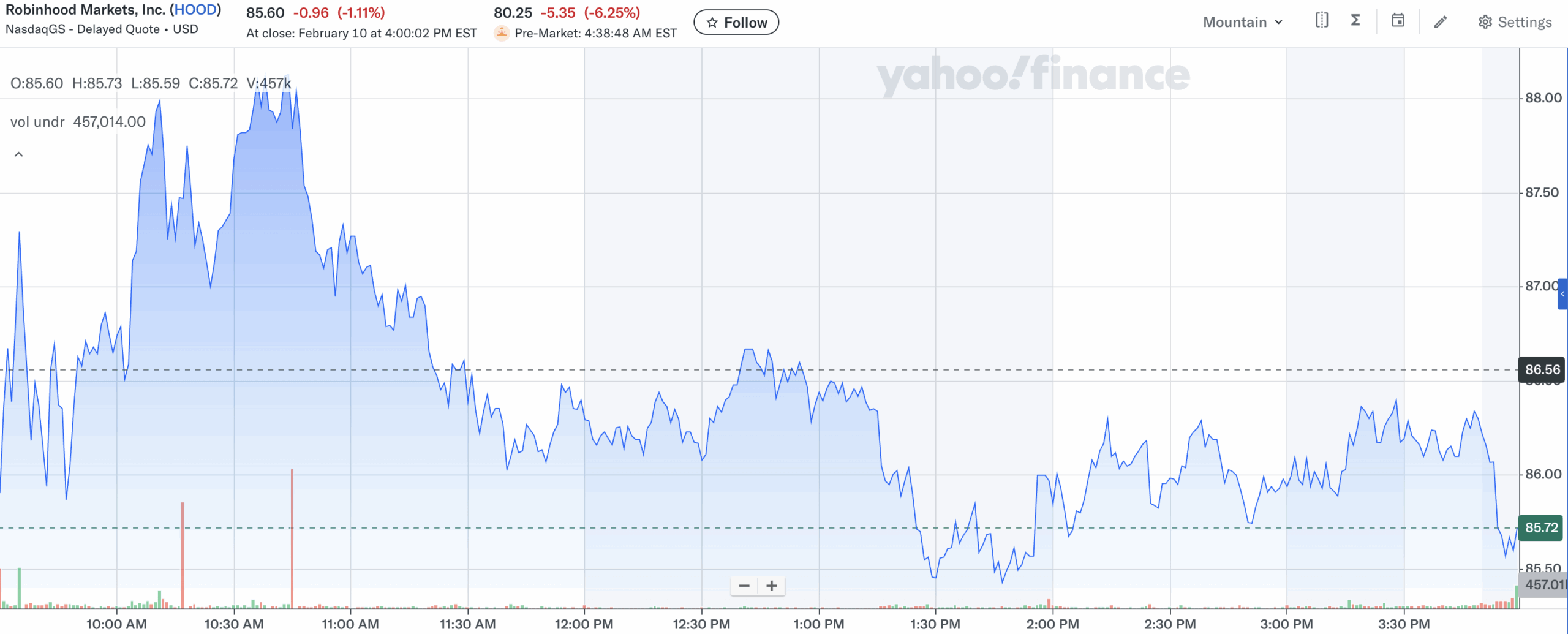
HOOD stock fell 8% after Robinhood missed Q4 2025 earnings expectations. Here’s what the Arbitrum-based blockchain testnet could mean for future growth. | Credit: Getty Images
Share
Key Takeaways
HOOD stock fell by 8% after Q4 revenue missed expectations, despite beating earnings per share estimates.
Crypto trading revenue disappointed, coming in at $221 million versus roughly $248 million expected, reflecting weaker digital asset activity.
Prediction markets are emerging as a major growth focus, with analysts spending more time discussing event contracts than crypto on the earnings call.
Robinhood launched the public testnet of Robinhood Chain, an Ethereum Layer 2 built on Arbitrum, signaling a long-term push into tokenization and on-chain finance.
While the earnings miss drove the immediate selloff, the broader story was more complex: crypto trading slowed, prediction markets took center stage on the earnings call, and Robinhood simultaneously launched the public testnet of its new blockchain.
For investors, the key question is whether the stock reaction reflects short-term disappointment or a deeper reassessment of growth expectations.
Robinhood Chain Explained: What the Blockchain Means for HOOD Stock
Robinhood confirmed that Robinhood Chain has entered its public testnet phase, marking a step toward building a blockchain designed for tokenized real-world assets and on-chain financial services.
The network is an Ethereum Layer 2 built on Arbitrum, with Chainlink providing oracle infrastructure. According to Robinhood’s announcement, developers can now test applications before the mainnet launch, expected later this year.
Robinhood announces its Chain public testnet is live. | Credit: Robinhood X profile
Johann Kerbrat, Senior Vice President and General Manager of Crypto at Robinhood, said the testnet lays the foundation for tokenized real-world assets and deeper integration with decentralized finance (DeFi). The chain is expected to support 24/7 trading and self-custody via Robinhood Wallet.
For HOOD stock, the blockchain strategy signals a long-term pivot toward infrastructure rather than simply brokerage services. However, testnets do not generate revenue immediately. They are development milestones, not financial catalysts.
Why HOOD Stock Fell 8% After Robinhood’s Q4 2025 Earnings Miss
Robinhood reported $1.28 billion in Q4 revenue, missing analyst estimates of approximately $1.34-$1.35 billion, according to LSEG data.
While profit per share beat expectations at 66 cents versus estimates of 63 cents, investors focused on slowing revenue growth. After triple-digit growth periods in 2025, quarterly growth moderated to roughly 27%.
Chief Financial Officer Shiv Verma said that active crypto traders remain engaged, but rebate rates were lower than expected due to pricing tier dynamics.
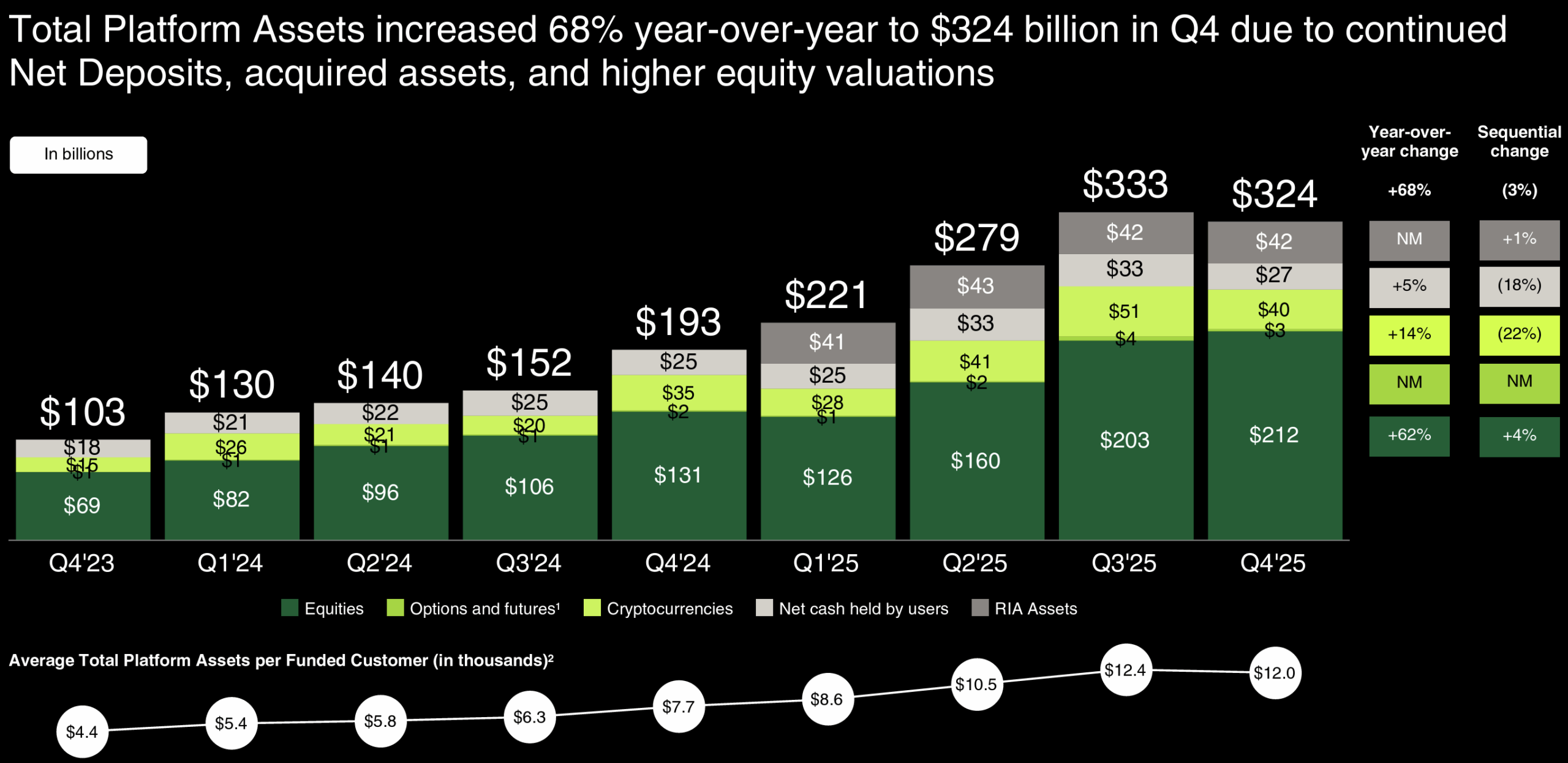
Total platform assets increased in the last quarter of 2025. | Credit: Robinhood
The broader crypto backdrop also mattered. U.S. spot Bitcoin ETFs saw significant outflows in November and December, according to Deutsche Bank. Lower volatility and reduced speculative activity typically pressure trading-driven platforms.
Although equities and options revenue rose 54% and 41%, respectively, crypto had previously been a high-margin growth driver. Its slowdown magnified investor concerns.
What Robinhood’s Blockchain Strategy Means for Crypto and DeFi
Despite softer crypto trading revenue, Robinhood is expanding its ambitions for crypto infrastructure.
Robinhood Chain aims to support tokenized equities and real-world assets. In 2025, the company already introduced tokenized stocks to European customers via Arbitrum One, enabling extended-hour access to U.S.-listed shares.
The new chain could eventually:
Enable on-chain settlement of tokenized securities
Steven Goldfeder, CEO of Offchain Labs, said the project could help advance tokenization and permissionless finance.
However, blockchain infrastructure projects typically require multi-year development cycles before generating material revenue. For now, the testnet is strategic positioning rather than earnings support.
The blockchain announcement did not offset the earnings miss because markets tend to prioritize near-term financial performance over long-term innovation.
Additionally, prediction markets dominated the discussion on the earnings call. Matthew Sigel, Head of Digital Assets Research at VanEck, noted that roughly 30% of analyst questions focused on event contracts rather than crypto.
Bolu suggested that event contracts and prediction markets could eventually represent a larger revenue stream than crypto trading. However, regulatory uncertainty remains a constraint.
Investors appear to be weighing:
Slowing growth
Premium valuation
Crypto revenue volatility
Long-term blockchain investments with uncertain timelines
In this context, the 8% decline reflects repricing rather than panic.
What’s Next for HOOD Stock After the Blockchain Testnet Launch
Robinhood today is more diversified than during previous crypto cycles. Revenue streams now include:
Net interest income.
Options trading.
Subscription services (Gold subscribers rose 58% year-over-year to 4.2 million).
AI automation, which now resolves 75% of support cases and is projected to generate over $100 million in cost savings in 2025.
Management signaled a strong 2026 product pipeline and reported solid January trading volumes.
For HOOD stock, future performance will likely depend on:
Stabilization or rebound in crypto trading activity
The blockchain testnet reinforces Robinhood’s long-term ambitions in tokenization and DeFi infrastructure. But until those initiatives translate into measurable revenue growth, investors may continue focusing on quarterly execution.
HOOD stock fell about 8% after Robinhood reported Q4 revenue below analyst expectations. While profits beat forecasts, revenue came in at $1.28 billion versus estimates closer to $1.34-$1.35 billion. Investors were also concerned about slowing crypto trading revenue.
Did Robinhood’s blockchain launch cause the stock drop?
No. The stock decline was primarily linked to the earnings miss and slower growth metrics. The blockchain testnet launch is a long-term initiative and does not yet generate revenue, so it did not offset short-term investor concerns.
What is Robinhood Chain?
Robinhood Chain is an Ethereum Layer 2 blockchain built on Arbitrum. It is currently in public testnet, meaning developers can test applications before the main network goes live. The goal is to support tokenized real-world assets and on-chain financial services.
How did crypto revenue impact Robinhood’s earnings?
Crypto trading revenue came in at $221 million, below expectations of around $248 million. Lower volatility and reduced trading activity in digital assets contributed to the shortfall.
Disclaimer:
The information provided in this article is for informational purposes only. It is not intended to be, nor should it be construed as, financial advice. We do not make any warranties regarding the completeness, reliability, or accuracy of this information. All investments involve risk, and past performance does not guarantee future results. We recommend consulting a financial advisor before making any investment decisions.
Giuseppe Ciccomascolo began his career as an investigative journalist in Italy, where he contributed to both local and national newspapers, focusing on various financial sectors.
Upon relocating to London, he worked as an analyst for Fitch's CapitalStructure and later as a Senior Reporter for Alliance News. In 2017, Giuseppe transitioned to covering cryptocurrency-related news, producing documentaries and articles on Bitcoin and other emerging digital currencies. He also played a pivotal role in establishing the academy for a cryptocurrency exchange website. Crypto remained his primary area of interest throughout his tenure as a writer for ThirdFloor.


 Easy
Easy