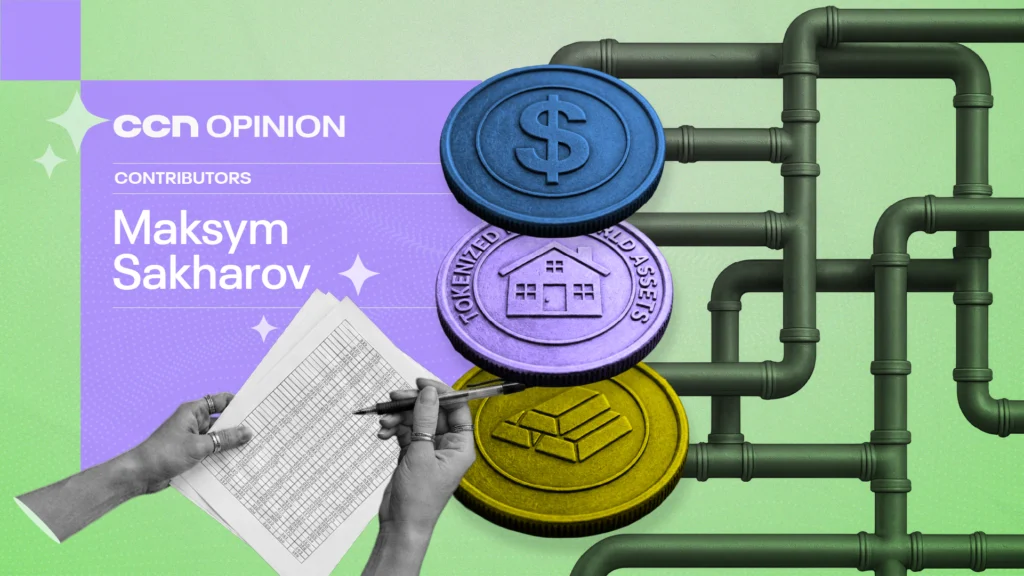
Maksym Sakharov thinks that crypto did not grow up by pumping in price. It grew up by fixing how money moves. | Credit: Hameem Sarwar
Share
Key Takeaways
Crypto’s real progress now shows up in infrastructure, not price movements. Tokenization, stablecoins, and on-chain settlement drive adoption.
Institutional adoption follows regulatory clarity, not market hype. Clear rules allow finance teams to integrate crypto into daily operations.
Tokenized real-world assets move finance faster and cheaper. On-chain Treasurys, credit, and funds settle in minutes instead of days.
Stablecoins prove blockchain utility at scale. Open, cross-border networks support payments where traditional systems fall short.
Crypto’s real breakthrough has nothing to do with price. It lies in replacing slow, fragmented financial plumbing with programmable, global infrastructure.
For years, the crypto industry has measured success almost entirely through price. The industry watched trading terminals, celebrated speculative runs, and measured progress in percentages.
That focus now looks to me less like sophistication and more like an early stage we’ve outgrown.
The real story in 2025 wasn’t another bull run. It’s been the quiet migration of real-world financial instruments onto blockchains.
The momentum is no longer coming from retail traders refreshing their screens. It’s coming from corporate treasuries, fund managers, and payment processors, adding digital asset infrastructure to their daily operations.
Here’s what I tell skeptics: adoption doesn’t happen when traders get excited. It happens when chief financial officers (CFOs), treasurers, and risk teams get comfortable.
The shift from price charts to balance sheets marks the most significant development in crypto to date.
Two factors drive it: clearer regulatory frameworks and tokenized real-world assets (RWAs) that serve practical financial needs.
Why Institutions, Not Traders, Drive Adoption
The single greatest catalyst for institutional movement has been the transformation in global regulatory posture.
After years of enforcement-led uncertainty, policymakers have shifted from |How do we stop this?” to “How do we safely integrate it?”
Bet on ESports with These Partners
Sponsored
Disclosure
We sometimes use affiliate links in our content, when clicking on those we might receive a commission at no extra cost to you. By using this website you agree to our terms and conditions and privacy policy.
The United States is leading this new approach. This year brought the GENIUS Act for stablecoin regulation, and the Securities and Exchange Commission (SEC) has moved from automatic opposition to active engagement on tokenization.
The effect has been direct and measurable: at least 24 out of 30 jurisdictions surveyed saw financial institutions announcing new digital asset projects this year.
Capital goes where the rules are clear. The Basel Committee’s decision to revisit strict capital requirements for banks holding crypto assets only reinforces the point, regulators are becoming enablers, not just enforcers.
Tokenization Moves Onto Corporate Balance Sheets
But regulatory clarity is just the unlock. The real story is what institutions are building with it.
The most compelling use case is tokenization, not as a crypto-native experiment, but as infrastructure for traditional finance.
It includes U.S. Treasury bonds, private credit funds, commercial paper, and increasingly, tokenized equity moving onto blockchain rails.
Real-World Assets Go On-Chain
This market is now worth more than $16 billion, according to DefiLlama, with projections suggesting growth to $30 trillion over the next decade.
However, the numbers matter less than what they represent: real financial instruments, held by real institutions, settling in minutes rather than days.
BlackRock’s BUIDL fund allows institutions to hold dollar-denominated, yield-generating assets that settle on-chain and integrate directly with decentralized finance protocols.
J.P. Morgan has also arranged a commercial paper issuance for Galaxy Digital on Solana, settled in USDC and purchased by Coinbase and Franklin Templeton.
Maksym Sakharov argues that “the true disruption was never the asset price.” | Source: Maksym Sakharov
This is a production-grade use case. What used to require T+2 settlement, meaning trades finalized two business days after execution, now clears in minutes. The operational costs drop. Access to global capital opens.
This is how crypto enters corporate balance sheets, not through headlines or hype, but through better plumbing.
Goldman Sachs and BNY Mellon are now collaborating to issue tokens representing shares in mainstream money-market funds, built to fit within existing legal and operational frameworks.
The technology does not reduce oversight. It makes compliance easier to track and more transparent at the asset level.
Why Stablecoins Matter Beyond Trading
Stablecoins have become the clearest proof of concept (PoC) for this shift. With a market capitalization of more than $309 billion and processing over $9 trillion in payments this year, they are playing a bigger role in payroll for foreign contractors as well as remittances and invoices between businesses.
Skeptics point to systems like FedNow as evidence that blockchains don’t offer much advantage.
And FedNow represents genuine progress, offering near-instant domestic settlement and reduced counterparty risk within the banking structure.
But it highlights the dividing line rather than erasing it.
FedNow requires both parties to hold accounts at participating banks. It rarely supports cross-border use.
Stablecoins operate on open networks accessible across jurisdictions, regardless of local banking relationships.
That distinction explains their traction in international commerce even as domestic systems improve. Accessibility explains their relevance.
Why Crypto’s Real Disruption Was Never Price
Some will call this institutional embrace a co-option; the very entities crypto was meant to disrupt are now absorbing it. I see it differently.
The true disruption was never the asset price. It was the underlying settlement infrastructure: global, programmable, and open.
Crypto as infrastructure, not speculation. That’s a big narrative shift.
That infrastructure is now being used to fix the plumbing of modern finance and in doing so, giving crypto its real purpose.
This changes what success looks like. Instead of Bitcoin (BTC) hitting a new all-time high, the industry should measure tokenized commercial paper issued, treasury bonds moved on-chain for overnight liquidity, and settlement times compressed from days to seconds.
Where Crypto Goes After Speculation
As more stable, income-generating RWAs constitute the value transacted on blockchains, the networks become less susceptible to pure sentiment-driven flows.
The correlation between crypto and tech stocks, a defining feature of the speculative era, may finally weaken.
Going forward, settling an invoice on a public blockchain or tokenizing a bond won’t grab headlines like a memecoin spiking 500%. But it will matter far more.
Crypto is no longer just a way to make money. It’s becoming a way to improve the financial system.
Disclaimer:
The views, thoughts, and opinions expressed in the article belong solely to the author, and not necessarily to CCN, its management, employees, or affiliates. This content is for informational purposes only and should not be considered professional advice.
About the Author
Maksym Sakharov
Maksym Sakharov is the group CEO, co-founder, and board member of WeFi, a deobanking platform that seeks to democratize access to DeFi. With over eight years of management experience in the IT and blockchain industries, Maksym has built a global fintech enterprise delivering institutional-grade on-chain banking infrastructure to users in more than 80 countries.