The HBAR ETF begins trading today on Nasdaq. Learn how to buy the new Hedera ETF (Ticker: HBR) and why it matters. | Credit: Hameem Sarwar/CCN.com
Share
Key Takeaways
The first spot ETF offering direct exposure to HBAR (the native token of the Hedera Hashgraph network) — will begun trading on the Nasdaq Stock Market.
The ETF holds actual HBAR tokens and not derivatives, with custody provided by established regulated firms.
This allows both retail and institutional investors to gain exposure to HBAR through a standard brokerage account.
For the Hedera ecosystem, the launch of the HBR ETF is a meaningful bridge between traditional finance and enterprise-blockchain applications.
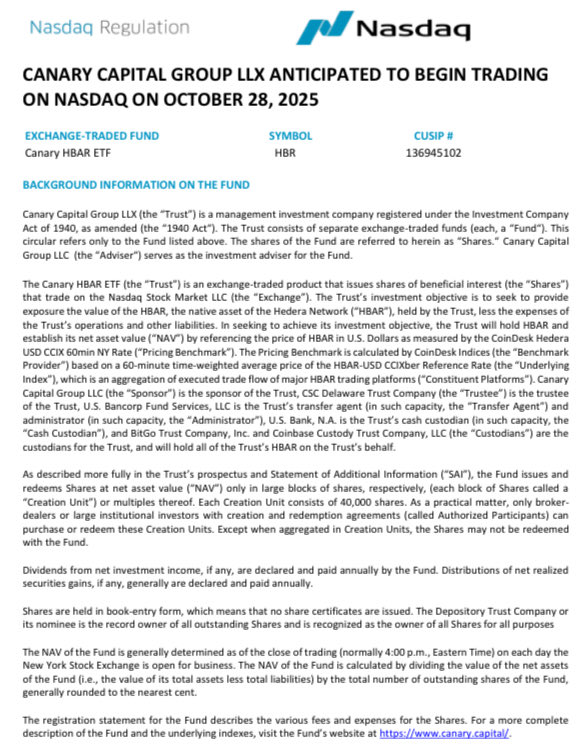
The Nasdaq has officially listed the Canary Hedera ETF (Ticker: HBR), the first spot exchange-traded fund offering direct exposure to HBAR, the native token of the Hedera Hashgraph network.
The ETF begins trading today, Oct. 28, 2025, amid an ongoing U.S. government shutdown, a backdrop that underscores the resilience of financial markets and the continued progress of digital-asset innovation even during political gridlock. The launch joins a new wave of regulated digital-asset products expanding institutional access to blockchain-based investments.
Unlike futures-based funds, the HBR ETF holds actual HBAR tokens in custody. Assets are secured by BitGo Trust Company and Coinbase Custody Trust Company, two of the largest regulated digital-asset custodians. Pricing is benchmarked using CoinDesk Indices’ Hedera USD Rate, providing transparent valuation for net asset value (NAV) calculations.
This structure gives investors a fully regulated pathway to gain exposure to HBAR price movements through a standard brokerage account, without the operational challenges of managing private keys or crypto wallets.
Try Our Recommended Crypto Exchanges
Sponsored
Disclosure
We sometimes use affiliate links in our content, when clicking on those we might receive a commission at no extra cost to you. By using this website you agree to our terms and conditions and privacy policy.
Institutional Access To The Hedera Ecosystem: Inside the Canary HBAR ETF
The Canary HBAR ETF allows investors to buy or sell shares that track the real-time price of HBAR, without needing to manage digital wallets or navigate crypto exchanges.
Ticker: HBR
Exchange: Nasdaq
Custodians: BitGo and Coinbase Custody
Pricing data: CoinDesk Indices
Fund type: Spot ETF (holds real HBAR)
Management fee: 0.95%
This structure mirrors the successful Bitcoin and Ethereum spot ETFs that have driven billions in institutional inflows since early 2025.
Nasdaq announced the launch of Canary’s ETF. | Credit: Nasdaq
The HBAR ETF is more than a new trading product, it’s a bridge between traditional finance and enterprise blockchain.
Hedera has positioned itself as a high-performance, carbon-negative network governed by a council of global corporations, including Google, IBM, Dell, LG, and Standard Bank. This council-based model provides transparency, predictable fees, and stable governance, qualities that appeal to institutional investors seeking compliant blockchain exposure.
With the launch of HBR, institutions can now allocate capital to the Hedera ecosystem through regulated markets. That access could accelerate adoption across tokenization, sustainability tracking, and enterprise-level applications already active on the network.
Canary HBAR Trust Explained
The Canary HBAR Trust is a private, Regulation D exempt investment vehicle sponsored by Canary Capital Group LLC, offering direct ownership of HBAR, the native token of the Hedera network.
With a minimum investment of $5,000, subscriptions are accepted daily via U.S. bank wires or HBAR contributions. Assets are held in custody by BitGo Trust Company, with a 2.50% sponsor fee and administration by Ascent Fund Services (USA).
Structured as a Grantor Trust (no K-1), the fund provides institutional and accredited investors secure exposure to Hedera’s fast, energy-efficient, enterprise blockchain ecosystem through professional, compliant management.
From Bitcoin To Hedera: The Broader ETF Revolution
The listing of the HBR ETF arrives during what analysts call the “second wave” of digital-asset ETF approvals. Following the success of spot Bitcoin and Ethereum ETFs earlier this year, regulators and exchanges have expanded access to other major blockchain assets, including Solana (BSOL) and Litecoin (LTCC).
These listings signal growing confidence in the operational maturity of digital-asset infrastructure. Custodians, pricing indices, and regulated trust structures are now robust enough to meet compliance and audit standards that satisfy both regulators and traditional asset managers.
For investors, the rise of altcoin ETFs diversifies opportunities beyond Bitcoin and Ethereum, broadening access to networks that power enterprise applications, tokenization systems, and real-world use cases.
Timeline Of The HBAR ETF: From Filing To Launch
The journey of the Canary HBAR ETF from concept to Nasdaq listing highlights the evolving path of crypto-based financial products through U.S. regulatory channels. The process took nearly a year and demonstrates both the growing maturity of digital-asset infrastructure and the increasing openness of regulators toward diversified blockchain exposure.
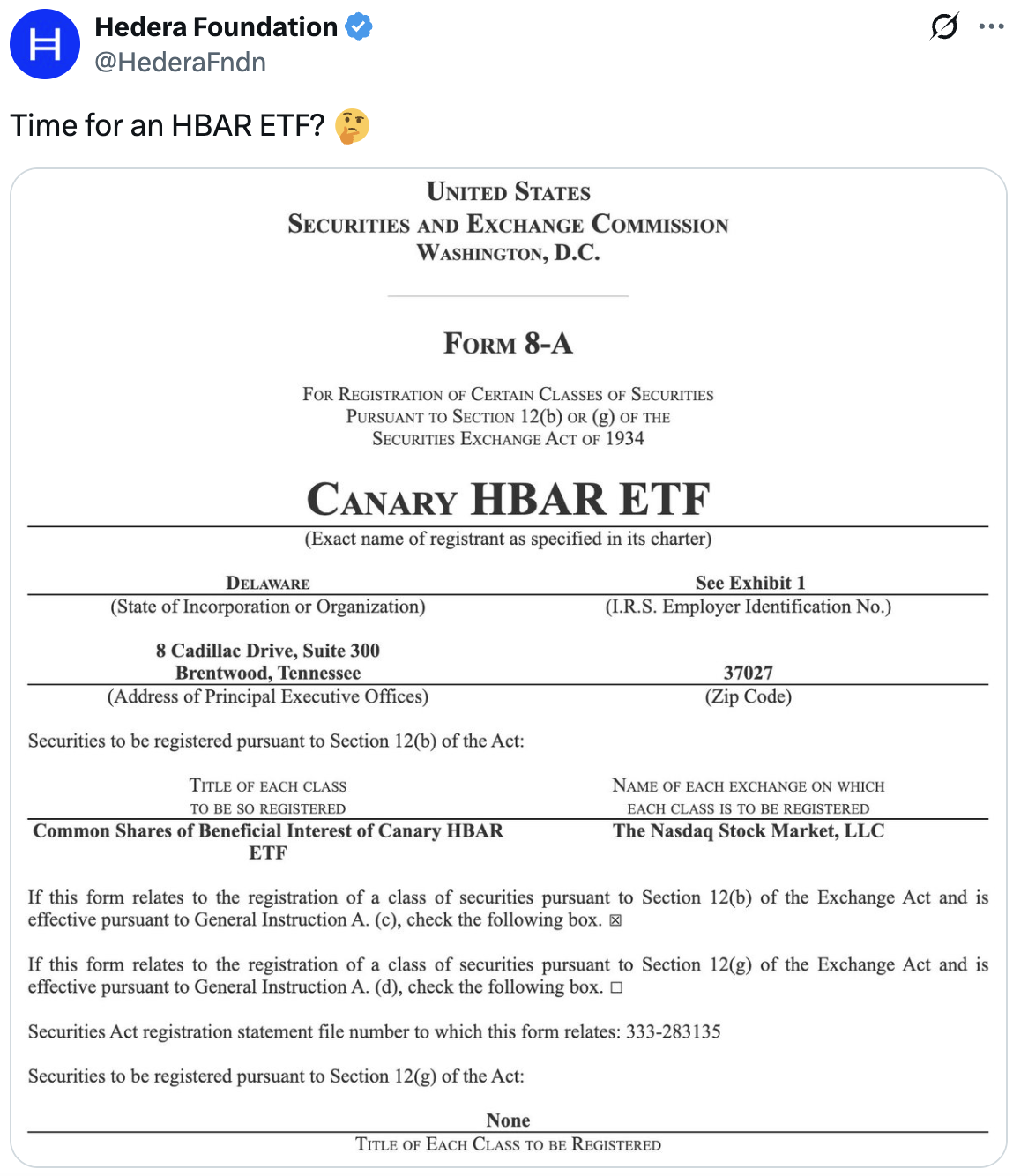
Hedera Foundation published the Canary’s ETF regulatory statement. | Credit: Hedera Foundation X profile
November 12, 2024 — Initial SEC Filing
Canary Capital Group LLC filed its initial Form S-1 registration statement with the U.S. Securities and Exchange Commission (SEC), proposing a spot ETF designed to hold HBAR directly. This filing marked the formal start of the review process for a regulated investment vehicle tied to the Hedera network’s native token.
February 24, 2025 — Nasdaq Submits Rule Filing
The Nasdaq Stock Market filed a Form 19b-4 with the SEC to approve the listing and trading of the HBAR ETF. This submission detailed how the exchange would oversee compliance, custody, pricing, and investor protections related to the new product.
March 4, 2025 — Amendment And Public Notice
Nasdaq amended its proposal under Rule 5711(d) to include additional transparency around custody (BitGo and Coinbase Custody) and pricing methodology (CoinDesk Indices). The filing was officially published in the Federal Register, opening a public comment period and moving the ETF closer to approval.
October 27, 2025 — Final Listing Clearance
Canary Capital submitted Form 8-A, completing the final administrative step for exchange registration. This cleared the ETF for official trading on the Nasdaq the following day.
October 28, 2025 — Official Launch On Nasdaq
The Canary HBAR ETF began trading under ticker HBR, offering investors the first spot ETF with direct exposure to HBAR, the utility token of the Hedera Hashgraph network. The launch coincided with a series of altcoin ETF listings, including Solana and Litecoin, marking what analysts call the “second wave” of digital-asset ETF approvals.
How To Buy The HBAR ETF
Trading the Canary HBAR ETF is straightforward for both retail and institutional investors.
Ticker symbol: HBR
Exchange: Nasdaq
Trading hours: U.S. market hours (9:30 a.m.–4:00 p.m. ET)
Where to buy: Available through most major brokerage platforms such as Fidelity, Charles Schwab, Robinhood, and E*TRADE.
Order types: Standard stock and ETF orders, such as market, limit, or stop.
For Institutions: Authorized participants can create or redeem shares in 40,000-unit blocks directly with the issuer.
For new ETFs, analysts often recommend using limit orders in the first days of trading to manage potential volatility as liquidity builds.
Why The Canary HBAR ETF Matters For Hedera and Hashgraph
For the Hedera network, this ETF marks a critical step toward mainstream financial recognition.
Hedera’s public ledger technology is designed for speed, energy efficiency, and enterprise use. It processes thousands of transactions per second while maintaining a carbon-negative footprint, a strong differentiator in an era of ESG-driven investing.
Unlike traditional blockchains, Hashgraph uses a unique Directed Acyclic Graph (DAG) structure and a gossip-about-gossip protocol to achieve fast, fair, and secure consensus without relying on miners or energy-intensive proof-of-work systems.
This architecture allows Hedera to process thousands of transactions per second, with low, predictable fees and minimal energy consumption, making it one of the most efficient distributed ledger technologies available today.
The ETF also improves price discovery and liquidity for HBAR by increasing demand through traditional trading venues. It can also attract research coverage, enhance institutional visibility, and strengthen Hedera’s perception as a stable, long-term platform rather than a speculative asset.
Another trader noted that ‘$HBAR is up 16% following the ETF listing news,’ strong momentum as institutional interest builds around the new Nasdaq-listed HBR ETF.
Risks Investors Should Consider
While the HBAR ETF offers regulated access, investors should understand the associated risks common to digital-asset products.
Market volatility: HBAR’s price remains highly sensitive to overall crypto-market sentiment and liquidity cycles.
Regulatory uncertainty: Changes in U.S. or international crypto regulations could impact trading or fund operations.
Custody risk: Despite strong custodians, all digital assets carry some risk of operational failure or security breaches.
Tracking error: The ETF’s share price may not perfectly track the real-time HBAR price due to management costs and creation/redemption timing.
Early trading dynamics: During its first weeks of trading, spreads may be wider until liquidity and trading volume mature.
Tax considerations: Like other ETFs, gains are subject to capital-gains taxation under U.S. law.
Investing In HBAR Versus The HBR ETF
Investors now have two main ways to gain exposure to the Hedera ecosystem — buying HBAR directly or investing through the HBR ETF.
Buying HBAR tokens offers full participation in the network: holders can stake tokens, use them for transactions, and benefit directly from network growth. However, this route requires managing wallets, private keys, and potential exchange risks.
The HBR ETF, listed on Nasdaq, provides a regulated and convenient alternative, allowing investors to access HBAR price movements through a standard brokerage account. While it removes custody complexity, it also forgoes staking rewards and carries management fees and potential tracking differences.
Spot HBAR ETF Approval: A Broader Signal For Blockchain Adoption?
The approval and listing of a spot HBAR ETF underscores how far the digital-asset industry has come in achieving regulatory integration. It also reflects the demand from investors for exposure to real-world blockchain networks that prioritize scalability, governance, and sustainability.
In essence, the HBAR ETF represents the maturation of the crypto market, where regulated products now provide direct, institutional-grade access to tokenized ecosystems built for enterprise and environmental responsibility.
When did the HBAR ETF officially launch and why is it significant?
The Canary HBAR ETF (Ticker: HBR) will officially launch on October 28, 2025, on the Nasdaq. This debut marks the first-ever spot ETF offering direct exposure to HBAR, the native token of the Hedera network. Its approval signals growing regulatory confidence in alternative blockchain assets beyond Bitcoin and Ethereum. For Hedera, the launch represents a major step toward institutional adoption, providing investors a regulated, transparent way to gain exposure to an enterprise-grade, sustainable blockchain ecosystem.
How can I buy or trade the HBAR ETF?
You can trade the HBAR ETF under the ticker HBR on the Nasdaq. It is available through most U.S. brokerage platforms such as Fidelity, Charles Schwab, Robinhood, and E*TRADE. To invest, search for “HBR” within your trading platform and execute an order as you would for any listed ETF. It is recommended to use limit orders during the early days of trading to account for potentially wider spreads.
What makes the HBAR ETF different from other crypto ETFs?
The HBAR ETF is unique because it focuses on Hedera Hashgraph, a carbon-negative, enterprise-grade blockchain network governed by major global organizations like Google, IBM, and LG. It combines sustainability and predictable performance with institutional-level governance, making it appealing to investors seeking ESG-aligned crypto exposure. Its launch also marks one of the first expansions of spot ETFs beyond Bitcoin and Ethereum.
What are the risks of investing in the HBAR ETF?
Investing in the HBAR ETF carries similar risks to other digital-asset products. These include market volatility, potential regulatory changes, custody and security risks, and tracking errors between the ETF’s price and the underlying HBAR token. As with any investment, it’s important to consider personal risk tolerance and diversify holdings rather than relying on a single crypto asset or ETF.
Disclaimer:
The information provided in this article is for informational purposes only. It is not intended to be, nor should it be construed as, financial advice. We do not make any warranties regarding the completeness, reliability, or accuracy of this information. All investments involve risk, and past performance does not guarantee future results. We recommend consulting a financial advisor before making any investment decisions.
Dr. Guneet Kaur is a senior editor at CCN.com and a Science Fellow at Exponential Science. She is a fintech and blockchain expert with extensive experience in digital finance education, blockchain ecosystems, and cryptocurrency markets. She has worked with global media such as Cointelegraph, as well as education and blockchain platforms, to design and lead strategic content and learning initiatives. As an educator and assessor for top-tier executive programs, she bridges real-world fintech trends with academic insight.
Dr. Kaur is also a published researcher and peer reviewer across fintech and data science journals, including Financial Innovation Journal and International Journal of Big Data Intelligence and Applications. Her work spans data-driven analysis, Web3 innovation, and technical content development. With a strong foundation in both industry and academia, she translates complex financial technologies into practical applications, empowering learners, professionals, and institutions across the rapidly evolving digital finance landscape.
Giuseppe Ciccomascolo began his career as an investigative journalist in Italy, where he contributed to both local and national newspapers, focusing on various financial sectors.
Upon relocating to London, he worked as an analyst for Fitch's CapitalStructure and later as a Senior Reporter for Alliance News. In 2017, Giuseppe transitioned to covering cryptocurrency-related news, producing documentaries and articles on Bitcoin and other emerging digital currencies. He also played a pivotal role in establishing the academy for a cryptocurrency exchange website. Crypto remained his primary area of interest throughout his tenure as a writer for ThirdFloor.


 Easy
Easy