CLARITY Act Vote Set for Sept. 15, But Prediction Markets Put 2026 Passage Odds at Just 19.5%
Share
Key Takeaways
The CLARITY Act could become the most important crypto legislation in US history by clearly defining which digital assets qualify as commodities versus securities.
The bill’s “mature blockchain system” test could officially place Ethereum under CFTC oversight rather than SEC scrutiny, significantly reducing regulatory uncertainty.
Institutional investors have long cited unclear regulations as the main obstacle preventing large-scale crypto allocations.
Major financial firms including BlackRock, Fidelity, JPMorgan, and Morgan Stanley are already building crypto infrastructure in anticipation of a clearer regulatory environment.
The cryptocurrency industry may finally be approaching the regulatory breakthrough it has spent years waiting for. At the center of that conversation is the Digital Asset Market Clarity Act of 2025, better known as the CLARITY Act, a sweeping legislative proposal that could fundamentally reshape how digital assets are classified, traded, and integrated into the global financial system.
After passing the House in July 2025 with strong bipartisan support and advancing through the Senate Banking Committee, the bill is now positioned for a full Senate vote and eventual reconciliation. For many market participants, the legislation represents far more than another crypto policy initiative. It is increasingly viewed as the regulatory green light capable of unlocking trillions of dollars in institutional capital.
And while several blockchain ecosystems stand to benefit, Ethereum has emerged as the primary focal point of the debate. both politically and financially. With regulatory uncertainty beginning to fade and institutional infrastructure rapidly maturing, many ETH bulls now believe the second-largest cryptocurrency could be on a path toward $7,000 and beyond.
What Is the CLARITY Act and Why It Matters for Crypto Markets
At its heart, the CLARITY Act aims to resolve one of the most contentious issues in crypto markets: whether digital assets should be treated as securities or commodities.
For years, the lack of clear rules created friction between the Securities and Exchange Commission (SEC) and the broader crypto industry. Enforcement actions, lawsuits, and shifting interpretations left investors and developers uncertain about compliance obligations, discouraging institutional participation.
Prediction markets see a high rate of approval for the CLARITY Act. | Credit: Grayscale X profile
The CLARITY Act attempts to end that ambiguity by introducing a dual-framework system.
Investment contracts and securities would remain under SEC jurisdiction.
Exchanges and brokers would face standardized registration requirements.
Developers would receive safe harbor protections for decentralized finance applications.
Noncustodial wallets and peer-to-peer transactions would gain explicit legal protections.
Open-source blockchain developers would receive clearer operating guidelines.
Institutions would gain better clarity around custody and staking operations.
Token issuers would face more transparent disclosure obligations.
For the industry, however, the most important component may be the bill’s “mature blockchain system” test.
How the CLARITY Act Could Give Ethereum Commodity Status
The mature blockchain system framework provides a statutory pathway for qualifying digital assets to be officially recognized as commodities rather than securities.
To qualify, a blockchain network must meet several objective criteria, including:
The blockchain must provide genuine utility or functionality.
The network must facilitate transactions, governance, or service access.
The codebase must remain open source and publicly auditable.
Rules governing the system must be transparent and pre-established.
No single entity may exercise centralized control over the network.
Holders controlling 20% or more of the supply cannot dominate governance.
Validators and node operators must remain sufficiently decentralized.
The ecosystem must demonstrate ongoing operational independence.
Ethereum is quietly becoming the biggest winner in crypto thanks to the CLARITY Act.
The new U.S. bill sets a clear “decentralization test” — five simple rules that decide whether a token is truly independent or still controlled by its team. Ethereum passes all five with flying… pic.twitter.com/Fa6jBoSPcr
It also removes the lingering threat of SEC enforcement actions that has weighed on crypto markets since the collapse of the 2021 bull cycle.
Ethereum is widely viewed as the clearest candidate to satisfy these mature blockchain requirements.
Why Ethereum Is Emerging as the Biggest Winner of Crypto Regulation
Ethereum’s evolution over the past several years has transformed it from a speculative smart contract network into the foundational infrastructure layer for much of the digital asset economy.
Following its transition to proof-of-stake, Ethereum now supports one of the most geographically and institutionally distributed validator ecosystems in crypto. No single entity controls the network, its codebase remains open source, and its governance structure aligns closely with the decentralization principles outlined in the CLARITY Act.
More importantly, Ethereum already powers the majority of on-chain financial activity, including:
Even competing Layer-1 networks often rely on Ethereum liquidity or interoperability standards. That positioning gives Ethereum a unique advantage if the CLARITY Act becomes law.
Institutional investors are not simply looking for speculative tokens. They are looking for trusted settlement layers capable of supporting tokenized financial infrastructure at scale. Ethereum already functions as that backbone.
This is why analysts increasingly believe ETH could become one of the biggest beneficiaries of regulatory normalization.
Ethereum’s Mature Blockchain Status Could Unlock Institutional Capital
Large financial institutions have repeatedly identified regulatory clarity as the biggest obstacle preventing meaningful crypto allocations. That barrier may finally be disappearing.
BlackRock, Fidelity, JPMorgan, Franklin Templeton, and Morgan Stanley have already developed:
Crypto custody systems
Tokenization initiatives
Institutional staking products
Blockchain settlement platforms
Digital asset ETFs
Stablecoin infrastructure
Tokenized money market funds
On-chain collateral systems
Crypto wealth management offerings
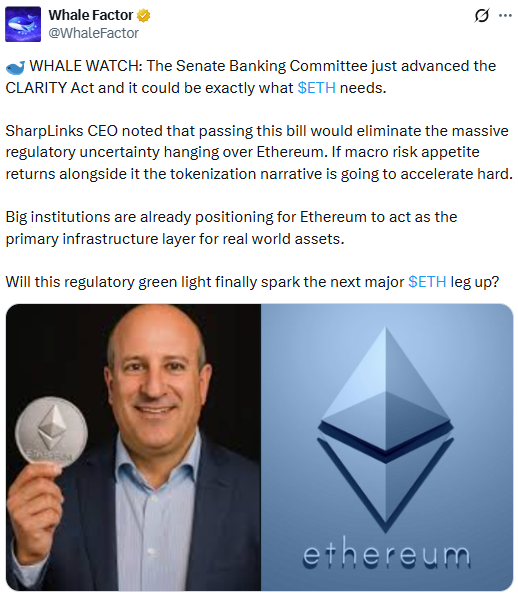
SharpLinks CEO sees a brighter future for Ethereum after the CLARITY Act passes. | Credit: Whale Factor X profile
Many of these firms have spent years building infrastructure quietly while waiting for policymakers to establish definitive rules.
The CLARITY Act could provide exactly that.
Once Ethereum gains stronger commodity recognition under CFTC oversight, institutions could confidently expand exposure through:
The scale of potential inflows is difficult to ignore. Global financial assets exceed $500 trillion. Even modest allocations of 1% to 3% from pensions, endowments, insurance reserves, and sovereign wealth funds could inject hundreds of billions, and eventually trillions, into digital assets over time.
Ethereum’s role as the dominant programmable settlement layer places it at the center of that opportunity.
Ethereum ETFs and Staking Products Could Drive Massive ETH Demand
The approval of spot Bitcoin ETFs demonstrated that institutional appetite for regulated crypto exposure is substantial. Ethereum appears positioned to follow a similar trajectory, but with an additional layer of utility that Bitcoin lacks.
While Bitcoin is often viewed primarily as digital gold, Ethereum offers productive on-chain functionality. Investors can:
That utility matters for institutions seeking more than passive exposure.
If staking-enabled Ethereum ETFs eventually receive regulatory approval under a clearer legislative environment, ETH could become one of the first blockchain-native yield-bearing institutional assets accessible through traditional brokerage infrastructure.
This possibility is one reason why bullish price targets are accelerating across the market.
Why Analysts Believe Ethereum Could Rally to $7,000
Crypto markets remain highly cyclical, but many traders argue that Ethereum’s current structure resembles previous generational breakout setups.
The bullish thesis rests on several converging catalysts:
Ethereum’s supply dynamics have also strengthened since the implementation of EIP-1559, which burns a portion of transaction fees. Combined with the large amount of ETH locked in staking contracts, available liquid supply has tightened considerably compared to previous cycles.
Deflationary pressure during periods of high activity
Strong developer retention across the ecosystem
At the same time, demand drivers continue to expand. The tokenization of treasury products, bonds, equities, and real-world assets is accelerating across traditional finance. Many of these initiatives are either launching directly on Ethereum or using Ethereum-compatible infrastructure.
If institutional adoption scales in parallel with regulatory clarity, analysts argue that Ethereum could experience a supply-demand imbalance similar to previous crypto bull markets — but on a much larger capital base.
That is where the increasingly popular $7,000 target comes from.
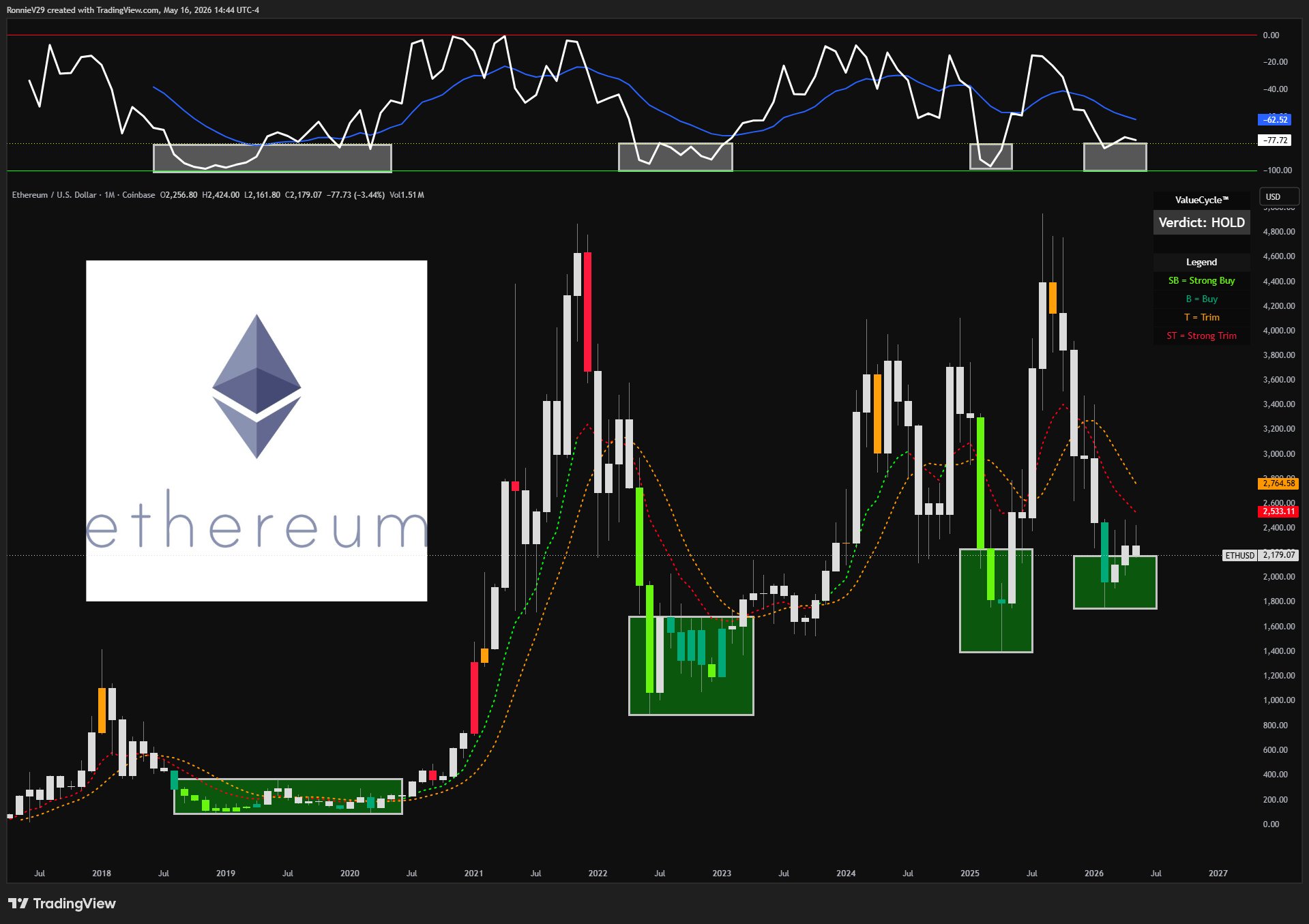
Some market participants believe Ethereum has already completed a long-term bottoming structure and is entering the early stages of a new expansion cycle. The phrase “generational setup” has become common among bullish analysts who compare the current environment to the pre-2021 breakout period.
Why Chainlink Could Benefit From the CLARITY Act
While Ethereum remains the headline beneficiary, the CLARITY Act could also strengthen several other blockchain ecosystems that align with the mature blockchain criteria.
Chainlink
Chainlink stands out as one of the most important infrastructure plays in the industry. The decentralized oracle network powers:
Chainlink’s LINK expected to increase. | Credit: Quinten Francois X profile
Its Cross-Chain Interoperability Protocol (CCIP) has positioned Chainlink as a key layer for tokenized financial products, making it highly relevant in a future where trillions of dollars in assets move on-chain.
Avalanche
Avalanche’s subnet architecture allows enterprises and financial institutions to create customizable blockchain environments optimized for:
Sui has attracted growing attention due to its focus on scalability and enterprise-grade infrastructure. Its strengths include:
Parallel transaction execution
High throughput capacity
Move programming language security
Low latency transaction finality
Developer-friendly architecture
Gaming and asset tokenization capabilities
Institutional-grade performance optimization
Still, Ethereum remains the ecosystem most deeply embedded in the current digital asset economy.
Ethereum’s Path to Becoming the Backbone of On-Chain Finance
The CLARITY Act represents more than just regulatory reform, it signals a major shift in how governments and institutions view blockchain technology. For years, the crypto industry operated under regulatory uncertainty, fragmented oversight, inconsistent enforcement, and limited institutional participation. That uncertainty kept many banks, asset managers, and corporations on the sidelines.
Now, the industry appears to be entering a new phase where integration with mainstream finance is becoming increasingly possible.
Ethereum sits at the center of that transition. The network already powers stablecoins, decentralized finance, tokenized assets, institutional staking, blockchain payments, and much of the growing on-chain financial ecosystem. Rather than creating entirely new trends, regulatory clarity could accelerate momentum that is already building across the sector.
That is why the CLARITY Act has become so closely tied to Ethereum’s outlook. Investors see ETH as one of the biggest potential beneficiaries of clearer regulation, expanding institutional infrastructure, rising ETF demand, growing tokenization markets, and increasing on-chain activity. Combined with Ethereum’s tightening liquid supply, many analysts believe these forces could fuel the next major leg higher for ETH.
Whether that leads to $7,000 remains uncertain, but one thing is becoming increasingly clear: Ethereum is evolving beyond a speculative crypto asset and emerging as a core pillar of the future digital financial system.
The Digital Asset Market Clarity Act of 2025 is proposed US legislation designed to establish clear regulatory rules for cryptocurrencies and blockchain-based assets. The bill divides digital assets into categories such as commodities and securities while defining which regulators oversee each market segment.
Why is the CLARITY Act important for crypto markets?
The bill addresses one of the biggest challenges facing the crypto industry: regulatory uncertainty. By creating clearer definitions and oversight frameworks, the legislation could encourage greater institutional participation and reduce fears of future enforcement actions.
How does the CLARITY Act affect Ethereum?
Ethereum is widely viewed as one of the biggest beneficiaries of the legislation because its decentralized structure closely aligns with the bill’s “mature blockchain system” criteria. This could strengthen ETH’s classification as a commodity under CFTC oversight rather than a security under SEC jurisdiction.
What is the “mature blockchain system” test?
The mature blockchain system test is a framework within the CLARITY Act that determines whether a blockchain network is sufficiently decentralized to qualify as a digital commodity. Factors include open-source development, validator distribution, governance transparency, and the absence of centralized control.
Disclaimer:
The information provided in this article is for informational purposes only. It is not intended to be, nor should it be construed as, financial advice. We do not make any warranties regarding the completeness, reliability, or accuracy of this information. All investments involve risk, and past performance does not guarantee future results. We recommend consulting a financial advisor before making any investment decisions.
Giuseppe Ciccomascolo began his career as an investigative journalist in Italy, where he contributed to both local and national newspapers, focusing on various financial sectors.
Upon relocating to London, he worked as an analyst for Fitch's CapitalStructure and later as a Senior Reporter for Alliance News. In 2017, Giuseppe transitioned to covering cryptocurrency-related news, producing documentaries and articles on Bitcoin and other emerging digital currencies. He also played a pivotal role in establishing the academy for a cryptocurrency exchange website. Crypto remained his primary area of interest throughout his tenure as a writer for ThirdFloor.


 Easy
Easy