Meet YoungHoon Kim — The World’s Highest IQ Holder Who Says Bitcoin’s Dip Is Temporary Manipulation and a New ATH Is Coming Soon
Share
Key Takeaways
Bitcoin’s death cross signals fading momentum, indicating that short-term price strength has weakened relative to the long-term trend.
A drop toward the $74K region is increasingly possible if Bitcoin fails to reclaim major support levels in the $92K–$94K range.
The death cross doesn’t guarantee a crash, but it historically appears during corrective phases and often amplifies fear-driven selling.
Market direction now hinges on investor sentiment and upcoming macro events, making the next few weeks crucial in determining whether Bitcoin rebounds or deepens its correction.
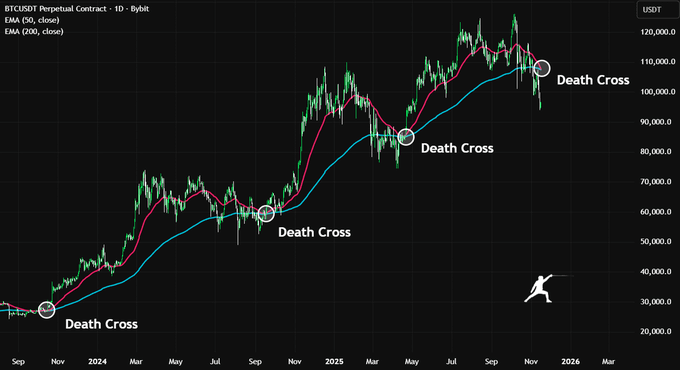
Bitcoin has officially formed a death cross, a technical signal that traders traditionally associate with weakening momentum and the potential for deeper price corrections. The crossover occurred in mid-November 2025, when Bitcoin’s 50-day moving average dipped below its 200-day moving average while the price slipped under the $94,000 zone.
With market sentiment shifting into “extreme fear,” many analysts fear the signal could pave the way to a retest of the $74K region.
But what does this pattern actually mean, and does it guarantee a major drop?
Try Our Recommended Crypto Exchanges
Sponsored
Disclosure
We sometimes use affiliate links in our content, when clicking on those we might receive a commission at no extra cost to you. By using this website you agree to our terms and conditions and privacy policy.
A death cross forms on a price chart when the 50-day moving average (short-term trend) crosses below the 200-day moving average (long-term trend).
This crossover typically suggests:
Recent momentum is fading
The uptrend is weakening
Sellers may be gaining control
Volatility could increase
Importantly, a death cross is considered a lagging indicator. It does not predict the future with certainty; instead, it reflects that downside pressure has already been building for weeks or months.
In crypto, where volatility is higher than traditional markets, the death cross can trigger strong emotional reactions, often amplifying fear-driven selling.
Bitcoin just triggered a deatch cross. | Credit:Rekt Fencer X profile
Why Bitcoin’s Death Cross Matters Right Now
Bitcoin has been under pressure since falling from its October peak near $126,000. The drop toward the mid-$90K range pushed the short-term moving average steadily lower, eventually crossing the long-term line and forming the death cross.
This moment matters for several reasons:
1. Market Sentiment Has Shifted
Fear levels have surged as investors worry about macro uncertainty, interest-rate delays, ETF outflows, and weakening momentum in the broader crypto market.
2. Key Technical Support Levels Are Breaking
Bitcoin recently lost several important support zones between $92,000 and $94,000. When major supports break while a death cross forms, it often strengthens the bearish narrative.
3. On-Chain Data Shows Rising Selling Pressure
Whales have moved large amounts of BTC onto exchanges, a behavior typically seen during periods of distribution or preparation for selling. Exchange reserves have ticked up, suggesting potential near-term supply increases.
Taken together, these forces create the conditions where a death cross can become more than a technical curiosity, it becomes a symbol of shifting market psychology.
Technical retracement levels: A standard Fibonacci retracement of Bitcoin’s full run from $40K to $126K places strong support around the mid-$70K zones.
Previous accumulation range: Earlier in 2025, institutional buyers accumulated heavily between $72K and $78K. Markets often revisit prior zones of high activity when correcting.
Loss of higher lows: Bitcoin has broken its trend of higher lows, a key characteristic of bull markets. Once this structure breaks, assets often retest lower consolidation zones.
Weakening ETF inflows:Spot Bitcoin ETFs, once a powerful driver in early 2025, have seen outflows in recent weeks. If this continues, it could accelerate downward pressure.
While nothing is guaranteed, the confluence of technical and on-chain signals makes the $74K region a logical area to watch if Bitcoin continues declining.
Historical Context: Are Death Crosses Always Bearish?
Bitcoin’s history shows mixed outcomes following past death crosses:
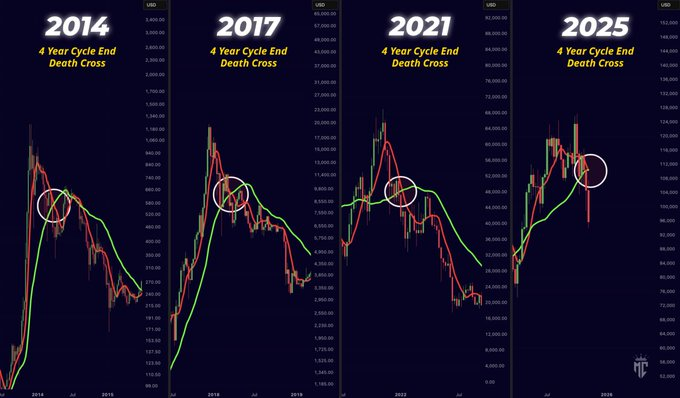
Sometimes the market dumped aggressively (e.g., 2018, early 2022).
Long-term investors may wait for deeper value zones
This scenario aligns with traders expecting a prolonged correction before the next major uptrend.
What Bitcoin Investors Should Watch Next
To understand whether Bitcoin bounces or breaks down, monitor:
The $92K–$94K zone — regaining this range strengthens the bullish case.
Market sentiment — continued “extreme fear” may trigger panic selling.
ETF flows — institutional outflows often precede stronger corrections.
Exchange inflows — rising BTC on exchanges typically signals selling pressure.
Macro movement — rate cuts or economic weakness can shift crypto momentum quickly.
Bitcoin’s Death Cross Marks a Shift in Momentum as Markets Enter a Critical Inflection Point
Bitcoin triggering a death cross is a meaningful technical signal and a reminder that momentum has shifted. While the pattern does not guarantee a crash, it reflects weakening short-term strength and raises the probability of a deeper correction.
If Bitcoin cannot reclaim critical support zones, a move toward the $74,000 range becomes increasingly plausible. But if buyers step in and sentiment improves, the death cross may simply mark a temporary cooling phase before the next surge.
For now, markets are at a critical inflection point, and the next few weeks will determine whether Bitcoin stabilizes or slides deeper into corrective territory.
Can the Bitcoin death cross be a buying opportunity instead of a warning sign?
Yes. In several past cycles, the Bitcoin death cross actually formed near market bottoms rather than peaks. For long-term investors, this crossover can sometimes mark a value zone, especially if fundamentals remain strong and sentiment begins to recover afterward.
Does a Bitcoin death cross always lead to a price crash?
No. While a Bitcoin death cross often appears during downturns, it is a lagging indicator and does not guarantee a crash. Sometimes, Bitcoin rebounds shortly after the crossover.
Why do traders pay attention to the death cross?
Traders monitor the death cross because it highlights weakening short-term momentum and can influence market psychology, often triggering increased selling or cautious positioning.
How should investors react when a Bitcoin death cross forms?
Investors typically assess key support levels, watch ETF flow trends, and track sentiment indicators. A death cross is a signal to be cautious, not necessarily to panic, as outcomes vary across cycles.
Disclaimer:
The information provided in this article is for informational purposes only. It is not intended to be, nor should it be construed as, financial advice. We do not make any warranties regarding the completeness, reliability, or accuracy of this information. All investments involve risk, and past performance does not guarantee future results. We recommend consulting a financial advisor before making any investment decisions.
Giuseppe Ciccomascolo began his career as an investigative journalist in Italy, where he contributed to both local and national newspapers, focusing on various financial sectors.
Upon relocating to London, he worked as an analyst for Fitch's CapitalStructure and later as a Senior Reporter for Alliance News. In 2017, Giuseppe transitioned to covering cryptocurrency-related news, producing documentaries and articles on Bitcoin and other emerging digital currencies. He also played a pivotal role in establishing the academy for a cryptocurrency exchange website. Crypto remained his primary area of interest throughout his tenure as a writer for ThirdFloor.


 Easy
Easy