Bridge Hacks Cost Billions: Here’s How to Safely Swap USDT on TRON Using NEAR Intents.
Share
Key Takeaways
Tron carried over $80 billion in USDT by mid-2025, more than half of the global supply.
Low fees, fast settlement, and exchange defaults drove adoption in remittances and payments.
Regulatory frameworks like the GENIUS Act, MiCA, and Hong Kong’s bill will test Tron’s position.
Tron’s dominance depends on balancing compliance, competition, and technical risks.
In 2025, Tron’s TRC-20 network became the dominant force for Tether (USDT) transfers, surpassing Ethereum’s ERC-20 network.
TRON announced it had over $80 billion in circulating USDT by Q2. Compared with Tether’s quarterly attestation of 157.1 billion issued tokens across all chains, it shows that approximately 51% of all USDT in the world exists on the Tron network. This signals record growth and unmatched reserves.
Tether just released its quarterly attestation for Q2 2025.
Highlights as of 30th June 2025: * 157.1B total issued USDt, end of Q2 2025. * 162.5B total assets/reserves, end of Q2 2025. * 5.47B excess reserves, on top of the 100% reserves in liquid assets that back all issued… https://t.co/bejhVFkMYtpic.twitter.com/XYVmueWZ0G
Tron’s data highlights a clear divide in blockchain use cases. Tron excels as a fast, low-cost rail for stablecoin transactions, while Ethereum solidifies its role as the hub for decentralized finance (DeFi), non-fungible tokens (NFTs), and developer innovation.
This article explores why Tron captured the USDT market, the mechanics behind stablecoins, and the trade-offs shaping crypto’s future in 2025.
But numbers only tell part of the story. To understand the forces driving this shift, industry voices can provide context beyond the charts.
CCN contacted SwissBorg’s CTO Nicolas Rémond for his perspective on Tron’s rise, its competition with Ethereum, and the role of regulation. He shared his insights on how stablecoin rails are evolving.
Why Tron Dominated USDT (But Not Ethereum Overall)
In July 2025, Tron cut transaction costs sharply. Average weekly fees dropped from 2.47 TRX to 0.72 TRX, marking a 70% decline. This low-fee strategy is a massive success. The move has reinforced Tron’s role as a low-cost rail.
Try Our Recommended Crypto Exchanges
Sponsored
Disclosure
We sometimes use affiliate links in our content, when clicking on those we might receive a commission at no extra cost to you. By using this website you agree to our terms and conditions and privacy policy.
As a result, major exchanges like Binance promote TRC-20, the technical standard for tokens on the Tron blockchain, as the default, branding it as “low fee, high speed,” which positions it as the most convenient option for traders.
Moreover, Tron’s straightforward user experience (UX) appeals to non-technical traders, especially in Latin America, the Middle East, North Africa, and Asia-Pacific. Freelancers and merchants in these regions value savings above all else.
Additionally, Paolo Ardoino, CEO of Tether, notes that 63% of USDT transactions involve only USDT, while 78% of transfers in other stablecoins include additional assets.
Another mind-blowing USDt stat 🤯
63% of USDt transactions send only USDt, while 78% of transactions in other stablecoins include other assets as well. pic.twitter.com/FSWXYZyoub
This suggests that USDT functions primarily as a direct medium of exchange, whereas competing stablecoins are more often tied to trading activity.
However, Tron relies on just 27 validators, raising centralization risks. Ethereum, with thousands of validators, provides stronger security but slower and more expensive transfers.
The contrast is also rooted in their history. Ethereum, launched in 2015, had a decade to build its DeFi and NFT ecosystems. Tron, founded in 2017, entered later but optimized for speed and cost, making it more attractive for high-volume stablecoin transfers.
This split highlights how Ethereum kept its DeFi and NFT dominance, while Tron is becoming the preferred network for payments and transfers.
What Stablecoins Actually Do in Crypto Markets
Stablecoins link the speed of crypto with the stability of the dollar. USDT, the largest of them, plays a central role in trading and payments.
USDT is issued by Tether Limited as a digital dollar pegged 1:1 to the U.S. dollar. It is backed by reserves such as $120 billion in U.S. Treasuries, according to Tether’s Q1 2025 attestation, referred to above.
A practical way to think about USDT is as a digital gift card: it holds value that can be spent across exchanges, wallets, or peer-to-peer platforms.
By July 2025, the total collection of assets and reserves of USDT reached $162.5 billion.
Settlement Asset vs. Speculative Asset: Why Traders Choose USDT
Traders depend on USDT because it works as both a settlement tool and a shield against volatility.
They move into USDT to avoid losses without leaving crypto when markets fall. A Mexican trader, for instance, may exchange other cryptocurrencies like Bitcoin for USDT during a downturn and re-enter once prices recover.
USDT’s appeal lies in its reliability; it serves the market more as a transactional currency than a speculative asset.
This distinction becomes clearer when looking at how stablecoins move, either inside exchanges or across blockchains.
On-Exchange vs. On-Chain: How Stablecoins Move Through the System
In 2025, USDT is moving along two main paths: on centralized exchanges (CEXs) and on blockchains such as Tron and Ethereum.
Most trading happens on exchanges, where USDT works as a fast settlement tool.
On-chain transfers tell a different story, with Tron handling more than half of all USDT. This shift shows traders and users choosing rails based on cost and speed.
Why Tron Leads Stablecoin Payments Across LATAM, MENA, and APAC
Each of the main players has a different role in how liquidity moves, and together they explain why Tron captured so much of the stablecoin flow in 2025.
Role of CEXs, OTC Desks, Market Makers
CEXs remain the main drivers of USDT trading. Platforms such as Binance and Coinbase handle most of the daily flow, with Binance pushing TRC-20 as the default rail because of its low fees. OTC desks, which handle bulk trades for institutions and large clients, lean on Tron to cut costs and settle faster.
Regional Flows (LATAM, MENA, APAC) and Remittances
Tron dominates in regions such as Latin America, the Middle East and North Africa, and Asia-Pacific:
In LATAM, freelancers use Tron to save on fees.
In MENA, merchants rely on it for cross-border payments.
APAC sees heavy remittance use, with Tron processing 273 million transactions in May 2025.
What Is USDT and Why Does It Matter?
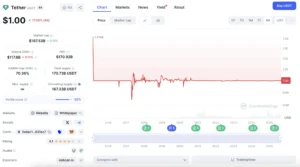
USDT, issued by Tether Limited, is a digital dollar pegged 1:1 to the U.S. dollar. USDT is usable on exchanges or peer-to-peer platforms, and its supply reached over $166 billion by August 2025.
Tether Stats | Source: CoinMarketCap
The reason USDT matters is its role as the backbone of crypto liquidity. Traders use it as a safe haven during market swings, exchanges rely on it for pricing and settlement, and millions worldwide use it for payments and remittances.
By moving on faster and cheaper networks like Tron, USDT transactions can cost just a fraction of a cent, making it far more efficient than traditional payment rails or even Ethereum-based transfers.
In 2025, USDT processed trillions in transaction volume, making it not only a tool for crypto investors but also a practical payment option in regions where banking systems are costly, slow, or inaccessible. Its ubiquity has turned it into the default currency of crypto markets, shaping how capital flows across centralized exchanges, DeFi platforms, and peer-to-peer transfers.
Tron vs. Ethereum: What’s the Difference?
Tron and Ethereum are decentralized, open-source blockchain platforms supporting smart contracts and decentralized applications (dApps). Their design choices set them apart, with Ethereum focusing on security and innovation while Tron prioritizes speed and cost efficiency. The table highlights the main contrasts.
Features
Ethereum
Tron
Consensus method and decentralization
Proof-of-stake, thousands of validators
Delegated PoS, 27 validators
Speed (TPS)
15–30 TPS; L2s 100+
1,000–2,500 TPS, 3-sec blocks
Transaction cost
$.40–$3, spikes $10–$40
$0.10–$0.50, near zero
Primary use
DeFi, NFTs, dApps
Stablecoins, remittances, payments
Network dominance
$100B+ TVL in DeFi
$81.69B USDT, 51% supply
Ethereum’s broad ecosystem and developer focus contrast with Tron’s streamlined role as a stablecoin network. These differences explain why both chains thrive side by side instead of one replacing the other.
SwissBorg’s CTO Nicolas Rémond notes: “Most of the activity on Tron comes from USDT transfers, and we see this as something of a missed opportunity for Tether in terms of value capture.”
He explains that this is why Tether (Bitfinex) launched Plasma, which “could eventually draw volume away from Tron.” He adds that adoption will take time as applications across South America and Asia adapt, but the shift will likely become “a strong trend.”
Rémond also highlights a broader trend: “We’re also seeing stablecoin issuers like Stripe, Circle, and Frax launching their own chains, specifically to maximize value capture from payments. The general direction in payments is for issuers to move to their own infrastructure.”
By contrast, he says, Ethereum and Solana remain the two leaders in DeFi.
“With the pace of innovation, rapid growth, and an ambitious roadmap ahead, we expect Solana’s role in DeFi to continue expanding.”
With this context in place, the next step is to examine how Tron crossed the $80 billion mark in USDT supply during 2025.
How Tron Captured Over $80B in USDT in 2025
Tron’s lead in USDT supply didn’t happen overnight. It unfolded across 2025 in a series of steps, with fees and institutional use all pushing adoption higher.
USDT supply explosion: Tron’s USDT supply surged past $80 billion in 2025, making it the largest stablecoin network by circulation.
Daily settlement dominance: The network consistently handled more than $23 billion in USDT transactions per day, overtaking Ethereum’s volume.
Transaction share: Over a quarter of all activity on Tron was directly tied to USDT transfers, showing how central the stablecoin is to its ecosystem.
Mass adoption use cases: Merchants in Latin America, freelancers in Africa, and remittance flows in Asia made Tron the go-to choice for real-world payments.
Technical edge: Low fees, fast confirmation times, and high throughput positioned Tron as the practical backbone for stablecoin transfers.
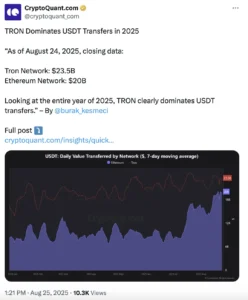
As of August 24, 2025, Tron processed $23.5 billion in daily USDT transfers, compared with $20 billion on Ethereum. The data, based on a seven-day moving average, shows Tron consistently leading stablecoin settlement volumes across the year. This reinforces Tron’s position as the primary rail for stablecoin payments, driven by lower fees, faster settlement, and strong adoption in remittance-heavy regions worldwide.
Tron outpaces Ethereum in USDT transfers. | Source: @cryptoquant_com on X
Compared to Ethereum, Tron now processes more than $21 billion in weekly USDT transfers, while Ethereum handles about $8 billion.
In 2025 alone, over $16 billion in new USDT was minted on Tron, further cementing its lead. Ethereum continues to dominate DeFi and NFTs, but Tron’s zero-fee transfers introduced in January 2025 and its low-cost and fast settlement design have turned it into the primary rail for stablecoin payments, remittances, and high-volume activity.
This timeline shows how Tron cemented its dominance step by step. The next question is: is TRC-20 USDT cheaper than ERC-20 USDT?
Cost, Speed, and UX: Why Everyday Users Picked Tron
In 2025, Tron’s TRC-20 network became the go-to rail for USDT transfers, especially for small payments, freelancers, and cross-border traders. The choice was about lowering costs, faster speeds, and an easier user experience than Ethereum’s ERC-20.
TRC-20 vs. ERC-20 Transfer Fees
Transaction costs remain the clearest difference between Tron and Ethereum. Tron’s resource model keeps fees negligible, while Ethereum’s congestion-driven costs weigh heavily on users.
Tron fees stay near zero: Most days, a TRC-20 USDT transfer costs $0.10–$0.50 and often even less thanks to Tron’s “bandwidth” resource model. Some transactions effectively settle for fractions of a cent.
Ethereum fees add up: Under normal conditions, ERC-20 USDT transfers typically cost $.40–$3, and during periods of congestion, fees spike to $10 or more. In extreme events, ERC-20 transfers have exceeded $30–$40 per transaction.
Retail-sized transfers get hit hardest. For a $100 USDT payment, as an example:
On Tron: fee = $0.10 (0.1%)
On Ethereum: fee = $3 (3%)
That 30× difference makes Ethereum impractical for smaller transfers. The contrast widens at higher values. In mid-2025, sending $1,000 on TRC-20 cost $1, while the same transaction on ERC-20 cost $30.
But low fees alone do not explain the preference. Speed and confirmation times complete the picture.
The idea that ETH is winning in stables is a fantasy. Sorry Tom Lee.
"TRON’s USDT supply reached an estimated $80.8 billion, surpassing Ethereum’s $73.8 billion for the first time"
"TRON processes daily USDT transfers seven times greater than Ethereum’s, highlighting its…
Tron is fast: Tron produces a block every 3 seconds, so most TRC-20 USDT transfers settle in 3–5 seconds.
Ethereum is slower: Ethereum’s average block time is 12–13 seconds, and users often wait 30–60 seconds for enough confirmations. During network congestion, delays stretch further.
Throughput capacity:
Tron: 1,000–2,500 TPS (transactions per second).
Ethereum (Layer-1): 15–30 TPS.
Real-world impact: In May 2025, Tron processed 273 million transactions on 28.7 million addresses, dwarfing Ethereum’s daily USDT activity, roughly one-sixth of Tron’s.
For users waiting to get paid, say a designer in Nigeria receiving $200, seconds instead of minutes and cents instead of dollars matter.
The combination of lower fees and faster confirmations explains why TRC-20 became the main rail for stablecoin transfers, especially in everyday payments and remittances.
Rémond comments on whether this advantage is sustainable: “In the short term, chains like Plasma will play an important role in payments. But over the longer term, the flywheel effect of ecosystems like Solana could allow them to absorb the payments use case as well, potentially becoming a backbone for this activity.”
He cautions that “there’s still a lot of work to be done, but the potential is there.”
Exchange and Wallet Defaults Drive Behavior
The way exchanges and wallets present choices powerfully affects which network users adopt. In 2025, these defaults worked in Tron’s favor.
Exchanges guide the flow: On its deposit/withdrawal pages, Binance explicitly labels TRC-20 as “low fee and high speed,” while ERC-20 is marked “higher fees.”
Default network bias: Many exchanges pre-select TRC-20 as the default option for USDT withdrawals. Since most users don’t switch networks manually, this reinforces Tron’s dominance.
Wallet nudges: Multi-chain wallets (TrustWallet, TronLink) display Tron alongside Ethereum, but users overwhelmingly pick Tron once they see the fee difference.
The result is that even users with little understanding of blockchain fees end up on TRC-20, simply because platforms guide them there.
This influence sets the stage for how freelancers, merchants, and peer-to-peer markets use Tron in everyday transactions.
Real-World Use Cases: Freelancers, Sellers, and P2P Markets
In the field, freelancers and P2P traders overwhelmingly turned to TRC-20 for USDT payments. Globally, stablecoin remittances via crypto have surged, and TRON often dominates those corridors. For example, in India and Southeast Asia freelancers and tech workers use USDT on TRON (or other fast chains) to bypass banking delays and FX losses.
CryptoQuant data confirm the trend: in 2025 roughly $9.9 billion of USDT flowed from Ethereum into TRON (a 76% YoY jump), with virtually no flow back.
Freelancers: In countries like India, the Philippines, and Nigeria, freelancers request USDT via Tron to avoid losing 5–10% of their pay to Ethereum gas fees. A $200 payout on Tron costs a few cents; on Ethereum, it could cost $5–10.
Cross-border sellers: Small e-commerce businesses in Asia and Latin America move thousands in monthly sales via TRC-20 USDT because it’s faster and more reliable than bank wires.
P2P markets: Platforms like Binance P2P show the majority of USDT trades happening on TRC-20 rails because buyers and sellers save money.
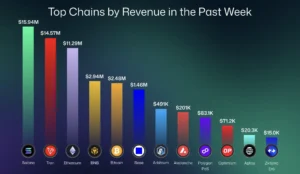
Tron tops $14.6M in weekly revenue, surpassing Ethereum. | Source: @Meghan_Crypt on X
Developer & Ecosystem Contrast: Tooling, Apps, and Culture
While users flocked to Tron for payments and stablecoins, the developer culture between Tron and Ethereum remained very different in 2025. Ethereum stayed the hub for DeFi, NFTs, and infrastructure, while Tron carved out a niche as the payment and remittance chain.
Developer Experience and Tooling
The strength of a blockchain often comes down to its developer ecosystem. Ethereum and Tron invest heavily in tools and education, but the scale and maturity differ.
Ethereum: the developer powerhouse.
Rich ecosystem of tools: Hardhat (testing and deployment framework), Foundry (fast smart contract development and testing toolkit), Truffle (smart contract management and testing suite).
Multiple languages supported (Solidity, Vyper).
Vast documentation, tutorials, and community forums.
Deep integrations across DeFi protocols and wallets.
Tron: smaller but growing.
Tron Virtual Machine (TVM) is EVM-compatible so that Ethereum developers can port Solidity contracts with minimal changes.
TronDAO runs HackaTRON hackathons and funds developers through a $1B+ ecosystem fund.
TRON Academy launched at Harvard in late 2022, training hundreds of students in its initial Hacker House event and expanding through partnerships with university blockchain clubs across multiple campuses.
App Mix Differences (Payments/Remittances vs DeFi/NFTs)
The types of applications that thrive on Ethereum and Tron show how each chain found its niche. Tron leans on payments and stablecoins, while Ethereum drives experimentation and innovation in DeFi, NFTs, and beyond.
Tron = Payments and Stablecoins
In 2025, Tron averaged over 8 million daily transactions and more than 2 million active addresses, cementing TRC-20 USDT as its most used contract.
The majority of Tron’s stablecoin supply is Tether.
Home to Uniswap, Aave, Compound, and Lido, the backbone of decentralized finance.
Hosts the largest NFT marketplaces (OpenSea, Blur) and most gaming/metaverse projects.
The ecosystem extends into real-world assets (RWAs), rollup infrastructure like Arbitrum and Optimism. Its gaming (NFT games, metaverse) and art markets are vast (e.g. NFT drops reaching billions).
Ethereum’s diversity keeps it the testing ground for emerging ideas, from liquid staking derivatives (LSDs) to advanced zero-knowledge rollup (ZK Rollups) systems.
While Ethereum can (and has) been used for payments, its high fees made it less common for everyday transfers by 2025.
The contrast is clear: Tron dominates everyday payments through USDT, while Ethereum sustains crypto’s experimental edge with its deep developer and protocol ecosystem.
Liquidity & Market Behavior: Why USDT on Tron Stuck Around
The shift from Ethereum reflects how liquidity, costs, and user behavior reinforce each other until one rail dominates.
Order Books, Trading Costs, and Market Dynamics
Market makers care about tight spreads and predictable costs. Tron’s near-zero fees keep spreads narrow, so more quotes remain active. That attracts order flow toward TRC-20 pairs and cements volumes on Tron. As pointed out before, current data shows Tron is far ahead of Ethereum in stablecoins-related use cases.
Treasury & Settlement Routines Behind the Scenes
Most of the movement in stablecoins comes from institutional desks rather than retail users. Exchanges, OTC brokers, and settlement firms shift large blocks of USDT between wallets to maintain liquidity.
These transfers are structured, often timed with trading hours in Asia, Europe, and the U.S. The process allows both small and large payments to clear without delay because funds are already positioned where they are needed.
This background activity directly relates to how stablecoins enter daily use, where freelancers, merchants, and peer-to-peer markets rely on the same blockchain.
TRON is processing $20 BILLION in stable coins DAILY, that's more volume than Visa!
Justin Sun: "Everyone who matters in crypto is already here" as Dubai dethrones Singapore as the crypto capital 🏙
From $5T to $7T projected volume in 2025. The revolution is happening on-chain…
As of August 18, 2025, Ethereum has not lost its relevance but instead carved out a specialized role distinct from Tron’s dominance in USDT transfers. Ethereum remains strong in security, decentralization, and fostering a vibrant developer ecosystem, particularly for DeFi, NFTs, and advanced financial products.
Layer-2 networks like Arbitrum, Optimism, and Base reinforce their competitiveness and boost scalability. These networks host complex financial infrastructure, making it the “Wall Street” of crypto.
Tron, in contrast, has become the “Western Union” of blockchain. It focuses on speed and low-cost transactions, especially for stablecoin payments.
The surge of USDT on Tron, which reached more than $80 billion by Q2 2025, highlights its appeal for everyday uses like remittances and peer-to-peer payments, driven by negligible fees and fast settlement.
Why USDT Didn’t Centralize on Ethereum L2s (Yet)
The move away from Ethereum layer-2s for USDT comes mainly from user experience challenges.
Bridging funds between chains is still complex, often requiring several steps that discourage everyday users. In contrast, Tron offers a simple one-click process.
Liquidity on L2s is also scattered across different platforms, which weakens trading depth and stability.
At the same time, limited merchant acceptance reduces the practical use of stablecoins on these networks.
Together, these issues slow down L2s in competing with Tron’s dominance in stablecoin transactions.
Risk Lens: What Concentration of USDT on Tron Means
The rapid growth of USDT on Tron brings benefits in speed and cost, but it also introduces risks that cannot be ignored.
Technical and operational risks: Tron’s reliance on just 27 validators raises centralization concerns, creating a larger attack surface than Ethereum’s thousands of validators. Liquidity and security challenges also emerge from cross-chain bridges, which remain key gateways for stablecoin movement.
Compliance and blacklisting: Tether can freeze addresses on both Tron and Ethereum, but jurisdictional pressures may push exchanges to enforce stricter rules. Tron’s position as a payment network exposes it to such moves, especially if regulators target everyday transactions.
Market structure shocks: A sudden shift in default payment rails by a leading exchange, or a sharp drop in fees on a rival chain or L2, could challenge Tron’s lead. Such moves would make it easier for users to return to ERC-20 or explore alternative networks.
These market shifts highlight how fragile stablecoin dominance can be. Technical advantages alone are insufficient, as regulation will decide which rails become the default for global payments.
Regulations and the Future of Stablecoin Rails
In 2025, global stablecoin regulation is reshaping the competitive landscape, with frameworks like the U.S. GENIUS Act, the EU’s MiCA, and Hong Kong’s Stablecoin Bill setting new standards for compliance, transparency, and reserve management.
These regulations aim to balance innovation with financial stability, impacting how stablecoin networks like Tron operate and compete.
U.S. GENIUS Act (July 2025): The GENIUS Act introduces the first federal framework for stablecoins in the United States. It requires 100% reserves in high-quality liquid assets like U.S. Treasuries, monthly transparency reports, and strict AML/KYC compliance. Yield-bearing stablecoins are banned to reduce speculative risks. Issuers with over $25 billion must register with the OCC, while smaller issuers can operate under state oversight. Tether’s $120 billion in Treasuries aligns with the reserve rule, but meeting compliance standards could still reshape how USDT functions on Tron.
EU MiCA (January 2025): MiCA enforces reserve backing, independent audits, and registration for stablecoin issuers. It also led to delistings of non-compliant tokens, with USDT losing market share across European exchanges. Circle’s USDC and EURC are gaining traction as regulated alternatives. Tron’s dominance in USDT transfers offers little protection here, as its growth in Europe depends on Tether achieving MiCA compliance.
Hong Kong Stablecoin Bill (August 2025): Hong Kong now requires licenses, reserves held with banks, and a minimum capital of HKD 25 million for non-bank issuers. The framework allows multiple fiat pegs and emphasizes cross-border payments. Pilot projects like JD.com’s stablecoin tests reflect this focus. Tron’s low-cost rails fit Hong Kong’s strategy, positioning it for growth in remittances and B2B payments across Asia.
Global Trends: Governments worldwide are converging on transparency, reserve standards, and consumer protection. The G20 pushes for interoperable rules, but uneven adoption still creates friction in cross-border transfers. Compliance costs estimated at $10 million annually for audits and reporting favor large issuers like Tether and Circle, potentially consolidating market share around a few dominant players.
SwissBorg’s CTO takes a clear stance: “We don’t expect these regulations to have a meaningful influence on the balance between Tron and Ethereum as stablecoin rails.”
Tron’s Future in the Stablecoin Wars
By August 2025, Tron carried $83.1 billion of USDT in circulation, representing just over half of Tether’s total supply. Its appeal lies in negligible fees and integration with major exchanges and wallets, making it the default rail for everyday payments in regions such as LATAM, MENA, and APAC.
The stablecoin wars are heating up, New L1s and L2s from giants like Circle, Stripe, and Tether could reshape the payments landscape and Tron’s $32B FDV shows the market potential.
Regulatory pressure: Tron’s reliance on 27 validators raises concerns under stricter frameworks like the GENIUS Act and MiCA, which favor decentralization and transparency. Tether’s strategy in the U.S., could bring Tron closer to compliance if it aligns with federal rules.
Competition: Solana and Ethereum’s L2s remain credible alternatives, especially if they improve user experience and reduce costs. New entrants like Plasma or payment-focused chains backed by fintech companies could also challenge Tron’s position.
Opportunities: Tron’s EVM-compatible Tron Virtual Machine and $1 billion ecosystem fund incentivize developers to build beyond stablecoin rails. Hong Kong’s regulatory sandbox adds another entry point for Asian institutional adoption.
Risks: EU restrictions, validator concentration, and vulnerabilities in cross-chain bridges remain significant. Market shifts, such as exchanges switching default rails or rivals cutting fees, could quickly erode Tron’s lead.
Conclusion
Tron’s ascent in 2025 reflects a decisive shift in how users move value across blockchains. Carrying over $80 billion in USDT, it became the leading rail for stablecoin payments, remittances, and peer-to-peer markets. Its appeal lies in low fees, fast transfers, and exchange defaults that nudged millions of users toward TRC-20.
Ethereum, however, remains the backbone of decentralized finance and innovation. With its rich developer ecosystem and layer-2 scaling solutions, Ethereum sustains its position as the hub for complex financial products, NFTs, and emerging technologies. Tron and Ethereum serve different functions, showing that blockchain success can take multiple forms.
The next stage will depend on regulation, competition, and market dynamics. Frameworks like the GENIUS Act, MiCA, and Hong Kong’s bill will shape stablecoin rails, while new rivals test Tron’s dominance. Whether Tron can maintain its lead depends on its ability to adapt while keeping the cost and convenience that drew users to its network in the first place.
No, Tron did not kill Ethereum. Tron dominates USDT transfers, while Ethereum leads in DeFi, NFTs, and developer activity.
Is USDT on Tron safe?
Yes, USDT on Tron is safe. Tether reserves back USDT, but centralization and regulatory risks remain.
Can I move my USDT from Tron to Ethereum?
Yes, users can move USDT from Tron to Ethereum. Bridges and exchanges allow transfers between TRC-20 and ERC-20 USDT.
What chain should beginners use for USDT?
Beginners often pick Tron for low fees, while Ethereum is used for DeFi and advanced apps.
Disclaimer:
The information provided in this article is for informational purposes only. It is not intended to be, nor should it be construed as, financial advice. We do not make any warranties regarding the completeness, reliability, or accuracy of this information. All investments involve risk, and past performance does not guarantee future results. We recommend consulting a financial advisor before making any investment decisions.
Dr. Lorena Nessi is an award-winning journalist and media technology expert with 15 years of experience in digital culture and communication. Based in Oxfordshire, UK, she combines academic insight with hands-on media practice.
She holds a PhD in Communication, Sociology, and Digital Cultures, and an MA in Globalization, Identity, and Technology.
Lorena has taught at Fairleigh Dickinson University, Nottingham Trent University, and the University of Oxford. She is a former producer for the BBC in London, with additional experience creating television content in Mexico and Japan.
Her research focuses on digital cultures, social media, technology, capitalism, and the societal impact of blockchain innovation.
She has written extensively on digital media and emerging technologies, with her work featured in both academic and media platforms. Her Web3 expertise explores how blockchain technologies shape culture, economics, and decentralized systems.
Outside of work, Lorena enjoys reading science fiction, playing strategic board games, traveling, and chasing adventures that get her heart racing. A perfect day ends with a relaxing spa and a good family meal.


 Easy
Easy