$WLFI Trading Guide: Full List of Exchanges & the Common Mistakes To Avoid.
Share
Key Takeaways
Major centralized exchanges offer WLFI/USDT spot markets, while top derivatives platforms list WLFIUSDT perpetual futures.
Spot trading means you own WLFI and can withdraw it; ideal for beginners. Perpetual futures use margin and funding fees, enable long/short strategies and suit experienced traders who understand liquidation risk.
Only a portion of WLFI supply circulates initially, with larger allocations locked and subject to future governance decisions.
Before trading WLFI, complete KYC where required, enable 2FA, confirm your region is supported, and verify you’re using official exchange pages and the authentic token contract if you trade on a DEX.
World Liberty Financial’s WLFI token, a Trump family-backed crypto project, is officially hitting the markets, and excitement is running high.
The token will become tradable and transferable Today at 12:00 UTC. If you’re wondering where and how to trade $WLFI, you’ve come to the right place.
The $WLFI token, the governance token for the Trump family-backed DeFi platform World Liberty Financial, is set to launch for public trading and initial token claims on September 1, 2025, at 12:00 UTC (8:00 AM Eastern Time). This marks the official token generation event (TGE)…
This comprehensive guide explains where to buy and sell $WLFI tokens, which exchanges support spot vs. futures trading, key listing schedules (including token unlock times), KYC and regional restrictions, and tips for navigating this highly hyped token launch safely.
Whether you’re a seasoned trader or a beginner, read on for all the details on WLFI’s trading debut.
Where to Buy $WLFI: Spot, Futures and Pre-Market Options Explained
We sometimes use affiliate links in our content, when clicking on those we might receive a commission at no extra cost to you. By using this website you agree to our terms and conditions and privacy policy.
This section explains a list of exchanges that currently support (or plan to support) WLFI trading, along with what types of trading they offer, when trading opens, KYC requirements, regional availability, and direct links to the WLFI markets.
The table below summarizes what type of trading is available, when markets open, whether KYC is required, and any notable regional constraints.
Exchange
Trading Type(s)
Start Time (UTC)
KYC Requirement
Regional Notes
KuCoin
Spot (WLFI/USDT), Pre-Market IOU (ended Sept 1)
Spot live at 13:00 Sept 1
Required for new users
Global access, not licensed in the U.S.
HTX
Spot (WLFI/USDT), Isolated Margin up to 10×
Sept 1, after deposits open Aug 29
Generally required
Not available in U.S., Mainland China, sanctioned regions
LBank
Spot (WLFI/USDT), Pre-Market delivery contract
Spot live 13:00 Sept 1, Withdrawals 24h later
Optional for crypto-only, required for fiat/high withdrawals
Broad global reach, some regional restrictions incl. U.S.
MEXC
Spot (WLFI/USDT, WLFI/USDC, WLFI/USD1)
WLFI/USDT at 12:00 Sept 1; others at 12:20 Sept 1
Optional for small trades, recommended for higher limits
KuCoin held a pre-market IOU trading session from August 24 until Sept 1 and will open spot trading for WLFI/USDT at 13:00 UTC on September 1, 2025.
Deposits were opened in advance, and the pre-market order book allowed price discovery before launch.
KYC verification is required for all new KuCoin users (as of 2023) to trade.
KuCoin is available globally (outside sanctioned regions), but it is not licensed in the U.S.; American users may face IP blocks or should proceed cautiously.
HTX – Spot Trading (WLFI/USDT) and Margin
HTX will list WLFI in its USDT spot market on September 1, 2025, after opening deposits on Aug 29. Trading is expected to begin once sufficient deposit liquidity is reached on Sep 1 (exact time to be announced by HTX).
Notably, HTX also announced WLFI/USDT isolated margin trading up to 10X leverage available from launch day, indicating you can trade WLFI on margin in the spot market.
KYC is generally required for HTX users, especially for withdrawals or large trades. HTX does not serve U.S. customers and has regional restrictions in places like Mainland China and other sanctioned countries.
LBank – Spot Trading (WLFI/USDT).
Crypto exchange LBank has a “World Premiere” listing of WLFI scheduled at 13:00 UTC on September 1, 2025.
Deposits and the WLFI/USDT spot market will open simultaneously at that time, with withdrawals enabled 24 hours later (Sep 2, 13:00 UTC).
LBank earlier launched a pre-market WLFI/USDT delivery contract on Aug 23 for early trading, which allowed users to trade WLFI “futures” that settle once the spot market opens. That pre-market contract had up to 20× leverage and was settled within 24 hours before the spot listing.
For spot trading on LBank, basic account signup is easy and KYC is optional for small crypto-only trades, though it’s required for fiat transactions and higher withdrawal limits.
LBank is globally accessible, but like many exchanges it may restrict users from the U.S. and certain regions (check their terms).
Exchange MEXC will list WLFI in its Innovation Zone with multiple trading pairs.
According to the official announcement, WLFI/USDT spot trading opens at 12:00 UTC on Sep 1, 2025, followed by WLFI/USDC and WLFI/USD1 (the project’s own stablecoin) trading at 12:20 UTC.
Withdrawals from MEXC will be enabled a day later on Sep 2 at 12:00 UTC.
Notably, MEXC is offering zero trading fees at launch for WLFI pairs as a promotion.
MEXC allows trading without full KYC for many users; however, KYC is recommended and may be required for certain features or large transactions.
MEXC is not licensed in the U.S., so U.S. traders should be aware of regional restrictions.
Gate.io – Spot Trading (WLFI/USDT).
Gate.io has confirmed it will list WLFI/USDT in its spot market on September 1, 2025 at 13:00 UTC. (This timing coincides with many other exchanges, indicating a broad market go-live at that hour.)
Gate.io typically opens deposits shortly before enabling trading. KYC is mandatory on Gate for most users, they enforce identity verification for virtually all features now.
Region-wise, Gate.io doesn’t serve the U.S. or Canada and has some jurisdictional restrictions, but it is popular in many other countries.
Users should use the official Gate.io site or app to access the WLFI market (be cautious of lookalike domains).
Bitget – Pre-Market & (Upcoming) Spot Trading.
Leading exchange Bitget launched pre-market trading for WLFI on Aug 23, 2025.
Bitget’s pre-market is similar to an OTC futures market: it allowed buyers and sellers to agree on WLFI prices before the token was publicly tradeable, even letting sellers participate without yet holding tokens (as long as they deliver by the settlement). This provided early price discovery and liquidity ahead of the official launch.
Spot trading on Bitget is expected to follow once WLFI officially launches, though the exact timeline for Bitget’s spot listing will be announced separately. Bitget supports both spot and derivatives, so it wouldn’t be surprising to see a WLFI/USDT spot market and possibly a perpetual futures contract once the token unlocks.
KYC at Bitget is not strictly mandatory for basic crypto trading (many users trade without verification), but it is required for certain services and large withdrawals.
Bitget is available globally with exceptions (it pulled out of the U.S. and some jurisdictions due to regulation).
Binance – Perpetual Futures (WLFIUSDT).
Binance, the world’s largest exchange, has not (as of now) announced a WLFI spot listing, but its derivatives platform jumped in early.
Binance Futures launched a USDⓈ-M (USDT-settled) WLFI/USDT perpetual futures contract on Aug 23, 2025. This contract was introduced with up to 5× leverage and initially operated in “pre-market” mode, using a capped price mechanism until a spot price index becomes available.
Binance’s announcement makes it clear that listing a futures contract “does not guarantee” a spot listing will occur, so they are testing the waters via derivatives.
Trading on Binance Futures is 24/7, and the WLFI perpetual will transition to standard pricing once exchange spot markets (index price) go live.
Binance requires full KYC for all users, and U.S. persons cannot use Binance’s global platform (Binance US has not mentioned WLFI at all).
The WLFIUSDT perpetual is available to traders in permitted countries via Binance’s website.
Bybit – Perpetual Futures (WLFIUSDT).
Bybit, another major derivatives exchange, similarly opened WLFI/USDT perpetual contracts in a pre-market phase on Aug 23, 2025 (at 10:15 AM UTC). This likely mirrors Binance’s move: Bybit offered WLFI perpetual futures to allow speculation ahead of spot trading.
Leverage on Bybit’s contract was reportedly up to 5× as well (per social media chatter). Bybit has not confirmed a spot listing yet, but if demand is high, they may list WLFI on spot later.
KYC on Bybit became mandatory for most features as of mid-2023, so new users must verify identity to trade.
Bybit withdrew from the U.S. and certain jurisdictions, but serves many regions in APAC, Europe, etc. U.S. traders cannot use Bybit legally.
Access the WLFI futures on Bybit via their Derivatives section (login required).
OKX – Spot Trading (WLFI/USDT) via Call Auction.
OKX’s global platform had not announced a WLFI listing initially, but OKX Turkey (OKX TR) did confirm a spot listing with a call auction process.
According to OKX TR, WLFI deposits opened on Aug 31, and a call auction ran from 12:00–13:00 UTC on Sep 1, followed by full spot trading at 13:00 UTC.
A call auction is a 1-hour opening period where users place orders that all execute at a single opening price, used to ensure orderly price discovery.
OKX also imposed initial trading limits (no market orders for 5 minutes, etc.) to curb volatility during launch.
After 13:00 UTC, WLFI/USDT trading became continuous on OKX TR. It’s unclear if the main OKX.com will also list WLFI (possibly they waited for regulatory reasons), but OKX’s move via its regional entity shows support for WLFI.
OKX requires KYC for most users (especially fiat or higher tiers), and region restrictions apply (U.S. not allowed).
Kraken – Spot Trading (planned)
U.S.-based exchange Kraken has publicly indicated it will support WLFI, but with a cautious approach.
On Aug 29, Kraken posted on social media that support for WLFI was “coming soon,” without giving an exact listing time. The project team also announced Kraken as an upcoming partner.
As of Sep 1, Kraken’s deposit for WLFI appears to be either live or imminent (a Kraken post mentioned deposits with geographic restrictions).
Kraken could roll out WLFI/USD and/or WLFI/EUR spot markets in the very near future, given its inclusion in the major exchanges planning listings.
Being a U.S.-regulated exchange, Kraken will require full KYC verification to trade WLFI. Regional availability will exclude certain areas, U.S. traders in NY or TX (for example) might face limits if Kraken’s license doesn’t cover those states.
Keep an eye on Kraken’s official blog or Twitter for the WLFI listing announcement and trading link.
As you can see, WLFI will be widely accessible across both centralized spot exchanges and derivatives platforms.
Other exchanges not mentioned above may list WLFI in the future; always confirm listings and timelines via the exchange’s official announcements before trading WLFI or any other crypto asset.
If you prefer decentralized trading, note that WLFI is an ERC-20 token (Ethereum-based), so it could appear on DEXs like Uniswap; however, the project’s focus is on centralized exchange launches for now, and beginners are generally safer sticking to the reputable centralized exchanges for liquidity and security.
Alternative Ways to Trade $WLFI (Beyond Major CEXs)
While centralized exchanges like KuCoin, HTX, and Gate.io lead in spotlight liquidity, SwissBorg offers a convenient fiat-access gateway, and open market routes via DEXs or swaps may emerge soon.
1. SwissBorg App (Smart Exchange)
SwissBorg officially supports WLFI from the moment trading activates. This means you can trade WLFI within the app using its Smart Engine, which automatically routes orders to the best available prices across multiple exchanges.
You can fund your account using bank transfer, card, Apple Pay, or Google Pay, making it accessible and straightforward for a wide range of users.
The app is regulated, operating in 47 countries and serving users in 16 different fiat currencies, offering strong compliance and regional accessibility.
2. PancakeSwap (BSC DEX)
WLFI is listed as a trading pair (e.g., WLFI–USDT) on PancakeSwap v2, the top decentralized exchange on BNB Chain.
Recent metrics show significant price action (e.g., up 4,700% in 24h on one pool) and a liquidity pool of approximately $138K
The pool is verified and shows no honeypot risk, but note that liquidity varies by pool, so it may be limited
3. Other DeFi Pools on BSC
WLFI also appears across other DeFi platforms like Maestro Bot, KyberSwap, and MEXC DEX+, indicating wider multi-DEX availability.
Liquidity on these can be low or dispersed, so trade volume and slippage may differ significantly.
How $WLFI Spot vs. Futures Trading Works
WLFI is available for spot trading on many exchanges, and also as a futures/perpetual contract on some platforms. It’s important to understand the difference:
Spot Trading WLFI
When you trade WLFI on the spot market, you are buying or selling the actual WLFI tokens for immediate settlement. In a spot trade, you own the tokens after purchase, and you can withdraw them to your wallet (once withdrawals open).
Spot prices are determined by real-time supply and demand on the exchange order book. For example, buying WLFI on LBank or KuCoin will give you actual WLFI in your exchange account that you can hold or transfer.
Spot trading is straightforward, no leverage is involved by default, and the value of your holding moves one-for-one with the market price.
WLFI Futures/Perpetual Trading
Futures contracts allow you to gain exposure to WLFI’s price without holding the token directly. A futures (or perpetual swap) is essentially an agreement between traders to settle the price difference of WLFI at a future time or continuously.
For instance, Binance’s and Bybit’s WLFIUSDT contracts are USDT-settled perpetual futures, you put up margin (in USDT or other allowed collateral) and profit from WLFI price moves long or short.
You do not take delivery of actual WLFI unless you close the position and then buy on spot. Futures often allow leverage, meaning you can trade a larger position than your capital (Binance and Bybit offered up to 5× leverage on WLFI initially).
This amplifies gains and losses. Perpetual futures have no expiry; instead, they use funding fees to peg to the spot price. In WLFI’s case, during the initial pre-listing phase, special pricing mechanisms and capped funding rates were used to manage volatility.
Key differences
With spot, you’re holding the asset and can only profit if price goes up (or lose if it goes down). With futures, you can go long or short, potentially profiting from either direction, and use leverage to amplify your position.
However, futures involve periodic funding fees and the risk of liquidation if the market moves against you beyond your margin buffer. Spot trading has no risk of liquidation, you only lose if you sell below your buy price, whereas a futures position can be force-closed if losses exceed your collateral.
Aspect
WLFI Spot Trading
WLFI Futures/Perpetual Trading
What you trade
Actual WLFI tokens
Contract referencing WLFI price
Ownership
You own WLFI after purchase
No token delivery; exposure via contract
Settlement & withdrawals
Immediate; tokens can be withdrawn once enabled
Cash-settled PnL; no on-chain WLFI unless you buy on spot
Price driver
Exchange order book (real supply/demand)
Tracks spot via index + funding mechanics
Directionality
Primarily long (profit if price rises)
Long or short (profit either way if you’re right)
Leverage
None by default
Leverage available (amplifies gains/losses)
Liquidation risk
No liquidation; position value can fall, but you hold
Liquidation possible if losses exceed margin
Ongoing fees
Trading fees only
Trading fees + funding payments (periodic)
Expiry
None
Perpetual (no expiry)
Complexity
Simpler; beginner-friendly
Advanced; requires margin/risk management
Best use case
Buy-and-hold, withdrawals, simple DCA
Hedging, shorting, tactical leveraged trades
Typical order choice at launch
Limit orders to avoid slippage in thin books
Limit/stop orders; manage margin and funding
Pre-market/IOU phase
Not applicable
Some venues offered delivery/IOU contracts pre-listing, settled when spot went live
For WLFI, another wrinkle was the concept of pre-market trading on some exchanges. Platforms like KuCoin, LBank, Bitget, and Bybit offered pre-listing IOUs or delivery contracts for WLFI. These are essentially one-time futures that existed before the token was unlocked on-chain. For example, KuCoin’s pre-market had buyers and sellers lock in WLFI prices that would be settled once spot trading began.
Sellers had to deliver real WLFI tokens by a deadline after Sept 1, or their collateral would be forfeited. This mechanism let the market start finding a price even while tokens were still locked.
Similarly, LBank’s pre-market contract was a delivery futures set to execute just before spot launch, with a final settlement based on the last hour trading average. These innovative approaches helped “watch the hype” build, as early speculative trading indicated market demand (for instance, WLFI IOUs traded around $0.30–$0.56 leading up to launch).
WLFI Token Unlock Schedule and Supply Structure
One big factor behind the WLFI hype is its tokenomics and unlock schedule. Unlike a typical token launch where a large circulating supply is available on day one, WLFI is using a “Lockbox” contract and phased unlock model.
Here’s what that means:
Total supply: WLFI has a total supply of 100 billion tokens (the contract is on Ethereum: 0xdA5e…CBeF6). However, the circulating supply at launch is only a small fraction of that.
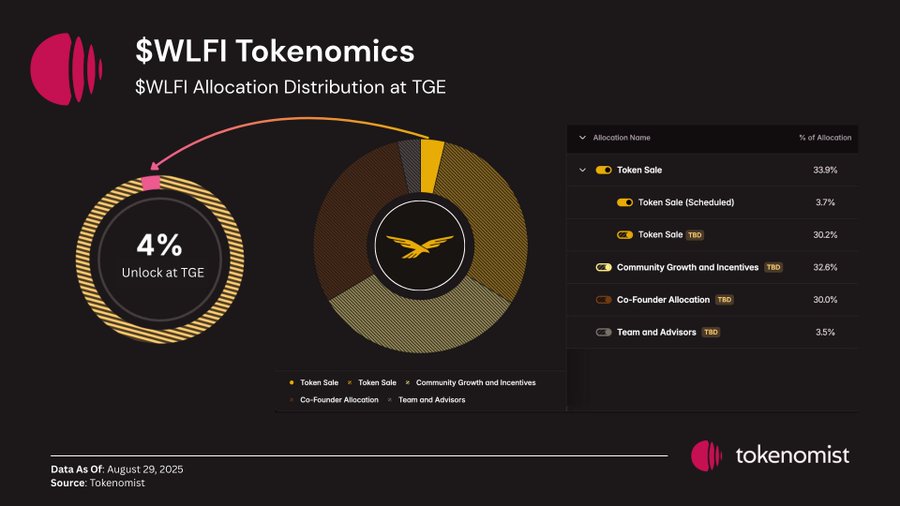
Initial circulation (TGE unlock): On September 1, 2025, the Token Generation Event (TGE) – only 3 billion WLFI tokens are being released for trading. This represents about 3% of the 100 billion total supply. In other words, 3 billion tokens (out of presumably the presale allocations) become claimable by holders at 8:00 AM ET on Sep 1 (just as exchanges list the token). These tokens come from early contributors and presale investors who can finally trade a portion of their holdings.
Locked tokens and vesting: The remaining 80%+ of tokens are locked up under a unique mechanism. Specifically, presale holders only get 20% unlocked now, and the other 80% of their allocation remains in the Lockbox contract. Future unlocks will not follow a fixed time schedule like linear vesting; instead, they are governed by community votes of WLFI token holders. This means the project’s community can vote on when and how much of those locked tokens to release into circulation over time, presumably to prevent flooding the market. The Lockbox is essentially a smart contract escrow that the WLFI DAO controls post-launch.
Supply reserve: According to project updates, 15% of the total supply (15 billion WLFI) is being held as a long-term reserve in the Lockbox to buffer the market. By keeping a large portion locked, the team aims to mitigate volatility and avoid overwhelming sell pressure. An audit by Cyfrin has verified the Lockbox contract’s integrity, ensuring the locked funds are secure and only released per the intended rules.
Trump Family and other stakes: World Liberty Financial’s high-profile backing also affects token distribution. Reports indicate the Trump family and their business allies hold a significant stake (e.g. around 22.5 billion WLFI, or 22.5% of supply, was attributed to them in one analysis). There’s also institutional backing (e.g. a $1.5B funding commitment via ALT5 Sigma, and others) which likely corresponds to large token allocations locked as treasury or partnership tokens. These strategic tokens are probably subject to their own lockups or vesting terms to align with the project’s growth.
Unlock timing and strategy: The first 3 billion unlock on Sep 1 is a critical “test of market resilience”, as it will show how the market absorbs the newly tradable tokens. Early investors who bought in private rounds at very low prices ($0.015–$0.05) might take profit now that price is many times higher, which could create selling pressure. However, because the majority of supply remains locked (97% of tokens are still not circulating), the project is effectively ensuring a degree of scarcity at launch. Future unlocks will be gradual and presumably conditional: the community governance can vote to release another tranche of tokens if market demand is strong or for project needs. This model puts some power in holders’ hands to pace the inflation of supply.
USD1 stablecoin interaction: Note that WLFI is tied to USD1, a U.S. dollar-based stablecoin the project launched (which is fully collateralized by U.S. Treasuries, aiming to bolster USD’s global role). USD1 is already in circulation (for example, it’s live on Kraken, and MEXC is listing a WLFI/USD1 pair). The success of USD1 could influence WLFI’s tokenomics indirectly, if USD1 is widely used, WLFI (as governance token) gains more utility and potentially more demand. But USD1 itself doesn’t affect the WLFI unlock schedule except that some exchanges (like MEXC) even list WLFI against USD1, reflecting the ecosystem linkage.#
WLFI Tokenomics. | Source: @Tokenomist_ai on X
Risks and Volatility of $WLFI Trading
Trading $WLFI is not for the faint of heart. As a newly launched, highly publicized token with a small initial float, price discovery can be wild.
Expect sudden price swings and liquidity spikes, thin order books and surging demand mean a single large order can move the market. It’s common for hyped coins to pump on launch and then snap back as early buyers take profit.
Early-investor selling is a real factor: Many presale participants bought at low prices and may unload part of their unlocked allocation, creating downward pressure, unless fresh demand absorbs it. That push-and-pull can make price action whipsaw in both directions.
Derivatives magnify moves: With perpetuals and futures in the mix, leverage can trigger liquidations that snowball into sharper rallies or selloffs. If you’re new, treat leverage as advanced, small mistakes get expensive fast.
Low float dynamics matter: A limited circulating supply makes WLFI easier to move, and price gaps between exchanges are common early on until arbitrage catches up. Use limit orders instead of market orders during peak volatility.
Hype cycles cut both ways: Headlines, endorsements, or regulatory chatter can flip sentiment instantly. Association with political figures can amplify both enthusiasm and skepticism, so be ready for fast narrative shifts.
Exchange stress is possible: Heavy traffic on launch days can mean site slowdowns, brief freezes, or delayed withdrawals. Don’t overreact to momentary glitches; plan orders and risk ahead of time.
No long-term price history: Finally, WLFI has no long-term price history. With fundamentals still forming and a large locked supply overhead, valuation can swing widely. Treat WLFI as high risk / high variance and only commit funds you can afford to lose.
With great hype comes great scam potential and user error. Here are some practical tips to trade WLFI safely and avoid common pitfalls:
Use official sources only. Bookmark the project’s site and your exchange portals. Avoid airdrop promises, “special unlocks,” and anyone asking for seed phrases.
Double-check URLs. Phishing domains are rampant around hyped launches. Verify HTTPS and exact spelling before logging in or depositing.
Finish KYC and lock down security. Complete verification early to avoid withdrawal delays. Enable 2FA, use strong unique passwords, and set anti-phishing codes where available.
Know the rules where you traded pre-market. Understand delivery windows, settlement cutoffs, and penalties. Expect some platforms to delay withdrawals for a short period post-listing.
Beware impersonators and copycat tokens. If using a DEX, verify the contract address, name alone isn’t enough.
Start small. Learn the order interface, watch behavior around unlocks, and resist FOMO. There will be more setups after the dust settles.
Prefer limit orders and protect downside. Limits reduce slippage; consider a stop-loss if you can’t watch the screen. If you must use leverage, keep it low.
Monitor official announcements. Listings, pauses, or unlock proposals can change the trading landscape quickly.
Control emotions. Have a plan, set targets, and avoid chasing candles or panic-selling on rumors. Diversify and size positions so a bad trade doesn’t derail your portfolio.
Conclusion
WLFI’s debut spans major spot venues and derivatives platforms, giving traders multiple on-ramps, but also multiple ways to overextend. Launch windows clustered around the same hour amplified activity, while KYC, regional access rules, and staged withdrawals shaped the first trading day experience. The token’s structure, small initial float, larger locked supply, and intense media attention, creates a classic recipe for high volatility.
If you participate, do it with clear risk limits, verified channels, and a preference for limit orders over impulse clicks. For beginners, spot markets with small position sizes are the most forgiving place to learn. For veterans, derivatives can be powerful, but only with disciplined sizing and robust liquidation buffers.
Bottom line: trade the plan, not the hype. Stay security-minded, keep emotions in check, and remember that preserving capital through choppy price discovery puts you in position to act when real trends emerge.
Is WLFI better to trade on spot or perpetual futures?
For beginners, spot is simpler; you buy the actual token, no liquidation risk. Perpetual futures let you go long/short with leverage, but funding fees and liquidations make them higher risk. If you’re new, start on spot with small size; use perps only when you fully understand margin and risk.
Do I need KYC to trade WLFI, and can US residents participate?
Most centralized exchanges now require KYC for full access (especially withdrawals/fiat on-ramps). Many popular global exchanges do not serve U.S. users on their main platforms. Always check the exchange’s regional policy, complete KYC early, and make sure trading WLFI is permitted where you live.
Why is WLFI so volatile at launch, and how do I avoid bad fills?
WLFI’s initial circulating supply is small, and hype drives heavy order flow—thin books + sentiment swings = big moves. Use limit orders (not market orders) during spikes, avoid high leverage, and size positions modestly. Expect gaps between exchanges until arbitrage normalizes prices.
How do I verify I’m buying the real WLFI and not a fake?
Only use official exchange listings and the project’s verified channels to find the token page. If you venture onto DEXs, confirm the contract address from an official source before trading. Never share seed phrases, ignore “airdrop/early unlock” DMs, and double-check URLs to avoid phishing sites.
Disclaimer:
The information provided in this article is for informational purposes only. It is not intended to be, nor should it be construed as, financial advice. We do not make any warranties regarding the completeness, reliability, or accuracy of this information. All investments involve risk, and past performance does not guarantee future results. We recommend consulting a financial advisor before making any investment decisions.
Onkar Singh has three years of experience as a digital finance content creator. Throughout his career, he has collaborated with various DeFi projects and crypto media outlets. In his leisure time, he enjoys fitness activities at the gym and watching movies across different genres. Balancing his professional and personal interests, Onkar continues to contribute to the digital finance landscape while pursuing his hobbies.


 Easy
Easy