Currently, the company led by Tom Lee holds approximately 3.2% of all circulating ETH.
Yet despite this consistent buying, Ethereum’s price continues to struggle.
So why hasn’t the market reacted?
Get These Top Crypto Casino Offers Now!
Sponsored
Disclosure
We sometimes use affiliate links in our content, when clicking on those we might receive a commission at no extra cost to you. By using this website you agree to our terms and conditions and privacy policy.
According to our investigation, several forces are working against upward momentum.
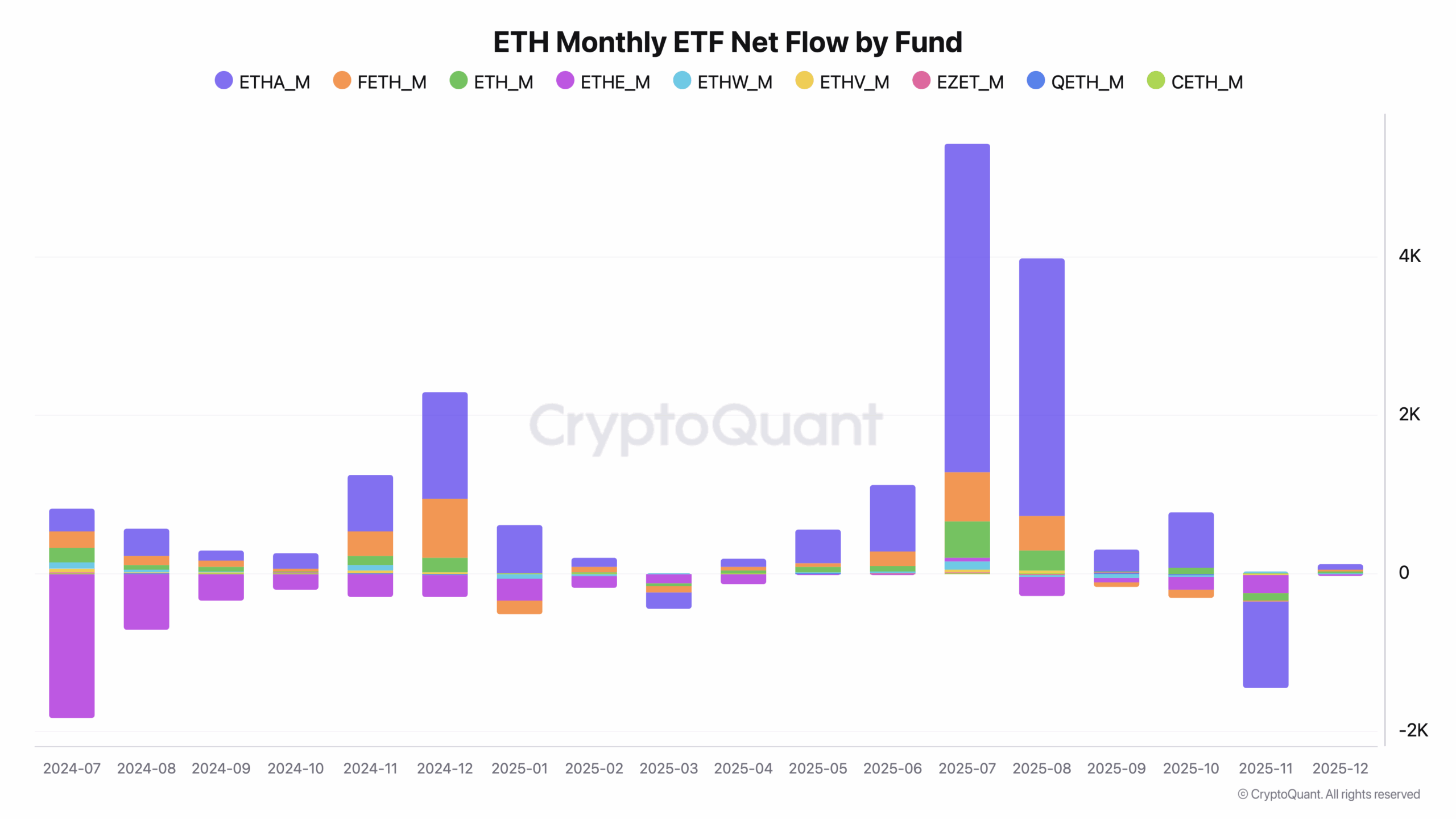
First, prominent asset managers have unloaded significant amounts of ETH over the past month. Grayscale alone has sold approximately $224 million worth of Ethereum.
BlackRock has gone even further, liquidating roughly $1.4 billion in the same period. This heavy selling has effectively neutralized Bitmine’s aggressive accumulation, limiting any positive impact on price.
Interestingly, BlacRock has also filed for a staked Ethereum exchange-traded fund (ETF) with the U.S SEC.
This move indicates the company’s long-term conviction for the token, even as short-term price action remains muted.
ETH Monthly ETF Net Flow by Fund | Credit: CryptoQuant
One key factor is the recent behavior of mega whales (wallets holding more than 10,000 ETH).
Glassnode data shows that these large holders accumulated heavily between July and September. That accumulation phase aligned with ETH’s surge above $4,862.
However, since Nov. 12, the trend has flipped. Mega whales have shifted into sustained selling, offloading significant amounts of ETH.
ETH Mega Whales Balance | Credit: Glassnode
Due to this, Ethereum’s price will likely struggle to reverse its downward pressure.
Participation Drops as Analyst Gives Take
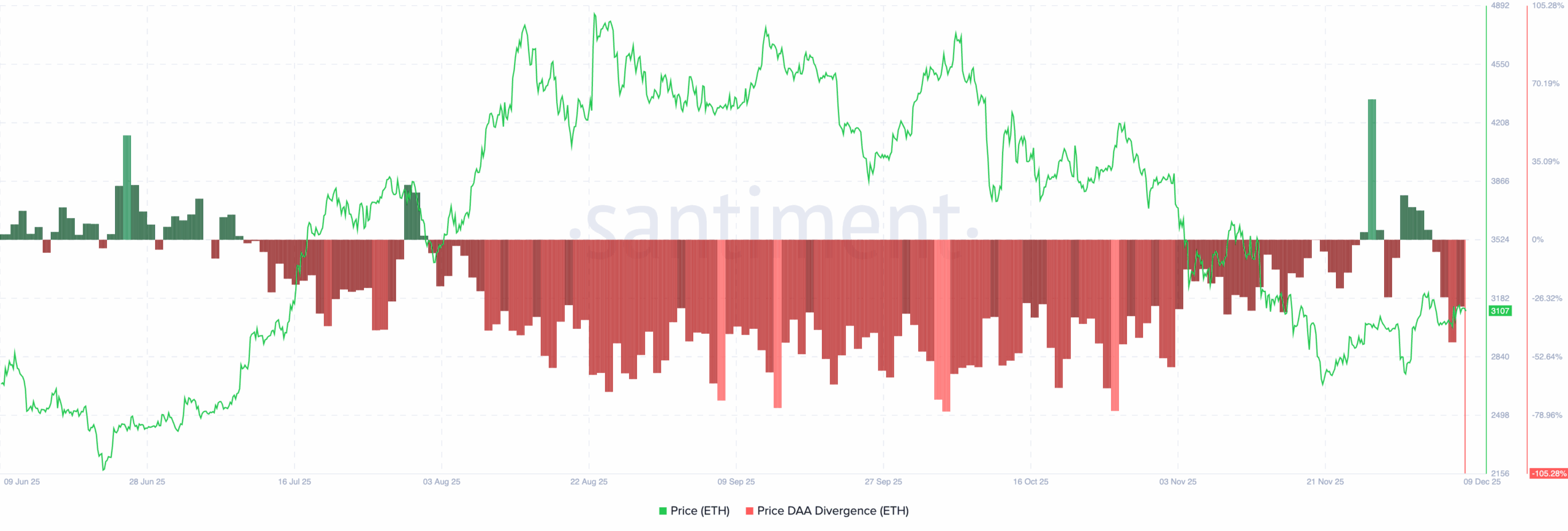
Another metric that reinforces this outlook is the Daily Active Addresses (DAA) Price Divergence.
At press time, Ethereum’s DAA divergence has plummeted to -105.28%, a level that indicates a significant disparity between price action and network activity.
A negative divergence of this magnitude means that Ethereum’s active user participation is falling far below what its current price would normally justify.
In simple terms, fewer wallets are interacting with the network even as ETH’s price attempts to hold critical support levels.
As a result, the likelihood of a sustainable breakout diminishes.
If DAA numbers continue to decline while prices remain elevated, ETH could face increasing sell pressure as the market corrects this imbalance.
In this scenario, Ethereum’s price may struggle to maintain its position above $3,000 and could slide toward lower support zones.
In the meantime, some analysts believe ETH’s price may take longer to stage a meaningful recovery.
One of them is the pseudonymous analyst Eliz, who argues that the altcoin is currently structurally compressed.
“The ETH cycle hasn’t started yet, and the ETH/BTC pair shows this extremely clearly: we are still in a phase of structural compression, with no sign of any real expansion. How long can this phase last? Weeks, months… in some cycles, even years. We don’t choose the timing; the market does,” Eliz noted.
This view suggests that Ethereum’s price is trading within a tight range, characterized by limited volatility, which delays major directional moves.
Therefore, until this compression resolves, ETH may continue to drift sideways rather than break higher.
ETH Price Analysis
From a technical standpoint, the daily chart shows Ethereum’s price is still trapped inside a descending channel.
Disclaimer:
The information provided in this article is for informational purposes only. It is not intended to be, nor should it be construed as, financial advice. We do not make any warranties regarding the completeness, reliability, or accuracy of this information. All investments involve risk, and past performance does not guarantee future results. We recommend consulting a financial advisor before making any investment decisions.
Victor Olanrewaju is a crypto analyst and reporter at CCN with deep roots in on-chain research and technical analysis. His crypto journey began in 2017, but it was the 2020 Uniswap airdrop that sparked a full-time pivot into the space.
With a foundation in copywriting, Victor honed his craft creating high-converting content for leading crypto brokers — most notably an XRP price prediction that ranked #1 on Google during the 2021 bull run.
He later joined AMBCrypto in 2022, where he combined storytelling with technical and on-chain analysis to cover key market narratives.
In 2024, he expanded his expertise at BeInCrypto, collaborating with analysts and using tools like Glassnode, Santiment, and IntoTheBlock to break down Bitcoin and altcoin trends.
At CCN, Victor covers the top cryptocurrencies, memecoins, macro shifts, blending real-time insights with deep-dive metrics.
He holds a Bachelor’s degree in Physics from the University of Ibadan, equipping him to simplify complex data for a wide audience. Follow his work or connect on LinkedIn or X.