YoungHoon Kim, dubbed the world’s highest IQ holder, predicts Bitcoin will ignite a June rally while XRP shocks markets. Here’s whether the forecast is realistic. | Credit: CCN.com
Share
Key Takeaways
World’s smartest man’s claims that Bitcoin will hit $100K in 24 hours grab attention, but price action is driven by liquidity, derivatives positioning, and other factors.
Heavy options open interest around the $100,000 strike creates hedging behavior by market makers that can suppress volatility and slow breakouts.
While many traders expect Bitcoin to eventually exceed $100K, prediction markets suggest the odds are very low over a 24-hour window.
ETF inflows and fund allocations tend to arrive gradually, meaning even bullish sentiment may not translate into immediate upside.
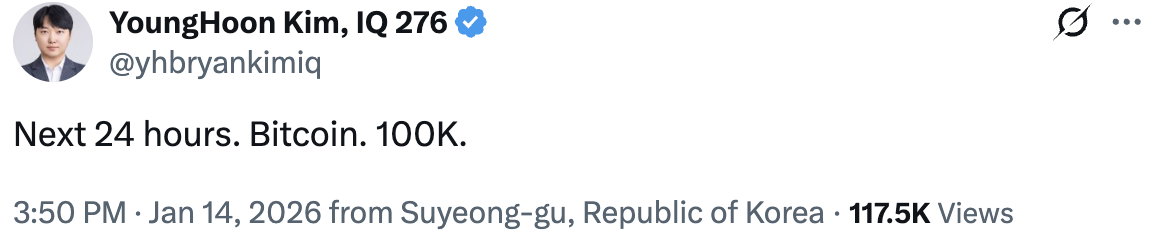
A recent tweet by YoungHoon Kim, identified online as having an IQ of 276, claimed Bitcoin price would hit $100,000 within 24 hours. Notably, the post did not include any supporting data, market analysis, or explanation for the prediction. Even so, the tweet spread rapidly, capturing attention across Crypto Twitter as traders debated whether a $100K breakout was imminent.
Bold Bitcoin price predictions like this are nothing new in cryptocurrency, they’ve propelled markets higher and sparked debates for over a decade.
However, Bitcoin’s price is not determined solely by personality, intelligence, or conviction. It’s driven by market structure, liquidity, derivatives flows, and institutional capital, forces far more powerful and measurable than a single forecast.
Here’s a deep, data-informed look at three structural reasons Bitcoin has consistently struggled to break above $100,000, even when sentiment is bullish and what that tells traders and investors about timing and probability.
Barrier #1: The Options Market’s Structural Resistance Around $100,000
A key difference between crypto and many other markets is the size and influence of the options market, the derivatives market where traders buy contracts that give them the right (but not obligation) to buy or sell Bitcoin at set prices in the future.
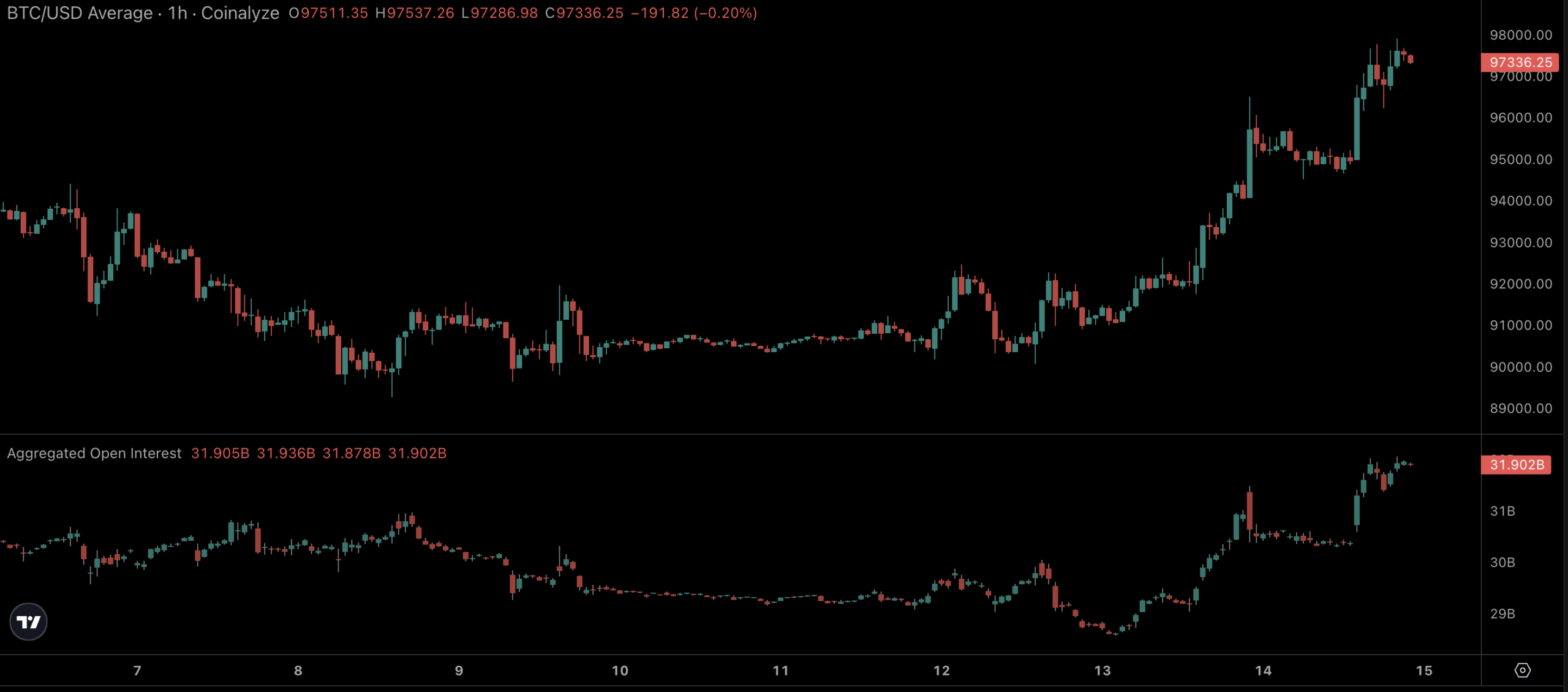
According to market data, open interest in Bitcoin options is heavily concentrated around the $100,000 strike price for contracts expiring later in January. Traders have placed large bets that $100K will be reached by the end of the month.
Open interests on Bitcoin. | Credit: Coinalyze
This concentration creates a natural liquidity magnet: as price approaches a heavily held strike, market makers and dealers who sold these options adjust their hedges (via buying or selling Bitcoin) to remain neutral, leading to what traders call gamma dynamics and hedging flows.
In simpler terms:
When large clusters of options exist at a price level (like $100,000), dealers hedge their exposure by trading spot Bitcoin.
This hedging activity increases mechanical buying or selling around those prices, which can either dampen moves or create resistance.
Some analysts, such as energy-sector managing partner David (@david_eng_mba on X), refer to these clusters as “gamma walls.”
The Math Behind the $100k Wall: The $574 Million Checkpoint.
Everyone is asking "Why haven't we broken $100k yet?"
It’s not a conspiracy. It’s mechanics.
We just ran the Escape Velocity Model (v3.1) on live data. Here is the cold, hard math of the resistance.
However, academic research has challenged the notion that gamma exposure alone meaningfully moves price:
Their analysis shows that Bitcoin gamma exposure is tiny relative to overall market activity – about 0.025% of daily options volume and an even smaller share of spot trading.
That is far below the level needed for hedging flows to meaningfully affect price, leading them to conclude that so-called “gamma walls” do not materially move Bitcoin prices on Deribit.
What does matter is that concentrated options positions often coincide with hedging behavior that suppresses volatility. This can keep price in a range even when sentiment is bullish, as hedging flows create mechanical supply or demand that offsets trader enthusiasm.
This explains why Bitcoin often gets “pinned” near key strike prices, not because someone is manipulating the market, but because of how market makers hedge massive derivatives exposure.
Barrier #2: Liquidity and Net Buying Pressure Required to Break Through
Supporters like analyst Michaël van de Poppe argue that ‘the bull market hasn’t died, it’s about to start.’
However, those expecting an imminent $100K breakout often point to sentiment, and sentiment alone rarely moves prices without capital actually changing hands.
A good example of how unreliable sentiment can be comes from long-term social media posts. In a widely shared forum thread from over a decade ago, a user predicted that Bitcoin would one day be worth $100,000 per coin. At the time, the reply was dismissive: “Keep dreaming.” Years later, it reflects that those who ignored the prediction missed life-changing gains, as Bitcoin ultimately did surpass $100,000 in October 2025.
An user said in 2014 that Bitcoin would have reached $100,000 in 2025. | Credit: Tyo’s X profile
For Bitcoin price to decisively push above $100,000, there must be enough net buying pressure to absorb any supply at that price and beyond. Liquidity indicators (like cumulative volume delta, which tracks the net difference between aggressive buys and sells) suggest very high levels of buying would be required to clear resistance. Estimates in some analytical models put this around hundreds of millions of dollars in tight buying pressure.
Why so much?
Large institutional participants (such as funds, ETFs, whales, and market makers) often place large sell orders near big round numbers like $100,000.
Smaller retail buying near strong resistance levels can be overwhelmed by these larger orders until significant capital flows in from outside (e.g., ETF inflows).
For example, during Bitcoin’s rally in early 2024, significant sell-side liquidity was visible around the $40,000–$42,000 range. That breakout became more convincing when spot Bitcoin ETF flows surged, with several days seeing $200 million to $300 million in net inflows across products like BlackRock’s IBIT and Fidelity’s FBTC, among others.
These sustained inflows helped absorb resting large limit orders and dealer hedges at key resistances, allowing the price to push higher.
In other words, Bitcoin isn’t struggling because it cannot go higher; it’s because the market needs fresh, significant capital to overcome existing supply, and that takes time.
Liquidity isn’t a switch you flip; it builds. This perspective aligns with how professional traders view resistance: it’s not a mystical barrier, it’s depth of supply vs. depth of demand.
Barrier #3: Probability and Timing — Breakouts Take Time
Even if Bitcoin price dangles near a major resistance like $100,000, the chance of breaking through in a short timeframe (like 24 hours) is low.
Predictive models that incorporate liquidity, volatility, and flow estimates suggest the odds of creating enough buying pressure for a breakout vary dramatically with time:
In the next 24 hours, the probability is extremely low (just a few percent).
Over a horizon of several days, probabilities rise.
Over the course of weeks or a month, the odds become significantly stronger.
Such models and market-implied probabilities now show that the odds of Bitcoin breaking through $100,000 are not fixed, but vary dramatically as time and conditions change.
Additionally, prediction markets provide a live, money-weighted view of breakout probability. On Polymarket, traders are currently assigning near-certainty that Bitcoin will remain above $80K–$90K by January 17, with probabilities ranging from 99% to 100%. However, confidence drops as the price threshold rises: the probability of being above $92K falls to 96%, and above $94K drops further to 87% within the same short time window.
Expectations on Bitcoin on Jan. 17. | Credit: Polymarket
This illustrates how markets price gradual continuation as highly likely, while assigning lower probability to rapid, vertical moves.
In other words, traders are confident Bitcoin will stay strong, but far less confident that it will generate the sudden surge in buying pressure required to clear major resistance levels like $100K in the immediate term.
So even when a breakout eventually occurs, predicting the exact day is nearly impossible without examining actual order flow data in real-time.
Also, remember that prediction markets are not perfect forecasts, but they reflect where traders are willing to risk capital, making them a useful proxy for short-term expectations rather than social-media optimism.
Operational Mechanics That Often Mask Breakouts
Let’s unpack some of the market mechanics that make Bitcoin appear stuck even when forces seem aligned for a breakout:
Hedging flow suppression: When options expiries are near, especially large ones, dealers adjust hedges by trading spot Bitcoin in ways that suppress volatility. This can keep prices stuck within ranges like $85K–$95K for longer than expected. Such behavior has been observed in recent months with heavy derivatives expiries.
Max pain dynamics: Some traders use the Max Pain Theory, which proposes that price tends to gravitate toward the strike price where the most options expire worthless. This model is not a rule, but it often coincides with short-term price compression before expiration.
Institutional flow timing: Institutional capital, such as allocations from ETFs, dedicated funds, and custody flows, tends to arrive in waves, not constant streams. That means even when sentiment is bullish, actual execution timing matters. A fund buying $200 million in Bitcoin over a week can have a very different impact than $200M over a single hour.
Why Some Bitcoin Price Predictions Miss Timing (Even If Directionally Right)
Bold forecasts, like a 24-hour $100,000 call, capture attention, but they often mix directional bias with concrete structural signals.
Here’s why such Bitcoin price predictions can be misleading:
Intelligence Isn’t Financial Foreknowledge
A high IQ doesn’t guarantee accurate short-term pricing predictions. Markets are complex adaptive systems where liquidity, psychology, and institutional behavior matter more than individual conviction.
Derivatives Expiry Distorts Short-Term Readings
Large options expiries can distort price action in the days before and after. This can delay breakouts even when the trend is ultimately bullish.
Short Timeframes Have Higher Risk of Noise
Over a 24-hour window, random volatility and liquidity swings can overshadow directional trends. Predicting longer moves (over weeks or months) is generally more feasible than pinpointing exact days.
Key Catalysts That Could Push Bitcoin Price Past the $100K Barrier
While the three barriers above explain current resistance, there are scenarios that could accelerate a breakout:
Heavy institutional inflows: If ETFs, hedge funds, or sovereign allocations pour capital into Bitcoin, supply at $100K could be absorbed quickly. Recent on-chain ETF flow data highlights how swiftly this can happen. On January 13, spot Bitcoin ETFs collectively recorded over $750 million in net inflows in a single session, led by strong contributions from major issuers such as Fidelity, Bitwise, BlackRock, and ARK. This marked the strongest day of ETF demand in more than three months, signaling that institutional appetite can return suddenly and at scale.
Major macro shifts: Changes in interest rates, inflation expectations, or regulatory clarity could drastically increase risk appetite and capital flows into crypto. One of the most closely watched macro events around January 15 was the scheduled Senate Banking Committee markup of the Digital Asset Market CLARITY Act, a proposed U.S. law aimed at establishing clear federal rules for cryptocurrencies and how they are regulated. Many traders and institutional participants viewed potential movement on the CLARITY Act as a catalyst that could boost confidence and attract larger capital flows into digital assets by reducing regulatory risk and clarifying compliance expectations.
Options expiry removals: After large expiries, gamma hedging pressures can dissipate, freeing price to move more on actual demand vs. supply rather than hedging flows. A clear example occurred after the late-December 2025 options expiry, when a heavy cluster of contracts around the $90K–$100K range rolled off. Once those positions no longer required active hedging, selling pressure eased and price began moving more freely based on actual spot demand, allowing momentum to build more naturally in the days that followed.
According to QCP Capital analysts, Bitcoin has been lagging behind the equity market and precious metal rally, but it has finally pushed through the $95k level that capped rallies since November.
“With potentially further fiat currency debasement in the U.S., which has been driving precious metals higher, the relative cheapness of Bitcoin relative to precious metals at this point may spur a rotation to digital assets,” analysts said.
“Risks remain, notably the pending Supreme Court decision on tariffs and further tensions’ escalation in Venezuela or Iran.”
“For now, the market continues to move higher in the face of these risks, which makes us believe this is already priced in. In the absence of a new unknown, any further escalations should be a buy-the-dip opportunity,” QCP analysts concluded.
Key Risks Bitcoin Investors Should Watch
ETF flow reversals: A slowdown or shift to net outflows could remove a major source of steady spot buying.
High leverage in futures markets: Elevated open interest increases the risk of liquidation-driven pullbacks.
Options expiry volatility: Large expiries near major strikes can suppress price or trigger sharp post-expiry swings.
Macro shocks: Unexpected inflation data, rate changes, or bond-market stress can spark risk-off selling across assets.
Regulatory headlines: Court rulings or policy shifts can quickly affect exchange access and institutional participation.
Profit-taking near $100K: Long-term holders may sell into round-number resistance, increasing short-term supply.
Bitcoin’s $100K Breakout Possible, But Not On a Stopwatch
Reaching $100,000 is far from implausible, and derivatives positioning suggests that many traders are betting on this outcome eventually.
However, structural barriers in the options market, liquidity demands, and the timing dynamics of capital flows mean that short-term predictive claims (such as 24 hours) are not grounded in how markets actually operate.
The market doesn’t react to conviction; it reacts to capital execution, depth of supply, and the mechanics of hedging and liquidity.
Understanding those forces is far more valuable than focusing on a single, time-bound price prediction.
Who is YoungHoon Kim and why did his prediction go viral?
YoungHoon Kim is an individual who has been identified online as having an exceptionally high IQ. His claim that Bitcoin would hit $100,000 within 24 hours spread quickly on crypto social media due to its boldness and the novelty of the source, not because it was backed by market data.
Why is $100,000 such a difficult level for Bitcoin to break?
$100,000 is a major psychological and structural resistance level. Large sell orders, heavy options positioning, and hedging activity tend to cluster around round numbers, creating deep supply that must be absorbed before price can move higher.
What are “gamma walls” and are they real?
“Gamma walls” refer to areas where concentrated options positions may influence hedging behavior. While academic research suggests gamma alone doesn’t directly move Bitcoin’s price, hedging flows tied to large options clusters can still dampen short-term price movement.
Sentiment does not move markets unless it is accompanied by actual capital deployment. Without sustained inflows from ETFs, funds, or large investors, retail buying is often insufficient to overcome structural resistance.
Disclaimer:
The information provided in this article is for informational purposes only. It is not intended to be, nor should it be construed as, financial advice. We do not make any warranties regarding the completeness, reliability, or accuracy of this information. All investments involve risk, and past performance does not guarantee future results. We recommend consulting a financial advisor before making any investment decisions.
Giuseppe Ciccomascolo began his career as an investigative journalist in Italy, where he contributed to both local and national newspapers, focusing on various financial sectors.
Upon relocating to London, he worked as an analyst for Fitch's CapitalStructure and later as a Senior Reporter for Alliance News. In 2017, Giuseppe transitioned to covering cryptocurrency-related news, producing documentaries and articles on Bitcoin and other emerging digital currencies. He also played a pivotal role in establishing the academy for a cryptocurrency exchange website. Crypto remained his primary area of interest throughout his tenure as a writer for ThirdFloor.
Max Moeller is a Chicago‑based writer and video editor passionate about games, tech, and crypto. Whether it’s crafting clear, insightful articles or piecing together engaging video retrospectives, he’s driven by curiosity and takes pride in keeping things human. Since 2017, Max has been published in a variety of notable crypto magazines.


 Easy
Easy