Key Takeaways
- Historically, strong Bitcoin rallies are often followed by capital flowing into altcoins.
- These coins can deliver outsized gains when narratives align but are also prone to liquidity issues, hype-driven crashes, and scams.
- Models like ChatGPT-5 can filter projects based on liquidity, dev activity, and narrative strength, but they cannot predict markets or eliminate human due diligence.
- Many shortlisted tokens fit into current hot sectors like L2 infrastructure, meme-utility hybrids, and DeFi tools.
The crypto market may be on the verge of a major shift. With Ethereum inching closer to a potential all-time high and Bitcoin dominance showing signs of softening, traders and analysts alike are whispering one word: altseason.
But unlike the hype-driven frenzies of the past, today’s tools are sharper. AI-powered market models, such as ChatGPT-5, are now being used to scan the blockchain landscape for promising projects, especially in the low-cap altcoin sector, where volatility meets opportunity.
What Is Altseason And Why Low-Caps Matter
Altseason refers to a market period when altcoins (cryptocurrencies other than Bitcoin) significantly outperform BTC. Historically, altseasons tend to follow periods of strong Bitcoin rallies, as capital flows from BTC into higher-risk, higher-reward projects.
Low-cap coins, projects with relatively small market capitalizations, are often the most reactive during altseason.
This is because:
- They require less capital to move prices.
- They often operate in emerging sectors (AI, DeFi, GameFi, L1/L2 solutions).
- They attract speculative interest faster when market sentiment flips bullish.
Of course, the same volatility that can generate explosive gains also increases the risk of heavy losses, making research and risk management essential.
How ChatGPT-5 Screened for Low-Cap Altcoins
The below detailed prompt was used to fetch a list of 7 low-cap altcoins to watch in the rest of August 2025:
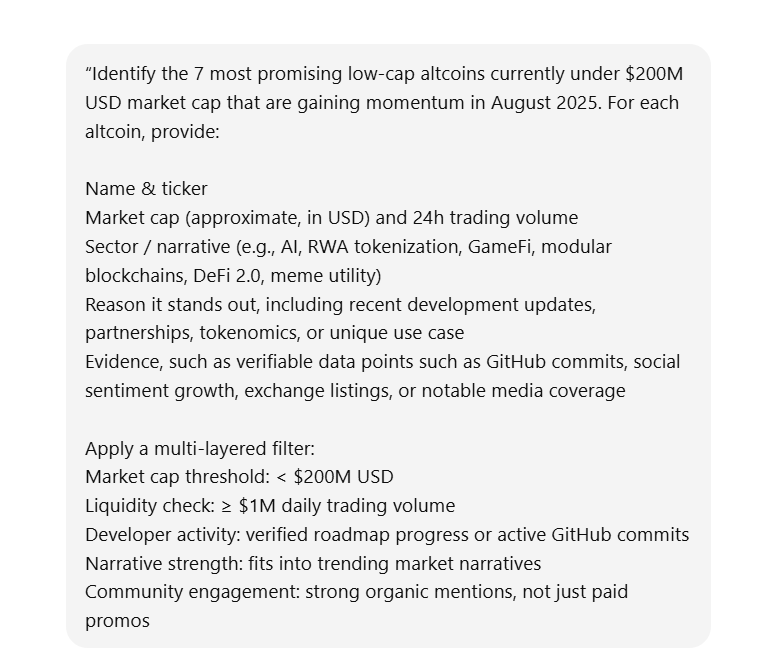
“Identify the 7 most promising low-cap altcoins currently under $200M USD market cap that are gaining momentum in August 2025. For each altcoin, provide:
- Name & ticker
- Market cap (approximate, in USD) and 24h trading volume
- Sector / narrative (e.g., AI, RWA tokenization, GameFi, modular blockchains, DeFi 2.0, meme utility)
- Reason it stands out, including recent development updates, partnerships, tokenomics, or unique use case
- Evidence, such as verifiable data points such as GitHub commits, social sentiment growth, exchange listings, or notable media coverage
Apply a multi-layered filter:
- Market cap threshold: < $200M USD
- Liquidity check: ≥ $1M daily trading volume
- Developer activity: verified roadmap progress or active GitHub commits
- Narrative strength: fits into trending market narratives
- Community engagement: strong organic mentions, not just paid promos
Present findings clearly, avoiding speculative price predictions and financial advice.”
7 Low-Cap Altcoins ChatGPT-5 Says to Watch
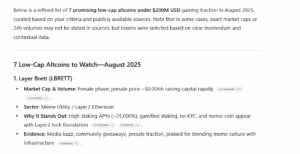
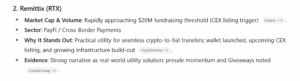
Based on the above prompt, ChatGPT-5 gave the below list of 7 low-cap altcoins to watch:
| Coin (Ticker) |
Sector |
Key Feature |
| Layer Brett (LBRETT) |
Meme / L2 ETH |
Meme meets infrastructure + high staking APY |
| Remittix (RTX) |
PayFi / Utility |
Real-world cross-border crypto-fiat flow |
| Little Pepe (LILPEPE) |
Meme / L2 Infra |
Meme culture meets Layer 2 performance |
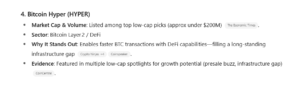
| Bitcoin Hyper (HYPER) |
BTC Layer 2 / DeFi |
Fast BTC + DeFi functions |
| TOKEN6900 (T6900) |
Meme / Presale |
Trend momentum in presale segment |
| Snorter Bot (SNORT) |
Trading Bot Utility |
Telegram DeFi tool + ease-of-use |
| Best Wallet (BEST) |
Wallet UX / Infrastructure |
Simplifying crypto for users |




How to Track Altseason Safely
If you’re following altseason trends, consider:
- Portfolio diversification: Avoid overloading on a single narrative.
- Set alerts: Use apps like CoinGecko or TradingView to monitor breakouts.
- Follow dev updates: The fastest way to detect fundamental changes.
- Secure storage: For long-term holds, move tokens off exchanges into reputable wallets.
Risks Involved in Low-Cap Crypto Trading and Using AI Tools
While low-cap altcoins can deliver outsized gains during strong market cycles, they also come with heightened risks. Adding AI-driven tools like ChatGPT-5 or Grok into the mix brings its own set of considerations.
Here’s what you need to know before diving in.
1. General Risks with Low-Cap Altcoins
-
- High volatility: Prices can swing 20–50% in a single day, especially when liquidity is low. Sharp moves may be triggered by a single large trade or a sudden shift in market sentiment.
- Liquidity traps: Even if a token shows significant percentage gains, exiting a position at your desired price can be challenging without causing slippage, particularly in low-volume markets.
- Rug pulls and scams: Some low-cap projects disappear overnight, with developers draining liquidity pools or abandoning their roadmaps. Always verify team credibility and look for independent smart contract audits.
- Regulatory uncertainty: Certain tokens may be classified as unregistered securities in specific jurisdictions, which could result in exchange delistings or legal action.
- Hype cycles: Many low-cap tokens rally purely on narrative, without underlying fundamentals. Once the hype fades, prices can decline sharply.
2. Risks of Using AI for Crypto Research and Trading
- Data limitations: AI tools like ChatGPT-5 and Grok rely on historical data and publicly available information. They cannot predict future events and may miss private or rapidly evolving market developments.
- Hallucination risk: AI models can produce confident but inaccurate statements, especially when data is sparse or based on unverified sources.
- Limited context on microcaps: Many small-cap coins have minimal documentation. AI models may draw conclusions from promotional content or incomplete data, potentially skewing analysis.
- Overemphasis on current narratives: AI can overweight trending sectors, such as AI tokens or GameFi, without accounting for long-term sustainability or market saturation risks.
- No real-time execution capability: AI models do not directly trade or adapt instantly to fast-moving market conditions. They are decision-support tools, not automated trading bots.
- Overreliance by users: Treating AI outputs as definitive investment advice instead of research support can lead to poor decision-making.
3. Best Practices to Reduce Risk
- Verify all findings through independent sources such as blockchain explorers, GitHub repositories, and third-party security audits.
- Start with small positions that you can afford to lose while testing strategies or exploring new tokens.
- Diversify across sectors and market caps to reduce single-asset risk.
- Stay informed by monitoring official project channels and reputable news outlets.
- Use AI as a research filter but make final investment decisions based on your own due diligence.
Conclusion
Whether the next altseason starts tomorrow or months from now, preparation beats prediction. By using advanced tools like ChatGPT-5 to scan the market, investors can build an informed watchlist, ready to act when momentum shifts.
Low-cap altcoins can offer high potential, but they also carry higher risk. The key is to treat this list as a research starting point, not a buy list. In crypto, informed patience often outperforms impulse.
FAQs
Generally, projects under a $200M market cap fall into the low-cap category.
There’s no fixed date. It often follows periods of strong Bitcoin performance, but macroeconomic and regulatory factors also play a role.
AI can process large amounts of market, on-chain, and social data quickly—helping surface projects worth investigating further.
No. AI tools such as ChatGPT-5 can help identify projects that fit certain filters—like market cap, liquidity, and community activity—but they cannot forecast price movements or guarantee profitability. They should be used as a starting point for your own research, not as definitive investment instructions.
The information provided in this article is for informational purposes only. It is not intended to be, nor should it be construed as, financial advice. We do not make any warranties regarding the completeness, reliability, or accuracy of this information. All investments involve risk, and past performance does not guarantee future results. We recommend consulting a financial advisor before making any investment decisions.

Giuseppe Ciccomascolo began his career as an investigative journalist in Italy, where he contributed to both local and national newspapers, focusing on various financial sectors.
Upon relocating to London, he worked as an analyst for Fitch's CapitalStructure and later as a Senior Reporter for Alliance News. In 2017, Giuseppe transitioned to covering cryptocurrency-related news, producing documentaries and articles on Bitcoin and other emerging digital currencies. He also played a pivotal role in establishing the academy for a cryptocurrency exchange website. Crypto remained his primary area of interest throughout his tenure as a writer for ThirdFloor.


 Easy
Easy