Key Takeaways
- Philip Bruno says banks can no longer ignore stablecoins as payment volumes accelerate.
- Confirmed enterprise demand, not regulation alone, is driving stablecoin adoption.
- AI agents, tokenized deposits, and instant payments will reshape banking by 2030.
- Bruno expects wholesale CBDCs to gain traction before retail digital currencies.
Global stablecoin payment volume is running at a $122 billion annualized rate across real payment firms, according to research published by Artemis and Castle Island Ventures in October 2025, with B2B flows alone hitting $76 billion. That figure, drawn from transaction data across 33 stablecoin payment companies, excludes DeFi trading and exchange activity entirely. It counts only payments made on behalf of businesses and consumers settling genuine commercial obligations.
For an industry that spent most of the past decade treating stablecoins as a crypto-native curiosity, those numbers represent a reckoning. The question is no longer whether stablecoins move real money. It is whether the banks and payment processors that handle most of the world’s commercial flows have positioned themselves to handle it.
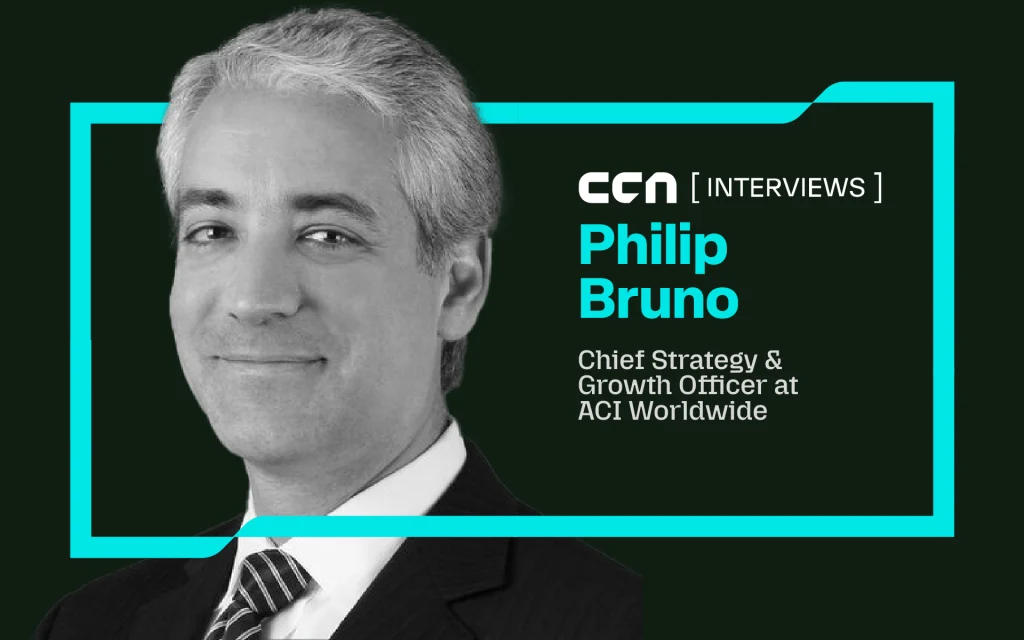
Philip Bruno has a direct answer to that question, and it is not a comfortable one for institutions still sitting on the sidelines. Bruno is chief strategy and growth officer at ACI Worldwide, a payments technology company whose infrastructure processes trillions of dollars annually across banks, processors and merchants in more than 90 markets.
ACI does not issue stablecoins, provide custody, or promote one issuer over another. It sits in the middle of the payments infrastructure, which is precisely why Bruno’s view of where the market is heading carries weight that a crypto-native advocate’s may not.
“It’s real now,” he told CCN during Payments Unleashed EMEA in London on June 30. “And if they’re not already working on it, they need to be.”
Stablecoin Payment Demand Is Becoming Too Large for Banks to Ignore
As noted earlier, stablecoin payments reached a $122 billion annualized rate by August 2025, including $76 billion in B2B transfers. Bruno says the market is larger still.
“I’ve seen numbers like that or even slightly higher for last year, as much as 300 to 400 billion. This year I see estimates that it could be close to $1 trillion.” At that scale, he said, “for global banks, you cannot ignore $1 trillion in flows.”
The question Bruno gets asked most often is not whether the volume is real but why so many traditional payment firms are still waiting. His answer is more nuanced than the compliance and cost arguments that dominate most industry conversations.
“I think they could get around any cost issue if they have a true business case,” he said. “What they’re looking for is confirmed demand. What did they see in their customers’ needs and wants and how did they solve those issues?”
On the consumer side, cross-border remittance is the clearest existing use case. On the commercial side, large corporations are already asking for stablecoin settlement, and that confirmed demand from sophisticated enterprise clients is what Bruno believes will pull more banks into the market. “With $300 or $400 billion already in 2025 of transactions,” he said, “that is confirmed demand.”
GENIUS Act Changes the Signal, Not Just the Rules
Bruno’s read on the GENIUS Act, signed into law in July 2025 with implementing regulations due by mid-2026, goes beyond the text of the legislation.
“The Genius Act is one piece of the puzzle because it provides more regulatory clarity,” he said. “But behind the Genius Act is now what I’ll call the stance of the administration, which is quite supportive, whereas the prior administration was quite negative and the signals coming out were quite negative.”
For an infrastructure provider like ACI, both the clarity and the stance matter. The company’s response is not to pick sides between stablecoins.
“We’re not promoting a given stablecoin. We’re not choosing between different stablecoins or options. We want our clients to be able to handle whatever they want to use, and so we will support that.”
In Bruno’s views, stablecoins are simply new payment types sitting alongside existing rails, and ACI’s core business is handling the complexity that comes with more payment types entering the ecosystem simultaneously.
Know Your Agents (KYA): Beyond Blocking Bots
The conversation around AI in payments has focused heavily on fraud detection and cost reduction. Bruno sees a more structurally significant shift coming on the merchant side, one that ACI is already building for.
“On the merchant side of our business, we are supporting agentic commerce,” he said. “Know your agent in addition to knowing your customer, knowing your business.”
Know Your Agents (KYA) as a compliance concept represents a genuine departure from how payments have always worked. The previous instinct when encountering non-human traffic, Bruno explained, was to block it.
“The old method was if it’s a bot, we want to block it. So the first thing is unblocking it so that the transaction can occur, even if it’s just shopping.” The more substantive layer is authorization: “Understanding the authorization rights that have been given to the agent on behalf of the customer. You need to know if that agent is authorized to make the transaction on behalf of the consumer or the business.”
Bruno went further, describing a shift in the nature of B2B commerce itself that most payments discussions are not yet contemplating. Rather than agents going out to find the best price across suppliers, he expects the model to flip toward reverse procurement.
“The buyer’s bot will come out and say, I’m a small home builder and I’m looking to build a house and I need 20,000 board feet of lumber. Instead of going out and checking different lumber yards, I can say here’s the specs, please bid on this for me.”
What that creates is not price discovery but something closer to an automated RFP process, with financing, settlement and payment infrastructure all embedded in the same transaction flow.
“We could work with banks who say they want to help the buyer bots be able to support those RFPs. They need to incorporate things like financing to be able to make that purchase, and it can all be included in that.”
Consumers Want AI Help, They Do Not Want AI Control
The trust question Bruno raised around KYA and agentic commerce is not abstract. ACI’s YouGov survey of more than 2,000 UK adults in June 2026 that puts precise numbers on the gap between consumer openness to AI shopping tools and their willingness to let those tools act autonomously with their money.
50% of respondents said they trust AI to find the best price. 43% trust it to follow spending limits they have set. But only 18% trust AI to act in their best financial interest, only 17% trust it to keep personal and payment data secure, and just 15% trust it to handle problems when something goes wrong. Seven in ten said purchases made without asking would affect their willingness to use an AI shopping agent at all. Six in ten said they would stop using one after a single mistake.
“The findings clearly show that consumers are open to AI helping them shop smarter, but only if they remain firmly in control of both the decision-making and their money,” said Adriana Iordan, head of merchant and payments intelligence at ACI Worldwide. “They’re telling us very clearly that they won’t hand control of their finances to an autonomous agent without safeguards. This isn’t a capability gap. It’s a trust and confidence gap.”
The accountability question the survey surfaces is the one that payments infrastructure has not yet resolved. 54% of UK consumers said the technology or AI company that built the agent should be responsible for refunds when something goes wrong.
Just 9% blamed the retailer and only 3% pointed to banks or card issuers. 59% said they would not trust any organization to manage AI-powered shopping and payments at all, with banks chosen by only 20% and technology companies by just 4%.
MiCA’s Trade-Off: Protection Versus Competition
Speaking on June 30, the day before MiCA’s transitional period ended, Bruno offered a measured assessment of what the mass failure of VASP authorizations means for the European payments landscape. Of the 1,200-plus firms that held pre-MiCA national registrations, fewer than 250 obtained full crypto-asset service provider authorization.
“With that high rate of failure, one of the negative issues is that it restrains competition and restrains the number of providers,” he said. “On the other side, when you have set standards that are there to protect players in the marketplace, it actually reduces points of failure.”
Bruno acknowledged the tension directly.
“There’s always a balance between setting the standard to protect, but also still having sufficient competition to build the market. Sufficient competition drives innovation. You don’t want to lose that.” He also noted that heavy regulatory regimes consistently tilt markets toward larger institutions. “It tends to restrict the play for smaller players, for smaller financial institutions, because they don’t have the capacity to support compliance the way larger institutions do.”
CBDCs Have a Wholesale Future, Not a Retail One
Bruno’s take on central bank digital currencies aligns with the direction several major central banks have quietly moved toward, even as their public communications have remained cautious.
“CBDCs were really proof of concepts as they came out in many cases, which doesn’t lend itself to adoption and solving real-world issues,” he said. Stablecoins, backed by private capital and competitive incentives, have moved faster. “Stablecoins in some ways right now has taken the attention away from CBDCs, and that’s where we’re seeing all of the adoption, with a lot of private money and investment to drive the use cases.”
Where he does see CBDCs eventually finding traction is on the commercial side rather than retail.
“Consumers in general have pretty good payment options for what they need to use for,” he said. “But on the commercial side, being able to settle in central bank money on a CBDC matters more to some of the commercial users because of large value transactions and the risk associated with what’s behind it.” Whether regulatory mandate rather than market demand ends up driving CBDC adoption is the variable Bruno watches most closely. “If there’s any type of mandated usage, that certainly can help drive adoption.”
Three Horses to 2030
Extended to a five-year horizon, Bruno’s view of the payments landscape organizes around what he calls a three-horse race.
“One is stablecoins, the other is tokenized deposits, and the third, which we haven’t talked about yet, is actually instant payments and the ability to have cross-border interoperability of instant payments.”
He pointed to what India, Singapore and Thailand have built with bilateral instant payment interoperability as the model that others will follow, with stablecoin competition pushing traditional instant payment networks to accelerate their own cross-border capabilities.
“I think those are the three different things that we’re going to see more innovation going on, and it’s going to be by use cases as to what is going to be more preferable in different situations between stablecoin, tokenized deposits, and instant,” he said. “Because of each other, it’s driving faster innovation in each one as a result, because they’re different players trying to push each one and therefore it’s driving innovation in all three.”
For the ACI survey’s 59% of UK consumers who said they would not trust any organization to manage AI-powered shopping and payments, Bruno’s three-horse race implies a further layer of work beyond rails and regulation. The settlement infrastructure is being built. The authorization frameworks are taking shape.
What the consumer data makes clear is that the trust infrastructure, the layer that determines whether ordinary people actually hand spending authority to the agents running on top of all of it, remains the hardest problem in the room, and the one that no amount of regulatory clarity or payment volume data can solve on its own.
Top Trending Crypto Articles
The information provided in this article is for informational purposes only. It is not intended to be, nor should it be construed as, financial advice. We do not make any warranties regarding the completeness, reliability, or accuracy of this information. All investments involve risk, and past performance does not guarantee future results. We recommend consulting a financial advisor before making any investment decisions.

Dr. Guneet Kaur is a senior editor at CCN.com and a Science Fellow at Exponential Science. She is a fintech and blockchain expert with extensive experience in digital finance education, blockchain ecosystems, and cryptocurrency markets. She has worked with global media such as Cointelegraph, as well as education and blockchain platforms, to design and lead strategic content and learning initiatives. As an educator and assessor for top-tier executive programs, she bridges real-world fintech trends with academic insight.
Dr. Kaur is also a published researcher and peer reviewer across fintech and data science journals, including Financial Innovation Journal and International Journal of Big Data Intelligence and Applications. Her work spans data-driven analysis, Web3 innovation, and technical content development. With a strong foundation in both industry and academia, she translates complex financial technologies into practical applications, empowering learners, professionals, and institutions across the rapidly evolving digital finance landscape.


 Easy
Easy