DeFi Aggregators vs. Traditional Exchanges: Where the Risk Really Lies
Share
Key Takeaways
DeFi aggregators are quietly outperforming the broader sector by capturing more real trading flow and yield, even as most DeFi tokens remain far below their 2021 peaks.
Platforms like 1inch and ParaSwap are seeing sharp short-term rallies and rising volumes, making aggregator tokens attractive for active traders.
Yield platforms such as Yearn Finance are turning market volatility into steady fee and yield streams as users and DAOs increasingly outsource their strategies.
But this growing reliance on aggregators also concentrates risk, since every added integration expands the attack surface and makes careful platform selection essential.
Decentralized finance (DeFi) aggregators don’t move markets the way Bitcoin or Etheruem do, but lately, the numbers say these platforms have been quietly outperforming big parts of the crypto market on a few key fronts.
Amongst the overall DeFi struggle of 2025, with CF Benchmarks DeFi Composite Index denoting a -5.7% year-to-date performance as of mid-September 2025, decentralized exchange (DEX) and yield aggregation platforms like ParaSwap and 1inch, among others, have shown strong token performance, faster user and volume growth, and more consistent yield than many of its competitors.
Here’s how these tools have been quietly beating the market, alongside the risks you shouldn’t ignore if you choose to get involved.
New Trending Crypto Wallet Offers
Sponsored
Disclosure
We sometimes use affiliate links in our content, when clicking on those we might receive a commission at no extra cost to you. By using this website you agree to our terms and conditions and privacy policy.
At a high level, DeFi aggregators are kind of like intermediaries, of which there are two major types:
DEX aggregators: DEX aggregators (1inch, ParaSwap) filter your swap through dozens of decentralized exchanges to search for the best price, even factoring in MEV and gas optimizations.
Essentially, these aggregators don’t replace DeFi, they sit on top of it, routing your trades and deposits across the rest of the layer-2 ecosystem.
Here’s how.
Why Aggregator Tokens Show Stronger Short-Term Performance Despite Long-Term Losses
Most DeFi tokens look battered on long-term charts. Many governance tokens remain 70-90% below their 2021 peaks, and that includes aggregator-powered cryptocurrencies. But in the shorter time frame where traders actually operate, some aggregators have been leading rebounds.
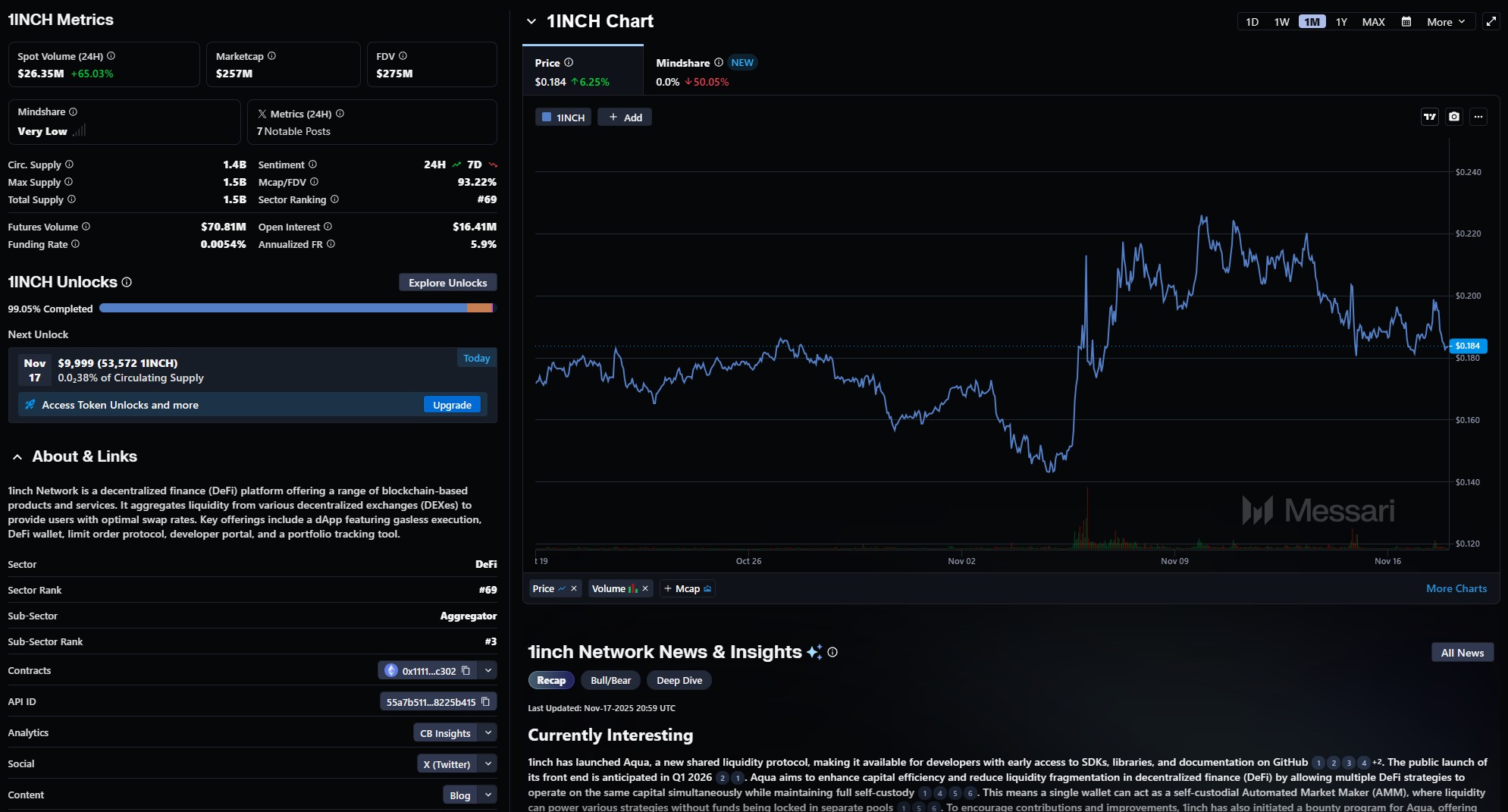
Market reports in November 2025 noted 1inch as one of the standout token movers during altcoin rallies, with single-day gains higher than 65% at times.
Source: Messari
That mix of slower long-term charts amongst violent upward swings in the short-term, makes aggregator tokens high-volume plays when it comes to short-term trades. For traders who care about relative performance rather than hitting new all-time highs, these profits are a form of “beating the market” that doesn’t always show up in headlines.
Aggregator Growth Shows Users and Volume Are Driving the Story
The more important story isn’t so much price action, it’s user activity, or flow.
Messari’s State of 1inch Q2 2025 report notes that over just three months, people traded about $28.6 billion worth of crypto through 1inch alone, double its previous quarter. This volume raised its share for DEXs on EVM chains from 32.5% to 59.1%. Essentially, 1inch facilitated over half of the volume on Ethereum-style networks. A separate summary shows that the network’s daily average volume rose to roughly $848.2 million.
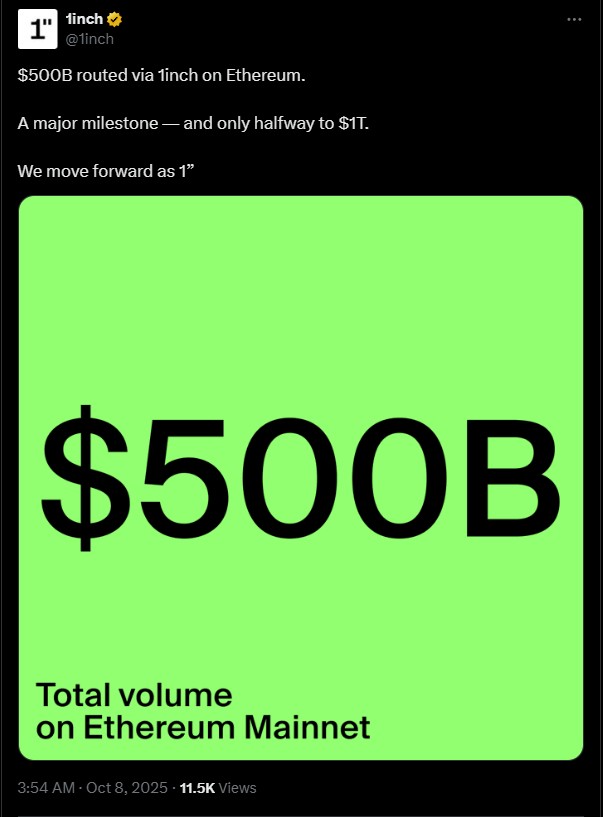
User growth is the same story. 1inch’s quarterly information shows hundreds of thousands of monthly active addresses, while competing aggregators fell behind. In October 2025, 1inch announced $500 billion in lifetime trading volume routed on Ethereum alone since 2019.
1inch recently rebranded from a DEX aggregator to a more unified DeFi solution with Aqua, a shared liquidity model that lets DeFi projects share one big pool of 1inch-provided funds to help with initial funding, rather than each building their own. This allows more trades and trading strategies all running through the 1inch system. But they’re not alone.
Source: @1inch on X
Other protocols like ParaSwap have also grown. ParaSwap managed about $12 billion in volume in Q3 2025, and has passed $100 billion in historical volume, according to CoinMarketCap’s AI summary on the project.
On the yield side of DeFi, Yearn Finance shows how much flow is going into aggregators for passive income, not just trading. Yearn’s own docs describe its Vaults as “crypto savings accounts in cyberspace,” where you deposit tokens and smart contracts move them across DeFi to earn yield for you.
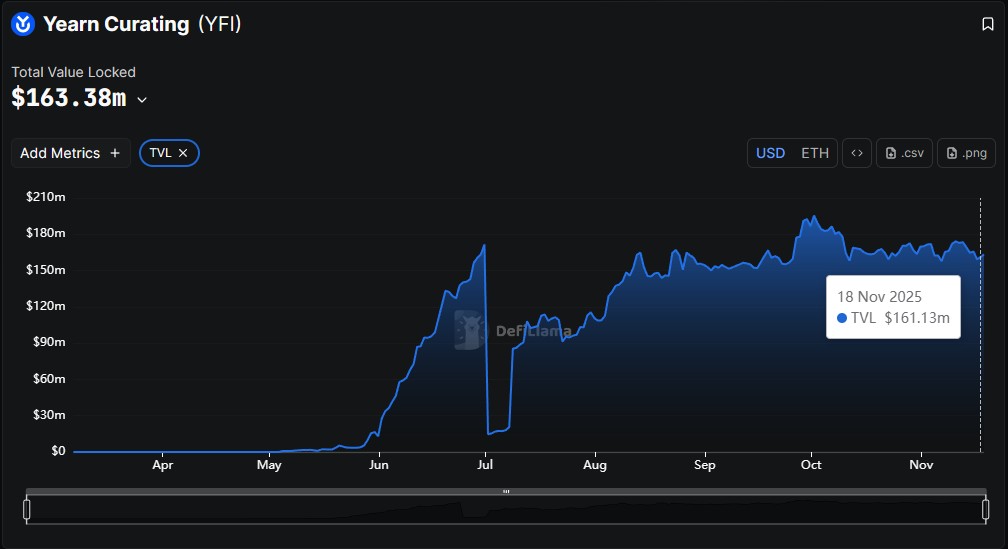
Data from DeFiLlama shows that vaults curated by Yearn hold around $160 million in total value locked (TVL) as of late 2025. Those vaults generate more than $2 million in annualized fees for the system. Even after the 2022-2023 bear market, the steady TVL and fee stream suggest that many users and decentralized autonomous organizations (DAOs) still trust Yearn to handle their yield strategies. Instead of chasing farms on their own, users are sending deposits into Yearn and letting the aggregator do the work.
Source: DeFiLlama
Risks That DeFi Aggregator Users Should Consider
Of course, the more power that aggregators have, the more risk surfaces.
CCN’s piece on the risks of DeFi aggregators compares these platforms to the likes of robo-advisors, and warns that “while DeFi yield aggregators composability unlocks efficiency, it also multiplies potential attack surfaces, making every integration a potential risk.”
Basically, every new lending app, yield farm, or bridge that an aggregator connects to is one more way things can break:
If just one of those pools gets hacked or fails, that trouble can spread to the vaults and aggregators that sent money to it.
And even if the aggregator’s own code is safe, the rules of a connected project can change overnight, suddenly making things riskier for aggregator users who thought they were just earning steady interest.
This is why it’s important to stick to the basics. Only utilize audited aggregators, start with small deposits, diversify platforms, and don’t chase APYs that look too good to be true.
How Aggregators Are Reshaping DeFi Heading Into 2026
Put all of this information together, and you get a pretty clear picture:
General DeFi indexes are still lagging behind the bigger crypto market, but more and more real trading is going through aggregators, not single DEXs.
Aggregator tokens often spike harder than the rest of DeFi.
Yield aggregators turn market ups and downs into income, helping some users earn steady returns, even if the market is rough.
The biggest players, such as 1inch, are working on shared liquidity and cross-chain tools.
If you’re trading or farming in 2026, it’s not enough to ask “which DEX or pool should I use?” The better question is: which aggregator is routing my trade, and how much of the market does it already control?
Whether prices show it or not, that’s where a lot of DeFi’s real power, alongside its risk, has quietly moved.
How does a DEX aggregator actually decide which route to use for my swap?
It scans many DEXs at once, compares prices, gas costs, and slippage, then picks the route (or mix of routes) that gives you the best effective final amount.
What fees do DeFi aggregators charge on top of normal DEX or protocol fees?
Usually, a small extra swap or performance fee, which is either taken from the trade itself or from the yield generated in a vault.
Is it safer to use a single trusted aggregator or to spread volume across several?
Spreading across a few reputable aggregators usually reduces risk, as you’re not fully exposed to a single codebase or integration set.
What are the main signs that an APY on a yield aggregator is too risky to trust?
Triple-digit yields with no clear source of revenue, vague docs, and no audits are all big red flags.
Disclaimer:
The information provided in this article is for informational purposes only. It is not intended to be, nor should it be construed as, financial advice. We do not make any warranties regarding the completeness, reliability, or accuracy of this information. All investments involve risk, and past performance does not guarantee future results. We recommend consulting a financial advisor before making any investment decisions.
Max Moeller is a Chicago‑based writer and video editor passionate about games, tech, and crypto. Whether it’s crafting clear, insightful articles or piecing together engaging video retrospectives, he’s driven by curiosity and takes pride in keeping things human. Since 2017, Max has been published in a variety of notable crypto magazines.


 Intermediate