Can ZEC survive the developer split? | Credit: Hameem Sarwar
Share
Key Takeaways
Several Zcash developers left after a leadership dispute.
The split introduces uncertainty and negatively impacts sentiment.
Positive funding rate amid the price drop suggests a further decline.
Zcash (ZEC) price has extended its seven-day decline to 10% as of this writing.
This comes after Josh Swihart, the CEO of Electric Coin Company (ECC), disclosed that some developers have split from Bootstrap, the nonprofit created to support the coin.
Amid the development, ZEC’s price failed to bounce back above $500 after falling below it a few days prior. Instead, the coin’s market value decreased again by 7% in the last 24 hours.
Here is why the Zcash developers left ECC, and how it could affect Zcash’s price.
Why Zcash Developers Left
Swihart, the former CEO of Electric Coin Co. (ECC), stated that the leadership dispute had reached a breaking point.
As a result, he stated that the entire ECC team left after ZCAM “constructively discharged” them.
In legal terms, constructive discharge is treated as a form of involuntary termination. It means the team was not formally fired.
Instead, Swihart argues the ZCAM team pushed them out with working conditions that became effectively intolerable.
After the departure, he said the former ECC staff have decided to form a new company, signaling they plan to keep building, but outside the current ZCAM/ECC structure.
“We’re founding a new company, but we’re still the same team with the same mission: building unstoppable private money. Importantly, the Zcash protocol is unaffected. This decision is simply about protecting our team’s work from malicious governance actions that have made it impossible to honor ECC’s original mission,” Swihart revealed.
Setup Remains Weak
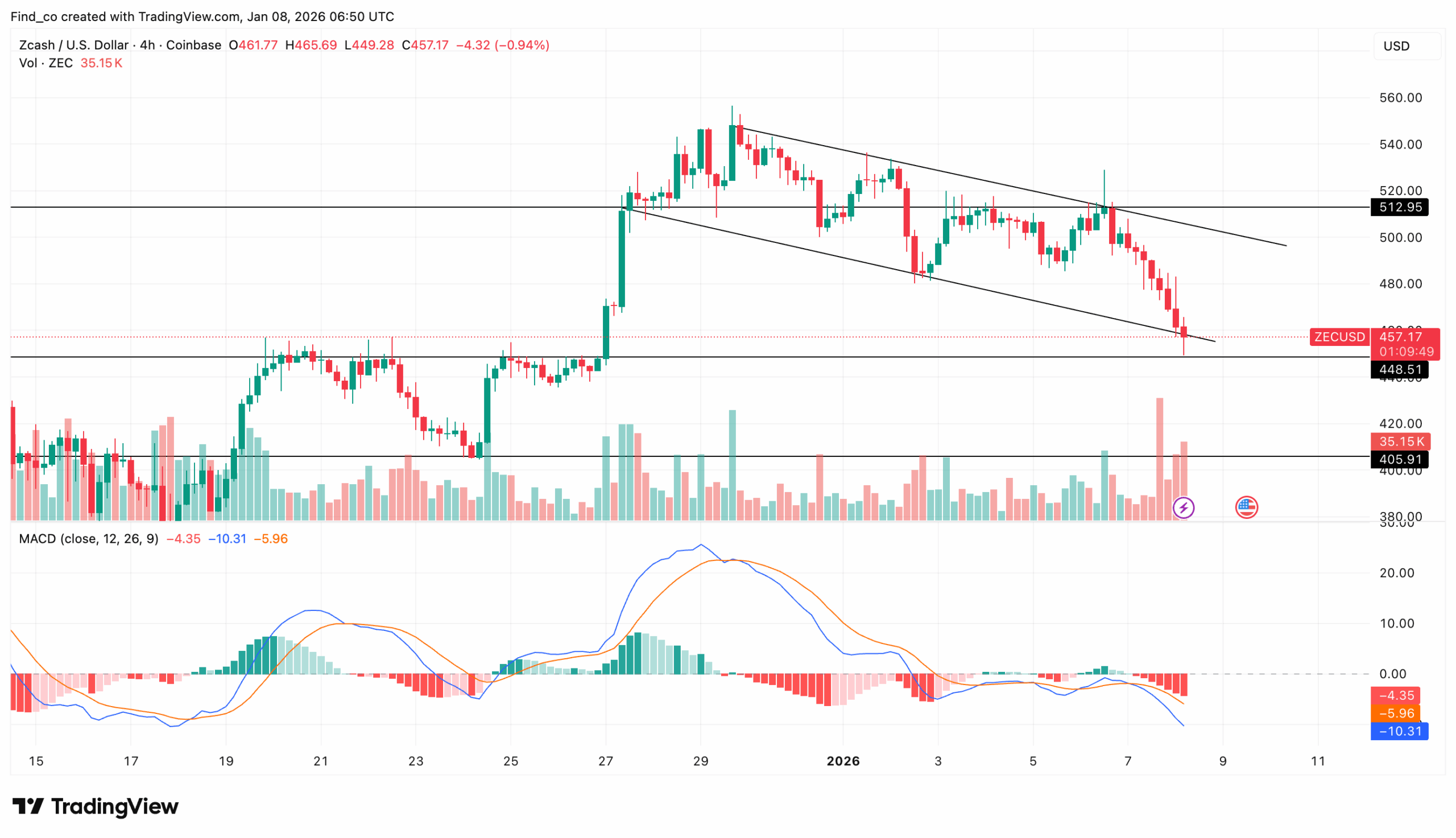
Amid the development, ZEC’s price remained trapped in a falling channel on the 4-hour chart. Besides that, the Moving Average Convergence Divergence (MACD) has formed a bearish crossover.
Due to that, the cryptocurrency is unlikely to rebound soon. Instead, Zcash will likely slide to the support near $448.51.
If bulls fail to defend this region, ZEC’s price may drop as low as $405.91, particularly with the overhead resistance at $512.95.
Outside the technical setup, the funding rate has flipped positive.
Since funding is positive while Zcash’s price is falling, it suggests traders are still leaning long despite the dip.
In other words, many are paying to maintain bullish positions, even as the spot price weakens.
That imbalance can signal confidence, but it can also raise risk. If ZEC’s price continues to slide, those crowded longs may unwind, and that can accelerate the downturn through long liquidations.
On the daily chart, ZEC’s price remains within an ascending channel. However, the price is now threatening to break below the lower trendline, which would weaken the bullish structure.
At the same time, ZEC is slipping toward another key risk zone. It is close to falling below the major Exponential Moving Averages, especially the 20 EMA (blue) and the 50 EMA (yellow).
If the price drops under those levels and fails to reclaim them, it signals that momentum has shifted from buyers to sellers.
If this weakness persists, ZEC’s price could fall below the $388.10 support level.
That break would likely open the door to a more profound decline toward $304.22, which becomes the next primary downside target.
Still, the trend can flip if demand returns. If buying pressure rises and Zcash holds the channel support while reclaiming the 20 EMA and 50 EMA, the move could turn into a false breakdown.
In that bullish scenario, ZEC could rebound and push toward $591.41.
Interestingly, Mert Mumtaz, the CEO of Helius, a prominent Solana ecosystem infrastructure company, also commented on the matter.
According to Mumtaz, a vocal Zcash supporter, the recent development could potentially drive ZEC’s price higher in the future.
“Extremely bullish zcash’s most competent (along with tachyon ofc), now unburdened by the crippling inefficiencies of foundation politics $10,000 the money is actually gonna be encrypted,” He opined.
Disclaimer:
The information provided in this article is for informational purposes only. It is not intended to be, nor should it be construed as, financial advice. We do not make any warranties regarding the completeness, reliability, or accuracy of this information. All investments involve risk, and past performance does not guarantee future results. We recommend consulting a financial advisor before making any investment decisions.
Victor Olanrewaju is a crypto analyst and reporter at CCN with deep roots in on-chain research and technical analysis. His crypto journey began in 2017, but it was the 2020 Uniswap airdrop that sparked a full-time pivot into the space.
With a foundation in copywriting, Victor honed his craft creating high-converting content for leading crypto brokers — most notably an XRP price prediction that ranked #1 on Google during the 2021 bull run.
He later joined AMBCrypto in 2022, where he combined storytelling with technical and on-chain analysis to cover key market narratives.
In 2024, he expanded his expertise at BeInCrypto, collaborating with analysts and using tools like Glassnode, Santiment, and IntoTheBlock to break down Bitcoin and altcoin trends.
At CCN, Victor covers the top cryptocurrencies, memecoins, macro shifts, blending real-time insights with deep-dive metrics.
He holds a Bachelor’s degree in Physics from the University of Ibadan, equipping him to simplify complex data for a wide audience. Follow his work or connect on LinkedIn or X.