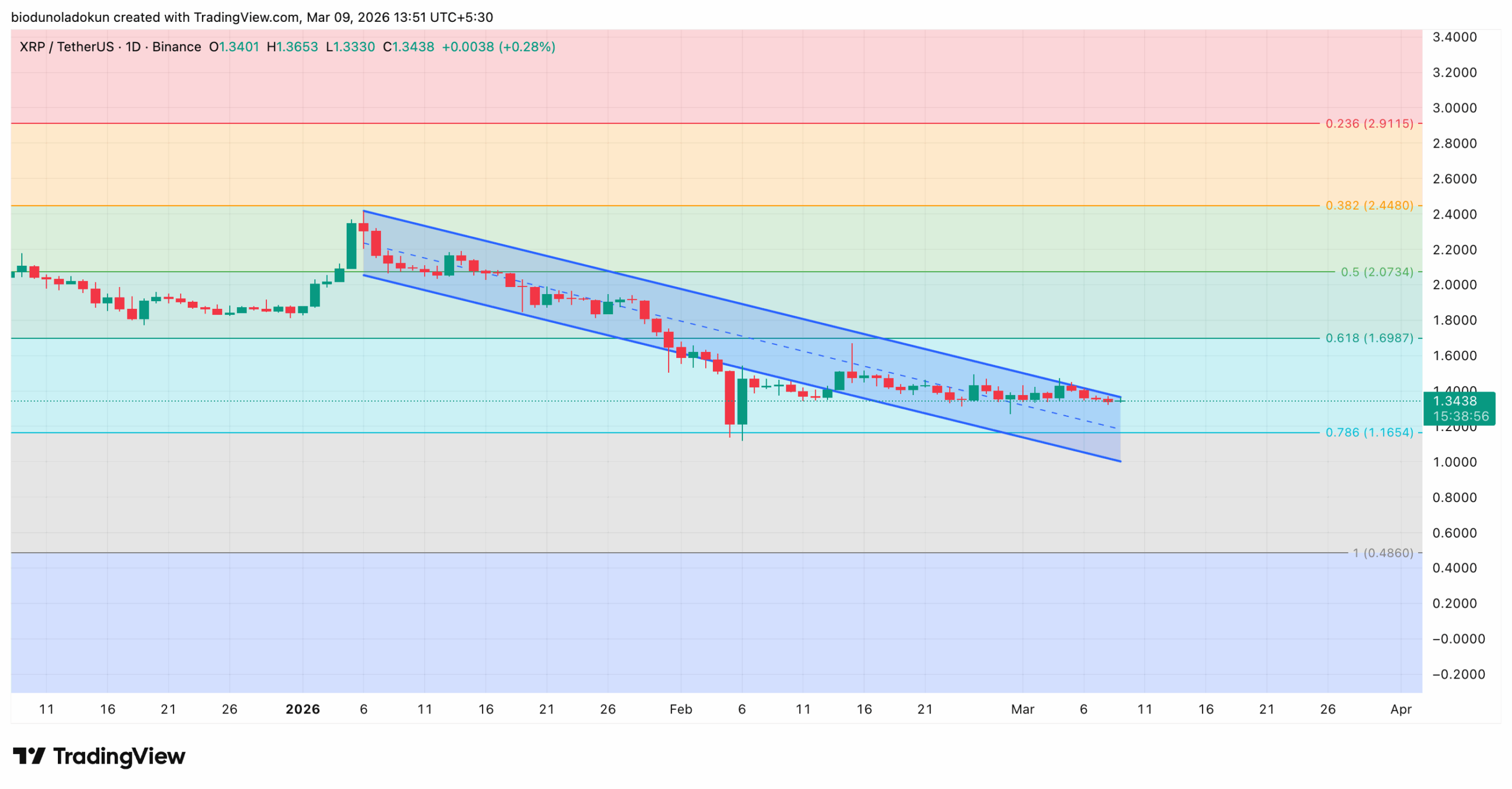
XRP has shed 45% since its January 6 high of $2.41 and is trading within a descending parallel channel.
XRP spot ETFs posted net outflows for the week ending March 6, signalling that institutional investors are reducing exposure.
XRP’s STH-NUPL has hit a seven-day low of -0.52, indicating short-term holder capitulation that could either accelerate the decline or mark a market bottom.
Ripple’s XRP is opening the new week under pressure, and the data suggests the pain may be far from over.
Since hitting a year-to-date high of $2.41 on January 6, the token has trended within a parallel descending channel, shedding 45% of its value.
With macro headwinds, institutional outflows, and deteriorating on-chain sentiment, the prospect of a slide to a 17-month low is now on the table.
XRP Feels the Heat as Risk-Off Sentiment Sweeps Markets
US-Israel attacks on Iran’s energy infrastructure, and the retaliatory strikes from Tehran that followed over the weekend, have triggered a fresh wave of risk-off sentiment across financial markets, sending oil prices surging and equity values lower.
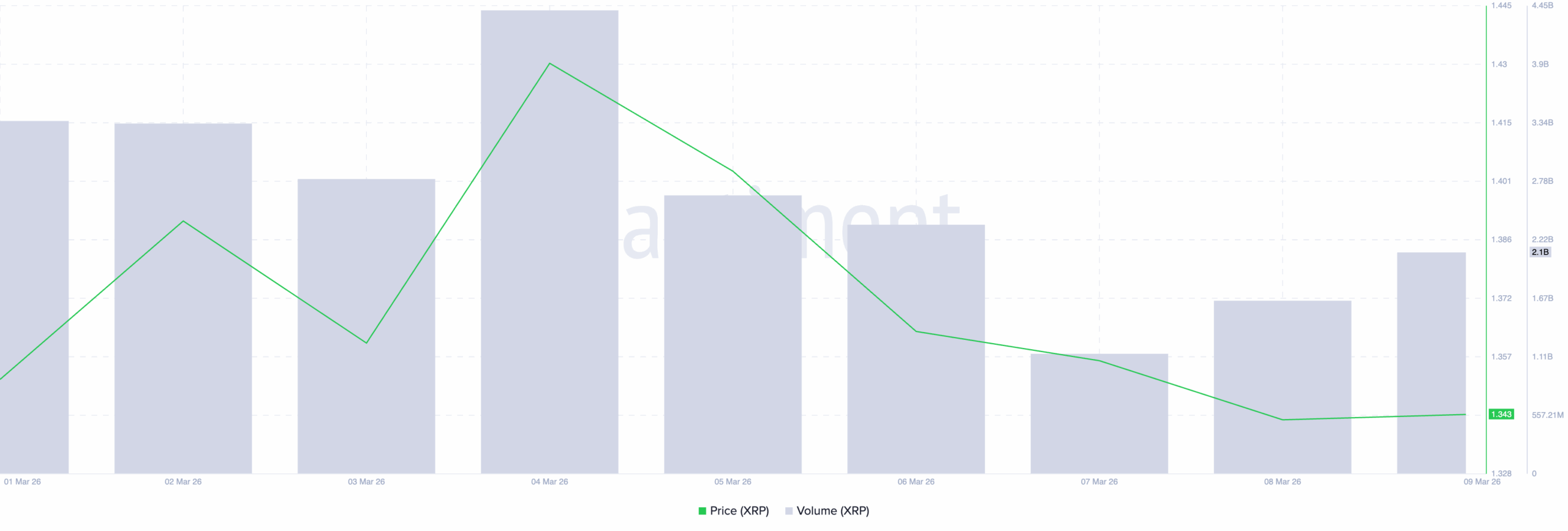
XRP has not been spared, with the token’s value down 1% over the past day and its trading volume up by over 70%.
This price-volume divergence is a classic sign of distribution. It suggests that the dominant force in the market right now is XRP sellers who are offloading positions into whatever liquidity is available, rather than stepping in to absorb the dip.
Smart Money Is Stepping Back
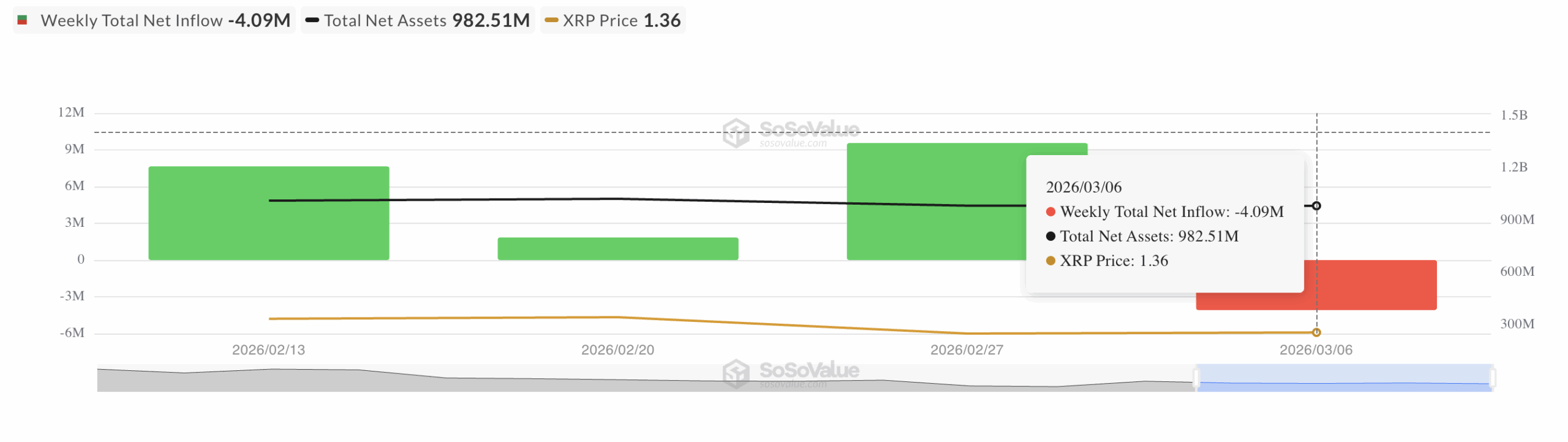
Institutional demand for the altcoin is also falling. According to SoSoValue data, XRP spot ETFs recorded net outflows of $4.09 million for the week ending March 6.
The outflows were concentrated in the latter half of the week, with March 5 and March 6 both logging negative daily net inflow figures, which dragged the weekly total into the red.
When capital inflows into these investment vehicles decline, it signals that institutional investors who tend to be more deliberate and better informed than retail participants are reducing their exposure to the asset.
If this continues into this week, it can weigh on XRP’s price, as shrinking institutional demand removes significant buying pressure, leaving the token more vulnerable to further selling.
On-Chain Data Points to Capitulation
The steady dip in XRP’s value since January 6 has pushed many holders—particularly short-term investors—into losses, heightening the risk of a further downside.
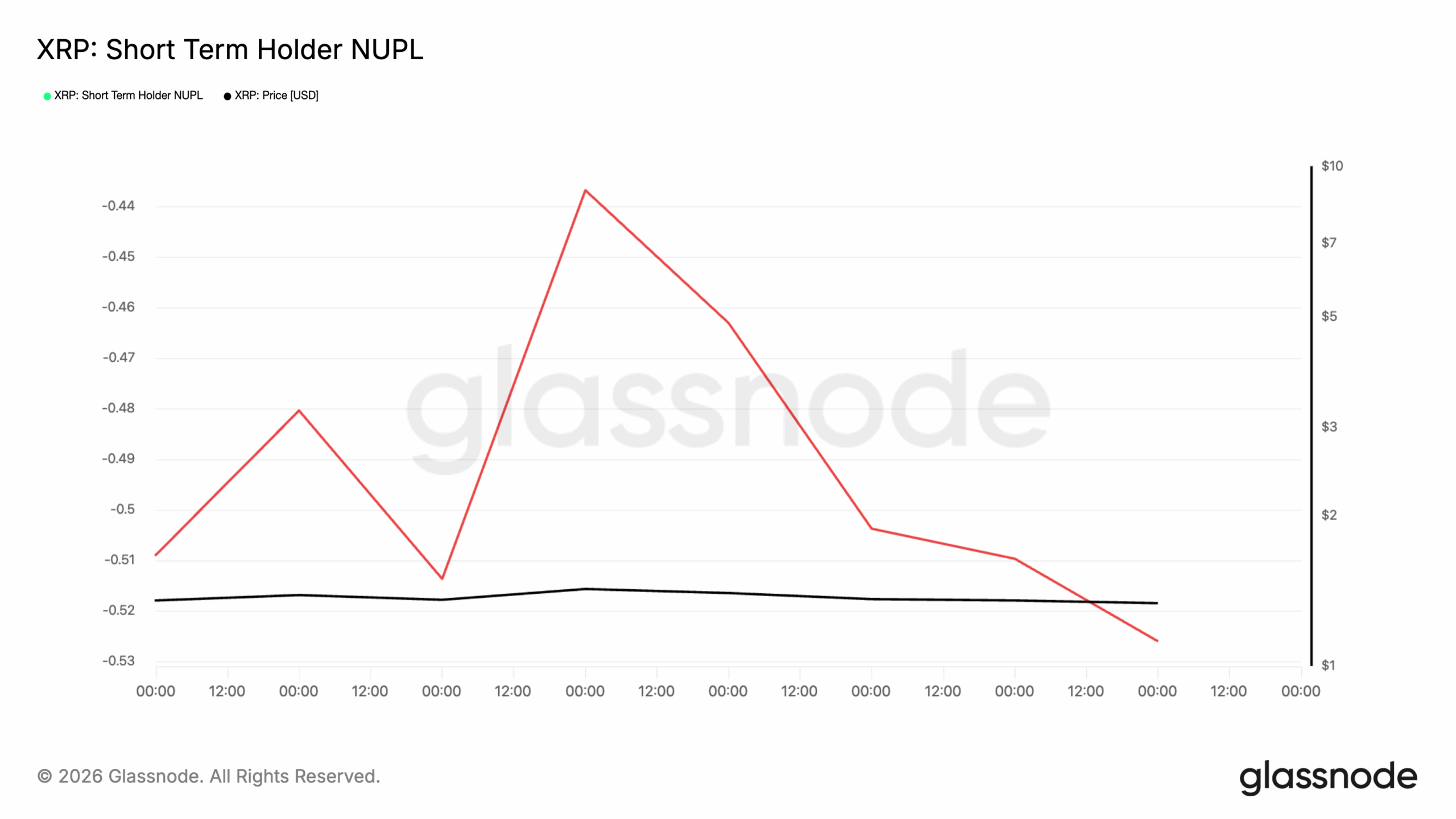
This is based on readings from the token’s Short-Term Holder Net Unrealized Profit/Loss (STH-NUPL) metric, which currently shows capitulation. As of this writing, XRP’s STH-NUPL sits at a seven-day low of -0.52.
Short-term holders are investors who have held their assets for less than 155 days and are the most reactive to price changes. When their NUPL turns negative, they are sitting on significant unrealized losses and experiencing capitulation.
In scenarios like this, these traders are increasingly likely to sell, adding further downward pressure to XRP’s price.
XRP’s Next Move Hinges on This Level
If the descending parallel channel holds and the current wave of selling continues, XRP risks falling to the $1.16 support floor. A breach below this level could trigger a breakdown of the channel structure entirely, opening the door to a 17-month low of $0.48.
However, there is another side to consider — particularly when looking at the activity of short-term holders.
When STH-NUPL turns deeply negative, as it has here, these holders typically sell to prevent further losses. But STH capitulation of this kind has historically been observed near market bottoms and can signal a bullish reversal.
It indicates that weak hands are exiting the market, clearing the way for more conviction-driven buyers to step in and trigger a trend reversal.
Disclaimer:
The information provided in this article is for informational purposes only. It is not intended to be, nor should it be construed as, financial advice. We do not make any warranties regarding the completeness, reliability, or accuracy of this information. All investments involve risk, and past performance does not guarantee future results. We recommend consulting a financial advisor before making any investment decisions.
Abiodun Oladokun is a Research Analyst at CCN, where he covers cryptocurrency markets with a focus on on-chain analysis, technical assessments, and emerging trends across decentralized finance (DeFi), real-world assets (RWA), artificial intelligence (AI), decentralized physical infrastructure networks (DePIN), Layer 2s, and meme coins.
Prior to CCN, he served as a Senior On-Chain Analyst at BeInCrypto, producing market reports spanning diverse crypto sectors.
Before that, he conducted technical analysis and market assessments of various altcoins at AMBCrypto, where he also contributed long-form quarterly research papers on DeFi, NFTs, DAOs, and scaling architectures, leveraging on-chain platforms including Messari, Santiment, DefiLlama, and Dune Analytics.
He began his crypto career as a research analyst at SixthSense DAO, developing blockchain forensic tools to trace the history of stolen assets.
Abiodun is a lawyer called to the Nigerian Bar and the founder of Ilé Ijó, a Lagos-based electronic dance music collective.