Home / Analysis / Crypto / Technical Analysis / Monero (XMR) Price Slides Below $350: 3 Reasons the Iran-Israel Middle East War Won’t Save the Privacy Coin
Why XMR is losing the 'safe-haven' race to Gold and Bitcoin | Credit: Hameem Sarwar
Share
Key Takeaways
XMR’s price has decoupled from the typical “geopolitical fear” rally, sliding to the $322 region.
XMR’s price is currently in a corrective phase after being rejected at the 0.786 Fib level.
For a confirmed bullish reversal, Monero’s price must reclaim the 0.236 Fib at $400.
Geopolitical fear usually sends money running toward assets that promise protection. Gold rallies. Oil spikes. Bitcoin often catches a bid.
Privacy coins? Not this time.
Monero (XMR), the flagship privacy cryptocurrency, has slid to $322, even as tensions in the Middle East intensify.
The assumption was simple: war drives surveillance fears, which should boost demand for anonymous transactions. Yet the market is telling a different story.
Here is why XMR’s price is down and what could be next for the altcoin
Why XMR Is Down
Even if privacy becomes a stronger narrative during conflict, sustained price appreciation requires liquidity and broad participation.
Notably, Monero’s market depth is significantly thinner than major assets like Bitcoin (BTC) or Ethereum (ETH).
So, in risk-off environments, traders prefer more liquid markets where they can enter and exit positions efficiently.
Without strong inflows, geopolitical headlines alone cannot reverse a technical downtrend. Therefore, XMR’s price is struggling to gain from the impact of the Israel-Iran war.
Uptrend Awaits Confirmation
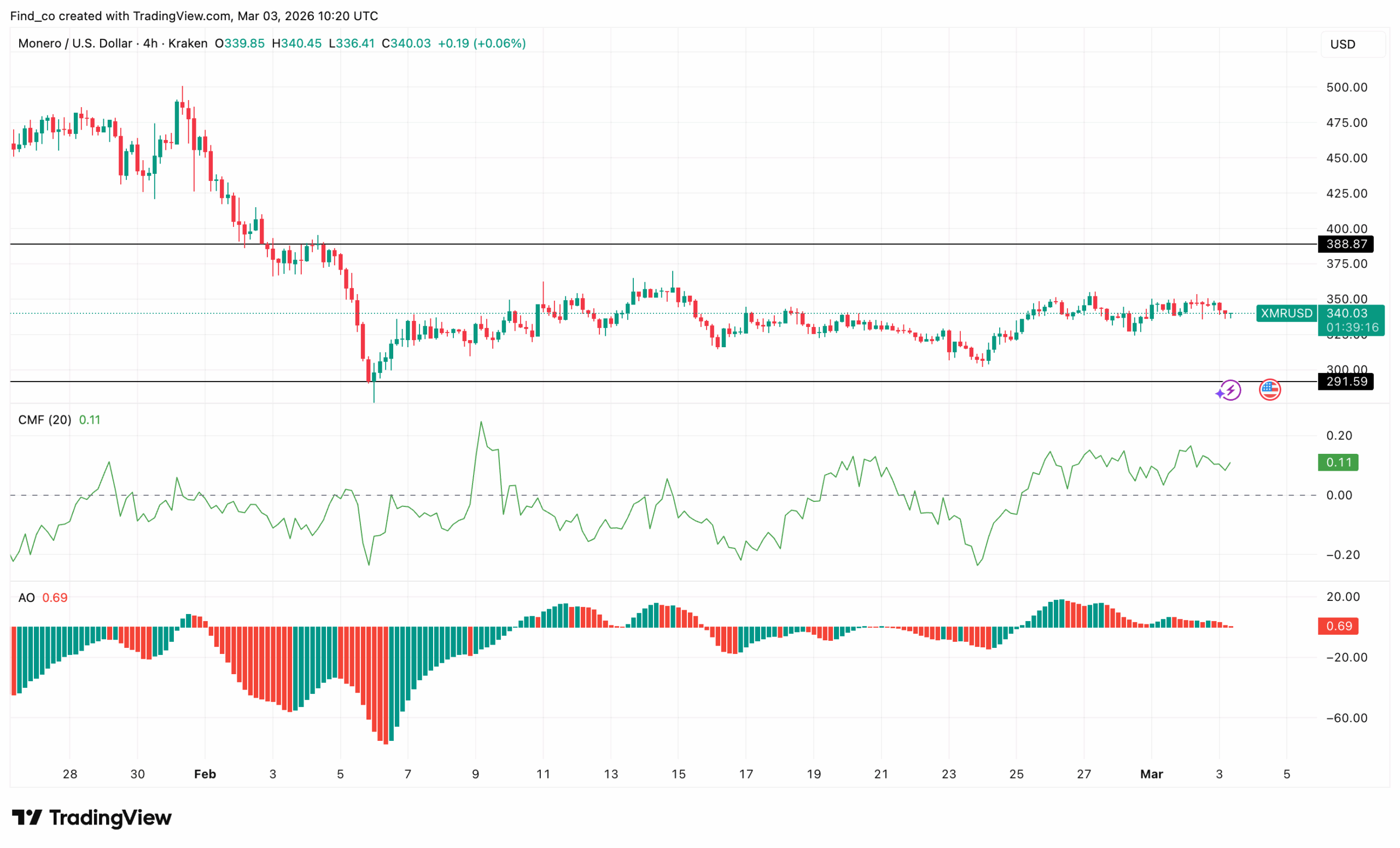
A look at the 4-hour chart shows XMR trading around $339, within clear boundaries. The upper resistance sits near $360–$370.
Meanwhile, strong support remains anchored around $285. This creates a well-defined horizontal channel.
Meanwhile, buyers are stepping in on dips. The Chaikin Money Flow (CMF) prints 0.10, signaling steady capital inflows into the asset. That indicates accumulation rather than distribution.
However, inflows remain moderate. They are supportive, not aggressive.
At the same time, the Awesome Oscillator (AO) hovers near equilibrium.
Green bars recently expanded but are now flattening. This shows bullish momentum attempted to build, yet follow-through weakened.
Technically, XMR’s price must reclaim $360 to shift the short-term structure bullish. Until then, rallies remain restricted.
However, if XMR’s price breaks above $360 with volume, upside could accelerate quickly
XMR Price Prediction: Bearish Continuation
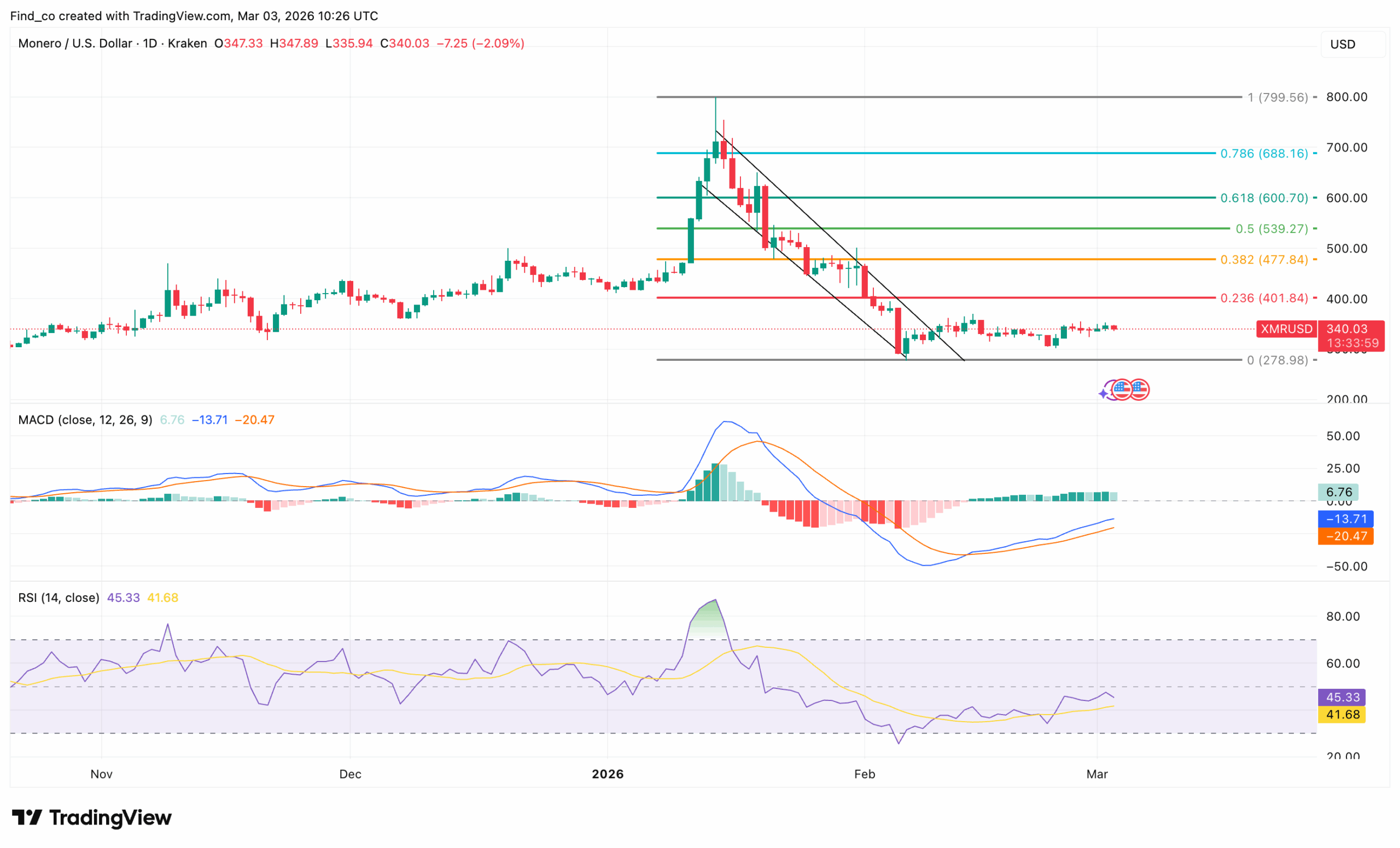
On the daily chart, XMR has entered a corrective phase after its explosive rally toward the $800 region, with price now trading around $340 following a rejection from the 0.786 Fibonacci level near $689.
The real acceleration came after the 0.382 level at $477 was broken.
That breakdown triggered a steep selloff that sent XMR’s price directly toward the zero Fib support near $277, where buyers finally stepped in.
Since then, Monero has been attempting to stabilize, forming a short-term base between $300 and $360.
However, the structure still shows lower highs beneath a descending trendline, suggesting bulls have yet to regain control.
Momentum indicators show early signs of recovery, but confirmation remains limited.
The moving average convergence divergence (MACD) is attempting a bullish crossover, with histogram bars gradually flipping green.
This suggests that bearish momentum is fading, though not fully reversed.
The Relative Strength Index (RSI) sits around 45, recovering from oversold territory but still below the neutral 50 level, indicating that buyers are present but not dominant.
For a substantial recovery, XMR’s price must first reclaim the 0.236 Fibonacci level at $400.
On the downside, failure to hold above the $277 support region would invalidate the current stabilization attempt and expose XMR’s price to further downside.
A break below $277 would shift the broader structure to the bearish side.
Disclaimer:
The information provided in this article is for informational purposes only. It is not intended to be, nor should it be construed as, financial advice. We do not make any warranties regarding the completeness, reliability, or accuracy of this information. All investments involve risk, and past performance does not guarantee future results. We recommend consulting a financial advisor before making any investment decisions.
Victor Olanrewaju is a crypto analyst and reporter at CCN with deep roots in on-chain research and technical analysis. His crypto journey began in 2017, but it was the 2020 Uniswap airdrop that sparked a full-time pivot into the space.
With a foundation in copywriting, Victor honed his craft creating high-converting content for leading crypto brokers — most notably an XRP price prediction that ranked #1 on Google during the 2021 bull run.
He later joined AMBCrypto in 2022, where he combined storytelling with technical and on-chain analysis to cover key market narratives.
In 2024, he expanded his expertise at BeInCrypto, collaborating with analysts and using tools like Glassnode, Santiment, and IntoTheBlock to break down Bitcoin and altcoin trends.
At CCN, Victor covers the top cryptocurrencies, memecoins, macro shifts, blending real-time insights with deep-dive metrics.
He holds a Bachelor’s degree in Physics from the University of Ibadan, equipping him to simplify complex data for a wide audience. Follow his work or connect on LinkedIn or X.