Peter Schiff Challenges Trump to Debate Over Inflation and Economic Policy — Here’s What’s at Stake
Share
Key Takeaways
The FOMC meeting is today, and the Federal Reserve is expected to cut rates. If so, this will be the second rate cut since September, when rates dropped to 4.25%.
How has the crypto market reacted to previous rate cuts, and what will happen today?
Today, the Federal Reserve’s FOMC meeting has the entire market on edge, with traders overwhelmingly expecting another rate cut.
After holding rates steady for over a year, the Fed began easing rates earlier this fall and could continue to do so today.
Historically, lower rates have fueled bullish momentum, but there have been periods when the two have not been correlated.
With that in mind, let’s examine previous rate-cut history and analyze some charts to determine what will happen.
Fed Rate Cuts
The U.S. Federal Reserve kept its interest rates steady at 5.5% for over a year, specifically between July 2023 and August 2024.
Rate cuts that began in August and continued until December lowered the interest rate to 4.5%, where it remained for the remainder of 2025.
However, interest rates remained at 4.5% until September 2025, and then they were cut by 0.25 bps to 4.25%
Get These Top Crypto Casino Offers Now!
Sponsored
Disclosure
We sometimes use affiliate links in our content, when clicking on those we might receive a commission at no extra cost to you. By using this website you agree to our terms and conditions and privacy policy.
In light of the October Fed rate meeting, the market gives a 98% chance of a 0.25% cut, and a less than 1% chance of a larger cut or keeping interest rates unchanged.
Therefore, the market is overwhelmingly expecting rate cuts in October for the second time this year, possibly marking the beginning of a stage of quantitative easing.
Previously, the Federal Reserve kept rates lower than 1% for over two years, from 2020 to 2022. Then, it started a massive rate increase that continued until 2024.
Since the market predicts a November rate cut, this article will analyze how the crypto market and Bitcoin reacted to previous rate cuts.
Crypto and Fed Rate Cuts
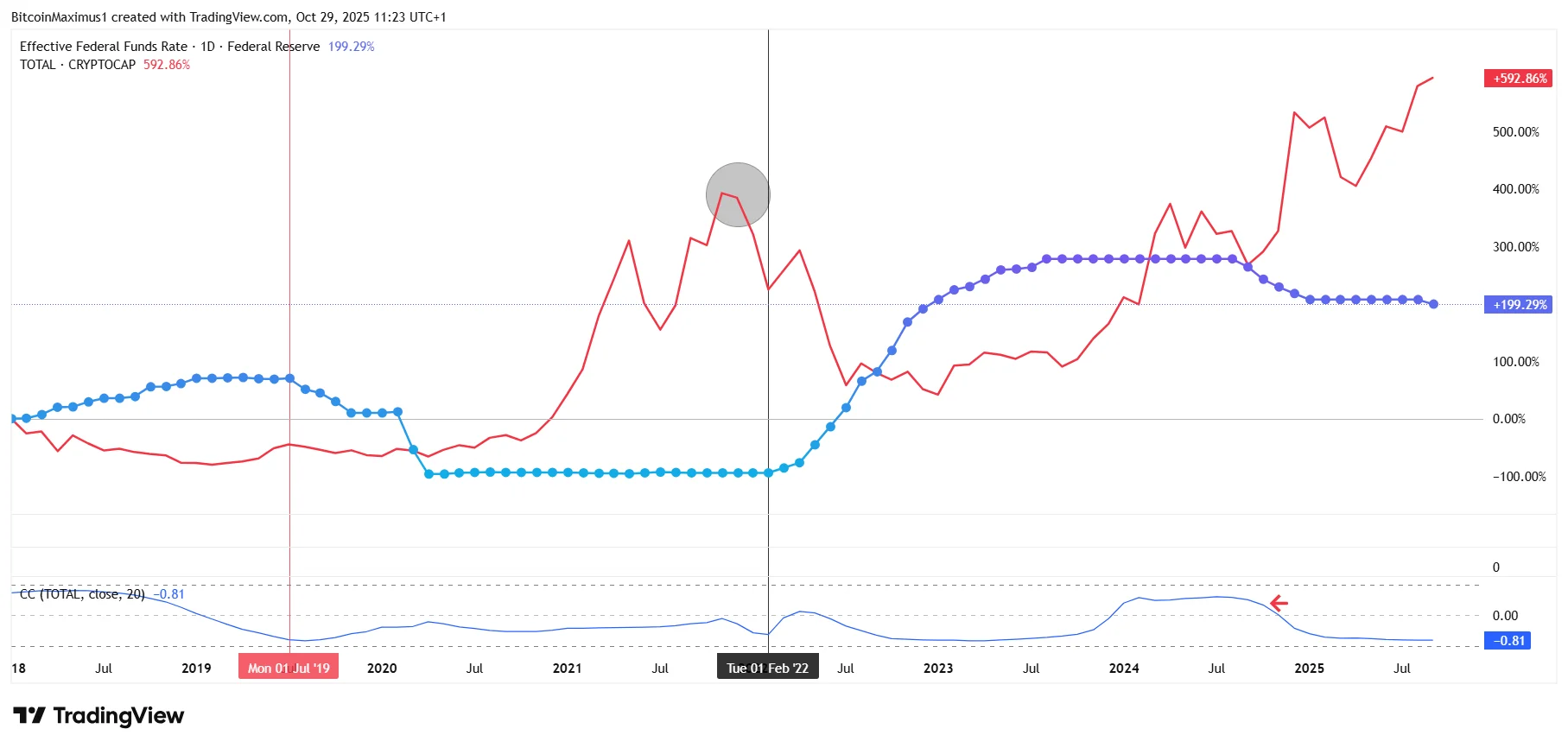
The easier access to liquidity created by rate cuts has an inherently bullish effect. This was the case when the Fed started rate cuts in July 2019, preceding a massive crypto market bull run.
However, it is worth noting that the bull run did not begin until much later, in October 2020, when the interest rate cuts had already been steady for some time and were below 1%.
Lower interest rates catalyzed the bull run, but the effect was delayed for over a year.
Afterward, the crypto market topped in November 2021 (black circle), but the decline was exacerbated after rates started increasing in February 2024.
While this proves a negative correlation between the two, it is worth mentioning that the crypto market rallied in 2023 despite gradually increasing interest rates.
Crypto Market And Fed Funds Rate | Credit: Valdrin Tahiri/TradingView
The charts prove a negative correlation between interest rates and the crypto market. However, the correlation is not perfectly negative, as the effect of rates on the crypto market has varied.
As indicated by the correlation coefficient (blue), there was even a brief period when the correlation between the two was positive.
This means a downward movement in one caused a similar downward movement in the other.
Nevertheless, the correlation coefficient is currently -0.81, indicating that the two assets are almost perfectly negatively correlated.
If that relationship holds, a Fed rate cut at today’s FOMC meeting will likely have a positive impact on the crypto market, sparking a bull run similar to 2021, especially if there are continued rate cuts in 2023.
How Does the Crypto Market Look?
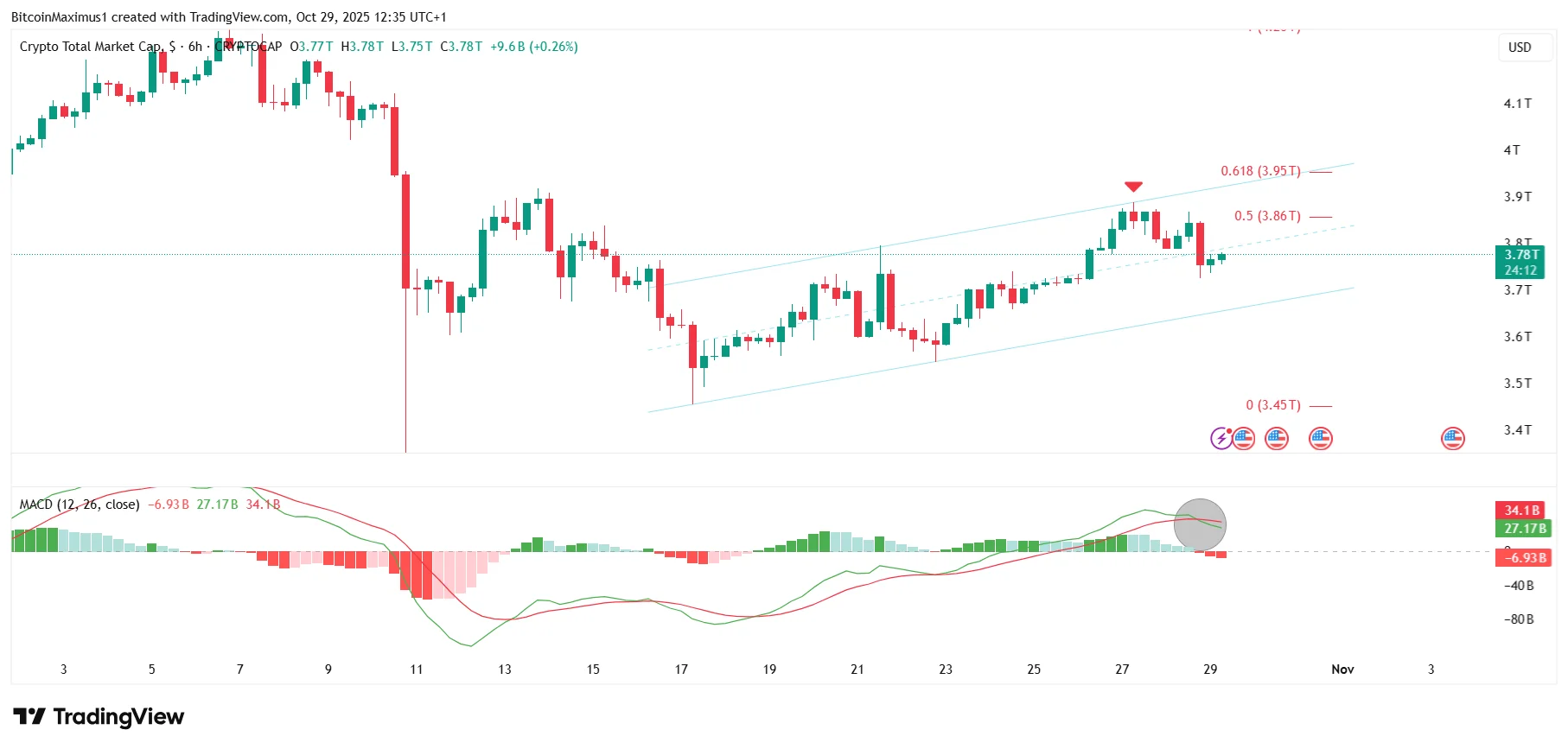
While the correlation between the two suggests that the crypto market (TOTALCAP) is likely to increase, the technical analysis of TOTALCAP indicates the opposite.
The TOTALCAP has bounced since October 17 but trades within an ascending parallel channel, which typically contains corrective movements.
Furthermore, TOTALCAP was rejected by the channel’s resistance trend line (red icon) and the 0.5-0.618 Fibonacci retracement resistance level.
Since TOTALCAP trades in the channel’s lower portion, the chances of a breakdown become even more likely.
Finally, the MACD has already made a bearish cross (black circle), another sign indicating that the crypto market trend is bearish.
For the bullish long-term prediction to become true, the crypto market has to close above the channel’s resistance and the $3.95 trillion resistance area.
Until that happens, the most likely future movement is a breakdown from the channel, followed by new lows.
What is the Sentiment?
The sentiment among crypto enthusiasts regarding today’s FOMC meeting is extremely bullish.
President Trump will meet with Xi Jinping on Oct. 30 to discuss trade.
Heavyweight companies such as Apple, Microsoft, Google, Amazon, and Meta will also announce earnings this week.
Crypto bulls hope that a rate cut, followed by a trade deal and higher-than-expected earnings, will positively affect the traditional markets and eventually trickle down to the crypto market.
What also holds weight is Fed Chair Jerome Powell’s speech, which will occur shortly after the meeting. Many believe it will mark the end of quantitative tightening in this cycle, an extremely bullish milestone for the markets.
However, with inflation still well above the Fed’s goal, there is skepticism that a period of quantitative easing will begin.
The most positive outlook would be a cut of more than 25bps, since the markets do not currently price that.
Additionally, mentioning the start of quantitative easing could catalyze a primary pump.
On the other hand, a minor rate cut and/or no mention of quantitative easing could have a bearish effect on the crypto market. This is because the market has already priced in a small cut.
Final Thoughts
If the Fed cuts rates again today, it could inject short-term optimism into the crypto market, even though technical indicators suggest a more cautious outlook.
Whether this meeting sparks a new uptrend or just a temporary bounce will depend on how traders interpret Powell’s tone and the broader economic picture regarding quantitative tightening.
Historically, subtle shifts in Powell’s tone have created significant volatility. If the cut is perceived as the start of a longer-term quantitative easing cycle, Bitcoin and the crypto market could see more inflows.
For now, the sentiment suggests a market rally, but cautions against it due to the technical outlook.
Disclaimer:
The information provided in this article is for informational purposes only. It is not intended to be, nor should it be construed as, financial advice. We do not make any warranties regarding the completeness, reliability, or accuracy of this information. All investments involve risk, and past performance does not guarantee future results. We recommend consulting a financial advisor before making any investment decisions.
Valdrin Tahiri is a cryptocurrency analyst and reporter at CCN, specializing in technical analysis with a focus on Elliott Wave theory, on-chain metrics, and fundamental research. He brings over seven years of experience in the crypto space as both a trader and writer.
He discovered cryptocurrencies in 2017 while earning his MSc in Financial Markets at the Barcelona School of Economics, which sparked a deep interest in blockchain and market dynamics. Since then, he’s contributed to top crypto outlets like BeInCrypto and CoinGape.
Valdrin also served as Community Manager of BeInCrypto’s Telegram group for three years, helping grow it into one of the largest crypto communities worldwide. His expertise in market structure and price patterns allows him to break down complex trends into clear, actionable insights.
He’s published thousands of articles covering altcoins, Bitcoin cycles, and macro trends.