Despite the choppy market action, whales are buying these altcoins | Credit: Veronica Cestari
Share
Key Takeaways
With the 2026 FIFA World Cup close by, crypto whales are increasing their exposure to CHZ.
Whale addresses holding ≥10,000 RAY have climbed to 553, indicating bullish sentiment in the token.
The 100 million to 1 billion Cardano whale cohort executed its largest buy-in in months, adding 150 million ADA.
The first quarter of 2026 has ended, and yet the crypto market has failed to sustain a market-wide upswing.
However, this does not imply that some tokens did not perform well. Now that April is here, crypto whales are accumulating some select altcoins for potential gains.
In this analysis, CCN spots three of these cryptos and what the accumulation could mean for their prices.
Chiliz (CHZ)
CHZ, native to the blockchain-based sports project, Chiliz, tops the list of altcoins whales are buying for gains in April.
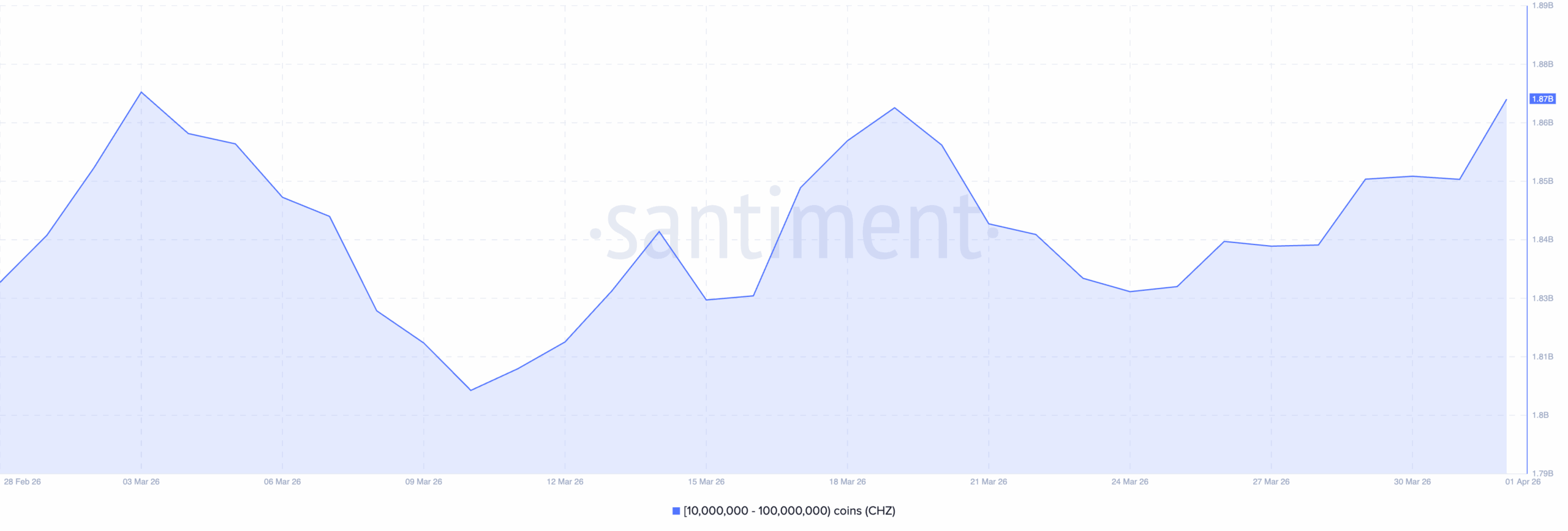
According to Santiiment, the 10 million to 100 million CHZ cohort has increased total holdings from 1.81 billion to 1.87 billion CHZ.
For context, this happened within the last few weeks.
That increase of 60 million tokens represents deliberate and sustained accumulation by participants whose position sizes require genuine conviction.
The timing of that accumulation is analytically significant. It is occurring directly ahead of a convergence of catalysts that the broader market has not yet fully priced.
The first and most immediate is the regulatory transformation.
On March 17, 2026, the SEC and CFTC issued joint guidance classifying Fan Tokens as digital collectibles rather than securities.
That classification has removed the primary structural barrier preventing Chiliz from accessing the full depth of institutional and retail demand in the US market.
Besides that, the second catalyst is the 2026 FIFA World Cup.
Hosted across the United States, Mexico, and Canada, and approximately 80 days away, the tournament represents the most concentrated period of sports-driven Fan Token demand in Chiliz’s history.
Historically, CHZ’s price has appreciated most significantly in the weeks leading up to major international sporting events.
Interestingly, it seems history will repeat itself. Over the last 30 days, the price of Chiliz has increased by nearly 30%. Considering the crypto whales’ accumulation, the altcoin could trade higher.
Raydium (RAY)
Raydium’s whale data is equally precise.
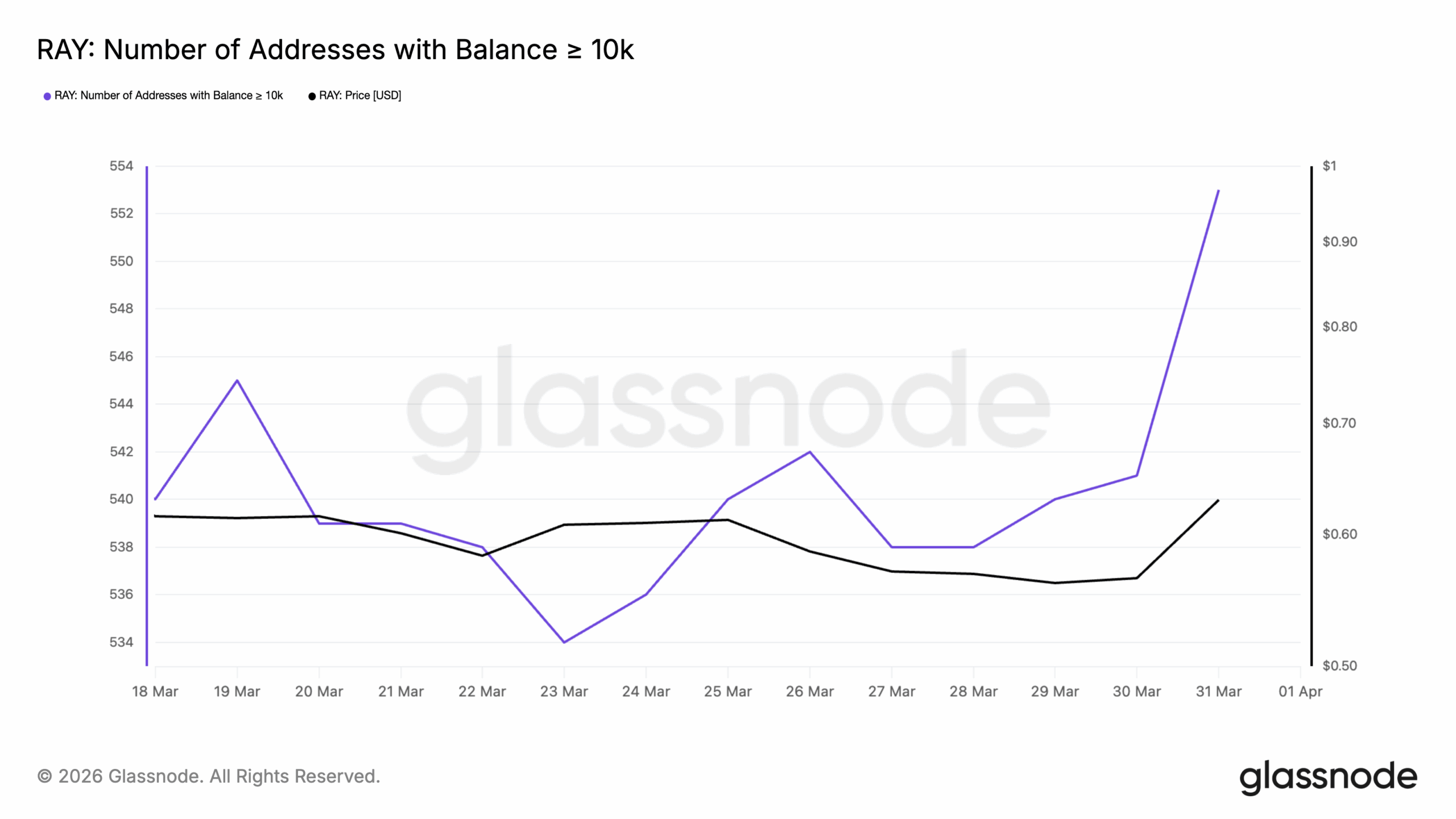
According to Glassnode, the number of wallets holding 10,000 or more RAY tokens has increased to 553.
For context, Raydium is not a speculative narrative token. It is the primary automated market maker and liquidity infrastructure layer for the Solana ecosystem.
Its revenue is real, recurring, and directly proportional to the trading volume in the Solana ecosystem.
When Solana’s on-chain activity increases as it does during memecoin momentum cycles, Raydium’s fee revenue increases in direct proportion.
And in some cases, this helps to drive the RAY token price higher. At the time of writing, the Raydium price hovers around $0.70, up 22% over the last 24 hours.
RAY Number of Addresses with Balance ≥ 10k | Credit: Glassnode
Thus, growth to 553 wallets holding 10,000 or more RAY tokens signals that sophisticated participants are anticipating exactly that kind of expansion in the Solana ecosystem in April.
Should this trend persist, Raydium’s price could be one of the altcoins to retest $1 in April.
However, if demand drops, this might not be the case. Instead, RAY might slide below $0.50.
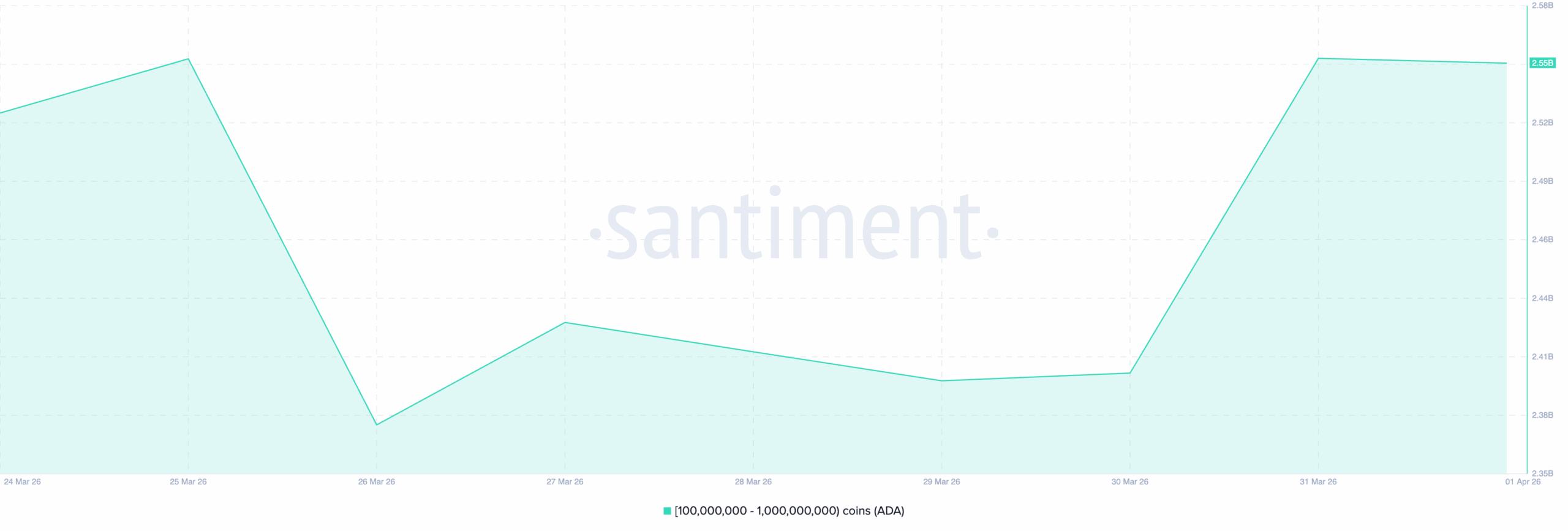
According to Satiment, the 100 million to 1 billion ADA cohort, representing the largest institutional-scale holders short of exchange-level and protocol-level wallets, has increased total holdings from 2.40 billion to 2.55 billion ADA.
That 150 million coin increase represents the largest accumulation event among large holders in recent months.
The 100 million to 1 billion cohort is analytically distinctive because of the scale of conviction it represents. These are not small institutional positions being established cautiously.
Disclaimer:
The information provided in this article is for informational purposes only. It is not intended to be, nor should it be construed as, financial advice. We do not make any warranties regarding the completeness, reliability, or accuracy of this information. All investments involve risk, and past performance does not guarantee future results. We recommend consulting a financial advisor before making any investment decisions.
Victor Olanrewaju is a crypto analyst and reporter at CCN with deep roots in on-chain research and technical analysis. His crypto journey began in 2017, but it was the 2020 Uniswap airdrop that sparked a full-time pivot into the space.
With a foundation in copywriting, Victor honed his craft creating high-converting content for leading crypto brokers — most notably an XRP price prediction that ranked #1 on Google during the 2021 bull run.
He later joined AMBCrypto in 2022, where he combined storytelling with technical and on-chain analysis to cover key market narratives.
In 2024, he expanded his expertise at BeInCrypto, collaborating with analysts and using tools like Glassnode, Santiment, and IntoTheBlock to break down Bitcoin and altcoin trends.
At CCN, Victor covers the top cryptocurrencies, memecoins, macro shifts, blending real-time insights with deep-dive metrics.
He holds a Bachelor’s degree in Physics from the University of Ibadan, equipping him to simplify complex data for a wide audience. Follow his work or connect on LinkedIn or X.