CCN Crypto Lifestyle Index: How Usability, Livability and Adoption Shape Global Crypto Rankings
Share
Key Takeaways
The CCN Crypto Lifestyle Index measures how crypto fits into daily life across countries.
The score uses five pillars: access, usage, earning power, legal climate, and cultural integration.
These pillars group into usability, livability, and adoption to reflect real-world conditions.
The index highlights where crypto moves beyond trading into everyday economic activity.
Crypto adoption no longer follows a single path. In some regions, people use it to protect savings or send remittances.
In others, it supports innovation, digital ownership, and new forms of income.
Traditional rankings focus on trading volume or ownership rates. These metrics fail to show how crypto fits into everyday life.
The Crypto Citizens Network’s (CCN) Lifestyle Index takes a different approach. It measures how easy it is to access crypto, how often it is used, and how deeply it connects to local economies and culture.
Each country receives a score out of 10. A higher score means crypto plays a stronger role in daily life, work, and economic activity.
To understand this shift more clearly, this article explains how the index works and what shapes each country’s score.
What Does the Crypto Lifestyle Index Measure?
The index focuses on real-world use rather than speculation.
It looks at whether individuals can access crypto, use it for transactions, earn income from it, and see it reflected in culture.
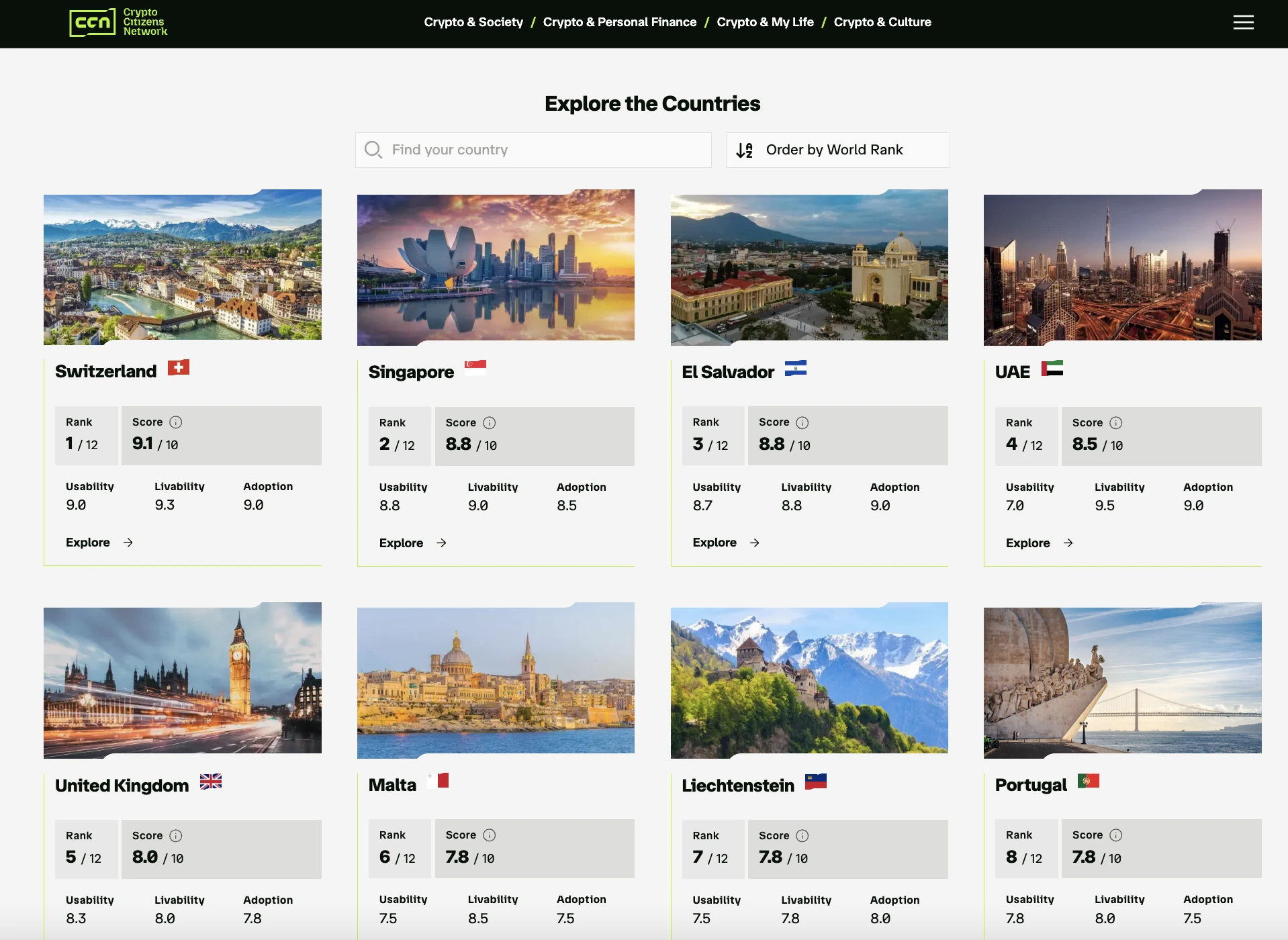
Global Crypto Lifestyle Index | Source: CCN
This creates a more complete picture of adoption across different economies.
To capture this, the index uses five pillars. Each one reflects a key part of how crypto functions in daily life.
Behind the Score: The Five Pillars
The scoring starts with five core areas that define crypto’s presence in a country:
Access: Connectivity based on internet coverage and mobile penetration, and use and access to global exchanges.
Usage: Payments, transfers, and everyday transactions.
Earning power: Opportunities to earn crypto through freelancing, staking, gaming, and remittances.
Legal climate: Regulation clarity, tax treatment, and government stance.
Cultural integration: Presence in media, art, sports, and public identity.
Each pillar is then scored from 0 to 10 to reflect its level of integration into daily life:
0–3: Limited or rare.
4–6: Growing or niche.
7–8: Common but not dominant.
9–10: Highly integrated into daily life.
This structure allows comparisons across countries with different levels of development.
How Pillars Translate Into Real-World Dimensions
While the five pillars provide detail, they also group into broader categories that reflect everyday experience.
The index organizes them into three dimensions:
Usability: Access + Usage. This shows how easy it is to enter and use crypto.
Livability: Earning power + Legal climate. This reflects whether crypto can support income and financial activity.
Adoption: Cultural integration. This captures visibility and social relevance.
Grouping these pillars helps translate raw indicators into real-life conditions across different countries.
This step shows whether crypto works in practice across different regions.
Calculating the Lifestyle Index Score
After grouping the pillars, the index produces a final score.
The final score reflects a balance between infrastructure, regulation, usage, and cultural presence.
This method ensures balance.
A country cannot rank highly based on infrastructure or regulation alone. It also needs real usage and cultural presence.
User perspectives and experiences play a key role in shaping the final assessment.
Why a Data-Driven Approach Matters
Reliable data sits at the core of the index.
The scoring draws on publicly available sources, including government reports, regulatory updates, and industry data.
In addition, the index incorporates an ethnographic approach through “Citizen Voices,” which reflects real experiences from crypto users. This includes both everyday users and industry leaders, whose insights help explain how regulation and innovation shape adoption.
Local insights and expert input help fill data gaps and provide additional context.
For example, in Mexico, users report that while platforms such as Bitso are easy to access, everyday retail payments remain limited. This explains why adoption scores may remain moderate despite strong usage in remittances.
The combination of quantitative data and real-world observations strengthens the index’s reliability.
As a result, this approach improves consistency and reduces bias. It also allows comparisons across regions where crypto serves different purposes, from financial survival to technological innovation.
As data improves and adoption expands, the index evolves.
How the Crypto Lifestyle Index Applies in Practice
To understand how the index works, looking at real countries can help with these specific examples.
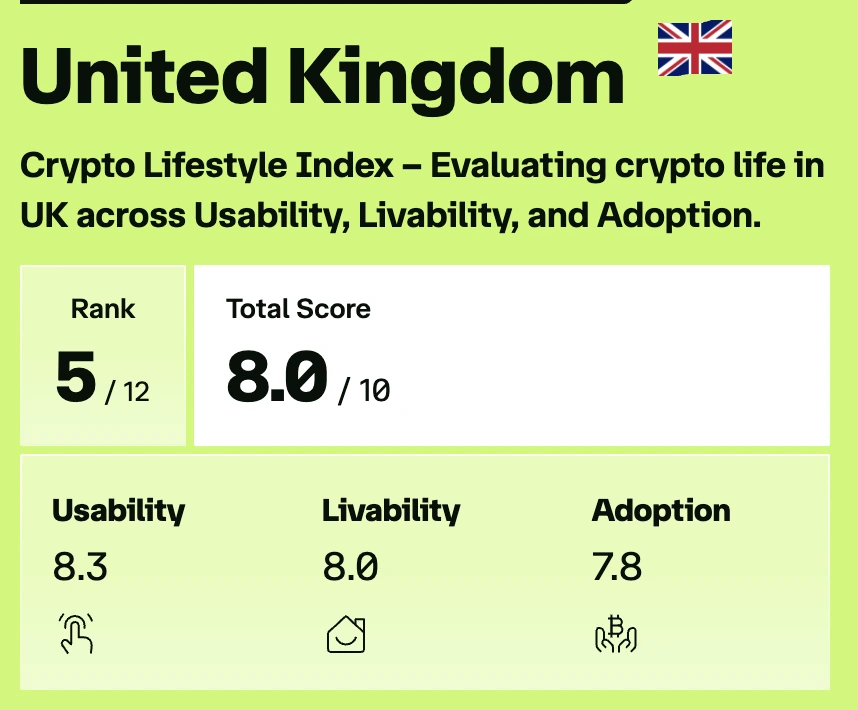
Crypto Lifestyle Index: United Kingdom | Source CCN
The U.K. provides a strong example of balanced crypto integration. The country scores highly in usability due to strong internet infrastructure and access to regulated exchanges.
Livability remains stable, supported by a clear legal framework and growing crypto job opportunities.
Cultural adoption continues to expand through media coverage, events, and non-fungible tokens (NFT) activity.
With a total score of 8.0/10, the UK reflects a mature crypto environment where infrastructure, regulation, and usage align, even if full mainstream adoption is still developing.
This balance results in a high overall score, reflecting a country where crypto is accessible, usable, and increasingly visible in everyday life.
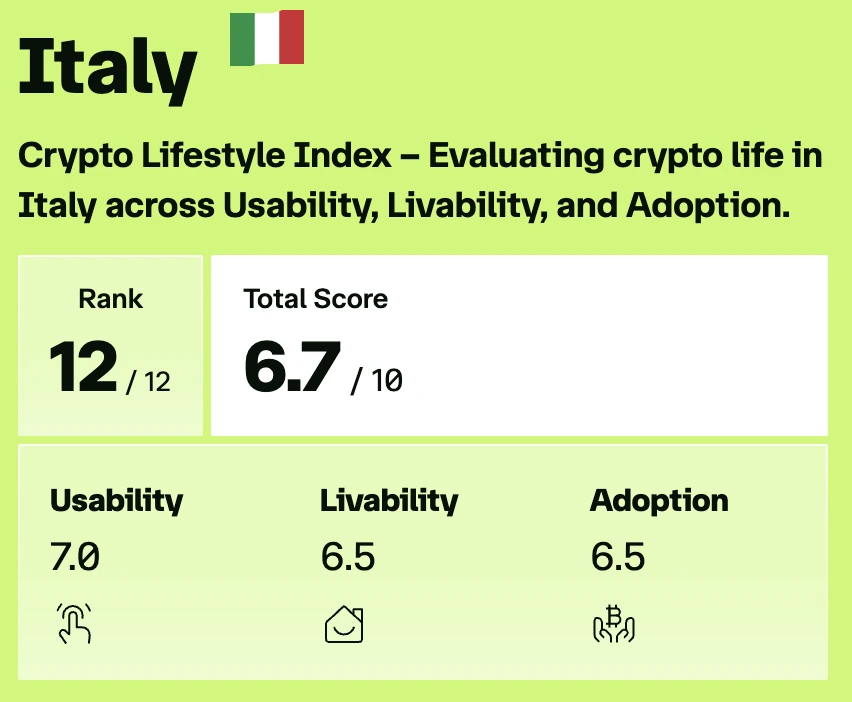
Italy, by contrast, shows a different path to adoption.
With a total score of 6.7/10, the country operates under the European Union’s Markets in Crypto-Assets (MiCA) framework, offering strong regulatory clarity and access to major exchanges. Internet penetration sits around 92%, and crypto ownership reaches 11% of the population aged 18–75, showing a solid user base.
However, usage remains limited compared to the UK. Crypto in Italy is still treated mainly as an investment tool rather than a daily payment method.
Most users buy and hold digital assets through regulated platforms, while relying on traditional banking and card systems for everyday transactions.
This creates a gap between access and real-world usage. Italy scores relatively well in usability but lower in livability and adoption, as earning opportunities, spending habits, and cultural integration remain less developed.
By contrast, countries facing economic instability may score lower on infrastructure but higher on usage, as individuals rely on crypto for remittances or savings protection.
Together, these examples show that crypto does not follow a single model. Some countries lead through infrastructure and regulation, while others adopt crypto out of necessity.
Why the Global Crypto Lifestyle Index Matters
Crypto goes beyond trading. It reflects a lifestyle that continues to evolve as adoption grows, rooted in an underlying ideology around financial independence, ownership, and decentralization.
Payments, freelance income, NFTs, and decentralized finance (DeFi) tools shape how individuals interact with digital value.
The index captures this shift by focusing on daily use rather than market speculation.
This approach makes it easier to identify where crypto delivers practical value.
Beyond Infrastructure: Different Paths to Adoption
Crypto adoption does not follow a uniform global model. In some nations, growth is fueled by sophisticated financial systems and institutional integration; in others, it is a tool of pure necessity.
El Salvador provides a clear study of this contrast. While the country’s landmark policy initially mandated Bitcoin as a legal payment method, the lifestyle reality is more complex.
While top-down government policy and lower-cost remittances drive significant volume, organic merchant adoption for daily retail remains a hurdle.
This creates a specific adoption model where usage is powered by policy and financial necessity rather than spontaneous market demand.
The Index captures this “utility of survival,” where crypto protects savings and facilitates cross-border transfers, and weighs it against high-tier use cases such as tokenized real estate, luxury retail payments, and digital ownership found in more stable economies.
Who should use the Crypto Lifestyle Index?
The Crypto Lifestyle Index is not just a ranking tool. It serves different purposes.
For digital nomads: Focus on the livability score to identify countries where crypto can support income, payments, and day-to-day financial activity.
For businesses and startups: Use the usability score to evaluate where infrastructure, exchange access, and user readiness support crypto-based products and services.
For policymakers and regulators: Compare legal climate scores to understand how regulation impacts adoption and competitiveness within a global context.
For users and investors: Look beyond total scores to understand how crypto functions locally, from access and usage to cultural integration.
By breaking down adoption into practical dimensions, the index helps translate global trends into real-world decisions.
Looking Ahead: Tracking the Future of Crypto Adoption
The Crypto Lifestyle Index provides a framework to track change over time.
As regulation becomes clearer, infrastructure expands, and new use cases emerge, countries will shift across the rankings.
This creates a consistent way to measure progress and compare global trends.
The index can also support research, policy decisions, and industry analysis. It highlights where crypto supports economic activity, financial access, and cultural participation.
Over time, it can help map how crypto moves from a niche technology into a core part of everyday economic life.
Ready to see where your country ranks?
Explore the full 2026 CCN Crypto Lifestyle Index leaderboard to see how countries compare – Global Crypto Lifestyle Index
FAQs
What does a high usability score mean for a traveler?
A high usability score (7.0+) signals strong internet infrastructure and easy access to regulated exchanges. For travelers and digital nomads, this means simple conversion between crypto and local currency through apps, along with the ability to use crypto-linked debit cards at most payment terminals without friction.
Why does the index prioritize livability over trading volume?
Traditional rankings focus on transaction volume, which often reflects institutional activity rather than everyday use. The livability dimension measures whether individuals can sustain daily life using crypto, including legal protection, tax clarity, and access to income opportunities such as freelance work or crypto-based salaries.
How do “Citizen Voices” influence the ranking?
Quantitative data alone does not always reflect real conditions. Citizen Voices provide user-based insights that highlight gaps between access and usability. For example, a country may report a high number of Bitcoin ATMs, but if users experience high fees or unreliable service, the access score adjusts to reflect actual usability.
What does a high overall score actually signal?
A high overall score reflects balance across usability, livability, and adoption. It indicates that crypto is not only accessible but also supported by regulation, integrated into economic activity, and visible in everyday culture. This creates an environment where individuals can realistically use crypto beyond trading.
Disclaimer:
The information provided in this article is for informational purposes only. It is not intended to be, nor should it be construed as, financial advice. We do not make any warranties regarding the completeness, reliability, or accuracy of this information. All investments involve risk, and past performance does not guarantee future results. We recommend consulting a financial advisor before making any investment decisions.
Dr. Lorena Nessi is an award-winning journalist and media technology expert with 15 years of experience in digital culture and communication. Based in Oxfordshire, UK, she combines academic insight with hands-on media practice.
She holds a PhD in Communication, Sociology, and Digital Cultures, and an MA in Globalization, Identity, and Technology.
Lorena has taught at Fairleigh Dickinson University, Nottingham Trent University, and the University of Oxford. She is a former producer for the BBC in London, with additional experience creating television content in Mexico and Japan.
Her research focuses on digital cultures, social media, technology, capitalism, and the societal impact of blockchain innovation.
She has written extensively on digital media and emerging technologies, with her work featured in both academic and media platforms. Her Web3 expertise explores how blockchain technologies shape culture, economics, and decentralized systems.
Outside of work, Lorena enjoys reading science fiction, playing strategic board games, traveling, and chasing adventures that get her heart racing. A perfect day ends with a relaxing spa and a good family meal.


 Easy
Easy