An online slot’s volatility tells you how often you’re likely to win and how large the payouts will be. You can choose low, medium, or high volatility slots, depending on your budget and appetite for risk.
In this guide, we’ll explain how slot volatility works. You’ll discover why low volatility slots suit players who like grinding out small wins, while highly volatile games appeal to players that enjoy chasing huge multipliers. We’ll show you how to find a slot’s volatility level, and we’ll help you choose a suitable volatility for your goals.
What is Slot Volatility?
Slot volatility explains how frequently winning combos will appear. Online slots fall into three broad categories:
Low volatility slots. These slots tend to deliver small, frequent wins.
Medium volatility slots. These games tend to generate reasonably regular wins and provide relatively large payouts.
<
strong>High volatility slots. These games typically provide large, infrequent wins.
Most slot providers classify their games as having low, medium, or high volatility. However, some opt for five categories: low, low-medium, medium, medium-high, and high. Others simply give you a scale of 1-5 or 1-10. The concept is always the same: highly volatile games tend to have large payouts and long dry spells, whereas low volatility slots produce smaller, steadier, and more frequent wins.
Low Volatility Slots
Low volatility slots typically pay out more frequently than other online slots. The trade-off is that the maximum win limits also tend to be pretty low.
These games are popular with players who enjoy long sessions. They also appeal to anyone clearing wagering requirements on casino bonuses. Low variance slots offer steadier returns than highly volatile games, so you’re less likely to endure a dry spell, which could wipe out your bonus money.
Here are some popular low volatility slots:
Starburst by NetEnt (96.09%) – This is arguably the most popular low volatility slot of all time. Starburst features 10 paylines that pay both ways, so you should land a win on a large portion of your spins. The expanding wilds trigger respins whenever they hit, keeping the action ticking over. This game is a staple at almost every crypto casino.
Blood Suckers by NetEnt (98%) – This vampire-themed slot combines low volatility with a high 98% RTP rate, so it has proved popular with players. Blood Suckers is especially useful when clearing wagering requirements on casino bonuses. You’ll benefit from free spins with a 3x multiplier, and there’s an interactive bonus round where you stake vampires through the heart to reveal instant prizes.
1429 Uncharted Seas by Thunderkick (98.6%) – This beautifully designed nautical slot pairs low volatility with a 98.6% RTP, so it’s ideal for stretching your bankroll. Expanding mermaid wilds and free spins provide regular boosts as you sail across the hand-drawn map.
Ugga Bugga by Playtech (99.07%) – Ugga Bugga has one of the highest RTP rates of any online slot at 99.07%. It uses an unusual layout, with 10 three-reel games in one, and a hold feature lets you freeze symbols from the first spin to improve your chances on the second. Wins are small but very frequent.
Wild Scarabs by Games Global (96.28%) – This Ancient Egypt-themed slot offers 243 ways to win across a 5×3 grid. The Stashed Wilds feature collects wilds as you play, while free spins give you a shot at bigger payouts, without long dry spells between wins.
Medium Volatility Slots
This is the middle ground, for players who value balance. You can expect reasonably regular wins, and you’ll still have the chance to land pretty large jackpots.
Some of the most popular online slots ever made fall into this bracket. Here are some high-profile examples of medium variance slots:
Fire Joker by Play’n GO (96.15%) – This fiery take on the classic fruit-themed slot is one of the most popular medium volatility games around. The Respin of Fire feature gives you a second chance when two reels match but miss a win, and filling the grid with matching symbols triggers a multiplier wheel worth up to 10x.
Divine Fortune by NetEnt (96.59%) – A progressive jackpot slot that offers the chance to win huge payouts. Divine Fortune has a 96.59% RTP, which is high for a jackpot slot, and players enjoy the Ancient Greek mythology theme, the slick animations, and the balanced volatility level.
Big Bass Bonanza by Pragmatic Play (96.71%) – An iconic fishing-themed slot, which is available at most crypto casinos. You’ll land wins regularly in the base game, while the free spins round sees the fisherman wild collect cash values attached to fish symbols, with retriggers boosting the multiplier. The max win is 2,100x your bet.
Golden Paw: Hold & Win by BGaming (97%) – This Arabian Nights-themed slot pairs medium volatility with a strong 97% RTP. The Hold & Win bonus is the highlight: coin symbols lock in place and create extra rows as they land, giving you a shot at the fixed jackpots, without long barren spells between features.
The Wild Chase by Quickspin (96.57%) – A slick heist-themed slot where wilds trigger respins and multipliers climb to 4x. The steady hit rate means wins land often enough to sustain your balance, while the free spins round delivers the bigger payouts.
High Volatility Slots
You’ll often find huge maximum win limits on these games. However, you may need to endure long dry spells while chasing those jackpots. High variance slots demand patience, and they suit players with large bankrolls and anyone playing short sessions.
These are some of the most famous slots with high volatility:
Gates of Olympus by Pragmatic Play (96.5%) – Zeus presides over this popular online slot, which features tumbling reels and a wins-pay-anywhere grid. You can win up to 5,000x your bet on Gates of Olympus.
Bonanza Megaways by Big Time Gaming (96%) – This is the game that made the Megaways feature famous. There are up to 117,649 ways to win, and you’ll also encounter cascading reels and unlimited win multipliers during the free spins, which turns every bonus round into a rollercoaster ride. Bonanza Megaways has a max win of 26,000x your bet.
Wanted Dead or a Wild by Hacksaw Gaming (96.38%) – This Wild West epic is extremely volatile. Its three bonus rounds – The Great Train Robbery, Duel at Dawn, and Dead Man’s Hand – each get progressively more volatile, while dueling VS symbols apply multipliers of up to 100x to entire reels. The max win is 12,500x your bet.
San Quentin by Nolimit City (96.03%) – Nolimit City built its reputation on extreme volatility, and this prison-themed slot is the poster child. Split wilds, xWays symbols, and razor multipliers combine for a 150,000x max win. Just be warned that the dry spells can be brutal, and this one demands sensible bankroll management.
Aztec Clusters by BGaming (97%) – This cluster-pays slot drops you into a 6×8 jungle grid, where Dig-Up modifiers, wild spins, and cascading wins build toward explosive payouts. The 97% RTP is strong, making it one of the better value picks in the high variance category.
Volatility vs. RTP: What’s the Difference?
Many players confuse volatility with return to player (RTP), but they’re two completely separate features. Volatility highlights how often you’re likely to win, whereas RTP tells you the amount you can expect back from a slot if your luck is average.
For example, let’s say a slot has a 97.24% RTP. That means you can expect $97.24 back for every $100 you wager if you have average luck. Of course, the results are random, so some players have above-average luck and others have below-average luck. However, choosing high RTP slots can improve your expected value.
These are some of the games with the best RTP rates, grouped by volatility:
Medium volatility slots: Ooh Aah Dracula (99%), Cowboy (98.4%), Cat’s Soup (98.06%), Devil’s Delight (97.6%), Big Bad Wolf (97.35%)
High volatility slots: Ryse of the Mighty Gods (99.1%), Book of 99 (99%), Mega Joker (99%), Jackpot 6000 (98.9%), White Rabbit Megaways (97.72%)
How to Find a Slot’s Volatility
There are a few different ways to find the volatility of an online slot:
Arrange or filter by volatility. Some of the best crypto casinos let you arrange their slots by volatility. Others group their games into specific sections – low volatility, medium volatility, high volatility – or they let you filter by volatility.
Check the game information. Open the slot’s information panel to check the volatility. Many providers highlight the volatility on a scale of 1-5.
Visit the provider’s website. If you can’t find the information you need, visit the software provider’s website to check the volatility. You can also read slot reviews to find volatility rates, but make sure you stick to reputable sites. It’s also best to check multiple reviews, as some sites display incorrect information.
Which Volatility Level Should You Choose?
The right volatility level depends on your budget, your risk tolerance, and how long you’re planning to play:
Choose low volatility slots if you have a modest bankroll and you enjoy long sessions. The frequent wins should keep your balance reasonably steady, and they’re also best for clearing wagering requirements.
Choose medium volatility slots if you want a balance of regular wins and meaningful payouts. Games like Big Bass Bonanza offer pretty steady wins, while still offering the chance to hit four-figure multipliers.
Choose high volatility slots if you’re patient and disciplined, and you have a large bankroll. Be prepared to endure long dry spells, but you should occasionally land huge wins.
Consider the RTP alongside the volatility, as high RTP slots will improve your theoretical returns at any variance level.
Conclusion
The best crypto casinos offer thousands of low, medium, and high volatility slots. You can stick to your favorite category, or mix it up depending on your specific session lengths and goals. Just check the volatility and the RTP in the game rules before playing. The best casinos also let you try out slots for free in demo mode before playing for real money, so you can get a feel for the volatility before diving in.
Key Takeaways
Satoshi Nakamoto’s estimated 1.096 million BTC is now worth about $83 billion, up $12.37 billion over 30 days.
Bitcoin’s 17.5% monthly rebound drove the increase, with BTC recently trading around $75,700.
Arkham estimates Satoshi remains Bitcoin’s largest individual holder, controlling roughly 5.5% of the cryptocurrency’s supply.
Satoshi Nakamoto has not needed to buy another Bitcoin to add billions of dollars to his estimated fortune.
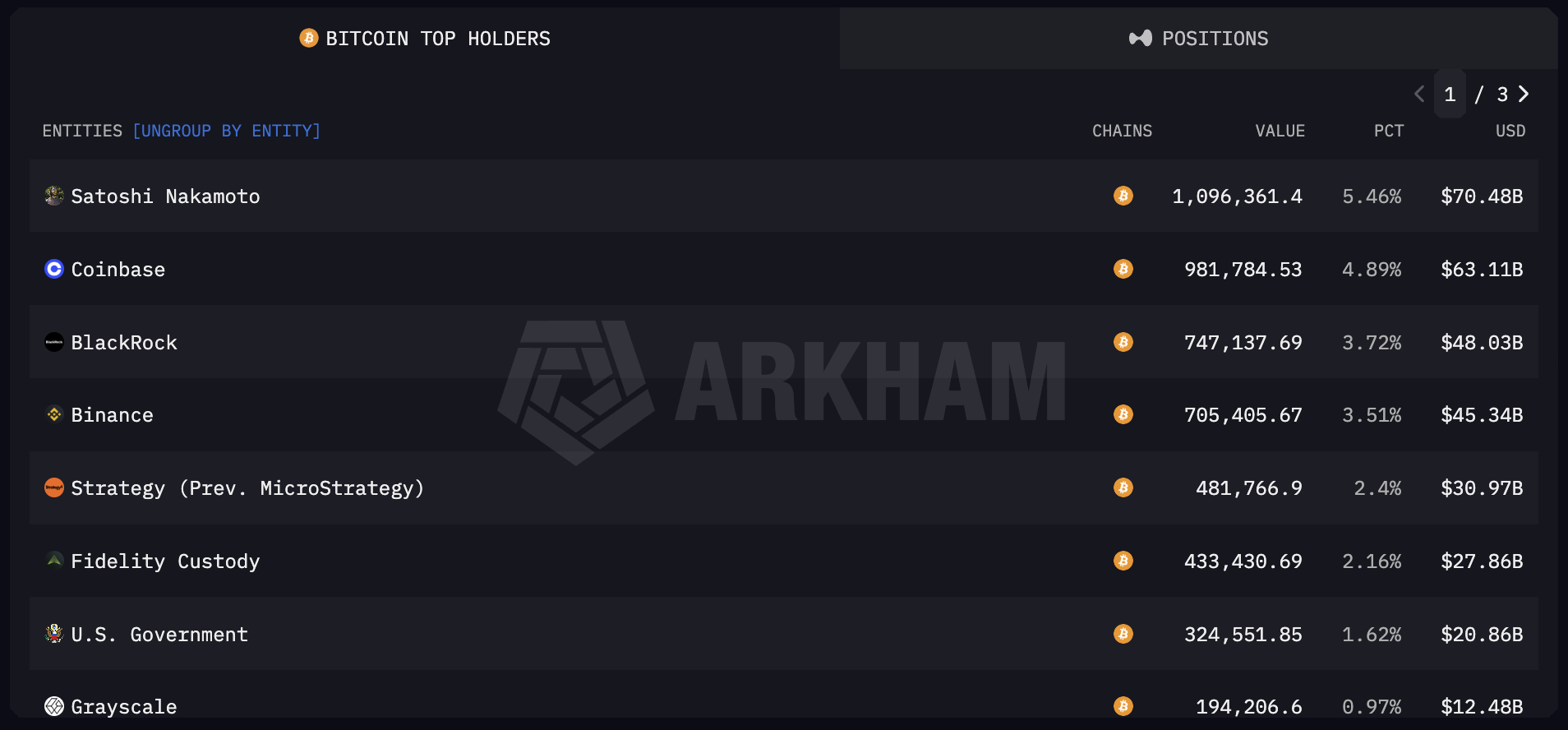
Wallets attributed to Bitcoin’s pseudonymous creator hold 1,096,361 BTC, valued at approximately $82.99 billion, according to the blockchain intelligence platform Arkham. Their value has increased by $12.37 billion in just 30 days as Bitcoin rallied 17.5%.
SATOSHI IS UP $12 BILLION THIS MONTH
Satoshi Nakamoto's 1,096,361 BTC is now worth $82.99B, up $12.37B over the past 30 days as Bitcoin gained 17.5%.
At roughly $75,700 per Bitcoin, a 1% move in BTC now changes the paper value of Satoshi’s estimated holdings by around $830 million.
The latest surge comes after a volatile summer for Bitcoin. BTC fell toward $60,000 in late August before recovering to above $70,000, although it remains well below its October 2025 record high of $126,000.
Try Our Recommended Crypto Exchanges
Sponsored
Disclosure
We sometimes use affiliate links in our content, when clicking on those we might receive a commission at no extra cost to you. By using this website you agree to our terms and conditions and privacy policy.
Arkham attributes roughly 22,000 early Bitcoin addresses to Nakamoto using the “Patoshi Pattern,” a distinctive mining pattern identified across blocks produced during Bitcoin’s earliest period.
Arkham estimates that the addresses collectively contain about 1.096 million BTC, or roughly 5.5% of Bitcoin’s supply, making Nakamoto the largest identified individual Bitcoin holder in its rankings. The company estimates the coins were earned from mining around 22,000 blocks.
The attribution is important: ownership of every coin has not been cryptographically proven to belong to Nakamoto. Researchers infer the connection from early mining behavior associated with Bitcoin’s creator.
17 Years of Bitcoin Price Swings
What makes the estimated fortune unusual is how little of it appears to have been touched.
Arkham describes its Satoshi cluster as effectively dormant, despite Bitcoin passing through multiple bull markets and crashes since its launch in 2009.
Top Bitcoin-holding entities (as of August 2026). | Source: Arkham
Independent research broadly supports the picture of an overwhelmingly dormant stash, although estimates and definitions vary. A September Bitquery audit found 1,023,352 BTC provably unmoved within its stricter reconstruction of the Patoshi set. It also stressed that linking the Patoshi miner to Nakamoto remains a strong but circumstantial inference.
At today’s valuation, that dormant position is approaching $83 billion again.
And with more than one million BTC attributed to Satoshi, every major Bitcoin rally can add billions to one of crypto’s largest and most closely watched paper fortunes.
Seven Senate Democrats who voted against advancing the CLARITY Act now say they remain committed to passing crypto market-structure legislation.
Bitwise CIO Matt Hougan responded with a terse “Fool me once…” as parts of the crypto industry questioned whether another deal could be reached.
Ripple CTO Emeritus David Schwartz argued that opposition tied to stablecoin yields ultimately protects bank profitability, challenging Sen. Josh Hawley’s rationale for voting against the bill.
Sens. Kirsten Gillibrand, Angela Alsobrooks, Cory Booker, Catherine Cortez Masto, Ruben Gallego, Mark Warner and Raphael Warnock said they remain committed to working across the aisle to pass legislation addressing regulatory certainty, consumer protection and ethics rules for elected officials.
The math remains difficult. The procedural vote needed 60 votes but received only 49. Even if all seven Democrats now backing further negotiations switched to yes, that alone would produce 56 votes, assuming every other vote remained unchanged.
Try Our Recommended Crypto Exchanges
Sponsored
Disclosure
We sometimes use affiliate links in our content, when clicking on those we might receive a commission at no extra cost to you. By using this website you agree to our terms and conditions and privacy policy.
Hougan responded to the Democratic statement with just three words: “Fool me once…”
His reaction captures broader frustration following months of negotiations over legislation intended to establish clearer boundaries between the SEC and CFTC and create a federal market structure for digital assets.
Time is another problem. StoneX analysts said there are only 14 congressional working days remaining before campaign season, while the House has canceled its final two weeks of September. That could leave a post-election lame-duck session as one of the remaining opportunities for another push this year.
Republican Sen. Josh Hawley, one of four Republicans who did not support advancing the bill, argued that allowing stablecoin rewards could draw deposits away from community banks, reducing the money available for lending to Missouri farmers and small businesses.
He said the quiet part out loud. It's about protecting bank profits. https://t.co/73Bnqt3o4k
Schwartz challenged that reasoning, arguing that restricting competing yield products ultimately protects the commercial banking model and bank profits rather than consumers.
That dispute goes to one of the hardest questions facing CLARITY negotiations: whether stablecoin issuers or affiliated platforms should be able to offer rewards that compete with bank deposits.
For now, the seven Democrats have offered no revised bill text or timetable for another vote. Their statement keeps negotiations politically alive, but the 60-vote threshold means any CLARITY Act comeback still requires additional senators to change their position.
The Fed’s new dot plot keeps the median federal funds rate at 4.1% through the end of 2027.
Policymakers project another 25-basis-point hike by year-end 2026, following September’s increase to 3.75%-4.00%.
Higher-for-longer rates could pressure Bitcoin by keeping Treasury yields elevated and making yield-bearing assets more attractive.
The Federal Reserve’s latest interest-rate projections have delivered a potentially significant warning for Bitcoin: high borrowing costs may persist much longer than markets had expected.
The Federal Open Market Committee raised its benchmark interest rate by 25 basis points on Wednesday, taking the federal funds target range to 3.75%-4.00%. The decision, the Fed’s first rate increase in three years, was approved unanimously by a 12-0 vote.
However, the rate increase itself was widely anticipated. The bigger surprise came from the Fed’s updated “dot plot,” which showed policymakers expecting interest rates to remain above 4% through the end of 2027.
The median projection for the federal funds rate now stands at 4.1% for both the end of 2026 and 2027, before declining only modestly to 3.9% in 2028 and 3.6% in 2029.
For Bitcoin, which has historically benefited from periods of expanding liquidity and lower interest rates, the prospect of a prolonged “higher-for-longer” environment could create another macroeconomic obstacle.
Try Our Recommended Crypto Exchanges
Sponsored
Disclosure
We sometimes use affiliate links in our content, when clicking on those we might receive a commission at no extra cost to you. By using this website you agree to our terms and conditions and privacy policy.
The September dot plot revealed a substantially more hawkish outlook than the Fed presented earlier this year.
Of the 18 policymakers who submitted projections for 2026, 12 expect the federal funds rate midpoint to reach 4.125% by year-end, implying another 25-basis-point increase from the new range.
Four see rates reaching 4.375%, implying another 50 basis points of tightening, while only two expect rates to remain around current levels.
The message becomes particularly striking in 2027.
🚨 THE FED’S DOT PLOT JUST SENT A HUGE MESSAGE TO THE BOND MARKET.
The Fed hiked rates today to 3.75%–4.00%.
Its new projections point to ANOTHER hike by year-end, then no cuts in 2027.
The median projected rate stays around 4.1% through the end of next year.
Eight officials project rates at 4.375% at the end of next year, while another six see them at 4.125%. Only four officials expect rates below today’s level.
That leaves the median projection at 4.1%, meaning the Fed currently sees no net rate cuts during 2027.
The outlook represents a sharp reversal from March, when policymakers were still projecting rate reductions across 2026 and 2027.
Fed officials also raised their economic growth expectations while keeping inflation concerns elevated. The median GDP growth projection stands at 2.3% for 2026 and 2.4% for 2027, while core PCE inflation is projected at 3.4% this year before easing to 2.5% in 2027.
Why 4.1% Rates Could Pressure Bitcoin
The Fed’s projected rate path matters for Bitcoin because higher interest rates increase the attractiveness of yield-bearing assets while tightening financial conditions across markets.
When investors can earn relatively high returns from cash, money-market funds or government bonds, the opportunity cost of holding non-yielding assets such as Bitcoin increases.
Fed September rate decision, key takeaways:
1. The Fed raised the federal funds target range 25bp to 3.75%-4%, its first hike in three years and in line with market expectations.
2. The vote was unanimous at 12-0. July's decision drew three dissents at 9-3.
Treasury yields were already elevated ahead of the decision. Bitcoin entered Wednesday trading near $76,000 after falling toward a four-week low, with rising yields and uncertainty surrounding monetary policy adding pressure to risk assets.
If markets begin to price in the Fed’s new trajectory more aggressively, Treasury yields could remain an important variable for Bitcoin.
The September projections are not a commitment, however. The dot plot represents individual policymakers’ assessments of appropriate monetary policy based on current economic assumptions and can shift considerably as inflation, employment, and growth data change.
Bitcoin Faces a Higher-for-Longer Liquidity Test
Bitcoin’s next macro challenge may therefore be less about Wednesday’s 25-basis-point hike and more about how long restrictive monetary conditions persist.
The Fed said inflation remains elevated and that its latest rate hike would support a “timelier” return to its 2% inflation target.
That language, combined with the dot plot, suggests policymakers are not yet preparing for a rapid return to easier monetary policy.
For crypto investors, the key transmission mechanism will likely be the bond market. Persistently elevated Treasury yields can tighten financial conditions, strengthen competition from yield-bearing assets, and reduce investors’ willingness to take exposure to volatile assets.
There is also an important caveat: the relationship between Fed policy and Bitcoin is not constant. Recent analysis has pointed to weaker correlations between Bitcoin and traditional assets, while crypto-specific developments have at times outweighed macroeconomic catalysts.
Still, the Fed’s September projections remove one potential bullish assumption from the equation.
Rather than delivering meaningful rate cuts next year, policymakers currently expect the federal funds rate to remain around 4.1% through the end of 2027.
For Bitcoin, that means the hoped-for liquidity tailwind may be considerably further away than investors thought.
Hackers hijacked HBO Max’s verified Reddit account and pushed 108 malicious ads in roughly 48 hours.
The PasteSwitch campaign targeted Windows and macOS users with information stealers, crypto clippers, and counterfeit wallet applications.
Reddit locked the compromised account and removed the ads, but the number of victims and any crypto losses remain unknown.
Hackers turned HBO Max’s verified Reddit account into a malware distribution channel, running 108 malicious advertisements in roughly 48 hours that targeted passwords and cryptocurrency wallets.
Security researchers at Hudson Rock and ADAMnetworks linked the attack to a broader campaign they call PasteSwitch, which delivered different malware depending on whether a victim was using Windows or macOS.
‼️ BREAKING: The official HBO Max Reddit account was hijacked and ran malvertising with a ClickFix attack on Reddit for 48 hours, pushing macOS malware to users.
The ad led to a convincing HBO Max landing page where the download button started no download. Instead it produced a… pic.twitter.com/vR34Na9QDt
The breach gave attackers something particularly valuable: the credibility of an established company’s verified account.
Try Our Recommended Crypto Exchanges
Sponsored
Disclosure
We sometimes use affiliate links in our content, when clicking on those we might receive a commission at no extra cost to you. By using this website you agree to our terms and conditions and privacy policy.
The campaign surfaced after a Reddit user spotted an advertisement from the verified u/hbomax account promoting an HBO Max application for macOS. HBO Max does not offer such a native Mac app.
Malicious HBO Max advertising on Reddit. | Source: BleepingComputer
Clicking the ad sent users to a convincing imitation website. Instead of downloading software, visitors were instructed to copy a command and run it through macOS Terminal.
The technique, known as ClickFix, gets victims to execute malicious code themselves rather than relying on a conventional malware download. Windows versions used tools including PowerShell and the Run dialog.
Researchers found the campaign went far beyond a fake streaming app. Of the 108 advertisements, 46 used HBO Max-themed lures, 36 impersonated AI coding software, 15 promoted a fake Mac disk utility and 11 used other developer-tool themes.
Crypto Wallets Were Directly Targeted
Once installed, the malware could steal browser credentials, cookies and other sensitive information.
The operation also deployed AnimateClipper and ZigClipper, malware designed to replace copied cryptocurrency addresses so funds can be redirected to attacker-controlled wallets.
Researchers also identified counterfeit cryptocurrency wallet applications designed to capture recovery phrases.
The attackers even used Binance Smart Chain smart contracts as part of their command-and-control infrastructure. Hudson Rock identified 36 onchain changes between March and July 2026 linked to the same controller address, allowing the malware infrastructure to rotate domains.
Reddit told TechCrunch that the HBO Max advertising account had been compromised and used to distribute malicious links. The platform subsequently locked the account and removed the ads.
How the account was initially compromised remains unclear. More importantly for crypto users, researchers have not established how many people installed the malware or how much cryptocurrency, if any, was stolen.
Two House committees advanced major crypto bills Wednesday, covering a federal Strategic Bitcoin Reserve and the taxation of digital assets.
The Digital Asset Tax Certainty Act passed the House Ways and Means Committee 38-5, with provisions covering transaction fees, mining, staking, and wash-sale rules.
The moves came one day after the Senate failed to advance the CLARITY Act, showing that other parts of Congress’s crypto agenda remain active despite that setback.
Two major crypto bills moved forward in the US House on Wednesday, giving Washington’s digital-asset agenda fresh momentum just one day after the Senate blocked the CLARITY Act.
The House Ways and Means Committee voted 38-5 to advance the Digital Asset Tax Certainty Act, a sweeping package designed to rewrite how cryptocurrencies are treated under federal tax law. Separately, the House Financial Services Committee advanced legislation to place the federal government’s Bitcoin holdings into a statutory Strategic Bitcoin Reserve.
PASSED: The Ways and Means Committee just passed the Digital Asset Tax Certainty Act — a historic step toward establishing a clear tax framework for digital assets.
Through strong bipartisan collaboration, Republicans and Democrats came together to modernize outdated tax rules… pic.twitter.com/g5aUK7TVNL
Neither measure is law yet. Both still face additional votes in Congress.
Their committee’s progress nevertheless opens two new fronts in the US crypto debate: whether Washington should hold Bitcoin as a long-term reserve asset and how Americans should be taxed on mining, staking, trading, or spending digital assets.
Try Our Recommended Crypto Exchanges
Sponsored
Disclosure
We sometimes use affiliate links in our content, when clicking on those we might receive a commission at no extra cost to you. By using this website you agree to our terms and conditions and privacy policy.
The American Reserve Modernization Act, H.R. 8957, would establish a Strategic Bitcoin Reserve and a separate Digital Asset Stockpile within the Treasury Department.
BREAKING: 🇺🇸 U.S. House Financial Services Committee advances the Strategic Bitcoin Reserve bill
The reserve would house federally held Bitcoin obtained primarily through criminal and civil forfeiture, while other government-owned digital assets would be kept separately. House Financial Services Committee Chairman French Hill described the proposal as a way to bring crypto holdings scattered across federal agencies under consistent Treasury custody and oversight.
The legislation is significant because the reserve concept currently rests on executive action.
President Donald Trump signed an executive order in March 2025 establishing a Strategic Bitcoin Reserve and directing the government to retain certain forfeited Bitcoin rather than sell it. H.R. 8957 would put the reserve into federal statute, making its legal basis less dependent on the policy of a particular administration.
The proposal has also included restrictions intended to treat the government’s Bitcoin as a long-term holding rather than an actively traded asset. Committee materials included a substitute amendment to H.R. 8957 as lawmakers considered the final language Wednesday.
The legislation was introduced by Alaska Republican Rep. Nick Begich. It had 23 cosponsors going into Wednesday’s committee consideration, although support within the Financial Services Committee itself was heavily Republican.
House Advances First Broad Crypto Tax Framework
The tax package could have more immediate consequences for everyday crypto users.
The Digital Asset Tax Certainty Act, H.R. 10357, would establish federal rules covering mining, staking, transaction fees, reporting requirements, and the treatment of digital assets under rules already applied to traditional investments.
One provision would provide an exception for certain crypto network or transaction fees of $10 or less, reducing the tax burden associated with small blockchain transactions.
The bill would also bring digital assets under wash-sale rules. Those rules generally prevent investors from selling an asset at a loss to claim a tax benefit and immediately buying back substantially the same investment.
Mining and staking rewards would be treated as ordinary income under the proposal, although lawmakers are still debating when that income should be recognized for tax purposes.
The 38-5 committee vote gave the legislation bipartisan support, though not every lawmaker agreed with the package. Some Democrats argued that portions of the bill amount to tax benefits for wealthy crypto investors and the industry.
Crypto’s Washington Push Isn’t Over After CLARITY
Wednesday’s votes came less than 24 hours after a much larger crypto bill ran into trouble across the Capitol.
The defeat exposed disagreements over issues including ethics provisions and stablecoin-related competition with banks.
The House action shows that those disputes have not stopped narrower crypto legislation from moving through Congress.
The Bitcoin reserve bill addresses government-held assets, while the tax package tackles questions that have persisted for years about how existing tax law applies to blockchain transactions.
Both measures still have a long route ahead. Committee approval advances legislation; it does not guarantee a House floor vote, Senate passage, or presidential signature.
The House is also expected to leave Washington ahead of the November elections, meaning the tax legislation could slip into the post-election lame-duck session.
For crypto policy, Washington is therefore moving on two tracks: the Senate’s attempt at comprehensive market-structure legislation has stalled, while more targeted proposals covering Bitcoin reserves and crypto taxes are still advancing.
BRICS is exploring deeper cross-border payment links among 11 economies that together account for roughly 41% of global GDP on a PPP basis.
The bloc wants faster, cheaper payments and more local-currency settlement, potentially tackling some of the same friction XRP was designed to address.
However, BRICS leaders have not formally adopted a unified “BRICS Pay” network, and there is no indication that XRP will be part of the infrastructure.
BRICS is working to connect payment systems across an economic bloc that represents roughly 41% of global GDP on a purchasing-power-parity basis, potentially creating a massive new cross-border payments network without relying on XRP.
That raises an uncomfortable question for the XRP narrative: if some of the world’s largest emerging economies can connect their own payment rails directly, how much need is there for a crypto bridge asset?
The 11-member BRICS bloc includes China, India, Brazil, Russia, Indonesia, Saudi Arabia, and the UAE, among others. Collectively, the group represents about 49.5% of the world’s population and roughly 41% of global GDP on a PPP basis in 2026, according to figures based on the IMF’s April World Economic Outlook.
Those numbers make even incremental progress on payments significant.
At the New Delhi summit on Sept. 12, BRICS leaders acknowledged work by the BRICS Payment Task Force on making payment and messaging channels more interoperable and facilitating greater settlement in members’ local currencies.
New Trending Crypto Wallet Offers
Sponsored
Disclosure
We sometimes use affiliate links in our content, when clicking on those we might receive a commission at no extra cost to you. By using this website you agree to our terms and conditions and privacy policy.
India’s UPI and Brazil’s Pix are already enormous domestic networks. Instant-payment systems across the 11 BRICS economies processed more than $10 trillion over the past 18 months, according to the Financial Times, although their use for cross-border payments remains relatively limited.
What is BRICS Pay, and can it rival the West’s SWIFT payments system?
'BRICS Pay will connect national payment systems of member countries to each other so international payments can be made more easily.
This will mean that trading transactions between entities or individuals…
UPI alone has more than 550 million users, while Pix has more than 170 million. Both are increasingly looking beyond their domestic markets through international connections.
That scale is what makes the XRP question interesting.
XRP’s core proposition as a bridge asset is to provide liquidity between currencies and make international settlement more efficient, without requiring institutions to maintain pre-funded accounts across multiple markets.
BRICS countries are now exploring whether some of that friction can be removed by making their existing payment infrastructures communicate directly with one another.
BRICS Pay Isn’t One Giant Payment Network
The New Delhi Declaration does not announce a completed BRICS-wide payment system.
Instead, leaders said the BPTF is exploring “pragmatic solutions” for cross-border payments and studying how existing national systems could become more interoperable.
Importantly, the declaration acknowledges there is “no one-size-fits-all approach.”
🚨 Putin Just Declared the Next Monetary System and It’s All Planned For China’s Gold
Putin just told BRICS the IMF, World Bank and WTO are out of date without any reforms while BRICS is set to rollout their new settlement system away from SWIFT and Dollar system.
Separate from the declaration, the Russian Direct Investment Fund, JSC BRICS Pay and BRICS Pay India announced an agreement on Sept. 11 to explore integrating the BRICS Pay project with Indian payment infrastructure and potentially launching pilot cross-border services.
This is important: BRICS Pay exists as an initiative, but it should not be treated as an officially adopted single payment architecture for all BRICS governments.
India has also proposed connecting central bank digital currencies across BRICS economies.
Reuters reported ahead of the summit that New Delhi’s goal was to make international transactions easier and faster rather than replace the dollar as the world’s reserve currency.
Does That Leave XRP Without a Job?
This is where XRP enters the conversation.
As mentioned above, XRP was designed to function as a bridge asset, potentially allowing two parties using different currencies to transfer value without maintaining pre-funded accounts in every destination currency.
BRICS is attacking a similar problem from another direction.
Instead of requiring a neutral cryptocurrency, countries could connect domestic payment systems, use CBDCs, or settle transactions directly in local currencies.
India’s UPI and Brazil’s Pix show how large those national rails have already become. Together, the two systems processed more than $10 trillion over the previous 18 months, according to the Financial Times.
But that does not automatically make XRP obsolete.
Connecting payment interfaces is only one part of a cross-border transaction. Countries still need mechanisms for foreign exchange, liquidity, and final settlement when trade flows between two currencies are unbalanced.
Those challenges are particularly important within BRICS because its members have different capital controls, currencies, and geopolitical priorities. Reuters reported that currency-swap arrangements would likely be necessary to address trade imbalances in a deeper BRICS payment network.
No Evidence BRICS Plans to Use XRP
For XRP holders, the clearest takeaway is also the simplest: there is currently no evidence in the New Delhi Declaration that BRICS intends to use XRP.
There is equally no announcement of a unified BRICS cryptocurrency replacing XRP, SWIFT, or the dollar.
What BRICS is building, instead, is a collection of potential connections among national payment systems, local currencies, and possibly CBDCs.
That makes the emerging competition less “BRICS Pay versus XRP” and more about which architecture can solve cross-border liquidity and settlement most efficiently.
If countries can connect their domestic rails and settle directly in national currencies at scale, the need for an independent bridge asset could diminish on those corridors.
If liquidity between those currencies remains fragmented, however, the problem XRP was designed to solve does not simply disappear.
For now, BRICS has demonstrated that it wants more payment options. It has not been demonstrated that XRP is one of them.
The US Strategic Petroleum Reserve has fallen to 285 million barrels, its lowest level since November 1982.
USOR, a Solana token built around a US oil-reserve narrative, trades near $0.0005 with a market cap of roughly $500,000.
Despite its branding, USOR does not represent ownership of or a redeemable claim on US government oil reserves, making the SPR drawdown a narrative catalyst rather than a change in the token’s backing.
America’s emergency oil stockpile has fallen to a level not seen in more than four decades, creating a new backdrop for one small crypto token built around the US oil-reserve narrative.
The US Strategic Petroleum Reserve (SPR) dropped to 285 million barrels last week, its lowest level since November 1982, according to Department of Energy data reported by Reuters.
The decline comes as Washington works through a previously arranged release of 172 million barrels from the emergency reserve.
For US Oil (USOR), a Solana-based token whose branding centers on the idea of an American oil reserve, the historic drawdown has drawn fresh attention to what the token actually represents.
Try Our Recommended Crypto Exchanges
Sponsored
Disclosure
We sometimes use affiliate links in our content, when clicking on those we might receive a commission at no extra cost to you. By using this website you agree to our terms and conditions and privacy policy.
USOR was recently trading around $0.0005, giving the token a market capitalization of approximately $500,000, according to CoinGecko.
The token has gained roughly 47% over the past 30 days, although it remains down about 18% over the past 7 days and approximately 99% below its January all-time high of $0.07219. Trading activity is also thin, with recent 24-hour volume at only around $3,100.
That combination makes USOR a highly volatile micro-cap token whose price can move sharply on relatively small trading volumes.
But investors should not confuse those claims with ownership of America’s Strategic Petroleum Reserve.
CoinGecko specifically warns that USOR is not backed by physical assets. There is also no evidence from the Department of Energy that holding the token provides ownership or redemption rights over federally controlled SPR crude.
Why the Strategic Petroleum Reserve’s 43-Year Low Matters
The SPR was established to provide emergency oil supplies during serious disruptions, meaning its depleted level has renewed attention on US energy security at a particularly volatile moment.
Oil markets are already dealing with significant geopolitical disruption. Brent crude was trading above $105 per barrel Wednesday, while WTI was above $102, despite both declining during the session as additional Saudi supply eased some concerns.
Meanwhile, the EIA reported that US commercial crude inventories fell to 423.4 million barrels in the week ending Sept. 11.
For USOR, those developments create an unusual disconnect.
The real US strategic reserve is becoming scarcer just as oil security has returned to the center of global markets. That could increase attention around tokens using oil-related narratives.
But USOR’s price does not directly track the number of barrels held in the SPR, nor does a decline in SPR holdings automatically increase the token’s fundamental value.
That leaves USOR facing a new reality: the oil-reserve narrative surrounding its name may be getting stronger, while its actual connection to America’s shrinking emergency stockpile remains unproven.
The Federal Reserve raised rates by 25 basis points to 3.75%–4.00%, its first hike since July 2023.
The decision was unanimous, with all 12 voting FOMC members supporting the increase.
New projections show most policymakers expect another 25-basis-point hike in 2026, keeping pressure on Bitcoin and other risk assets.
The Federal Reserve raised interest rates by 25 basis points on Wednesday, delivering its first hike in more than three years as policymakers stepped up efforts to bring persistent inflation back toward target.
The Federal Open Market Committee voted 12-0 to increase the federal funds target range from 3.50%–3.75% to 3.75%–4.00%.
SUMMARY OF FED DECISION (9/16/2026):
1. Fed hikes interest rates by 25 bps for first time since July 2023
2. The decision was made in a 12-0 unanimous vote
3. Fed says the decision will support a "timelier" return to 2% inflation
“Inflation remains elevated,” the Fed said, adding that the move would support a “timelier return” to its 2% inflation goal. The central bank also struck a firm tone, saying it “will deliver price stability.”
Try Our Recommended Crypto Exchanges
Sponsored
Disclosure
We sometimes use affiliate links in our content, when clicking on those we might receive a commission at no extra cost to you. By using this website you agree to our terms and conditions and privacy policy.
The bigger development for financial markets came from the Fed’s updated projections.
Sixteen of 18 policymakers now expect at least one additional 25-basis-point increase before the end of 2026, while only two see rates remaining at their new level. The median projection puts the policy rate at 4.00%–4.25% at the end of 2026 — and still there at the end of 2027.
The Fed also raised its 2026 inflation forecast. PCE inflation is now projected at 3.7%, compared with 3.6% in June, and policymakers do not expect inflation to return to the 2% target until 2029.
At the same time, the central bank raised its 2026 economic growth forecast from 2.2% to 2.3% and lowered its year-end unemployment projection from 4.3% to 4.1%.
What Does the Fed Interest Rate Hike Mean for Bitcoin?
The 25-basis-point increase itself was widely anticipated, with markets assigning a more than 90% probability to the move before the announcement. Bitcoin was trading near $75,580 shortly before the decision.
The more important signal for crypto is the Fed’s indication that tightening may not be finished.
Higher rates can weigh on Bitcoin and other risk assets by increasing yields available on government debt and tightening broader financial conditions. The 10-year Treasury yield briefly topped 5% on Tuesday, reaching its highest level since 2007.
Attention now turns to Fed Chair Kevin Warsh‘s press conference and what could trigger the additional rate increase policymakers are projecting.
CFTC Chairman Michael Selig said the agency is “ready to ship” crypto rules using its existing statutory authority.
The Senate rejected a motion to advance the CLARITY Act by 49 votes to 50, well short of the 60-vote threshold.
Crypto supporters reacted positively, though agency-led regulations could face legal challenges without new legislation.
Commodity Futures Trading Commission Chairman Michael Selig said the agency is prepared to move forward with new crypto regulations after the Senate blocked the CLARITY Act on Tuesday.
Try Our Recommended Crypto Exchanges
Sponsored
Disclosure
We sometimes use affiliate links in our content, when clicking on those we might receive a commission at no extra cost to you. By using this website you agree to our terms and conditions and privacy policy.
“President Trump promised to deliver a future-proof crypto asset regulatory market structure one way or the other, and we will help him get the job done using our existing statutory authorities.”
Selig ended the statement with an unmistakably defiant message:
“The U.S. is and will remain the crypto capital of the world. The CFTC is locked in and ready to ship its rules for the new frontier of finance.”
Selig’s statement suggests the Trump administration will now pursue parts of its crypto agenda through agency rulemaking rather than wait for Congress to revive the bill.
That route could allow the CFTC to clarify how existing commodities laws apply to digital assets and trading platforms.
However, regulations issued without new legislation may face court challenges over whether the agency has exceeded the authority granted to it by Congress.
CLARITY Act Falls Short in Senate
The remarks came one day after senators rejected to proceed with the Clarity Act.
The motion received 49 votes in favor and 50 against, leaving it 11 votes short of the 60 needed to overcome the Senate’s cloture threshold.
Bitcoin fell below $76,000 after the US Senate failed to advance the CLARITY Act.
Veteran trader Peter Brandt previously predicted an Oct. 4 market bottom, potentially in the high-$40,000 range.
Bitcoin must first lose a major support cluster near $71,000 before Brandt’s bearish scenario becomes technically credible.
Bitcoin’s price slipped below $76,000 on Wednesday, bringing veteran trader Peter Brandt’s warning of an October plunge into the high-$40,000s back into focus.
The world’s largest crypto traded near $75,877, its lowest level in almost four weeks, after losing nearly 4% during Tuesday’s session, according to CoinMarketCap.
Bitcoin has now surrendered most of its September recovery and sits roughly 40% below the record high of approximately $126,000 reached in October 2025.
Try Our Recommended Crypto Exchanges
Sponsored
Disclosure
We sometimes use affiliate links in our content, when clicking on those we might receive a commission at no extra cost to you. By using this website you agree to our terms and conditions and privacy policy.
As CCN reported in July, Brandt made an unusually specific prediction that Bitcoin’s bear market would bottom on Oct. 4.
“I’ll go out on a limb and say we bottom on October 4th. So we’ll see,” he said during an interview with Cointelegraph.
Brandt based the forecast partly on Bitcoin’s historical four-year cycle.
Previous bull markets have often peaked between 16 and 18 months after a halving, then entered a downturn lasting approximately one year.
Bitcoin’s latest record was set on Oct. 6, 2025, about 18 months after the April 2024 halving. A bottom in early October 2026 would therefore arrive almost exactly one year after the peak.
Brandt’s accompanying price scenario placed Bitcoin in the high-$40,000 range.
A fall to around $48,000 would represent a 62% peak-to-trough decline and require another drop of roughly 37% from current prices.
A fall all the way to $40,000 would require Bitcoin to lose approximately 47% from $76,000.
CLARITY Act Defeat Hits Bitcoin
Bitcoin’s latest decline accelerated after the Senate failed to advance the CLARITY Act.
The procedural vote ended 49–50, leaving the legislation 11 votes short of the 60 required to overcome the Senate threshold and proceed.
Three Republican senators joined Democrats in opposing the motion.
Despite some bulls remaining, its failure forced markets to remove some of the regulatory optimism that had supported Bitcoin’s late-summer recovery.
Institutional demand also weakened.
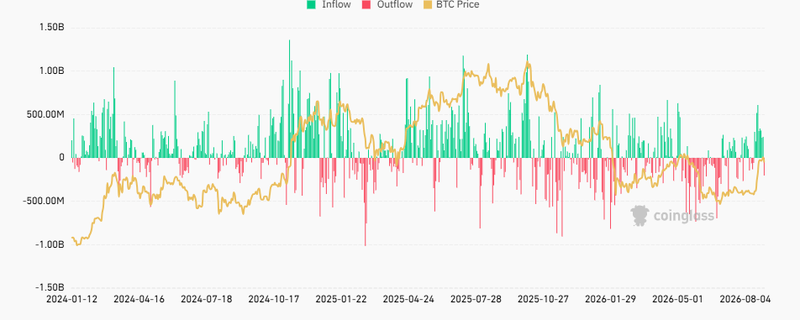
US-spot Bitcoin exchange-traded funds recorded approximately $450 million in net outflows on Tuesday, reversing the previous session’s $160 million inflow, according to SoSoValue data cited by FXStreet.
The setback came as investors also await the Federal Reserve’s interest-rate decision.
What Stands Between Bitcoin and $40K Price?
Despite the deteriorating outlook, Bitcoin remains far above Brandt’s target and continues to trade above several important moving averages.
The 50-day exponential moving average sits near $73,567, while the 200-day EMA is close to $73,105.
The 100-day EMA provides additional support around $71,384, analysts said.
Together, those levels form a considerable demand zone between approximately $71,000 and $74,000.
However, Brandt is also not alone in identifying October as a potential turning point.
CCN previously reported that NYDIG modeled a historically based scenario in which Bitcoin falls to between $38,000 and $39,000 in early October.
Brandt Remains a Long-Term BTC Bull
Brandt’s short-term warning should not be confused with a permanently bearish view of Bitcoin.
The trader has predicted that Bitcoin could reach between $250,000 and $300,000 during its next major cycle in 2029.
However, with Oct. 4 less than three weeks away, his remarkably precise prediction is about to face its decisive test.
A Texas woman says scammers threatened her with immediate arrest and pressured her into depositing $23,700 at Bitcoin kiosks while she held her infant.
Her lawsuit alleges Athena Bitcoin’s safeguards failed to stop the transactions.
The victim reportedly recovered only about 12% of her money.
A US mother has sued Bitcoin ATM operator Athena Bitcoin after scammers allegedly threatened to arrest her unless she deposited $23,700 into the company’s kiosks.
Meagan Venable, a resident of Pearland, Texas, filed the lawsuit in Texas after she allegedly was targeted by thieves while holding her baby.
Try Our Recommended Crypto Exchanges
Sponsored
Disclosure
We sometimes use affiliate links in our content, when clicking on those we might receive a commission at no extra cost to you. By using this website you agree to our terms and conditions and privacy policy.
According to court documents cited by the Houston Chronicle, the scammers told Venable that she needed to pay “bond money” immediately or face arrest.
Holding her infant during the incident and fearing that she would be taken into custody, Venable reportedly made cash deposits at two Athena Bitcoin kiosks.
Venable recovered only around 12% of the $23,700, leaving her with losses of approximately $20,856.
Former Ohio Attorney General Marc Dann, whose firm represents Venable, argued that Venable’s case reflects broader weaknesses in how crypto kiosks process potentially suspicious transactions.
Dann’s firm filed a separate lawsuit against Athena Bitcoin in August on behalf of Douglas Schuler, a 62-year-old Houston resident.
According to that complaint, someone impersonating a Harris County sheriff’s deputy called Schuler in February and demanded money for a supposed bond.
He allegedly deposited more than $20,000 in a single transaction, an amount the lawsuit claims exceeded limits previously publicized by the company.
How Bitcoin ATMs Work
The complaints argue that Athena Bitcoin failed to implement effective safeguards despite knowing that criminals frequently use cryptocurrency kiosks to extract money from victims.
Athena’s existing protections allegedly rely heavily on screen-based warnings and customer attestations.
The lawsuits contend that such measures are inadequate when a frightened victim is following a scammer’s instructions in real time.
Once cash is deposited, the kiosks can convert it into Bitcoin and transmit the crypto to the recipient’s wallet.
Because blockchain transactions are generally irreversible, the money may become difficult or impossible to recover within minutes.
The plaintiffs argue that Athena could introduce stronger protections, including transaction holds, additional verification and direct intervention when deposits display common fraud indicators.
Bitcoin ATM Scam Losses Surged 31% in One Year
Crypto kiosk fraud is far from a Texas-only problem.
The FBI received 10,956 complaints in 2024 mentioning crypto ATMs or kiosks, with reported losses totaling $246.7 million.
Complaints almost doubled from the previous year, while losses increased by 31%, according to the agency’s 2024 Internet Crime Report.
Older Americans suffered a disproportionate share of the damage.
People over 60 submitted 2,674 complaints in cases where age information was available and reported losing more than $107.2 million.
Tech-support schemes produced the largest crypto kiosk losses, costing victims approximately $107.4 million.
Government impersonation scams accounted for another $44.6 million, while fraudulent investment schemes generated losses of about $38.1 million.
In a separate analysis covering the first half of 2024, the FTC found that approximately 86% of reported Bitcoin ATM fraud losses involved government impersonation, business impersonation or technical-support scams.
Athena Bitcoin operates approximately 800 kiosks in Texas and nearly 3,000 nationwide, according to the lawsuit.
The company has issued scam warnings since 2017 and says high-value deposits receive additional scrutiny.
However, the lawsuits allege that those protections rely too heavily on screen warnings and customer confirmations.
Why One Lost BTC Fortune Was Recoverable
The alleged kiosk scam involving Venable ended with Bitcoin being transferred to a wallet outside her control.
A recently reported British investor’s missing fortune presented a different problem, the assets were tied to a failed exchange.
The investor, identified as Chris, recently recovered dozens of BTC worth approximately £3.3 million, according to LBC.
Chris had purchased Bitcoin through Intersango after entering the market in 2011 with an initial £1,500 investment.
When the exchange stopped operating several years later, he could no longer access a balance then worth around £4,000.
The breakthrough came when lawyers reconstructed his ownership using account information and transaction records.
CEL Solicitors prepared to pursue proceedings in the US, but negotiations reportedly resolved the dispute before it reached a court hearing.
The recovered Bitcoin was subsequently transferred to an account controlled by Chris.
He intends to keep part of the holding while converting some into cash to improve his family’s living arrangements.
The Federal Reserve raised interest rates by 25 basis points to 3.75%–4.00%, its first rate hike since July 2023.
The decision was unanimous, with all 12 voting FOMC members backing the increase as the Fed seeks a “timelier” return to 2% inflation.
The Fed’s updated projections point to one more 25-basis-point hike in 2026, putting the future rate path at the center of the outlook for Bitcoin and other risk assets.
The Federal Reserve raised interest rates by 25 basis points Wednesday for the first time since July 2023, taking the federal funds target range to 3.75%–4.00% as policymakers respond to persistent inflation.
The Federal Open Market Committee approved the move in a unanimous 12-0 vote and said the increase would support a “timelier return of inflation to 2 percent.”
BREAKING: The Federal Reserve officially hikes interest rates by 25 basis points, marking its first rate hike since July 2023.
This ends the longest Fed interest rate pause since 2008.
But for Bitcoin and the broader crypto market, the bigger question may now be what comes next.
The decision was largely anticipated by markets. Ahead of the announcement, fed funds futures had assigned more than a 90% probability to a quarter-point increase.
That leaves the Fed’s updated projections and Chair Kevin Warsh’s comments as the next major signals for markets.
A Reuters poll published Monday similarly found that 86 of 101 economists, or 85%, expected a quarter-point hike at the Sept. 15–16 meeting.
With the hike now heavily priced into financial markets, attention shifted toward the Fed’s updated economic projections, particularly the dot plot, which shows where individual policymakers expect interest rates to go.
For crypto investors, those dots could provide a much stronger signal than Today’s rate move.
Try Our Recommended Crypto Exchanges
Sponsored
Disclosure
We sometimes use affiliate links in our content, when clicking on those we might receive a commission at no extra cost to you. By using this website you agree to our terms and conditions and privacy policy.
Bitcoin was trading around $75,580 shortly before the Fed announcement, according to Reuters, after falling almost 4% Tuesday. The cryptocurrency had dropped as low as $75,026, leaving it near its weakest level in four weeks.
Importantly, that decline cannot be attributed entirely to expectations of tighter monetary policy.
Bitcoin’s Tuesday selloff followed the U.S. Senate’s failure to advance the CLARITY Act, dealing a setback to hopes for comprehensive US crypto market-structure legislation. Reuters said Bitcoin continued to feel the effects of that vote Wednesday ahead of the Fed decision.
The Fed’s decision nevertheless introduces another challenge for crypto markets.
Higher interest rates increase yields available on government debt and tighten financial conditions, potentially reducing investor appetite for volatile assets such as Bitcoin.
The US 10-year Treasury yield had already briefly crossed 5% Tuesday, before retreating to around 4.96% ahead of the Fed announcement.
Why Did the Fed Raise Rates?
The Fed’s move comes as inflation remains above its 2% target.
The central bank said Wednesday’s action was designed to accelerate inflation’s return toward that goal. It also described job gains as strong and said unemployment had changed little.
The quarter-point increase itself was not a major surprise. Markets had assigned a more than 90% probability to a 25-basis-point hike before the announcement.
That makes what the Fed signaled about future rates potentially more important for Bitcoin than Wednesday’s hike alone.
Dot Plot Signals Another Rate Hike
The Fed’s updated dot plot shows policymakers expect the federal funds rate to reach a median 4.1% by the end of 2026, implying another quarter-point increase from the new range.
🚨 THE FED’S DOT PLOT JUST SENT A HUGE MESSAGE TO THE BOND MARKET.
The Fed hiked rates today to 3.75%–4.00%.
Its new projections point to ANOTHER hike by year-end, then no cuts in 2027.
The median projected rate stays around 4.1% through the end of next year.
More notably, the median projection remains at 4.1% at the end of 2027, implying policymakers currently foresee no rate cuts next year.
That matters for Bitcoin because it suggests restrictive monetary conditions could persist longer than investors hoping for renewed easing might have expected.
Rather than Wednesday’s widely anticipated 25-basis-point move, the prospect of another hike followed by rates remaining elevated through 2027 could become the more consequential macro signal for crypto markets.
What Does the Fed Rate Hike Mean for Bitcoin?
Bitcoin now faces two separate pressures: renewed uncertainty over US crypto regulation following the CLARITY Act setback and a Fed signaling that its tightening may not yet be finished.
Still, Wednesday’s hike was overwhelmingly anticipated, meaning the rate increase itself was largely reflected in market expectations before the announcement.
The immediate question for Bitcoin is therefore less about the 25 basis points delivered Today and more about whether the Fed follows through with another hike and how long rates remain elevated afterward.
The CLARITY Act failed to clear the Senate’s 60-vote threshold despite more than a year of negotiations and 126 changes Republicans said Democrats requested.
Trump-related ethics concerns dominated the debate, but fights over bank deposits, securities rules, enforcement, and the legislative calendar also fractured support.
The 50-49 procedural result does not necessarily kill the bill: Sen. Thom Tillis changed his vote to preserve a route for reconsideration.
After more than a year of negotiations, 126 revisions requested by Democrats and a final weekend scramble to rewrite some of its most controversial provisions, the CLARITY Act still could not get through the Senate’s front door.
The Senate voted 50-49 on Sept. 15 to invoke cloture on the motion to proceed to the Digital Asset Market Clarity Act, leaving supporters 10 votes short of the 60 required. The vote was procedural rather than a vote on final passage.
This afternoon, Senate Democrats proved they were never truly serious about protecting consumers and preserving American leadership. I sat at the table with Senate Democrats working in good faith to get this done while they played games.
This means the Senate did not vote down the substance of the entire bill, but it refused to end debate and move it into formal consideration.
The result was nevertheless striking because the legislation had previously demonstrated at least some bipartisan momentum. It advanced from the Senate Banking Committee 15-9 in May, and Republicans said the final text incorporated 126 substantive changes requested by Democrats.
So how did a bill that had been negotiated for more than a year end up without a single Democratic vote on the floor?
The answer goes well beyond the familiar argument over whether the Securities and Exchange Commission or the Commodity Futures Trading Commission should regulate crypto.
Five different fault lines converged at almost exactly the wrong time.
Try Our Recommended Crypto Exchanges
Sponsored
Disclosure
We sometimes use affiliate links in our content, when clicking on those we might receive a commission at no extra cost to you. By using this website you agree to our terms and conditions and privacy policy.
1. CLARITY Became a Vote on Trump’s Crypto Business, Not Just Crypto Regulation
The biggest obstacle was one that the original market-structure debate was never designed to address: whether a sitting president should be allowed to hold substantial financial interests in an industry his administration regulates.
President Donald Trump reported more than $1.4 billion from crypto businesses in 2025, including more than $500 million in revenue from World Liberty Financial crypto products, according to his government financial disclosure.
That changed the politics surrounding CLARITY.
For Democrats who might otherwise have supported a market-structure framework, the question was no longer simply whether the SEC or CFTC should oversee a particular token.
It was whether Congress could rewrite the rules governing an industry while the president had significant financial exposure to that same industry.
Sen. Mark Warner illustrated the problem particularly clearly. Warner said negotiators had come close to resolving difficult law-enforcement and national-security issues, but the conflict-of-interest question ultimately prevented him from supporting the procedural vote.
Republicans tried to close that gap.
Their final proposal incorporated much of the Tillis-Gallego ethics framework and expanded the role of state attorneys general in enforcement. Republicans described those provisions as among the toughest ethics restrictions imposed on federal elected officials.
Democrats disagreed that the safeguards went far enough. Their late counterproposal sought, among other things, stronger enforcement and a requirement that a president divest once holdings crossed a specified threshold.
That distinction proved crucial.
The dispute was no longer whether CLARITY needed ethics rules. Both sides had effectively accepted that it did.
They could not agree on what those rules were meant to prevent.
2. Crypto Bill Turned Into a Fight Over Bank Deposits
One of the less obvious reasons CLARITY struggled had little to do with Bitcoin, token classifications or decentralized exchanges.
It was about bank deposits.
Payment stablecoins increasingly compete for the same dollars consumers traditionally hold in bank accounts. If crypto platforms can offer rewards or interest-like incentives on stablecoin balances, banking groups argue customers could move deposits from banks into stablecoins.
That became particularly sensitive for community banks.
All 77 state bankers associations, together with the American Bankers Association and Independent Community Bankers of America, pressed senators to tighten the bill’s stablecoin provisions before the vote. They argued that deposit losses could ultimately reduce the money available for mortgages, agricultural lending, and small-business credit.
Republicans attempted an unusual compromise.
The final CLARITY text gave the Treasury secretary authority to intervene if stablecoin incentives caused damaging deposit flight, creating what supporters called a regulatory “circuit breaker.”
But banking groups argued that the mechanism acted too late. Their position was essentially that regulators should not have to wait for substantial deposit flight before closing the loophole.
That transformed an abstract crypto-policy fight into something senators from agricultural and rural states could view through the lens of local credit.
The concern crossed party lines. Republican Sen. Josh Hawley, who ultimately opposed advancing the bill, raised concerns about the consequences for agricultural lending.
That helps explain why CLARITY’s problems were not purely partisan.
CLARITY was trying to regulate crypto market structure while simultaneously refereeing a much bigger fight over who gets to hold America’s cash.
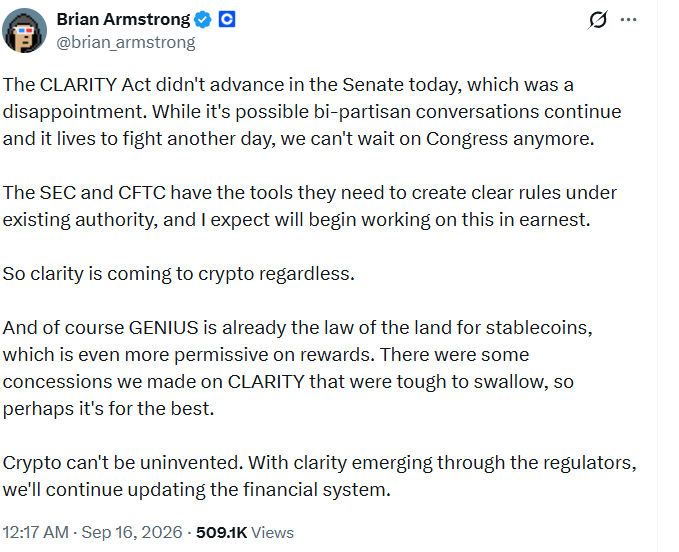
Armstrong Reacts to CLARITY Vote Failure. | Source: @brian_armstrong
3. Crypto Bill Was No Longer Just About Crypto Assets
Another fault line received less attention than the Trump ethics battle: critics argued that CLARITY could affect conventional financial assets as well.
Sen. Elizabeth Warren argued on the Senate floor that provisions in the legislation could allow companies unrelated to crypto to place assets on blockchains and potentially escape protections that otherwise apply under securities law.
She also objected to provisions that expand banks’ ability to conduct activities involving digital assets, including crypto-backed lending, derivatives, and blockchain infrastructure.
Those were arguments made by Warren and other opponents, rather than an agreed interpretation of what the bill would do; supporters said the legislation instead created clearer regulatory guardrails and consumer protections.
That disagreement exposed a deeper problem.
CLARITY started as an attempt to answer a seemingly straightforward question:
When is a digital asset a security, and when is it a commodity?
By the time the Senate reached its vote, lawmakers were debating something much broader: what happens when traditional securities, banks, exchanges and financial products themselves move onto blockchain rails?
That made the legislation harder to contain politically.
A senator did not have to oppose cryptocurrency to worry about how CLARITY might interact with securities law, banking regulation or investor protections.
In other words, the closer crypto gets to mainstream finance, the harder it becomes to write a “crypto-only” law.
4. More Than 100 Compromises Still Could Not Produce a Coalition
Perhaps the strangest part of CLARITY’s failure is how much negotiation preceded it.
The final draft contained 126 substantive changes requested by Democrats, according to Republican sponsors. Those changes covered issues including ethics, stablecoins, developer protections, consumer safeguards and enforcement.
Yet no Democrat ultimately voted to proceed.
That suggests the problem was no longer a collection of individual provisions that could easily be traded away one by one.
The coalition itself had broken down.
Democratic senators who had been viewed as potentially reachable, including Kirsten Gillibrand, Catherine Cortez Masto, Angela Alsobrooks, Cory Booker, and Mark Warner, ultimately opposed advancing the bill.
Here is the full list of votes for Clarity, you are are urged to vote accordingly!
**CLARITY Act cloture — Sept. 15, 2026 — 49 Yes, 50 No, 1 Not Voting**
Alsobrooks — No Baldwin — No Banks — Yes Barrasso — Yes Bennet — No Blackburn — Yes Blumenthal — No Blunt…
Meanwhile, Republicans did not hold their entire conference either.
Susan Collins, Josh Hawley, and Jerry Moran opposed cloture. Thom Tillis ultimately recorded a “no” vote as well, although his switch was procedural rather than opposition to the legislation.
That produced an unusual situation.
The bill had undergone more than a hundred negotiated changes, but those compromises did not add up to 60 votes.
In fact, the number of concessions may reveal something about why CLARITY became so difficult to finish. Every additional issue brought into the negotiations, including stablecoins, DeFi, developer liability, banking, ethics, national security, and enforcement, created another constituency capable of deciding the final text still did not go far enough.
CLARITY was trying to resolve too many unresolved crypto battles in a single piece of legislation.
5. The Senate Ran Out of Political Time
The fifth reason may ultimately prove as important as anything written in the bill.
CLARITY did not merely need more negotiations.
It needed them immediately.
Congress is preparing to leave Washington ahead of the November midterm elections, sharply reducing the remaining legislative window. Reuters reported that the failed vote effectively put the legislation on ice as lawmakers prepare to leave Washington this month.
The timing changed to negotiating incentives.
When lawmakers have months available, voting to begin debate can be relatively low-risk because controversial provisions can still be amended.
When Congress is approaching an election recess, advancing a 600-plus-page financial-regulation package can look much closer to accepting the framework that already exists.
The final Republican text was released only shortly before the vote. Democrats then submitted another counterproposal Monday night, focused partly on expanding the ethics provisions. No agreement was reached before Tuesday’s vote.
Sen. Cynthia Lummis made the compressed timetable explicit before the vote, describing the moment as “now or never” for CLARITY.
That urgency was intended to force a deal.
Instead, it may have made “no” easier.
Lawmakers who remained uncomfortable with one major provision had little reason to assume there would be enough time to fix it later.
CLARITY May Have Failed, But It Is Not Technically Dead
The immediate result looks severe.
Bitcoin fell more than 5% as the vote appeared headed for defeat, while shares of Coinbase and Circle fell as much as 10%, according to Reuters.
The failure also leaves the SEC and CFTC with a larger role in determining crypto policy through agency rulemaking rather than legislation.
But there is an important procedural detail hidden inside the 50-49 result.
Republican Sen. Thom Tillis originally voted yes before switching his vote to no. Reportedly, the switch preserved his ability to seek reconsideration of the failed vote.
People are missing a key detail about today’s Clarity Act vote.
Sen. Thom Tillis initially voted YES, but switched his vote to NO after it became clear the cloture motion had failed.
Why?
Under Senate procedure, a senator who voted with the prevailing side can ask to… https://t.co/Bs0aDSCw4G
Under Senate procedure, a senator on the prevailing side can move to reconsider a vote. Tillis’s switch, therefore, did not necessarily signal that he had abandoned CLARITY; it helped preserve a procedural route for supporters to bring the cloture question back without simply beginning the legislative process from scratch. Tillis subsequently said the maneuver was intended to allow work on the legislation to continue.
There is even a recent crypto precedent. The GENIUS Act initially failed a cloture vote in May 2025, but the Senate later reconsidered and advanced it.
Whether CLARITY can repeat that sequence is another question. The calendar before the midterms is considerably tighter, and supporters would still have to find the missing votes.
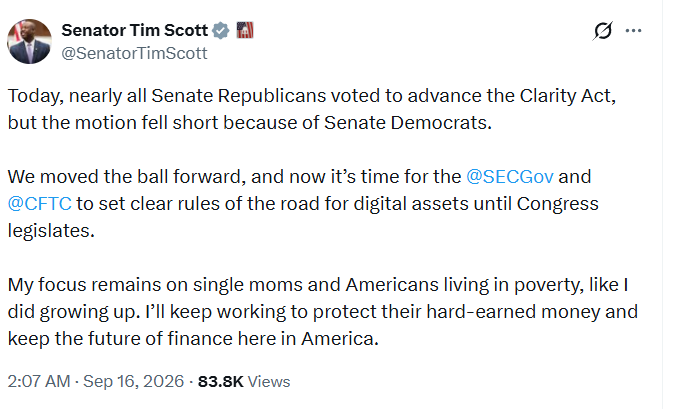
Tim Scott Urges Regulators to Set Crypto Rules. | Source: @SenatorTimScott
The SEC and CFTC have already been working on digital-asset rules, and industry executives, including Coinbase CEO Brian Armstrong, have argued that the agencies can use their existing authority to provide at least some regulatory clarity. But agency rules are also easier for future administrations to reverse or challenge than a framework enacted by Congress.
So Sept. 15 may not ultimately be remembered as the day the CLARITY Act died.
It may instead be the day Washington discovered that deciding who regulates crypto was the easy part. The harder questions are now who can profit from it, whether stablecoins should compete with bank deposits, how blockchain-based finance fits into securities law, and how much of that architecture Congress is actually capable of settling in a single bill.
A WLFI founder allocation that matches President Donald Trump’s disclosed holdings has entered a new vesting contract, placing the position on a defined unlock schedule.
The arrangement required an immediate 10% token burn and imposed a two-year cliff, preventing any of the remaining tokens from becoming sellable before May 2028.
The development comes as Trump’s crypto interests face heightened scrutiny during negotiations over the CLARITY Act and its ethics provisions.
A World Liberty Financial token position matching President Donald Trump’s disclosed founder allocation has been placed into a vesting contract that prevents sales until at least May 2028.
Onchain records show that six founder-linked wallets moved WLFI into the contract on May 19. The largest deposited 15.75 billion tokens before the contract applied a mandatory 10% burn, leaving 14.175 billion WLFI, matching Trump’s disclosed founder allocation.
At recent prices, the remaining position is worth roughly $800 million.
The move is notable because founder tokens were previously subject to indefinite restrictions. The new arrangement provides a defined path to eventual liquidity, but only if holders accept stricter vesting conditions.
Top Crypto Tax Accounting Software
Sponsored
Disclosure
We sometimes use affiliate links in our content, when clicking on those we might receive a commission at no extra cost to you. By using this website you agree to our terms and conditions and privacy policy.
World Liberty proposed overhauling its token vesting structure in April, covering more than 62 billion WLFI that had previously lacked a fixed unlock timetable.
Under the proposal, founders, team members, advisers, and partners could move their allocations to a new schedule that requires a 10% burn, followed by a two-year cliff and three years of gradual vesting.
The community subsequently approved the arrangement, and the founder wallets entered the contract in May.
LATEST: ⚡ A WLFI position matching Trump’s disclosed holdings, worth roughly $800M, has been moved into a vesting contract that burned 10% of the tokens and blocks sales until May 2028. pic.twitter.com/bkbjuOFhAl
For the allocation matching Trump’s holdings, no tokens can be sold before May 2028. After the cliff expires, the remaining WLFI would be released gradually rather than becoming available at once.
World Liberty spokesperson David Wachsman said the founders transferred their tokens after the community approved the burn and accepted what he described as the strictest lock-up conditions applying to WLFI holders.
Vesting Changes the Economics of Trump’s WLFI Stake
The new arrangement does not mean Trump has sold or cashed out the position. Instead, it changes when the tokens could potentially become liquid.
That distinction matters because WLFI was originally launched as a governance token with transfer restrictions. Establishing a specific vesting schedule gives founder allocations an eventual route to the market that did not previously exist.
The 10% burn also permanently reduces the founder allocation before any future unlock.
For Trump’s reported position, a 15.75 billion-token allocation would therefore fall to 14.175 billion WLFI after the burn.
CLARITY Act Puts Trump’s Crypto Wealth Under Spotlight
The timing is politically significant as the Senate debates the CLARITY Act and ethics restrictions covering government officials’ digital-asset interests.
Democrats have pushed for stronger safeguards to address potential conflicts of interest involving senior officials, with Trump’s crypto ventures becoming a central issue in negotiations. The latest bill discussions have included restrictions on officials issuing tokens and requirements involving divestment or blind trusts under certain circumstances.
However, the WLFI vesting arrangement predates those negotiations: the governance proposal emerged in April, and the tokens moved into the contract in May.
That makes the $800 million figure potentially striking but currently illiquid. The Trump-linked allocation now has something it previously lacked: a path toward becoming sellable, but that path does not begin to open until 2028.
The Senate voted 49–50 against advancing the CLARITY Act, leaving the crypto industry reeling from defeat.
However, Ripple’s CEO has remained positive about the firm’s momentum despite failure.
Coinbase CEO Brian Armstrong pointed to the CFTC’s ability to continue pushing new rules without the bill.
Chairman Michael Selig previously said he would instruct staff to prepare alternative rules using the agency’s existing authority.
XRP plunged nearly 12% from Tuesday’s intraday high after the US Senate failed to advance the CLARITY Act, triggering a major selloff across crypto assets.
However, Ripple insists the vote does not alter XRP’s existing momentum in the industry.
It came as others pointed to Commodity Futures Trading Commission Chairman Michael Selig’s claim that he had instructed staff to prepare alternative crypto-market rules if Congress failed to act.
Try Our Recommended Crypto Exchanges
Sponsored
Disclosure
We sometimes use affiliate links in our content, when clicking on those we might receive a commission at no extra cost to you. By using this website you agree to our terms and conditions and privacy policy.
The Senate rejected a motion to advance the CLARITY Act by 49 votes to 50 on Tuesday, falling short of the 60 senators needed to move the legislation forward, according to the official Senate record.
The defeat represents a major setback for the crypto industry’s long-running efforts to establish a lasting division of responsibilities between the SEC and the CFTC.
Although Senators blocked consideration of the legislation, the bill remains technically alive, with little time and an uncertain path forward ahead of the midterm elections.
Democratic opposition focused heavily on ethics and national security.
Senator Elissa Slotkin said the bill’s protections against public officials profiting from crypto were “simply too thin.”
Today, I voted no on the Clarity Act, legislation meant to regulate cryptocurrency in America.
The ethics provisions in this bill are simply too thin. President Trump, his children, and his Cabinet are making billions of dollars in the crypto space, in part from bilking everyday…
She also raised concerns about money laundering and whether the CFTC possessed sufficient staffing to implement the proposed regime.
“The ethics provisions in this bill are simply too thin,” she wrote on X.
Adding: “President Trump, his children, and his Cabinet are making billions of dollars in the crypto space, , in part from bilking everyday Americans out of their hard-earned money.”
Those objections reflected the wider Democratic position that the bill did not adequately address the Trump family’s financial exposure to the crypto industry.
Three Republicans—Susan Collins, Josh Hawley, and Jerry Moran—also voted against advancing it.
Garlinghouse’s CLARITY Act Response: “This One Stings”
Ripple CEO Brad Garlinghouse acknowledged the scale of the defeat, saying his team had given “everything” to move the bill across the finish line.
“This one stings,” he said, claiming the failure fell with politics taking precedence over policy.
He called for a post-mortem on how a bill backed by much of the industry collapsed.
However, he said the failed vote does not change Ripple’s legal footing, international presence, customer base, or business momentum.
“Ripple’s business has never been stronger — real demand across traditional finance and the digital asset ecosystem,” he wrote.
Adding: “A missed vote in Washington doesn’t change our momentum, our global footprint, or our customers.”
In its formal response, Ripple said its operations remained strong across payments and institutional markets.
The company also stressed that it would continue participating in SEC and CFTC rulemaking despite the legislative setback.
XRP’s Legal Status Did Not Disappear
Ripple Chief Legal Officer Stuart Alderoty argued that XRP stands on “settled ground.”
A 2023 federal court ruling found that XRP, considered by itself, was not an investment contract.
The decision also found that Ripple’s programmatic exchange sales did not constitute securities transactions, although certain contractual sales to institutional investors did.
XRP’s regulatory footing strengthened further in March 2026 when a joint SEC–CFTC interpretation explicitly included it among examples of digital commodities.
The agencies said XRP and several other tokens derived their value primarily from functioning crypto networks rather than from investors relying on others’ essential managerial efforts.
“SEC Chairman Atkins and a CFTC Chairman Selig understand these markets,” Alderoty said. “We expect future rulemaking from both agencies to continue to set out clear rules of the road.”
Analyst Maps XRP’s Route From $6.19 to $17
The failure comes as market analyst EGRAG Crypto mapped a long-term XRP target zone between $6.19 and $8.07.
His extended scenario reaches $11.45, above $13, and potentially $17 if the token completes its current macro-wave structure.
From XRP’s price near $1.29, the highest target would represent gains of more than 1,200%.
The prediction is back in focus after Garlinghouse’s response: if XRP already possesses the legal clarity the wider industry was seeking, can the token recover without the CLARITY Act?
EGRAG’s forecast uses Elliott Wave structure and Fibonacci extensions to project XRP’s next major cycle.
The analyst identified $8.07 as the first long-term target zone for a potential fifth macro wave. That would already translate into gains of around 525% from XRP’s current price.
If momentum accelerates beyond that zone, the technical extensions rise considerably:
$11.45
Above $13
An extreme target near $17
The $17 scenario would put XRP more than 1,200% above its current price.
Selig’s CFTC “Plan B” CLARITY Act
Attention has now turned to Selig and the CFTC.
In August, Selig said he had directed staff to explore crypto-market rules that could be introduced under the agency’s existing authority if the CLARITY Act stalled.
The proposal could allow registered firms, and potentially currently unregistered crypto exchanges, to operate as a type of designated contract market.
Selig also instructed staff to engage with developers of onchain financial protocols to determine how they could operate legally in the United States.
“If Congress will not” deliver a market structure, the CFTC would attempt to do so, Selig said in his original agency remarks.
Brian Armstrong, Coinbase CEO, said that the CLARITY Act was “coming to crypto regardless.”
“The SEC and CFTC have the tools they need to create clear rules under existing authority, and I expect will begin working on this in earnest,” he wrote on X.
However, while the CFTC can create some new rules, it cannot give itself complete jurisdiction over every non-security crypto spot market.
The Government Accountability Office has previously identified the absence of a federal regulator over non-security crypto spot trading as a major oversight gap.
Agency rules are also inherently more vulnerable than legislation, meaning they can be challenged in court and reversed by a future administration.
XRP Risks Falling to $1.20
XRP fell 7.95% to $1.29 over 24 hours, according to CoinMarketCap.
That was much worse than the total crypto market’s 1.83% decline and Bitcoin’s 1.48% drop.
The decline also pushed XRP below important technical levels, including its 200-day moving average near $1.355.
CoinMarketCap also said this breakdown likely triggered stop losses and made buyers reluctant to enter the market.
The key support level is now $1.25. If XRP holds above it, analysts see a possible rebound toward $1.34.
If $1.25 fails, XRP could fall to $1.20.
“The path of least resistance remains down until key resistance is reclaimed,” CoinMarketCap said.
The next major catalyst is the Federal Reserve’s September 16 interest-rate decision.
A hawkish result could put more pressure on XRP, while a dovish signal could support a relief rally.
Ripple CLO Stuart Alderoty says XRP’s regulatory position remains intact despite the CLARITY Act’s failure.
Alderoty also highlighted the SEC and CFTC’s 2026 treatment of XRP as a digital commodity.
XRP bull Jake Claver is targeting $20 to $30, though reaching those levels would imply a market capitalization well above $1 trillion.
XRP bulls are reviving ambitious price targets of as much as $30 after Ripple Chief Legal Officer Stuart Alderoty argued that the cryptocurrency remains on firm regulatory ground despite the US Senate’s failure to advance the CLARITY Act.
Alderoty said the setback in Congress does not change XRP’s existing legal position, pointing to both Ripple’s landmark 2023 court ruling and a March 2026 interpretation issued by the Securities and Exchange Commission (SEC) alongside the Commodity Futures Trading Commission (CFTC).
“Don’t forget – Ripple and XRP stand on settled ground,” Alderoty wrote on X. “The 2023 federal Court ruling established XRP is not a security.”
His characterization simplifies a more nuanced ruling: the federal court found that XRP itself was not inherently a security and that Ripple’s programmatic exchange sales did not constitute securities transactions, while Ripple’s direct institutional sales constituted unregistered securities offerings.
The renewed regulatory focus comes as some XRP traders continue to promote aggressive upside scenarios. XRP advocate Jake Claver said he is targeting a longer-term price between $20 and $30, while outlining a potential path through $1.17, $1.90, $3.10 and eventually $5.20.
Try Our Recommended Crypto Exchanges
Sponsored
Disclosure
We sometimes use affiliate links in our content, when clicking on those we might receive a commission at no extra cost to you. By using this website you agree to our terms and conditions and privacy policy.
Alderoty also highlighted an important regulatory development that arrived earlier this year.
In March, the SEC and CFTC issued a joint interpretation addressing the regulatory treatment of crypto assets, with XRP identified as a digital commodity.
Alderoty argued that the development gives XRP a clearer regulatory foundation even without the CLARITY Act, adding that he expects future SEC and CFTC rulemaking to continue establishing clearer rules for the industry.
Don’t forget – Ripple and XRP stand on settled ground. The 2023 federal Court ruling established XRP is not a security.
And in March the SEC and CFTC issued a joint interpretation naming XRP a digital commodity. SEC Chairman Atkins and a CFTC Chairman Selig understand these… https://t.co/63ML5xmbAP
The distinction echoes the central issue in Ripple’s long-running litigation with the SEC.
In July 2023, Judge Analisa Torres ruled that XRP itself was not inherently an investment contract. Ripple’s institutional XRP sales violated securities laws, but its programmatic sales through exchanges did not satisfy the same test.
The case became one of the most consequential legal battles in the US crypto industry, providing XRP with a degree of judicial clarity that many other major cryptocurrencies lacked.
CLARITY Failure Leaves Agencies in Focus
The regulatory backdrop has become more important after the Senate failed to advance the CLARITY Act on Sept. 15.
Some XRP supporters argue that the failed legislation does not prevent development of the XRP Ledger or use of XRP under existing rules.
Community member Mr. Cauliman said builders should focus on payments, marketplaces and other applications rather than waiting for Congress, arguing that the “rails are live” and XRP holders need to make use of the infrastructure already available.
CLARITY failed today. That doesn’t mean $XRP stops.
This is why having an SEC that actually understands crypto matters so much. We don’t need Congress to give us permission to use the rails we already have. The SEC and CFTC have already moved toward clearer treatment of crypto…
Ripple CEO Brad Garlinghouse similarly said the company would continue engaging with the SEC and CFTC as the agencies develop rules intended to fill gaps left by Congress.
Garlinghouse described the failed CLARITY vote as disappointing but maintained that Ripple’s business remains strong, pointing to demand from traditional finance and the wider digital asset ecosystem.
The distinction is significant. Agency interpretations and rulemaking can provide regulatory guidance, while comprehensive market-structure legislation could establish a more durable statutory framework.
XRP Bulls Revive $20 to $30 Price Target
Against that regulatory backdrop, XRP bulls are again discussing substantially higher valuations.
Claver said he intends to continue accumulating XRP below $3 and considers $20 to $30 sufficient for his personal investment objectives.
In another post, he mapped a potential progression from $1.34 to $1.17, followed by advances toward $1.90, $3.10 and $5.20.
However, these levels remain speculative targets rather than outcomes supported by the regulatory developments themselves. Commodity treatment does not automatically translate into higher demand or price appreciation.
For XRP to approach $20 or $30, adoption and capital inflows would have to increase dramatically. With tens of billions of XRP already circulating, such prices would imply a market capitalization well above $1 trillion, depending on circulating supply at the time.
The immediate argument from Ripple is therefore less about price than regulatory continuity: Congress may have failed to advance CLARITY, but XRP enters the post-vote environment with substantially more defined US regulatory treatment than it had when the SEC sued Ripple in 2020.
The Senate failed to advance the CLARITY Act in a 49-50 cloture vote.
Crypto markets reacted sharply, with $300 million in leveraged long positions liquidated within about 20 minutes after the vote.
The defeat leaves the timeline for comprehensive US crypto market structure legislation uncertain.
The US Senate’s failure to advance the CLARITY Act triggered an immediate selloff across crypto markets, with roughly $300 million in leveraged long positions reportedly liquidated within about 20 minutes of the vote.
The Senate rejected cloture on the motion to proceed with the Digital Asset Market CLARITY Act on Tuesday, Sept. 15, by 49 votes to 50, leaving the legislation well short of the 60 votes required to advance. The official Senate roll-call record confirms the 49-50 result.
Bitcoin fell below $75,000 following the vote, while Ethereum, XRP and other major cryptocurrencies also came under selling pressure. Reports tracking derivatives markets estimated that approximately $300 million of leveraged long positions were wiped out within roughly 20 minutes as falling prices triggered forced liquidations.
The defeat prompted an angry response from Republican Sen. Cynthia Lummis, one of the legislation’s leading architects, who accused Democrats of derailing more than a year of negotiations.
“Democrats chose politics over the American people, again,” Lummis said following the vote, while arguing that Republicans had repeatedly accommodated Democratic demands during negotiations.
Try Our Recommended Crypto Exchanges
Sponsored
Disclosure
We sometimes use affiliate links in our content, when clicking on those we might receive a commission at no extra cost to you. By using this website you agree to our terms and conditions and privacy policy.
The procedural defeat represents a major setback for efforts to establish a comprehensive federal regulatory framework for digital assets.
The CLARITY Act seeks to establish rules governing digital commodities and clarify the respective roles of the Securities and Exchange Commission (SEC) and Commodity Futures Trading Commission (CFTC).
Senate rejects Clarity Act, triggering the month's biggest STH capitulation
“With 23,200 BTC sent to exchanges at a loss, this STH capitulation event is the largest recorded over the past month.” – By @Darkfost_Cocpic.twitter.com/OLCo7Mf0PS
The Senate version had undergone multiple revisions ahead of Tuesday’s vote, including changes concerning decentralized finance, credit unions and ethics provisions.
However, the bill needed 60 votes to invoke cloture and move forward. No Democratic senator supported the procedural motion, while several Republicans also voted against it.
Here is the full list of votes for Clarity, you are are urged to vote accordingly!
**CLARITY Act cloture — Sept. 15, 2026 — 49 Yes, 50 No, 1 Not Voting**
Alsobrooks — No Baldwin — No Banks — Yes Barrasso — Yes Bennet — No Blackburn — Yes Blumenthal — No Blunt…
The failed vote leaves the legislation’s path uncertain, particularly with lawmakers facing a compressed legislative calendar ahead of November’s midterm elections.
Another procedural vote remains possible, but supporters would first need to assemble significantly broader bipartisan backing.
Ethics Fight Over Trump Crypto Holdings Derails Deal
The final negotiations became increasingly focused on ethics rules governing crypto holdings by federal officials, particularly President Donald Trump’s financial interests in the sector.
Republicans had revised the bill to give state attorneys general additional enforcement powers and require public officials with certain significant financial interests to divest or place assets in a blind trust.
Democrats argued the provisions remained insufficient.
This afternoon, Senate Democrats proved they were never truly serious about protecting consumers and preserving American leadership. I sat at the table with Senate Democrats working in good faith to get this done while they played games.
Sen. Mark Warner said after the vote that negotiators had made progress on national security and law enforcement issues but that unresolved conflicts of interest prevented him from supporting the bill. Democrats had pushed for broader restrictions covering the president and family members and stronger divestment requirements.
Lummis offered the opposite assessment, arguing Democrats had repeatedly introduced new demands after Republicans accepted earlier proposals.
She also claimed the failed legislation would have strengthened consumer protections and restricted politicians’ personal crypto investments. Her statement characterized the outcome as damaging to US competitiveness and beneficial to overseas rivals, including China.
Crypto Market Reacts With $300M Liquidation Cascade
Traders reacted quickly to the setback.
Bitcoin’s decline below $75,000 helped trigger a cascade of forced closures across leveraged positions. As exchanges automatically liquidated traders unable to meet margin requirements, those sales added further downward pressure and contributed to additional liquidations.
The market was already contending with broader macroeconomic pressures, including elevated Treasury yields and changing expectations for Federal Reserve policy, making leveraged positions particularly vulnerable to a negative regulatory catalyst.
JUST IN: 🇺🇸 $300,000,000 worth of crypto longs positions liquidated in the past 20 minutes after U.S. Senate fails to advance Crypto Clarity Act. pic.twitter.com/U3feFvzRMv
The CLARITY Act’s failure does not necessarily end the push for US crypto regulation. The SEC and CFTC have continued pursuing regulatory changes independently, although legislation would provide a more durable statutory framework than agency rulemaking alone.
SEC Chair Paul Atkins said before the vote that the administration intended to continue advancing its digital asset agenda regardless of whether Congress passed the legislation.
For now, however, the 49-50 Senate vote removes one of the crypto industry’s most closely watched legislative catalysts and leaves the timing of comprehensive US market structure legislation uncertain.
XRP Ledger’s BatchV1_1 amendment has moved to the brink of the validator threshold needed to start its activation process.
The upgrade would allow up to eight transactions to be bundled together, supporting atomic swaps and other multi-step operations.
BatchV1_1 replaces an earlier Batch amendment that was pulled after researchers discovered a critical authorization vulnerability before it reached mainnet.
The XRP Ledger is closing in on a significant network upgrade, with its BatchV1_1 amendment now just one validator vote away from crossing the support threshold needed to begin the activation process.
Live governance data on Sept. 15 showed BatchV1_1 with 27 of 35 trusted-validator votes, or roughly 77% support. The XRP Ledger requires an amendment to maintain support above 80% for two consecutive weeks before it can activate.
That means one additional supporting validator would put the proposal at the required threshold according to the current tracker, although activation would still not be immediate. The amendment would first have to maintain sufficient validator backing throughout the two-week window.
Try Our Recommended Crypto Exchanges
Sponsored
Disclosure
We sometimes use affiliate links in our content, when clicking on those we might receive a commission at no extra cost to you. By using this website you agree to our terms and conditions and privacy policy.
BatchV1_1 Brings Atomic Transactions to XRP Ledger
BatchV1_1 is based on XLS-56, a proposal designed to let users package multiple operations together instead of submitting each independently.
The upgrade introduces a Batch transaction capable of containing up to eight inner transactions.
One of its most important capabilities is atomic execution, where a group of transactions can be structured so that either the required operations succeed together or the intended batch conditions prevent a partial outcome.
That could unlock more sophisticated XRP Ledger applications without requiring developers to coordinate a series of independent transactions.
The XLS-56 specification highlights potential uses including trustless token and NFT swaps between multiple accounts, combining NFT minting with offers, platform-fee payments and flash-loan-style operations.
For developers, the key benefit is reducing the risk that one step of a multi-transaction process succeeds while another fails, leaving users with an unintended ledger state.
Original Batch Upgrade Was Halted Over Critical Bug
BatchV1_1 also carries an important security history.
The original Batch amendment was introduced with XRP Ledger version 2.5.0 in June 2025 but never activated on mainnet.
In February 2026, researchers Pranamya Keshkamat and Cantina AI’s Apex tool discovered a critical flaw in its signature-validation logic.
The BatchV1_1 amendment has reached the required 80%+ vote threshold on the XRP Ledger.
If it holds this level, it will go live in 2 weeks.
The amendment allows multiple transactions to be bundled into a batch and processed together. pic.twitter.com/7m8lgBT3bG
Under certain conditions, the vulnerability could have allowed an attacker to execute inner transactions from another account without possessing that account’s private keys.
XRPL validators were advised to stop supporting the amendment, while version 3.1.1 disabled the affected Batch implementation. Because the amendment had not activated, the vulnerability did not put mainnet funds at risk.
BatchV1_1 was subsequently developed as its replacement, incorporating fixes for the authorization issue.
One Vote Does Not Mean Immediate Activation
The corrected amendment arrived with XRPL version 3.3.0 on Aug. 6 alongside other proposed features, including ConfidentialTransfer, DynamicMPT, PermissionDelegationV1_1 and Sponsor.
Validator support has risen sharply since then. On Sept. 8, BatchV1_1 had only 24 of 35 votes, or 68.57%. This means it was still several votes short of the activation threshold.
Still, crossing the threshold is only the first hurdle. XRP Ledger’s amendment system requires sustained consensus, so support must remain high enough for 14 consecutive days before BatchV1_1 becomes active.
If that happens, XRPL will gain something it has historically lacked: a native way to coordinate multiple transactions as a single batch. It may potentially give developers greater flexibility for payments, trading and more complex onchain applications.
The return to player (RTP) rate tells you how much you can expect back from a casino game if your luck is average. Sticking to high RTP slots and table games can improve your theoretical returns at a crypto casino.
We’ve explained what RTP means in casino games and how to find the RTP on a game you’re interested in. You’ll also discover which games have the best RTP percentages, and which games to avoid.
What Does RTP Mean in Casino Games?
The RTP tells you the percentage of your money that you’ll get back from a casino game if you have average luck. For example, let’s say a slot has a 96.24% RTP. That means the average player can expect to get $96.24 back for every $100 wagered on that game.
Of course, every spin is completely random. That means some players will enjoy a winning session, and others will endure a losing session. However, choosing a game with a high RTP rate will theoretically improve your chances of a winning session.
How is RTP Calculated?
RTP is calculated differently depending on the type of game. For table games like roulette and baccarat, the RTP is a direct product of the rules.
For example, a European roulette wheel has 37 pockets, and you’ll get paid out at 35:1 on a winning number. That results in an RTP of 97.3%. American roulette adds a second zero, which drops the RTP to 94.74%. Nobody sets this figure. It’s simply a result of the math.
Slots are different. The software provider decides on a target and then designs the game’s math model – symbol weightings, paytable values, and bonus frequency – to hit that RTP. The figure is then verified by running millions of simulated spins before the game is released.
In both cases, RTP describes the long-term average. Individual sessions are often completely different.
It’s also worth noting that independent auditors test online slots and table games to confirm the RTP figures are accurate. If you stick to games from large studios like Pragmatic Play, NetEnt, BGaming, and Hacksaw Gaming, you can rely on their games to be certified for fairness and accuracy by top auditors like eCOGRA, iTech Labs, and BMM Testlabs.
RTP vs. House Edge
The RTP tells you the house edge on any casino game. You simply need to subtract the number from 100 to calculate the casino’s edge.
For example, if a game has a 95.78% RTP, the house edge is 4.22%. If a game has a 99.51% RTP, the house edge is just 0.49%.
Every casino game has a house edge. That allows the casino to pay its overheads and operate a viable business. However, you can improve your expected return by choosing a game with a low house edge.
It’s also worth noting that the RTP – and by extension, the house edge – can vary depending on which bet you place when playing certain games. For example, a pass line bet has a 1.41% house edge when you play craps, whereas an Any 7 bet has a 16.67% house edge.
RTP and Volatility: What’s the Difference?
RTP and volatility are often confused with one another, but they refer to two completely different features. The RTP tells you how much you can expect back with average luck, whereas volatility tells you how often you’re likely to win and how large those wins will be.
For example, online slots fall into three broad categories:
Low volatility: These games tend to deliver small, frequent wins.
Medium volatility: Slots with relatively frequent wins and reasonably large jackpots.
High volatility: These games tend to provide large, infrequent payouts.
If you’re patient and you like chasing big jackpots, you might enjoy volatile slots. On the other hand, low volatility slots may appeal if you like grinding out lots of small wins.
You’ll find low, medium, and high volatility slots with identical RTP rates. Here’s an example:
Babushkas by Thunderkick is a low volatility slot. The max win is 390x.
Turning Totems has a medium volatility rate and a 998x max win.
Pink Elephants is a highly volatile slot with a max win of 8,200x your bet.
The RTP rate on all three games is 96.14%. Over the long-term, you can expect $96.14 back for every $100 wagered if your luck is average. However, you’ll get to that figure in completely different ways when playing each game.
RTP by Game Type
We’ve explored the RTP rates of some of the most popular casino games. Table games tend to have higher RTP percentages than slots, but you’ll find high RTP slots at the best crypto casinos.
Slots
Most online slots have an RTP of 94% to 96.5%. You’ll find some slots with lower RTP rates, but there are also plenty of slots with very strong RTP figures. Here are some of the best options to look out for:
Goblin’s Cave by Playtech (99.32%)
Ugga Bugga by Playtech (99.07%)
Book of 99 by Relax Gaming (99%)
Mega Joker by NetEnt (99%)
Ooh Aah Dracula by Barcrest (99%)
Jackpot 6000 by NetEnt (98.86%)
1429 Uncharted Seas by Thunderkick (98.6%)
Moonstone by Smartsoft (98.5%)
Blackjack
Blackjack typically has an RTP of around 99.5%, but only if you know when to hit, stand, split cards, and double down. It’s also important to choose a game with player-friendly rules, as that will increase the RTP. For example, if you’re allowed to double down on any two cards, it can increase the RTP by around 0.25%.
Single deck blackjack games tend to have better RTP rates than classic blackjack. One game, Single Deck Desperado Blackjack, has a 99.96% RTP.
Roulette
The roulette RTP depends on the roulette variant you play:
European roulette: The wheel has 37 pockets, numbered 0-36. Each pocket pays 35:1, while outside bets like red/black and odd/even pay 1:1, but they lose if the ball lands on zero. That results in a 97.3% RTP.
French roulette: These games feature one of two rules: la partage (a 50% rebate if the ball lands on zero) or en prison (if the ball lands on zero, your stake goes in prison, and you can win it back on the following spin). Either rule cuts the house edge in half, increasing the RTP to 98.65%.
American roulette: This game features an additional pocket – the double zero. That increases the house edge and cuts the RTP to 94.74%.
Baccarat
The RTP on baccarat depends on which bet you place: 98.94% on the banker, 98.76% on the player, and 85.64% on the tie. It’s best to stick to the banker bet, as that has the lowest house edge. Also avoid side bets, as they normally have poor RTP rates.
Video Poker
Lots of video poker games have an RTP of more than 99%. However, you only benefit from that high RTP if you know which cards to keep and which to discard when building your hand. The best online casinos let you practice for free in demo mode, and you can then switch to real money play when you’ve mastered the perfect strategy.
Crypto Games
Crypto games like Plinko, Dice, Crash, and Mines often have a 99% RTP. The RTP will vary depending on the provider, but games from BGaming and Stake Originals tend to have 99% RTP rates.
How to Find a Casino Game’s RTP
There are a few different ways to find a casino game’s RTP:
Arrange by RTP. Some crypto casinos let you arrange their slots and table games by RTP. You can then quickly see which games have the best RTP rates.
Check the game rules. Open the game and select the information icon, the hamburger menu, or the question mark icon. You can then browse the game rules, and the RTP is normally listed near the bottom of the document.
Visit the provider’s website. Search for the game on the software provider’s site. For example, NetEnt and BGaming clearly display the RTP on all of their games. Just bear in mind that these rates can vary from one casino to the next, so if you want to find a slot’s RTP, it’s best to source that information from the casino.
Why RTP Matters When Choosing a Casino Game
You’ll unlock several benefits by choosing casino games with high RTP rates. For example, a slot with a 98% RTP will stretch your bankroll further over time than a slot at 94%.
It’s also sensible to play high RTP games when clearing the wagering requirements on casino bonuses. You’ll stand a much better chance of clearing the requirements if you play baccarat or French roulette instead of American roulette.
Searching for RTP rates can also help you choose a reliable casino. The best crypto casinos display the RTP figures clearly. They host games from certified providers, and don’t quietly run reduced-RTP versions of popular slots. If a casino makes it hard for you to figure out what the RTP is on each game, it should set alarm bells ringing.
Conclusion
Now that you know what RTP is and where to find it, you can make smarter decisions about which games to play. Choose online slots with RTP rates above 96.5%, but make sure you also consider the volatility when selecting a game. If you prefer table games, the best options include single deck blackjack, baccarat, and French roulette. Crypto games like Plinko and Dice often have high RTP percentages and simple rules too. Just check the game rules to confirm the RTP before playing, as the rates can vary at different casinos.
Key Takeaways
The CLARITY Act failed to secure the 60 votes needed to advance in the US Senate.
The defeat followed a breakdown in bipartisan negotiations over crypto ethics rules and other provisions.
The setback could make passing comprehensive US crypto market structure legislation significantly harder before the midterm elections.
The US Senate failed to advance the Digital Asset Market CLARITY Act on Tuesday, dealing a major setback to efforts to establish comprehensive federal rules for thecryptocurrency industry.
The procedural vote to invoke cloture on the motion to proceed to H.R. 3633 fell short of the 60 votes required to advance, after several senators who had previously supported major crypto legislation opposed the measure. The vote was procedural rather than a vote on final passage, meaning the CLARITY Act is not formally dead but cannot move forward through the planned process.
BREAKING: The Crypto Clarity Act officially fails to pass in the Senate in a major setback for US crypto regulation.
The defeat came despite a last-minute push by Republican lawmakers to secure enough Democratic support.
Several senators who backed the GENIUS Act stablecoin legislation broke against CLARITY. Galaxy Digital research head Alex Thorn identified Democratic Sens. Angela Alsobrooks, Mark Warner, Raphael Warnock, Lisa Blunt Rochester, Catherine Cortez Masto and John Fetterman among the “No” votes, alongside Republican Sen. Susan Collins.
🚨CLARITY vote on track to FAIL in the US Senate
"NO" votes so far from key YES voters on GENIUS:
Angela Alsobrooks Mark Warner Ralph Warnock Lisa Blunt Rochester Catherine Cortez Masto John Fetterman Susan Collins https://t.co/Nk4b5NyUz5
That distinction matters because the defections suggest opposition was not necessarily a rejection of crypto legislation broadly. Instead, lawmakers remained divided over provisions specific to the CLARITY Act, particularly ethics and conflict-of-interest safeguards.
The defeat came despite a last-minute push by Republican lawmakers to secure enough Democratic support.
Try Our Recommended Crypto Exchanges
Sponsored
Disclosure
We sometimes use affiliate links in our content, when clicking on those we might receive a commission at no extra cost to you. By using this website you agree to our terms and conditions and privacy policy.
Republicans released revised legislation ahead of the vote that they said incorporated 126 substantive changes requested by Democrats, including changes to ethics provisions governing public officials’ crypto interests.
But the concessions failed to resolve the dispute.
Democrats continued demanding tougher conflict-of-interest rules, with Sen. Elizabeth Warren arguing Tuesday that the revised provisions did not go far enough. Banking groups were also dissatisfied with changes addressing stablecoin rewards and their potential impact on traditional bank deposits.
Republicans entered the vote without a guaranteed path to 60 votes. With 53 GOP senators, the party needed support from Democrats or independents even with complete Republican unity.
According to Punchbowl News and Crypto In America, Senate Republicans rejected Democrats’ latest CLARITY Act counterproposal ahead of Tuesday’s 2:15 p.m. ET cloture vote, which requires… pic.twitter.com/19Q1UXkXSC
That unity itself was uncertain. Sens. John Cornyn, Susan Collins and John Curtis had expressed varying degrees of hesitation about the legislation ahead of the vote.
Cathie Wood Trimmed Coinbase as COIN, Strategy Slide Ahead of CLARITY Vote
Cathie Wood’s ARK Invest trimmed several major crypto positions ahead of the Senate’s CLARITY Act vote, while Coinbase and Strategy shares fell sharply as regulatory uncertainty weighed on crypto-linked stocks.
ARK sold 36,628 Coinbase shares worth roughly $7 million on Monday, alongside about $13.8 million of Circle shares. The firm also unloaded positions in Bullish and Bitmine and sold approximately $40 million of its ARK 21Shares Bitcoin ETF (ARKB). The sales came after crypto stocks rallied Monday, suggesting at least some of the activity may have been portfolio rebalancing or profit-taking rather than a direct bet against the CLARITY Act.
The mood reversed Tuesday. Coinbase shares fell around 6%, while Michael Saylor’s Strategy dropped roughly 3%–5% as Bitcoin slid toward $76,000 ahead of the Senate vote.
The selloff underscores how closely crypto equities are tracking both Bitcoin and Washington. Coinbase could be particularly sensitive to the CLARITY Act because the legislation would establish clearer rules governing digital assets and the division of regulatory authority in the US.
However, broader risk-off conditions, including rising Treasury yields and oil prices ahead of the Federal Reserve’s rate decision, are also pressuring markets.
What Happens to the CLARITY Act Now?
The failed cloture vote is a major setback, but it does not formally kill the CLARITY Act. Senate leaders could reopen negotiations, revise the legislation and attempt another vote if Republicans and Democrats can bridge their remaining differences.
The bigger problem is time. With the November midterm elections approaching and lawmakers still divided over ethics, stablecoin rewards and other provisions, the window for Congress to pass comprehensive crypto market structure legislation in 2026 is narrowing.
Crypto industry groups had warned immediately before the vote that advancing the legislation was critical to keeping the process alive. Reuters noted that another delay would be negative for the industry, although markets had increasingly priced in the possibility that comprehensive crypto legislation would not become law in the near term.
The Senate voted 49-50 against advancing the CLARITY Act, leaving the crypto market structure bill well short of the 60 votes needed.
The defeat followed a breakdown in bipartisan negotiations, particularly over ethics and conflict-of-interest provisions tied to public officials’ crypto holdings.
The failed vote leaves the future of comprehensive US crypto market structure legislation uncertain ahead of the November midterm elections.
The US Senate failed to advance the Digital Asset Market CLARITY Act on Tuesday, delivering a major setback to one of the crypto industry’s biggest legislative priorities.
Senators voted 49-50 on the procedural measure, according to the Associated Press, falling 11 votes short of the 60 needed to invoke cloture and move toward consideration of the legislation.
JUST IN: 🇺🇸 Zero Democrats voted to advance the Crypto Clarity Act.
The vote was not on the final passage of the CLARITY Act. Instead, senators were voting on cloture on the motion to proceed to H.R. 3633. Failure means the Senate cannot advance the bill through the planned process, although the legislation is not formally dead.
Try Our Recommended Crypto Exchanges
Sponsored
Disclosure
We sometimes use affiliate links in our content, when clicking on those we might receive a commission at no extra cost to you. By using this website you agree to our terms and conditions and privacy policy.
No Democrats Back CLARITY Act as Four Republicans Vote No
The CLARITY Act failed 49-50, with no Democratic senators voting to advance the legislation, according to the Senate Press Gallery result and a vote breakdown circulated by crypto commentator Ran Neuner.
Here is the full list of votes for Clarity, you are are urged to vote accordingly!
**CLARITY Act cloture — Sept. 15, 2026 — 49 Yes, 50 No, 1 Not Voting**
Alsobrooks — No Baldwin — No Banks — Yes Barrasso — Yes Bennet — No Blackburn — Yes Blumenthal — No Blunt…
Four Republicans — Susan Collins, Josh Hawley, Jerry Moran and Thom Tillis — joined Democrats in voting “No.” Democratic Sen. Chris Coons did not vote, while the remaining 49 senators backed cloture.
The result was particularly notable because several Democrats who previously supported the GENIUS Act stablecoin legislation broke against CLARITY. They included Angela Alsobrooks, Lisa Blunt Rochester, Catherine Cortez Masto, John Fetterman, Kirsten Gillibrand, Mark Warner and Raphael Warnock.
Republican Sens. John Cornyn and John Curtis, whose positions had been closely watched ahead of the vote, ultimately voted “Yes.”
The result left Republicans 11 votes short of the 60-vote threshold, highlighting how dramatically bipartisan support for crypto legislation has deteriorated since passage of the GENIUS Act.
Crypto executives reacted quickly to the Senate defeat, with Ripple CEO Brad Garlinghouse calling the result a missed opportunity for US consumers and the country’s competitiveness in digital assets.
“This one stings,” Garlinghouse said shortly after the vote. He said Ripple and the wider crypto industry had put significant effort into getting the legislation across the finish line, arguing the push was bigger than any single company.
“Ultimately, consumers and US competitiveness got left behind,” Garlinghouse said.
The Ripple CEO blamed the defeat on Democratic politics, describing opponents as the “anti-crypto army,” and said a post-mortem was needed to understand why the legislation failed.
However, Garlinghouse argued that the defeat does not leave the US crypto industry without a regulatory path. He expects the SEC under Chair Paul Atkins and the CFTC under Chair Michael Selig to continue developing rules to address gaps left by Congress.
“Ripple’s business has never been stronger,” Garlinghouse added, arguing that the Washington setback would not change the company’s global expansion or customer demand.
Crypto Industry Looks to SEC, CFTC After Senate Defeat
Lighter founder Vladimir Novakovski struck a similarly forward-looking tone, saying the failed procedural vote had not diminished the persistence of US crypto builders.
Novakovski said he remains supportive of legislation establishing a “real, rules-based framework” that allows the SEC and CFTC to operate within their respective areas of expertise.
“Even without CLARITY, both agencies have real tools to guide this industry,” he said, pointing to their existing regulatory activity and Lighter’s ongoing work with the CFTC as it seeks a license to operate in the US.
Other industry voices were considerably more critical. Crypto commentator Scott Melker blamed Senate Democrats for the outcome, arguing that failure to pass CLARITY undermined efforts to address the very political conflicts surrounding crypto that Democrats had cited during negotiations.
I would like to be the first to congratulate Senate Democrats.
Your failure to pass The Clarity Act will allow the Trump family to continue to use crypto as their personal piggy bank until the end of time.
The reactions underline the industry’s likely next move: with Congress unable to deliver market structure legislation for now, attention shifts back to the SEC and CFTC and what regulatory clarity they can provide without new legislation.
Bitcoin, Coinbase and Strategy Slide
Crypto markets were already under pressure before the vote.
Bitcoin fell more than 3% Tuesday, trading below $77,000 as expectations for the CLARITY Act deteriorated. Prediction-market odds of the legislation becoming law in 2026 had fallen to 19% from 31% ahead of the Senate showdown.
Crypto-linked stocks also suffered. Coinbase (COIN) and Strategy (MSTR) fell more than 4%, while Robinhood (HOOD) dropped around 3% during Tuesday’s session. Broader risk-off pressure from rising Treasury yields and oil prices also weighed on markets, making it difficult to attribute the declines entirely to Washington.
What Happens to the CLARITY Act Now?
Tuesday’s defeat does not formally kill the CLARITY Act. Senate leaders could reopen negotiations, revise the legislation and attempt another procedural vote.
But time is becoming a major obstacle.
With the November midterm elections approaching, lawmakers face a narrowing legislative calendar. The failed vote is a major blow to the crypto industry’s years-long push for comprehensive US market structure legislation.
Senate Republicans rejected Democrats’ latest CLARITY Act counterproposal just hours before a critical procedural vote.
Democrats sought stronger ethics provisions and narrower protections for some blockchain developers, while making relatively limited changes to the stablecoin rewards compromise.
The Senate needs 60 votes to advance the bill, and its support remained uncertain heading into the vote.
Senate Republicans have rejected Democrats’ latest counteroffer on the CLARITY Act, leaving the landmark crypto market structure bill facing an uncertain 60-vote test on Tuesday.
According to Punchbowl News and Crypto In America, Senate Republicans rejected Democrats’ latest CLARITY Act counterproposal ahead of Tuesday’s 2:15 p.m. ET cloture vote, which requires… pic.twitter.com/19Q1UXkXSC
The Senate is scheduled to vote at approximately 2:15 p.m. ET on whether to invoke cloture on the motion to proceed with the legislation. The procedural vote would not pass the CLARITY Act into law but would allow the Senate to begin formally considering it.
Try Our Recommended Crypto Exchanges
Sponsored
Disclosure
We sometimes use affiliate links in our content, when clicking on those we might receive a commission at no extra cost to you. By using this website you agree to our terms and conditions and privacy policy.
Democrats Push for Stronger Ethics and Developer Rules
Democratic negotiators submitted their counterproposal late Monday after meeting in Senate Minority Leader Chuck Schumer’s office, according to reports. The proposal followed Republicans’ release of what they described as their “last, best and final offer.”
Republicans say their latest bill text already incorporates 126 substantive changes requested by Democrats, including revisions covering ethics, decentralized finance and enforcement.
However, Democrats continued to push for tougher conflict-of-interest restrictions involving public officials and their crypto interests. The dispute has become particularly significant because of President Donald Trump’s involvement in digital assets, including World Liberty Financial and his memecoin.
Democrats’ counteroffer also sought changes to protections for non-custodial blockchain developers under the Blockchain Regulatory Certainty Act, while the stablecoin yield provisions were reportedly left largely intact.
The Republican draft had already narrowed developer protections and introduced an 18-month Treasury “circuit breaker” that could restrict stablecoin rewards if they cause substantial deposit outflows from community banks.
60 Votes Remain Uncertain
The rejection leaves lawmakers with little time to bridge their remaining differences.
Republicans control 53 Senate seats, meaning they would need Democratic or independent support even if every Republican backed cloture. That is far from guaranteed: Republican Sens. Susan Collins and John Cornyn were among lawmakers who had yet to commit ahead of the vote.
The stakes are significant for the crypto industry. Failure to clear Tuesday’s procedural hurdle could make passing comprehensive market structure legislation considerably harder before the November midterm elections, with the congressional calendar rapidly narrowing.
The Indian Gaming Association has urged Native American tribes to pressure senators into voting against the CLARITY Act.
The organization says the legislation could strengthen sports prediction markets without preserving tribal gambling laws.
Its intervention places Kalshi and Polymarket at the center of the crypto bill.
The Indian Gaming Association has urged senators to reject the CLARITY Act.
They warned that the crypto legislation could threaten Native American control over gambling and one of tribal governments’ most important sources of revenue.
In an urgent action alert issued ahead of today’s Senate vote, the association argued that the latest version fails to address the expansion of sports- and casino-style contracts through federally regulated prediction markets.
It described the legislation as potentially the “greatest threat to Tribal sovereignty in a generation.”
Try Our Recommended Crypto Exchanges
Sponsored
Disclosure
We sometimes use affiliate links in our content, when clicking on those we might receive a commission at no extra cost to you. By using this website you agree to our terms and conditions and privacy policy.
Tribal gaming refers to casinos and other gambling operations owned or regulated by federally recognized Native American tribes.
Tribes possess certain sovereign governmental rights within the United States.
The Indian Gaming Regulatory Act of 1988 established the federal framework governing gambling on tribal lands.
Tribal governments use gambling income to support employment, infrastructure, education, and social services in their communities.
The National Indian Gaming Commission reported that tribal gambling generated a record $43.9 billion in gross gaming revenue during the 2024 financial year.
More than 500 tribally owned and licensed gaming establishments were active across 29 states.
Why Is a CLARITY Act Affecting Tribal Casinos?
The CLARITY Act is intended to establish how the SEC and CFTC divide responsibility for crypto.
However, the legislation also contains provisions affecting the CFTC’s authority and transactions involving digital commodities.
This matters as prediction market Kalshi operates as a CFTC-regulated designated contract market. Polymarket has also pursued a regulated route into the US market.
Prediction exchanges describe their products as event contracts, but critics argue the experience can look almost identical to placing a sports bet.
Traditional sportsbooks must generally secure licenses in every state where they operate.
Tribal casinos and sportsbooks may additionally be governed by federal legislation and tribal law.
Prediction exchanges instead argue that federal commodities regulation permits them to offer event contracts across state boundaries.
This has produced a growing series of legal disputes between prediction-market companies and tribal organizations.
Association Targets Kalshi and Polymarket
The Indian Gaming Association claims the CLARITY Act would produce the largest expansion of CFTC authority since the Dodd-Frank Act of 2010.
It alleges that the CFTC is already allowing gambling to occur through platforms such as Kalshi and Polymarket despite objections from state and tribal authorities.
The association therefore wants lawmakers to add language confirming that the federal commodities law does not override:
State gambling legislation.
Tribal gaming laws.
The Indian Gaming Regulatory Act.
Other relevant federal gambling restrictions.
It also wants designated contract markets prohibited from listing contracts based on sports betting or casino games.
Without those protections, the group fears prediction platforms could continue expanding into sports while avoiding the licensing and taxation requirements imposed on tribal casinos.
Latest Changes Fail to Satisfy Indian Gaming Association
Senator Cynthia Lummis released revised CLARITY Act language on Sept. 10, limiting certain DeFi provisions to spot and cash digital-commodity transactions.
Her office said the change addressed tribal concerns about the legislation’s potential impact on prediction markets.
It has encouraged member tribes to contact senators whose votes could prove influential and to urge them to vote against the bill.
What Happens in Today’s CLARITY Act Vote?
The Senate is scheduled to vote at 2:15 p.m. ET on Sept. 15 for the motion to proceed to the CLARITY Act.
This is not a vote on final passage. Instead, senators will decide whether to advance the legislation toward formal debate.
Supporters need 60 votes to clear the procedural threshold.
Failure would severely damage the bill’s prospects of being enacted in 2026, although supporters could theoretically revise the proposal and attempt to revive it later.
Balancer is considering a full shutdown after monthly revenue plunged roughly 95%.
The decline accelerated after a $128 million exploit in November 2025.
Balancer’s at least $9 million DAO treasury could ultimately be distributed to BAL holders if the proposal passes a Snapshot vote.
Balancer could shut down after more than five years of operations as the decentralized finance (DeFi) protocol struggles to recover from a $128 million exploit and a dramatic collapse in revenue.
A new governance proposal authored by Balancer Treasury Council member Marcus Hardt calls for winding down the protocol and eventually distributing its remaining treasury to BAL token holders.
The proposal is currently under discussion, with a Snapshot vote expected to run from Sept. 25 to Sept. 29. Until then, Balancer said nothing changes for users, with pools and withdrawals continuing to operate normally.
The potential shutdown follows a steep deterioration in Balancer’s finances. Monthly revenue peaked above $1 million in October 2025 but has since fallen by roughly 95%, dropping below $60,000 in August. September is reportedly tracking even lower.
Try Our Recommended Crypto Exchanges
Sponsored
Disclosure
We sometimes use affiliate links in our content, when clicking on those we might receive a commission at no extra cost to you. By using this website you agree to our terms and conditions and privacy policy.
Balancer’s financial problems accelerated after a November 2025 exploit drained approximately $128 million from its v2 pools.
The protocol subsequently approved a restructuring in April designed to establish a leaner and more sustainable operation. The plan included budget cuts, ending BAL emissions and directing protocol fees toward the DAO.
A proposal to wind down Balancer and distribute the treasury to BAL holders is live on the forum, authored by Marcus Hardt. Discussion is open; a Snapshot vote is expected to happen from 25 to 29 September.
Nothing changes today: pools and withdrawals work as they do now. Any…
Balancer v3 was expected to become a major source of growth, with new products including AutoRange Pools intended to increase adoption and revenue.
However, v3 failed to generate enough income to replace Balancer’s older infrastructure, with most protocol revenue still coming from v2.
Revenue declined from more than $200,000 in April to less than $60,000 in August, while the proposal estimates Balancer’s total monthly expenses at approximately $150,000.
Hardt argued that continuing operations under the existing model would therefore gradually deplete funds that could instead be returned to BAL holders.
Balancer Treasury Worth at Least $9M Could Go to BAL Holders
Under the proposed shutdown, Balancer would begin winding down operations in stages.
Eligible pools capable of being paused would become withdrawals-only on Oct. 30. Contracts that cannot be paused would continue operating, although protocol fees would be reduced to zero wherever technically possible.
Contributor contracts would end the following day, on Oct. 31.
sad day for defi
balancer was one of the protocols that helped define what onchain finance could look like, and so much that came after was built on ideas they helped pioneer
thank you to the team for pushing the space forward when almost none of this was obvious yet https://t.co/KaB62h5cc2
A smaller transition team would then maintain the infrastructure necessary for withdrawals and other final operations. Spending throughout the wind-down would be capped at $400,000 before the final distribution.
Balancer’s DAO treasury is currently worth at least $9 million, according to figures cited from treasury manager kpk.
The proposal would distribute eligible treasury assets to BAL holders, while BAL tokens held by the DAO itself would generally be excluded.
Funds recovered from the $128 million exploit would also remain separate and continue to belong to affected liquidity providers.
Snapshot Vote Could Determine Balancer’s Future
The proposed treasury distribution would take place considerably later than the operational shutdown.
The first distribution round is expected to begin at the end of May 2027. BAL holders would burn their tokens in exchange for a proportional share of eligible treasury assets, with the initial claim period running until November.
An additional airdrop is planned for January 2028, followed by a final treasury sweep around six months later.
The proposal would also cancel the BAL token buyback previously authorized under BIP-919.
BAL holders will ultimately decide whether the shutdown proceeds. The Snapshot governance vote is scheduled for Sept. 25-29 and requires a quorum of 5 million BAL.
Meanwhile, Balancer contributors are reportedly preparing a separate governance proposal that could preserve parts of the protocol’s infrastructure under a new name.
If the wind-down proposal passes, Balancer’s decline would mark another major retrenchment for the DeFi sector, turning a protocol that generated more than $1 million in monthly revenue less than a year ago into one preparing to return its remaining assets to token holders.
Tom Lee says Fundstrat clients who allocated 2% to Bitcoin more than a decade ago saw the position grow to over 85% of their portfolios.
Ethereum ETFs attracted $216 million in one session, while Lee-led BitMine now owns approximately 4.9% of ETH’s supply.
Lee’s $6,000 Ethereum forecast would require a roughly 142% rally — and follows several bullish Bitcoin and ETH targets that missed their deadlines.
Tom Lee has forecast that Ethereum will reach $6,000 as institutional investors increase their exposure to the crypto.
The BitMine chairman’s prediction comes as US Ethereum ETFs attract fresh inflows and his company closes in on owning 5% of ETH’s circulating supply.
However, Lee has repeatedly missed crypto targets, including forecasts that Bitcoin would reach $25,000 in 2018 and $250,000 in 2025.
His latest call also follows a new claim that Fundstrat clients who originally allocated just 2% of their portfolios to Bitcoin saw the position grow to more than 85% without buying additional BTC.
Try Our Recommended Crypto Exchanges
Sponsored
Disclosure
We sometimes use affiliate links in our content, when clicking on those we might receive a commission at no extra cost to you. By using this website you agree to our terms and conditions and privacy policy.
Fundstrat began recommending that willing clients allocate 2% of their portfolios to Bitcoin more than a decade ago, when the crypto traded below $1,000.
In a recent Wealthion interview, Lee said the average account that followed the recommendation subsequently saw Bitcoin grow to represent more than 85% of its portfolio.
“Our original recommendation for a 2% position, for the average account for Fundstrat that actually took our advice, is now over 85% of their portfolio,” Lee said.
“They bought 2% and Bitcoin’s gone up a lot in price.”
The statistic puts into perspective the enormous returns from holding Bitcoin through multiple crashes and recoveries.
However, it also assumes investors left the position untouched.
Regularly rebalancing a diversified portfolio would have prevented Bitcoin from growing to an 85% weighting.
Tom Lee Says Ethereum Can Reach $6,000
Despite bullish Bitcoin predictions, Lee’s attention remains heavily on Ethereum, which he believes could become a central settlement layer for tokenized Wall Street assets and AI-driven financial activity.
That calculation produces an Ethereum price of exactly $6,000.
With ETH currently trading near $2,482, the target would require a rise of approximately 142%.
Bitcoin, meanwhile, would need to climb roughly 95% from around $77,000 to fulfill the other half of Lee’s scenario.
Lee believes the next 12 months could be “really bullish” for crypto as leverage returns to the market and the four-year cycle approaches what he considers a bottom.
Recent fund flows provide some support for the institutional side of that argument.
Meanwhile, Bitcoin ETFs recorded a $13.29 million net outflow during the same session, marking their fourth consecutive day of withdrawals.
BitMine Approaches 5% of Ethereum Supply
The most aggressive institutional buyer is currently BitMine, where Lee serves as chairman.
According to a Sept. 8 company announcement, BitMine owns 5.93 million ETH, equivalent to approximately 4.9% of the crypto’s 122 million circulating supply.
The company purchased another 28,086 ETH during the preceding week and said it had acquired Ethereum every week since launching its treasury strategy in June 2025.
Of its total holdings, 5.07 million ETH has been staked.
BitMine estimates the position is generating approximately $330 million in annualized staking revenue.
Holding almost 5% of Ethereum gives BitMine enormous exposure to any price increase — but also creates a potential concentration risk if the market moves against it.
Tom Lee’s Crypto Predictions Have Frequently Missed
Lee’s long-term conviction in Bitcoin proved highly profitable for investors who bought early and continued holding.
His predictions involving specific prices and deadlines have produced a much less consistent record.
In 2018, Lee repeatedly forecast that Bitcoin would reach $25,000 before reducing his year-end target to $15,000 as the market deteriorated.
Bitcoin finished the year near $3,700.
Lee later acknowledged that the outcome was a “huge disappointment,” saying the prediction had failed both on price and timing.
In May 2021, he maintained that Bitcoin could reach $100,000 by the end of that year. However, it finished December at approximately $46,000.
Lee went on to project that Bitcoin could reach between $200,000 and $250,000 during 2025.
Instead, Bitcoin ended Dec. 31 at approximately $87,509, according to CoinMarketCap.
His Ethereum forecast missed by an even wider margin.
Lee predicted Ethereum could reach between $10,000 and $12,000 before the end of 2025.
Later, Ethereum finished the year at approximately $2,967, marking more than 70% below the bottom of its projected range.
Can Ethereum Reach $6,000 This Time?
Ethereum’s setup has strengthened in several measurable ways.
BitMine is approaching its 5% supply objective, and staking has locked a substantial quantity of ETH into network validation.
But reaching $6,000 before the end of 2026 would still require Ethereum to more than double from current levels.
Lee’s target also depends in part on Bitcoin climbing to $150,000 and Ethereum improving substantially against Bitcoin. I
f either of these assumptions fails, the calculation no longer produces $6,000.
Crypto ETFs attracted $6.8 billion over six consecutive weeks, including $1.3 billion last week.
BlackRock’s IBIT captured $3.4 billion, accounting for roughly half of total crypto ETF inflows during the six-week streak.
The four-week average inflow reached $1.5 billion, its highest since November 2025.
Crypto exchange-traded funds (ETFs) have recorded their strongest sustained demand in nearly a year, with investors pouring $6.8 billion into the products over six consecutive weeks.
Crypto ETFs attracted roughly $1.3 billion in net inflows last week, following a much larger $3.3 billion haul the previous week. The streak pushed the four-week average to around $1.5 billion, its highest level since November 2025.
BlackRock’s iShares Bitcoin Trust (IBIT) has dominated the resurgence. The world’s largest spot Bitcoin ETF attracted approximately $3.4 billion during the six-week period, accounting for half of the industry’s total inflows.
The renewed appetite comes as Bitcoin trades near $78,000 after recovering from its 2026 lows, suggesting institutional investors are once again increasing their exposure despite lingering uncertainty around the sustainability of the rally.
Try Our Recommended Crypto Exchanges
Sponsored
Disclosure
We sometimes use affiliate links in our content, when clicking on those we might receive a commission at no extra cost to you. By using this website you agree to our terms and conditions and privacy policy.
BlackRock’s IBIT Captures Half of Crypto ETF Inflows
The latest figures point to a sharp improvement in institutional crypto demand after a more challenging period for digital asset investment products.
IBIT alone captured $3.4 billion of the $6.8 billion flowing into crypto ETFs during the past six weeks. That means BlackRock’s fund accounted for roughly 50% of all inflows over the period.
More importantly, the six consecutive positive weeks indicate that the rebound has not been driven by a single unusually strong trading session.
BREAKING: Crypto ETFs attracted +$1.3 billion in inflows last week, following +$3.3 billion in the week prior.
This also marks their 6th consecutive weekly inflow.
Over this period, these funds have posted +$6.8 billion in inflows.
The four-week average of $1.5 billion is now at its highest in around 10 months, providing another indication that larger investors are rebuilding crypto exposure.
However, flows have not been uniform across the market. US spot Bitcoin ETFs recently recorded four consecutive daily outflows totaling about $462.7 million, while Ethereum ETFs attracted $216.4 million in a single session last week.
BlackRock’s ETHA accounted for $148.8 million of those Ethereum inflows, raising questions about whether some institutional capital could be rotating from Bitcoin toward ETH.
Bitcoin ETF Demand Faces $80,000 Test
The broader six-week ETF trend remains positive, but Bitcoin’s ability to sustain momentum may depend on whether those inflows continue as BTC approaches the psychologically important $80,000 level.
Bitcoin was trading around $78,000 after finding support in the $75,668-$76,279 region. The cryptocurrency has also moved above its 100-hour moving average near $77,290 and challenged the 200-hour average around $78,151.
A sustained move above that area could put last week’s highs between approximately $79,850 and $80,537 back into focus.
There are nevertheless signs that the market’s supply-demand balance is becoming more complicated.
Bitcoin reserves on Binance have reportedly climbed to their highest level of 2026, increasing the amount of BTC potentially available for sale.
At the same time, leveraged positioning has played a larger role in recent price action, potentially making the market more vulnerable to liquidations if momentum reverses.
Ethereum Rotation Remains Unconfirmed
Ethereum’s recent ETF inflows have raised the possibility of an institutional rotation away from Bitcoin, but price action has yet to provide convincing confirmation.
ETH briefly surged from around $2,403 to $2,666 last week, a gain of roughly 7.8%, before surrendering much of the advance.
Ethereum is now battling around its converged 100- and 200-hour moving averages near $2,494-$2,497. A break above the $2,531-$2,567 resistance zone could strengthen the case for renewed upside.
Ethereum’s hourly chart shows some divergence from Bitcoin. | Credit: Investinglive
For now, however, Bitcoin remains the dominant institutional crypto asset.
The bigger picture is increasingly clear: after months of weaker appetite, ETF demand has accelerated significantly.
With $6.8 billion entering crypto funds in six weeks and the four-week inflow average reaching a 10-month high, institutional capital is once again becoming a major force in the market.
Whether that demand can persist as Bitcoin challenges $80,000 may determine whether the latest recovery develops into a broader rally or stalls near resistance.