Key Takeaways
- Crypto card payments hit a record $828 million in May 2026, but card spending represents only one segment of the rapidly expanding stablecoin economy.
- Institutional stablecoin use is growing faster than retail adoption, with B2B payments accounting for roughly 60% of stablecoin payment volume and surging 733% year over year.
- Stablecoin infrastructure is diverging, with retail users prioritizing convenience while institutions increasingly favor compliance, predictable costs, and regulated settlement rails.
- As MiCA and emerging US stablecoin rules take effect, regulatory compliance is becoming a key factor shaping where large-scale stablecoin flows and financial infrastructure develop.
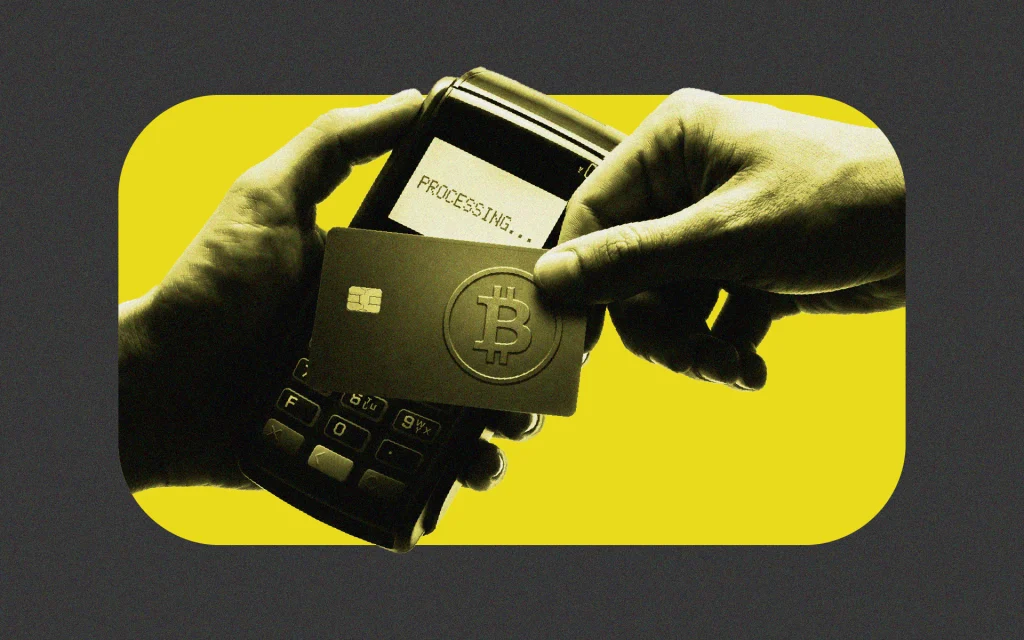
Crypto cards just posted their biggest month yet. In May 2026, crypto card payment volume hit $828M, up 178% year over year, with USDT at 61% of volume, USDC at 26%, and Visa at 97% of network volume.
It is tempting to read that as a simple mainstreaming narrative. People are spending their stablecoins on everyday purchases, and the rails are following suit.
As important as the numbers are, they also hide something more important. The stablecoin economy is splitting into two lanes, and crypto cards sit almost entirely in one of them.
Beneath the Numbers
Card flows are easy to understand. A stablecoin balance gets wrapped in a card experience and spent at a merchant. It’s basically adoption.
Interpretation, however, may vary. Card spending is not the slice of stablecoin payments that makes the most impact on the largest infrastructure decisions.
McKinsey estimates that actual stablecoin payments annualize to about $390B, far below the headline trillions that often get quoted. Within that, the center of gravity is business usage, not retail. B2B stablecoin payments are about $226B a year, roughly 60% of stablecoin payment volume, and they grew 733% year over year.
So the real story behind the crypto card surge is not just that consumers are spending more. It is that stablecoins are getting pulled in two directions at once.
Two Stablecoin Economies
The retail lane optimizes for convenience and habit. It comprises small payments, peer-to-peer transfers, and card top-ups. It is shaped by distribution and simple workflows.
The institutional lane optimizes for risk, controls, and scale. It includes high-value B2B settlement, treasury movements, payroll, and cross-border operational flows. Those decisions come with counterparty and regulatory risk.
McKinsey’s regional breakdown supports how uneven the market is. Stablecoin payments originating from Asia account for about $245B, or 60% of total stablecoin payment volume, with Singapore, Hong Kong, and Japan leading the charge. Such a kind of concentration is usually a result of the way in which the initial wave of users was onboarded, and they simply remained with what was working.
That is why there is a chance of a crypto cards boom, and institutional usage boom at the same time, but pursuing different infrastructure directions.
The Chain Choice Is Changing
Retail stablecoin usage has long been associated with Tron. It became the default in many regions through habit, local liquidity, and early distribution.
The only difference is the assumption that the chain choice is primarily concerned with a low-cost transfer.
Fees fluctuate, and the right comparison is based on the transaction type and the set up of the user. Nonetheless, the previous mental paradigm is losing its credibility.
While basic transactions on Tron can indeed be inexpensive, real-world stablecoin usage, particularly TRC-20 USDT transactions, can regularly reach $2–$3. The point is that even when the counts change, the numbers change. Institutions are concerned with foreseeable unit economics and the lack of surprises when increasing volume.
That brings liquidity depth and infrastructure maturity back into the center. It also brings compliance teams into the room.
Compliance Is Becoming the Rail
The institutional lane is following compliance over ideology. This is whereby regulation starts to shape the topology of stablecoin flows.
In Europe, MiCA established a common framework and presented authorization and supervision requirements for stablecoin issuers and crypto-asset service providers.
As a consequence, major platforms began restricting certain stablecoins for EEA users ahead of enforcement, and Reuters reported Coinbase planned delistings of some stablecoins in Europe to comply with MiCA. The European Systemic Risk Board also notes that major service providers delisted non-MiCAR compliant stablecoins, specifically including USDT among the examples.
The regulatory trend in the US has also tightened towards payment stablecoins. Recently, Treasury and FinCEN have put forward regulations related to GENIUS Act requirements addressing sanctions and anti-money laundering requirements of allowed payment stablecoin issuers.
Serious capital will want to follow through on what compliance teams can certify which makes this hard to ignore. It is one reason the institutional lane gravitates toward auditable reserves, clearer issuer obligations, and infrastructure that is congenial to regulated activity.
Crypto Cards Are Growing, but They Are Not the Whole Market
Crypto cards render stablecoins understandable to consumers. They are also a useful signal because card-linked spending is one of the easier categories to tag onchain, which is why it shows up cleanly in analytics.
However, the biggest growth is happening where stablecoins are used to tackle an infrastructure issue within businesses.
McKinsey’s framing paints a clear picture. The total amount of the transaction of the stablecoins cannot be interpreted as a payment. A lot of on-chain volume is trading, internal shuffling, and automated activity. Once you filter for payments, the growth concentrates around real-world operational friction use cases, especially B2B settlement and liquidity management.
Think of the cards as the front-end distribution layer, while the institutional lane is closer to plumbing.
What the Divergence Implies
If you are a bank or a payments firm, the risk is not that consumers will suddenly pay for everything with stablecoins. The risk is that businesses will route high-value flows around slow and expensive settlement, then build their finance stack on top of that choice.
The stress test is already visible.
Retail adoption can run on inertia. In the local context, people continue to consume what is convenient and liquid.
Conviction is the driving force behind institutional adoption. It compels definite choices regarding custody, controls, reporting, and what will be accepted by regulators. It also tends to consolidate around the rails, which are capable of managing audits and large counterparties without improvisation.
Crypto cards will keep rising, but what remains to be seen is whether the institutions will keep up with it. As MiCA and the US stablecoin regime tighten, that consolidation marks the point where stablecoins move from an edge case into accepted financial infrastructure.
The headline may be crypto cards, but the real tale is infrastructure.
Trusted Partners with Special Offers
The information provided in this article is for informational purposes only. It is not intended to be, nor should it be construed as, financial advice. We do not make any warranties regarding the completeness, reliability, or accuracy of this information. All investments involve risk, and past performance does not guarantee future results. We recommend consulting a financial advisor before making any investment decisions.
About the Author
Anton Lobintsev is the Co-founder and CTO at SquareFi, where he’s building stablecoin payment infrastructure. Anton is a seasoned entrepreneur with over 20 years in the technology industry, building companies at the intersection of infrastructure, compliance, and product innovation. As SquareFi's Chief Technology & Product Officer, he leads product development, legal compliance, and strategic partnerships.
Anton entered the IT industry in 2003 through enterprise server sales, and in 2007, he founded a systems integration company delivering high-performance computing infrastructure, which partnered with global giants including IBM and HP. He then moved into legal tech and later co-founded a venture focused on intellectual property management and digital rights, where he also served as CTO.