Key Takeaways
- FTT, CEL, VGX, LUNC, USTC, LUNA and SFM continue trading despite failed businesses, collapsed models or major legal fallout.
- “Zombie token” covers different situations: Terra’s networks retain community activity, while FTT has lost its original exchange utility.
- Thin liquidity, contract migrations and similar tickers can make these tokens difficult to assess or sell.
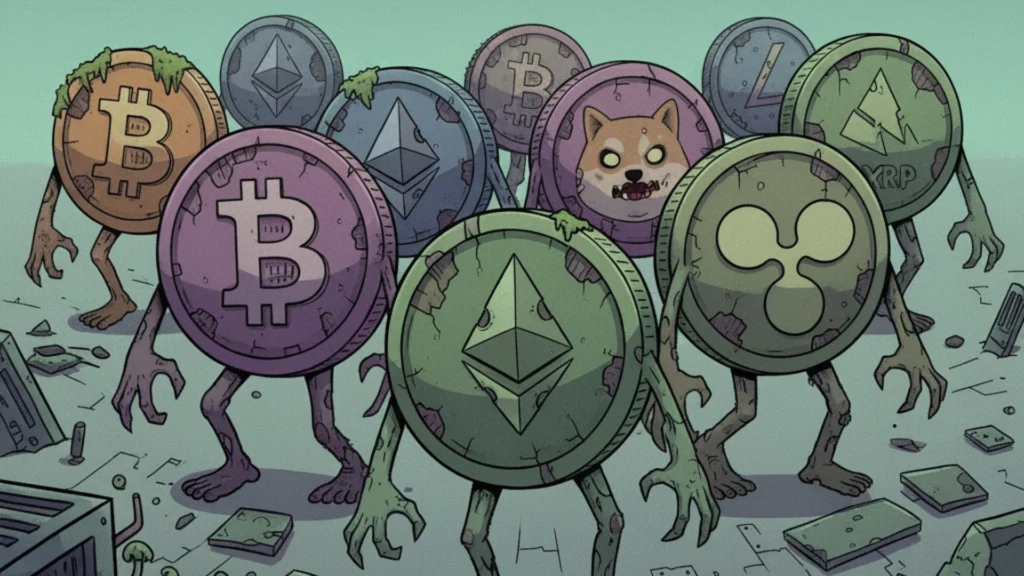
A crypto company can collapse, its founders can face prison, and its original business model can disappear. The token, however, may keep trading.
As of late October, several assets associated with spectacular failures still have exchange listings, liquidity pools or communities pursuing revivals.
“Zombie token” is an editorial description, not a formal classification. These seven examples range from assets stripped of their original utility to functioning networks carrying the legacy of failed projects.
Their survival demonstrates why a quoted price alone says little about an investment’s underlying health.
1. FTX Token (FTT): Trading Without FTX
FTT remains one of the clearest examples of a token outliving its business.
FTX stopped operating in November 2022, removing the exchange services that originally supported FTT’s utility.
Yet the token continues trading. CoinGecko’s data showed approximately $1 million in daily turnover and a price roughly 99.7% below its peak.
CoinMarketCap explicitly warns that FTT no longer has any use. Bankruptcy headlines should not be confused with restored token functionality.
2. Celsius (CEL): The Loyalty Token After the Lender
CEL once supported rewards and borrowing benefits within Celsius’s lending platform. Today, the company’s recovery process and its token market tell different stories.
Celsius announced a fourth creditor distribution of $344.4 million in January 2026.
Meanwhile, CEL remains quoted on decentralized markets, approximately 99.9% below its historical high in CoinGecko’s data.
Creditor distributions represent bankruptcy recoveries, not evidence that the former lending platform or CEL’s original benefits have returned.
3. VGX: A Token Searching for Another Life
VGX survived Voyager Digital’s bankruptcy and subsequently moved into an ecosystem managed independently by the VGX Foundation.
That distinction matters: the token is not simply an operating Voyager loyalty program awaiting a rebound.
CoinGecko identifies the foundation’s independent role and continues tracking VGX markets, although reported activity can be extremely thin.
Repurposing offers a possible second life, but an existing ticker and new ambitions do not establish meaningful adoption or dependable exit liquidity.
4. Terra Classic (LUNC): A Collapse With a Community
LUNC is the original Terra network’s token, renamed after the ecosystem’s devastating 2022 collapse.
Unlike an abandoned exchange token, it belongs to a blockchain that still has validators, governance and community maintenance. Calling it “dead” would therefore misrepresent its operational status.
Its inclusion reflects the enormous gap between Terra’s original ambitions and its subsequent survival. Continued network activity demonstrates persistence; it does not restore the economic model that failed.
5. TerraClassicUSD (USTC): The Stablecoin That Is Not Stable
USTC offers an especially stark contradiction: a former dollar-pegged asset trading around half a cent.
CoinGecko’s figures showed approximately $1.58 million in daily trading volume, despite the token remaining far below its former dollar target.
Trading activity has survived the failure of its defining promise. USTC should consequently be understood as a volatile speculative asset, rather than treated as equivalent to a functioning dollar stablecoin.
6. Terra (LUNA): The Reboot Outliving Its Sponsor
The newer LUNA belongs to the separate Terra blockchain launched after the original collapse.
Terraform Labs’ website still announces its wind-down, while LUNA continues to trade approximately 99.8% below its historical peak, according to CoinGecko’s current snapshot.
The distinction between a company and a blockchain is crucial. Community-supported infrastructure can survive a corporate shutdown. What remains uncertain is whether that survival can support a durable ecosystem beyond the history attached to its name.
7. SafeMoon (SFM): The Brand Survives the Verdict
SafeMoon’s legal reckoning advanced in February 2026, when former CEO Braden John Karony received a 100-month prison sentence for fraud and money-laundering conspiracies.
Yet SFM remains tracked, with CoinGecko flagging a contract migration and listing Solana-based trading.
That creates an additional complication: legacy tokens, migrated assets, and similarly named coins can differ substantially. The brand’s survival does not erase its history, and a familiar name is insufficient to identify what it actually trades.
Top Trending Crypto Articles
The information provided in this article is for informational purposes only. It is not intended to be, nor should it be construed as, financial advice. We do not make any warranties regarding the completeness, reliability, or accuracy of this information. All investments involve risk, and past performance does not guarantee future results. We recommend consulting a financial advisor before making any investment decisions.

Giuseppe Ciccomascolo began his career as an investigative journalist in Italy, where he contributed to both local and national newspapers, focusing on various financial sectors.
Upon relocating to London, he worked as an analyst for Fitch's CapitalStructure and later as a Senior Reporter for Alliance News. In 2017, Giuseppe transitioned to covering cryptocurrency-related news, producing documentaries and articles on Bitcoin and other emerging digital currencies. He also played a pivotal role in establishing the academy for a cryptocurrency exchange website. Crypto remained his primary area of interest throughout his tenure as a writer for ThirdFloor.