Learn what triggered these historic Bitcoin drawdowns | Image credit: CCN
Share
Key Takeaways
Bitcoin experienced several historic drawdowns exceeding 70%, triggered by exchange failures, regulatory shocks, macroeconomic tightening, and speculative bubbles.
Early crashes reflected weak infrastructure and low liquidity, while later downturns were increasingly linked to global financial conditions and institutional activity.
Events such as the Mt. Gox collapse, the ICO bubble burst, the Terra ecosystem collapse, and the FTX bankruptcy triggered major market-wide liquidations.
Bitcoin reached a historic peak near $126,000 in October 2025 before entering another market correction during early 2026.
Bitcoin remains one of the most volatile financial assets ever created.
Since its launch in 2009, the cryptocurrency has experienced dramatic price cycles that include explosive rallies followed by severe crashes.
These downturns have often erased between 50% and 90% of market value within months or even days.
Several factors repeatedly triggered these collapses. Early crashes resulted from exchange hacks, technical failures, and extremely low liquidity. Later downturns reflected regulatory uncertainty, macroeconomic shifts, and the collapse of major crypto institutions.
Each crash also reshaped the industry. Exchanges strengthened security standards, regulators increased oversight, and institutional investors gradually entered the market.
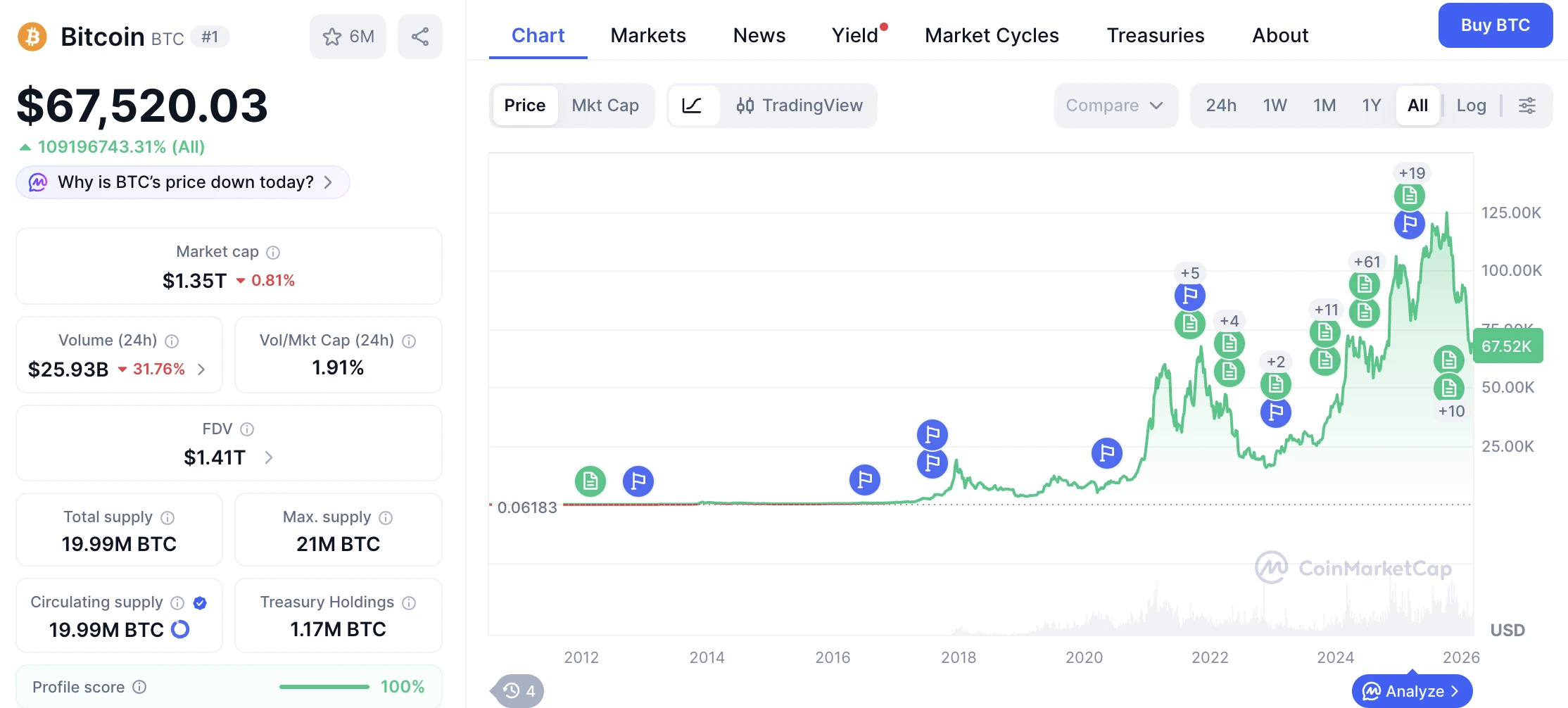
Bitcoin reached a new peak near $126,000 in October 2025, the highest price recorded since its creation. However, the market entered another correction afterward. By March 2026, Bitcoin trades around $67,000–$70,000, roughly 45% below the 2025 high.
Bitcoin performance chart | Source: CoinMarketCap
This article explains the 10 biggest Bitcoin crashes in history, what caused them, and how the market reacted to each collapse.
The first major Bitcoin crash occurred during the earliest phase of the cryptocurrency market.
In June 2011, Bitcoin surged to around $32 before collapsing almost instantly to roughly $0.01 on the Mt. Gox exchange. The $0.01 price represented a nominal flash crash on a single exchange rather than a global market valuation, as the event resulted from compromised accounts and abnormal trading activity on Mt. Gox.
At that time, Mt. Gox processed nearly 90% of global Bitcoin trading, which meant technical problems on the platform could affect the entire market.
Hackers compromised exchange accounts and sold large quantities of stolen Bitcoin at extremely low prices. Thin liquidity amplified the damage.
Peak price: $32
Crash low: $0.01
Estimated drop: 99%
Bitcoin required nearly 20 months to recover and reach new highs.
The event exposed major weaknesses in early crypto infrastructure and pushed exchanges to strengthen security practices.
Lessons from the Flash Card
Just as the 2011 crash was noise from a single exchange (Mt. Gox), many modern crashes are noise from specific institutional failures, such as the 2025 Exchange Traded Funds (ETF) rebalancing or the FTX collapse. The signal remains the protocol’s survival.
August 2012 Bitcoin Crash: Ponzi Scheme Collapse Hits Early Market
One of the earliest market crashes followed the collapse of Bitcoin Savings & Trust, an investment operation that promised unusually high returns to participants.
Authorities later identified the scheme as a Ponzi operation.
When the platform failed, investor confidence weakened and Bitcoin prices dropped sharply.
Peak price: $15–$16
Bottom price: $7
Estimated drop: 56%
Lessons From the Early Ponzi Collapse
The noise during the incident centered on fears that cryptocurrency markets could not function without fraud.
The signal appeared in the regulatory and legal response that followed.
The case became one of the first cryptocurrency fraud prosecutions handled by U.S. regulators, which helped establish early legal precedent for crypto-related financial crimes.
How China’s Bitcoin Restrictions Triggered the 2013–2015 Bear Market
Bitcoin experienced its first prolonged bear market after the explosive rally of 2013.
Prices climbed above $1,100 during late 2013 before falling steadily to roughly $170 by early 2015.
Regulatory pressure from China played a central role. Authorities prohibited Chinese banks from handling Bitcoin transactions, which triggered uncertainty across the market.
The crash also reflected the natural correction of an overheated speculative bubble.
Peak price: $1,150–$1,200
Bottom price: $170–$210
Estimated drop: 86%
Bitcoin did not surpass its 2013 high again until 2017, highlighting how long early bear markets could last.
#Bitcoin has survived 9 major drawdowns since 2011:
🔸 Jun 2011 | Mt. Gox Hack | -99% drop | ~2 yrs to recover 🔸Dec 2013 | China Ban & Mt. Gox Bankruptcy | -87% drop | ~3 yrs to recover 🔸Dec 2017 | ICO Bubble Burst & Global Regulatory Crackdown | -84% drop | ~3 yrs to recover… pic.twitter.com/3qo6qjbd6o
The noise was the 2013 China ban headlines, which made many believe Bitcoin was finished. The signal was the network’s resilience; despite being cut off from the world’s largest market at the time, Bitcoin continued to produce blocks every 10 minutes, eventually leading to the massive 2017 bull run.
April 2013 MT. Gox Crash: Exchange Overload Triggers a 70% Bitcoin Drop
Bitcoin experienced another dramatic crash only months after the first major rally of 2013.
Rapid price growth overwhelmed the infrastructure of Mt. Gox, which remained the dominant exchange at the time.
Trading interruptions and distributed denial-of-service attacks created severe liquidity disruptions that caused Bitcoin’s price to collapse within days.
Peak price: $259–$266
Bottom price: $45–$70
Estimated drop: 70–83%
The crash exposed how centralized trading infrastructure could destabilize the entire market.
Lessons From the 2013 Exchange Overload
The noise came from the belief that Bitcoin itself had failed because its price collapsed so quickly.
The signal appeared in the broader ecosystem. The network continued operating normally while developers, exchanges, and new startups began improving the infrastructure around Bitcoin.
These improvements later helped expand the cryptocurrency industry.
2014 Bitcoin Crash: MT. Gox Bankruptcy Shakes the Crypto Market
The most devastating exchange collapse in early Bitcoin history occurred in February 2014.
Mt. Gox halted withdrawals after discovering that roughly 850,000 Bitcoin were missing, likely stolen over several years through security breaches.
The exchange soon filed for bankruptcy protection.
The incident shattered market confidence and accelerated the ongoing bear market.
Estimated decline during the event: 50–60%
Broader drop from 2013 peak: 85%
Lessons From the MT. Gox Collapse
The noise during the crisis centered on fears that Bitcoin itself would disappear after the failure of its largest trading platform.
The signal came from the rapid evolution of custody and exchange standards that followed.
Cold storage practices, proof-of-reserves discussions, and improved exchange security gradually became industry norms.
Dec 2017–Dec 2018 Bitcoin Crash: ICO Bubble Collapse Hits the Market
Bitcoin experienced a major correction after the massive rally of 2017. Prices climbed rapidly throughout the year and reached nearly $19,700 in December 2017 before entering a prolonged bear market.
The rally coincided with the peak of the Initial Coin Offering (ICO) boom. Hundreds of blockchain projects raised billions of dollars by issuing new tokens. Many projects lacked working products or sustainable business models.
As regulators began investigating ICO fundraising practices, investor confidence weakened and capital quickly exited the market.
Peak price: $19,700
Bottom price: $3,200
Estimated drop: 84%
Lessons From the ICO Bubble Collapse
The noise during the crash centered on fears that cryptocurrency markets were dominated by speculative fundraising and failed projects.
The signal appeared in the structural changes that followed. The industry shifted toward stronger regulations, better project standards, and more mature fundraising models.
March 2020 Bitcoin Crash: Pandemic Panic Triggers Global Sell-off
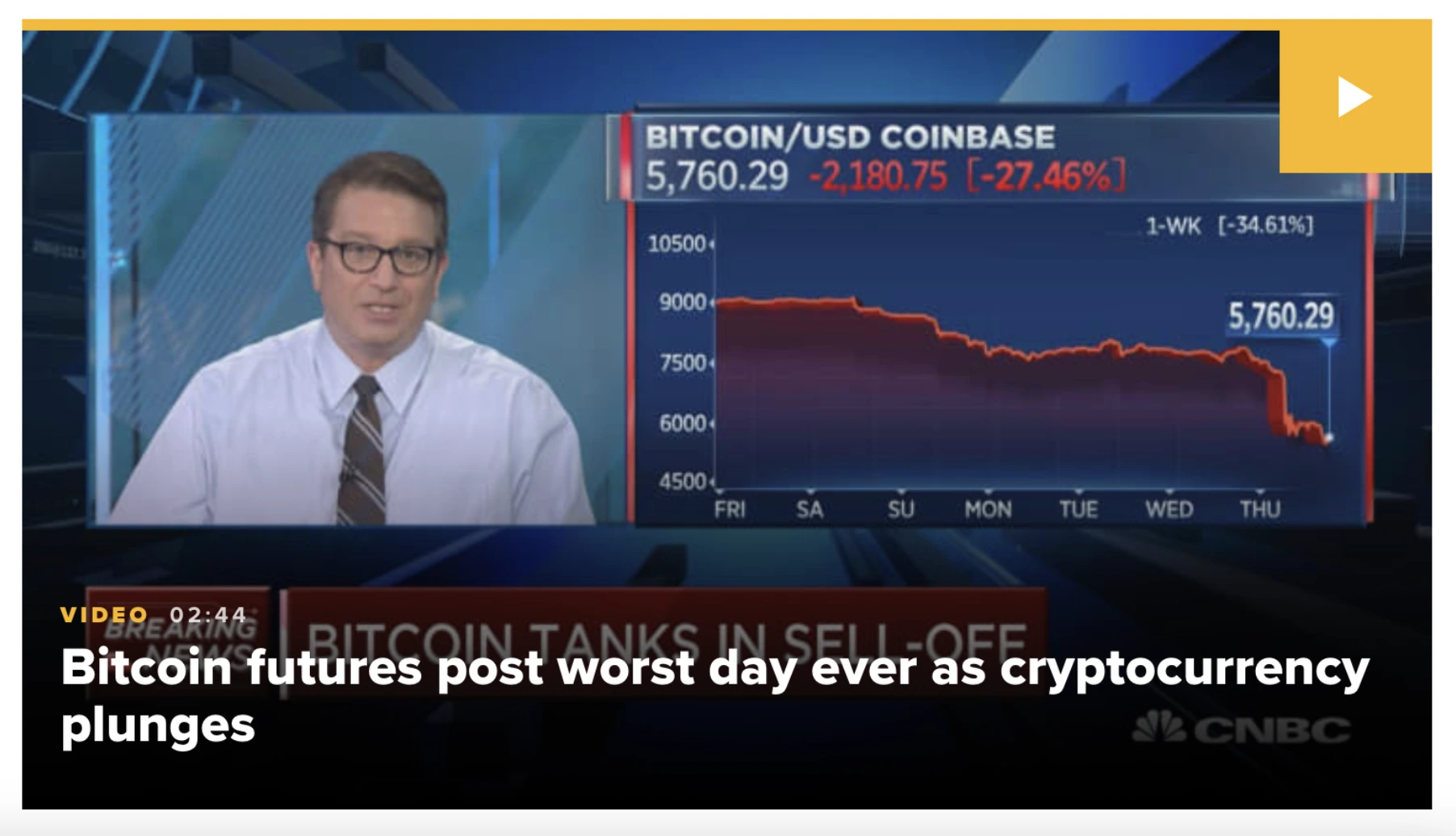
Bitcoin suffered one of its fastest crashes during the early days of the COVID-19 pandemic.
Financial markets around the world experienced severe liquidity stress as investors rushed to sell assets and raise cash.
Bitcoin dropped from around $9,000 to roughly $4,000 in a single day during what traders later called Black Thursday.
The decline occurred simultaneously with historic drops in equity markets and commodities.
Lessons From the COVID Market Crash
The noise came from fears that Bitcoin would collapse alongside traditional financial markets.
The signal appeared shortly afterward. Massive monetary stimulus and renewed institutional interest drove Bitcoin into one of the strongest bull markets in its history.
May–June 2021 Bitcoin Crash: China Mining Ban Shocks the Market
Historically, China hosted the majority of global Bitcoin mining activity.
In May 2021, Chinese authorities introduced sweeping restrictions on cryptocurrency mining and trading.
Large mining operations shut down or relocated to other regions, including North America and Central Asia.
At the same time, Tesla announced that it would suspend Bitcoin payments because of environmental concerns related to mining energy consumption.
These developments triggered a sharp market correction.
Peak price: $64,000
Bottom range: $30,000
Estimated drop: 44–53%
Lessons From the China Mining Crackdown
The noise came from headlines suggesting that Bitcoin mining would collapse without China’s infrastructure.
The signal appeared in the network’s adaptability. Mining operations relocated quickly to new jurisdictions, which ultimately increased geographic decentralization.
November 2022 Bitcoin Crash: FTX Collapse Triggers Industry Contagion
The 2022 market downturn intensified after several major failures across the cryptocurrency industry.
The collapse of the TerraUSD (UST) stablecoin and its sister token Terra (LUNA) in May 2022 erased more than $40 billion in market value and triggered widespread liquidations across the crypto sector.
The failure destabilized several lending platforms and hedge funds, including Three Arrows Capital, which deepened the ongoing bear market.
The collapse of the FTX exchange later became one of the largest financial scandals in cryptocurrency history.
Investigations revealed that the company misused customer funds and relied heavily on its own exchange token, FTT.
When confidence collapsed, users rushed to withdraw assets from the platform.
FTX filed for bankruptcy in November 2022.
Bitcoin prices dropped sharply during the crisis.
Price before collapse: $21,000
Immediate low: $15,500
Estimated drop: 25–30%
The collapse triggered a wave of failures among crypto lenders and trading firms.
Lessons From the FTX Bankruptcy
The noise during the crisis suggested that centralized exchanges could permanently damage the cryptocurrency ecosystem.
The signal emerged amid renewed focus on transparency.
Proof-of-reserves systems, self-custody practices, and decentralized financial tools gained renewed attention after the collapse.
Bitcoin reached a historic peak near $126,000 in October 2025 during the post-halving market cycle.
The rally reflected strong institutional demand, expanding spot Bitcoin exchange-traded funds, and broader global adoption of digital assets.
Profit-taking, tighter liquidity conditions, and volatility across risk assets triggered a decline across the crypto sector.
However, geopolitical tensions and global economic uncertainty also shaped market sentiment during this period, as discussions around conflicts in the Middle East and shifting U.S.–China economic relations influenced risk assets across global markets.
By early 2026, Bitcoin traded near $60,000–$70,000, representing a significant drawdown from the 2025 peak.
Peak price: $126,000
Bottom range: $60k–$70k
Estimated drop: 40–50%
Lessons From the 2025–2026 Correction
The noise during this correction focused on short-term market narratives surrounding institutional flows, ETF-driven trading activity, and macroeconomic uncertainty.
The signal remains the long-term growth of the Bitcoin network, which continues to expand through increasing adoption, development activity, and global participation.
Historical Bitcoin Crashes: 10 Deepest Price Drawdowns You Should Know
Bitcoin’s history is defined by its ability to recover from extreme volatility. The table below ranks the most severe corrections by their peak-to-trough percentage decline.
Crash Period
Drop (%)
Peak Price
Bottom Price
Primary Cause
June 2011
99%
$32
$0.01
Mt. Gox hack; illiquidity.
August 2012
56%
$15
$7
Ponzi scheme (BS&T) collapse.
April 2013
70–83%
$260
$45
Mt. Gox lag; DDoS attacks.
Feb 2014
50–60%
$800
$400
Mt. Gox insolvency and bankruptcy.
Nov 2013–Jan 2015
86%
$1,150
$170
China crackdown; bubble burst.
Dec 2017–Dec 2018
84%
$19,700
$3,200
ICO bubble; regulatory scrutiny.
March 2020
60%
$9,000
$4,000
Global COVID-19 liquidity panic.
May–June 2021
44–53%
$64,000
$30,000
China mining ban; Tesla concerns.
Nov 2021–Nov 2022
77%
$69,000
$15,500
Macro tightening; FTX/Terra failure.
Oct 2025–Early 2026
45%
$126,000
$67,000
Post-ATH correction; ETF rebalancing.
These events represent the most severe corrections recorded across Bitcoin’s history.
Future of Bitcoin After Major Crashes
Bitcoin’s long-term trajectory continues to follow a cycle of rapid expansion, sharp corrections, and gradual recovery.
Each market downturn has historically strengthened the ecosystem. Exchange security improved after the Mt. Gox collapse. Regulatory frameworks were developed after the ICO boom. Institutional custody and transparency practices expanded after the FTX bankruptcy.
New developments continue shaping the next phase of Bitcoin’s evolution. These include expanding institutional investment, broader global adoption, growth in spot Bitcoin exchange-traded funds, and increased regulatory clarity across major markets.
Volatility remains a defining characteristic of the asset. However, each crash has historically led to structural improvements across the industry.
Bitcoin’s future will likely depend on how global regulation, institutional capital flows,
technological innovation, and macroeconomic conditions interact with the network’s fixed supply and decentralized design.
Historically, Bitcoin bear markets have produced declines between 70% and 85% from peak to trough during major market cycles.
How long do Bitcoin bear markets usually last?
Most Bitcoin bear markets last 12 to 24 months, although recovery to new all-time highs can take several years.
Do Bitcoin crashes follow the halving cycle?
Bitcoin market cycles often correlate with the four-year halving schedule, where supply reductions precede bull markets followed by corrections.
Could Bitcoin volatility decrease in the future?
Increasing institutional participation, deeper liquidity, and regulatory clarity may reduce volatility over time, although large price swings remain common in crypto markets.
Disclaimer:
The information provided in this article is for informational purposes only. It is not intended to be, nor should it be construed as, financial advice. We do not make any warranties regarding the completeness, reliability, or accuracy of this information. All investments involve risk, and past performance does not guarantee future results. We recommend consulting a financial advisor before making any investment decisions.
Dr. Lorena Nessi is an award-winning journalist and media technology expert with 15 years of experience in digital culture and communication. Based in Oxfordshire, UK, she combines academic insight with hands-on media practice.
She holds a PhD in Communication, Sociology, and Digital Cultures, and an MA in Globalization, Identity, and Technology.
Lorena has taught at Fairleigh Dickinson University, Nottingham Trent University, and the University of Oxford. She is a former producer for the BBC in London, with additional experience creating television content in Mexico and Japan.
Her research focuses on digital cultures, social media, technology, capitalism, and the societal impact of blockchain innovation.
She has written extensively on digital media and emerging technologies, with her work featured in both academic and media platforms. Her Web3 expertise explores how blockchain technologies shape culture, economics, and decentralized systems.
Outside of work, Lorena enjoys reading science fiction, playing strategic board games, traveling, and chasing adventures that get her heart racing. A perfect day ends with a relaxing spa and a good family meal.


 Easy
Easy