Key Takeaways
- XRP at $100 would imply a massive market capitalization of $6.35 trillion.
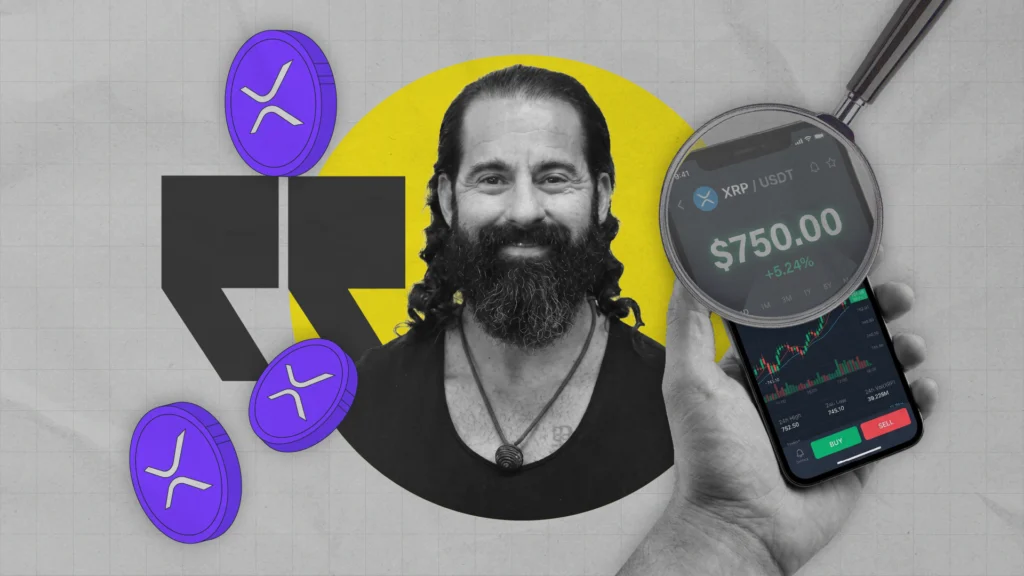
- Viral forecasts range from Standard Chartered’s reported $28 target for 2030 to Jake Claver’s $750 call for the end of 2026.
- ChatGPT considers both $100 and $750 to be extreme scenarios that would require demand far beyond what recent announcements indicate.
XRP reaching $100 by 2030 would require a roughly 96-fold rise from today’s price, pushing its market capitalization above $6 trillion at the circulating supply recorded that day.
The debate comes as technical analyst Ali Martinez has outlined a possible $48 price, while Standard Chartered’s reported roadmap projects $28 by 2030.
Popular commentator Jake Claver has gone considerably further, predicting more than $750 before the end of 2026.
Meanwhile, Ripple’s institutional expansion has provided concrete developments to examine.
But how much demand do those developments create for XRP itself?
To examine whether $100 is realistic by 2030 — and whether Claver’s $750 target has a credible foundation — we asked ChatGPT to assess the valuations, supply assumptions, and adoption required.
What Have Analysts Predicted for XRP?
In a March 13, 2026 post, reproduced in contemporaneous reporting, Martinez wrote:
“A multi-year triangle on $XRP points to $48 as a potential target for the next bull run.”
Meanwhile, Standard Chartered has published a separate bullish thesis based on payments, tokenization and investment demand.
In April 2025, Geoffrey Kendrick, the bank’s global head of digital assets research, told The Block:
“By the end of 2028 we see XRP’s market cap overtaking Ethereum’s.”
The bank’s subsequently reported roadmap, previously covered by CCN, projects $12.60 in 2028 and $28 in 2030.
Claver’s prediction is substantially more aggressive.
As CCN previously reported, he forecast XRP above $750 by the end of 2026, saying:
“I think XRP will be higher than 750 bucks on the day that you’re talking about.”
His thesis links Japanese capital flows, a reverse carry-trade unwind, and institutional settlement demand.
Those are proposed catalysts. They do not establish that XRP will reach his target, and his deadline is much earlier than the 2030 horizon examined here.
What Would $100 XRP Be Worth?
CoinMarketCap listed 63.52 billion XRP in circulation during research on Nov. 14, with the token trading just under $1.
Using that reference price, reaching $100 would require over 9,515% upside.
| Supply assumption |
Valuation at $100 |
| Approximately 63.52 billion circulating XRP |
$6.35 trillion |
| 70 billion XRP |
$7 trillion |
| 80 billion XRP |
$8 trillion |
| 100 billion XRP maximum-supply reference |
$10 trillion fully diluted valuation |
However, sustaining that price would require sufficient buying demand to absorb the XRP offered for sale at a vastly higher valuation.
A $6.35 trillion XRP valuation would exceed the market value of either Apple or Nvidia—the two largest listed companies in an early-November ranking.
Apple was valued at around $5.10 trillion and Nvidia at $4.83 trillion on Nov. 4.
At $100 per token and the stated circulating supply, XRP would be worth roughly 25% more than Apple and 32% more than Nvidia.
At the maximum-supply reference, XRP’s $10 trillion fully diluted valuation would slightly exceed Apple and Nvidia combined, using their Nov. 4 valuations.
Can Ripple’s Institutional Growth Support XRP Demand?
Recent announcements demonstrate expanding institutional access to the XRP Ledger ecosystem.
On Oct. 27, Ripple and BNY announced that BNY’s Digital Asset Custody platform supports XRP and RLUSD.
The companies also outlined plans involving tokenized assets, stablecoin minting and redemption, and trade finance.
Custody can make XRP easier for institutions to hold. However, the announcement does not quantify additional XRP purchases by BNY’s clients.
A day earlier, Aviva Investors announced a tokenized share class for its Sterling Liquidity Fund on XRPL.
The underlying fund has approximately £22 billion in assets, but the entire fund was not tokenized.
Aviva disclosed a £50 million investment in the new share class and more than £86 million across its two tokenized offerings.
For the price thesis, the question is whether expanding activity leads institutions and investors to retain materially larger XRP balances.
$100 XRP by 2030? ChatGPT Weighs In
ChatGPT assessed the target against supply calculations and institutional announcements.
“A $100 XRP price by 2030 is an extreme upside scenario.
“The arithmetic allows it, but the developments examined here do not establish the sustained token demand needed to make it a central expectation.”
The model identified a distinction between making XRP accessible and creating demand to own it.
Custody services could remove practical barriers for institutions, while tokenization could broaden activity on the ledger.
“The strongest version of the bullish case requires XRP to become an asset that institutions and investors want to hold in substantial quantities, alongside its use in transactions.”
ChatGPT also distinguished payment volumes from token balances.
XRP that changes hands quickly could facilitate transaction volumes substantially larger than the value held at any moment.
“A large payments market therefore cannot simply be divided by XRP’s supply to produce a justified token price,” it said.
Its qualitative scenarios were:
-
Bearish: Ripple’s business and XRPL activity expand, but weak investment demand limits XRP’s price gains.
-
Central case: Institutional access improves, but evidence remains insufficient to support $100 as the expected outcome.
-
Bullish: Sustained investment inflows, larger liquidity balances and wider XRP usage reinforce one another.
-
Extreme upside: Those drivers expand enough to sustain a circulating valuation above $6 trillion, potentially higher as supply changes.
Could XRP Reach Jake Claver’s $750 Target?
Claver’s $750 forecast requires a much larger repricing.
From today’s price, XRP would need to rise around 72,015%, reaching about 721 times its starting value.
Claver’s reported prediction applies to the end of 2026.
Looking at whether $750 is achievable by 2030 gives the scenario additional time, but still does not resolve its heavy demand assumptions.
ChatGPT said:
“A $750 XRP price would require a transformation in demand far beyond what the announcements reviewed here demonstrate. I would not treat it as a credible central forecast for 2030, and the evidence is even less supportive of the original end-2026 deadline.”
For that scenario to become more persuasive, institutions would need to retain very large XRP balances, and investment demand would need to absorb selling.
Is $100 by 2030 Realistic?
Comparing the forecasts shows the scale of the different outcomes.
Using 63.52 billion circulating XRP:
| XRP price |
Implied market capitalization |
| $12.60 |
$800 billion |
| $28 |
$1.78 trillion |
| $48 |
$3.05 trillion |
| $100 |
$6.35 trillion |
| $750 |
$47.64 trillion |
The market-cap calculations reveal how far apart these forecasts are.
At a constant circulating supply, moving from Standard Chartered’s $28 target to $100 would require XRP’s valuation to expand by another $4.57 trillion.
Reaching $750 would add a further $41.29 trillion.
The decisive question is how much of the token institutions and investors will choose to own, and at what price.
Announcements can certainly strengthen confidence, but sustaining a multi-trillion-dollar valuation requires buying demand that persists beyond the initial excitement.
ChatGPT believes $100 by 2030 remains a speculative possibility, but the evidence provides considerably less support for $750.
Top Trending Crypto Articles
The information provided in this article is for informational purposes only. It is not intended to be, nor should it be construed as, financial advice. We do not make any warranties regarding the completeness, reliability, or accuracy of this information. All investments involve risk, and past performance does not guarantee future results. We recommend consulting a financial advisor before making any investment decisions.

Kurt Robson is a London-based reporter at CCN, specialising in the fast-moving worlds of crypto and emerging technology. He began his career covering local news in Cornwall after graduating from Falmouth University with First Class Honours in Journalism. There, he cut his teeth on everything from council meetings to missing swans.
He quickly rose through the ranks to become a frontline journalist at several of the UK’s leading national newspapers. Over the years, he has interviewed musicians and celebrities, reported from courtrooms and crime scenes, and secured multiple front-page exclusives.
Following the upheaval of the COVID-19 pandemic, Kurt shifted his focus to technology journalism—just ahead of the AI boom. With a natural curiosity and a trained eye for emerging trends, he has found a new rhythm in reporting on innovation.
At CCN, Kurt's work focuses on the cutting edge of crypto, blockchain, AI, and the evolving digital world. Drawing on his background in people-first reporting and his deep interest in disruptive tech, Kurt delivers stories that are insightful, entertaining, and human-centric.