Key Takeaways
- Coach JV blames frustration toward Ripple figures on unrealistic forecasts while maintaining that XRP is his largest crypto holding.
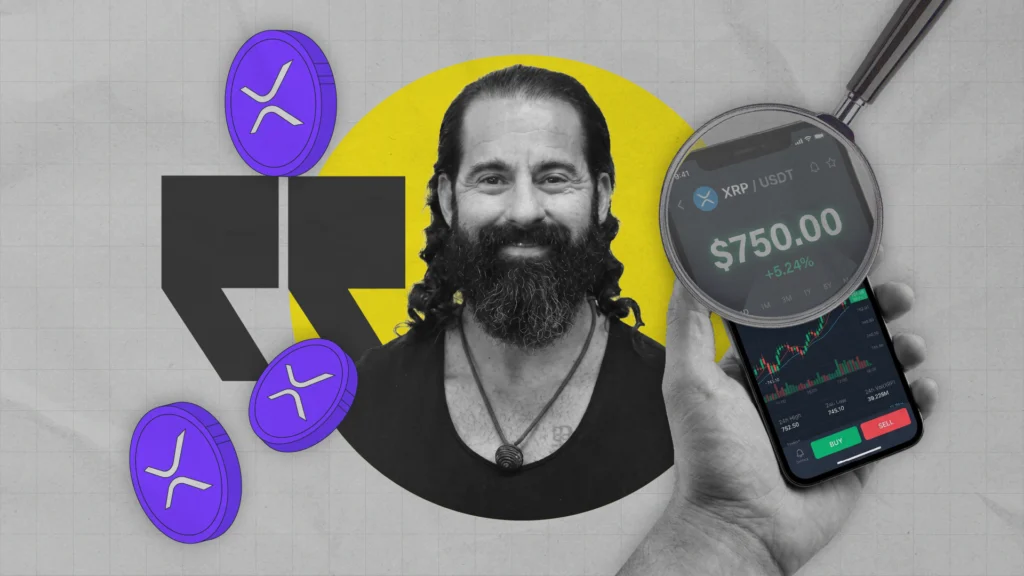
- He did not name Jake Claver, whose past predictions include $750 XRP by year-end and a missed $100 target for 2025.
- At 63.52 billion circulating tokens, $750 XRP would imply a massive $47.64 trillion market capitalization.
Crypto influencer and investing coach Coach JV has defended David Schwartz and Brad Garlinghouse against frustration within the XRP community, arguing that unrealistic price forecasts have encouraged holders to expect financial outcomes that were never guaranteed.
Coach JV, who shares investing commentary, said XRP remains his largest crypto holding despite his criticism of the hype surrounding it.
His comments add another perspective to a debate that has already drawn scrutiny of Jake Claver’s $750 year-end forecast and other predictions stretching into four figures.
Coach JV Says XRP Holders Have Been Sold Unrealistic Expectations
In his X post on Thursday, Coach JV attributed the backlash against Ripple figures to the expectations surrounding the token.
“The reason David Schwartz and Brad Garlinghouse are facing so much frustration from the XRP community has less to do with XRP itself and more to do with years of unrealistic price predictions, manufactured hype, and expectations that were never guaranteed.”
He argued that some investors have become fixated on the prospect of an event that will abruptly transform their finances.
“People have been conditioned to wait for a magical date, a secret announcement, or a switch to flip that will suddenly change their financial future.”
His message urged investors to reconsider where they place responsibility when prices disappoint:
“Stop attacking people because the market hasn’t delivered on someone else’s timeline.”
Ex-Ripple CTO David Schwartz Pushes Back on XRP Holder Demands
Coach JV’s comments follow a public confrontation between XRP Ledger co-creator David Schwartz and a holder questioning whether years of support would ever translate into financial rewards.
In the exchange covered on Nov. 10, X user My2Cents called on Schwartz or Ripple CEO Brad Garlinghouse to address frustration within the community.
“Promise after promise and 0 results,” the user wrote.
With XRP trading around $1.10 during the discussion, the user questioned whether the token’s role primarily benefited Ripple rather than its holders.
Schwartz rejected the suggestion that the company was withholding an undisclosed strategy that would eventually explain everything.
“There’s no secret plan we aren’t telling you about.”
He said Ripple regularly discusses its plans, pushing back against expectations of a hidden development waiting to transform XRP’s fortunes.
The discussion also addressed how XRP could benefit from activity on its network.
Another participant questioned whether its use to cover transaction fees offered a convincing explanation for the substantial price appreciation.
Schwartz dismissed fees alone as a significant driver of expected price.
Instead, he pointed to XRP’s broader position within the ledger.
Schwartz maintained that successful adoption of XRPL should allow XRP to capture some of that value. However, that argument did not establish a price target or a timetable for returns.
XRP Remains His Largest Holding Despite Taking Profits
Coach JV said his criticism of the surrounding hype had not changed his investment position.
“Let me be very clear. XRP is my number one crypto holding, and I continue accumulating during these downturns. My conviction has not changed. But conviction should never replace logic.”
He said he sold XRP after reaching previously selected profit targets, moved capital into cash-flowing assets, and retained liquidity.
He also said he bought back at lower prices following the October 10, 2025 sell-off.
“You can take profits without abandoning your conviction. And you can question unrealistic predictions without being bearish.”
The post also promoted his CAPL + DR™ investing framework, which stands for cash flow, protection, and de-risking.
The approach encourages investors to build income-producing assets, protect wealth, and reduce exposure by taking profits.
Jake Claver’s $750 XRP Forecast Faces a Year-End Test
The wider debate includes Claver’s prediction that XRP will exceed $750 before the end of 2026.
Asked about his expectations for Dec. 31, Claver said:
“I think XRP will be higher than 750 bucks on the day that you’re talking about.”
His scenario involves Japanese capital returning home, a global liquidity rotation, a prospective BlackRock XRP ETF and XRP’s use in securities settlement.
The forecast drew public questioning from technical analyst ChartNerd, who challenged Claver’s $750 deadline alongside Kwok’s $1,000 target for 2030.
“Public predictions will inevitably invite public scrutiny,” ChartNerd wrote.
Claver also previously predicted $100 XRP before the end of 2025, a target the token failed to reach.
After the deadline passed, he defended his broader thesis while acknowledging delays:
“Timelines always get extended.”
In October, he reaffirmed another forecast of $10,000 XRP by late 2026 or early 2027.
“I still think that,” he said.
What Would $750 XRP Actually Require?
Using today’s $1.03 price, reaching $750 would require a 72,716% increase, making XRP about 728 times as valuable per token.
Using around 63.52 billion circulating XRP, the valuation implications are massive:
| XRP price |
Implied market capitalization |
| $100 |
$6.35 trillion |
| $750 |
$47.64 trillion |
| $1,000 |
$63.52 trillion |
| $10,000 |
$635.2 trillion |
Even at $100, XRP’s implied $6.35 trillion market capitalization would exceed Nvidia’s roughly $4 trillion valuation and be more than four times Bitcoin’s approximately $1.38 trillion market value.
At $750, XRP would be worth approximately 12 times Nvidia and 35 times Bitcoin, based on those reference valuations.
A $1,000 price would push its market capitalization beyond $63 trillion — roughly 16 times Nvidia — while $10,000 would imply $635 trillion, or around 460 times Bitcoin’s current market value.
Why Ripple’s Growth Does Not Guarantee Three-Digit XRP
The central valuation question is how institutional activity translates into XRP that participants need to acquire and retain.
XRP is required for network fees and reserves.
However, assets can move across XRPL without using XRP as their principal settlement currency.
The ledger’s official documentation explains that XRP can bridge token trades when that route offers a better rate than trading directly.
That question has followed Ripple through successive announcements.
Its investments in tokenization companies ZILO and Licuido prompted some holders to question why its expanding financial infrastructure was not delivering stronger XRP returns.
One trader argued that the developments were positive for Ripple but “don’t play any big role in the XRP price.”
More recent developments have reinforced the distinction.
Aviva Investors launched a tokenized share class of its approximately £22 billion Sterling Liquidity Fund on XRPL, committing £50 million to the offering.
Meanwhile, Ripple’s UK and Europe managing director, Cassie Craddock, described its London office as “over capacity” and reported stronger engagement from British institutions.
None of these developments have had a massive growth impact on XRP’s price.
The information provided in this article is for informational purposes only. It is not intended to be, nor should it be construed as, financial advice. We do not make any warranties regarding the completeness, reliability, or accuracy of this information. All investments involve risk, and past performance does not guarantee future results. We recommend consulting a financial advisor before making any investment decisions.

Kurt Robson is a London-based reporter at CCN, specialising in the fast-moving worlds of crypto and emerging technology. He began his career covering local news in Cornwall after graduating from Falmouth University with First Class Honours in Journalism. There, he cut his teeth on everything from council meetings to missing swans.
He quickly rose through the ranks to become a frontline journalist at several of the UK’s leading national newspapers. Over the years, he has interviewed musicians and celebrities, reported from courtrooms and crime scenes, and secured multiple front-page exclusives.
Following the upheaval of the COVID-19 pandemic, Kurt shifted his focus to technology journalism—just ahead of the AI boom. With a natural curiosity and a trained eye for emerging trends, he has found a new rhythm in reporting on innovation.
At CCN, Kurt's work focuses on the cutting edge of crypto, blockchain, AI, and the evolving digital world. Drawing on his background in people-first reporting and his deep interest in disruptive tech, Kurt delivers stories that are insightful, entertaining, and human-centric.