Key Takeaways
- Mike Novogratz said CLARITY Act negotiations were down to “word-smithing,” although ethics and stablecoin disputes remain unresolved.
- XRP bull Charusan claimed XRP should already trade at $15 and reiterated his controversial $324.22 forecast.
- 24/7 Wall St. analyst Sam Daodu estimated regulatory certainty could attract up to $8 billion and push XRP toward $5.
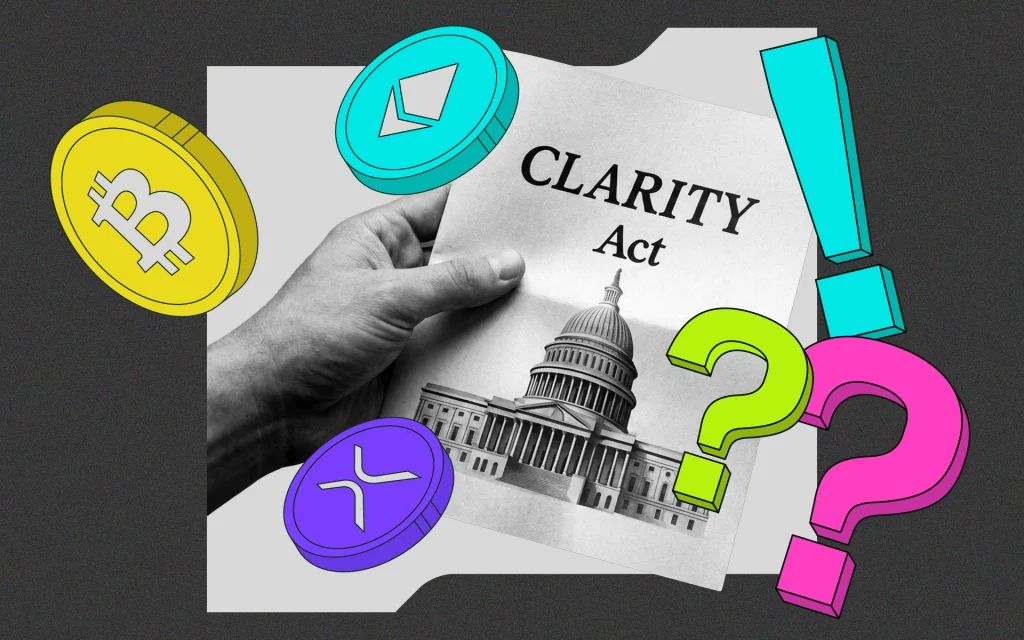
XRP’s price outlook has returned to the spotlight after Galaxy Digital Chief Executive Mike Novogratz said negotiations over the “in danger” CLARITY Act were down to final “word smithing,” raising hopes that lawmakers could be approaching a compromise.
With the Senate scheduled to begin a five-week recess on Aug. 10, lawmakers have just 21 calendar days to reach an agreement before the bill enters a more difficult pre-election window.
Meanwhile, prominent XRP bull Charusan claimed the price should already be trading at $15 and reiterated that he expects it to eventually outperform Bitcoin and Ethereum.
Mike Novogratz Says CLARITY Act Is Down to ‘Word Smithing’
Novogratz called on Republicans and Democrats to resolve their remaining differences after months of negotiations over the legislation.
“The Clarity Act is essential for America’s future,” the Galaxy CEO wrote on X on Saturday.
“We are down to ‘word smithing’ around an ethics clause.”
Novogratz said that Americans did not want politicians to gain a financial advantage unavailable to ordinary citizens.
However, he said he was “calling on both sides to read the room.”
He called on Republican senators to increase pressure on the White House while urging Democrats to accept that a digital asset bill could not eliminate every form of corruption across the federal government.
“Prove to us that, like with housing, Congress can still function for the long-term good of the American people,” he wrote.
John E. Deaton, the founder of CryptoLaw who represented XRP holders during the SEC’s case against Ripple, backed Novogratz’s intervention.
“Members of Congress should listen and hear Novogratz’s words,” Deaton wrote.
“This is such a no-brainer. Let’s add language that addresses the conflicts of interest issue but let’s also accept the fact that we can’t end all grift in Washington in a digital assets clarity act.”
The comments followed a series of lobbying events involving approximately 50 executives from crypto companies ahead of critical negotiations expected this week.
The Senate Banking Committee advanced the legislation by a bipartisan 15-9 vote in May, formally moving it toward the Senate floor, the committee said.
However, even Senate approval would not immediately make the bill law.
Any differences from the version previously passed by the House would need to be resolved before the final legislation could be sent to President Donald Trump.
Why Is the CLARITY Act Still Being Held Back?
The bill cannot advance without Republican support.
The party holds 53 Senate seats, meaning it would need at least seven additional votes to overcome the expected 60-vote procedural threshold.
Securing that support has proved difficult as negotiators remain divided over protections against conflicts of interest.
Democrats want tighter limits on crypto holdings and business activity involving senior officials, particularly following scrutiny of President Trump’s family investments.
Republicans maintain that the existing proposal already introduces substantial safeguards.
Lawmakers are also struggling to agree on whether stablecoin platforms should be allowed to provide returns to customers.
Traditional banks say such products could compete with deposits without being subject to comparable regulation, while crypto firms want the legislation to preserve certain rewards connected to how customers use their platforms.
Deaton warned last week that the dispute could derail the legislation entirely.
“After everything crypto has been through this past decade, the Clarity Act could die over ‘ethics concerns’?” he wrote.
“Simulation confirmed. You can’t write satire this good.”
His warning came after Politico reported that Republican senators were preparing to release updated legislative text following a meeting with Trump, despite Democratic negotiators not supporting the ethics provisions being presented.
The release was postponed, meaning it is expected at some point this week.
Could the CLARITY Act Be Delayed Until 2027?
Missing the August 10 deadline would not automatically kill the legislation.
Senators could resume negotiations after returning in September or attempt to pass it during the post-election session.
However, the approaching midterm elections and competition from other legislative priorities would leave limited time for a floor vote.
If Congress failed to complete the process before its current term ended in January, the unfinished legislation would expire.
Lawmakers would then need to reintroduce it in the new Congress, with previous votes no longer carrying over.
That could push the process well into 2027 as the bill moved through committee consideration and votes in both chambers again.
Senators Increase Pressure for CLARITY Act Passage
Lawmakers from both parties have nevertheless begun speaking more forcefully about reaching an agreement.
Sen. Mark Warner, a Virginia Democrat involved in the negotiations, said he wanted lawmakers to bring the process to an end.
“I want this done,” Warner said. “I’m tired of being in crypto hell. I want America to lead in digital assets.”
Sen. Cynthia Lummis, a Wyoming Republican and one of the legislation’s most prominent supporters, issued another call for its passage on Sunday.
“If something is genuinely decentralized, it should not be regulated like a bank,” Lummis said.
“Getting that distinction right took years of work, and we finally have the opportunity to make it law. Let’s pass the Clarity Act.”
XRP Bull Says Price Should Already Be Worth $15
As the regulatory negotiations continued, Charusan doubled down on his belief that XRP’s price remains significantly undervalued.
“If people realized what the XRPL is truly capable of, the price of XRP would be $15 right now,” he wrote.
“But most people who HODL XRP don’t even really know why they are HODLing.”
The analyst added that he had not spent six years holding and researching XRP merely for it to reach $15.
“I know exactly what I am HODLing,” he said.
Charusan did not provide a new calculation supporting the $15 valuation or explain when he expected XRP to reach that level.
However, the comments reinforced his previous prediction that XRP could eventually rise above $300 and outperform both Bitcoin and Ethereum.
In June, Charusan published a model that predicted an XRP price of $324.22.
“The reason I always set a $300 target is because my mathematical calculations explicitly point to $324.22,” he wrote.
“This price is the inevitable outcome of the liquidity velocity and institutional pool depth calculations behind the asset.”
His model assumes that only 15 billion XRP would remain freely available once large financial institutions began using the network.
Charusan also assumes that $1.2 trillion in daily volume from DTCC clearing, derivatives collateral, and cross-border banking would be routed through an XRP-based settlement system.
Applying a regulatory buffer multiplier of four creates a hypothetical liquidity requirement of $4.8 trillion.
CLARITY Act Passing, Measured XRP Price Growth?
The calculation received pushback from critics who questioned both the assumed institutional volume and the claim that only 15 billion XRP would remain available.
It also assumes that financial institutions would route substantial activity through XRP itself, rather than using the XRP Ledger without the token.
Passing the CLARITY Act could reduce regulatory uncertainty surrounding digital assets, but it would not require banks, clearing companies, or payment providers to adopt XRP.
Charusan’s forecast is also considerably higher than the price ranges outlined by many other analysts.
Sam Daodu, an analyst at 24/7 Wall St., wrote a report in May that the CLARITY Act could still have a meaningful effect on XRP’s price but remained grounded in its growth prediction.
Daodu argued that the absence of legislation had discouraged some banks, custodians, and asset managers from increasing their exposure to XRP.
“The CLARITY Act would write the commodity classification permanently into federal statute and move XRP’s jurisdiction from the SEC to the CFTC,” he said.
Adding: “That shift is the entire mechanism behind the institutional-capital argument for XRP’s long-term price.”
He estimated that between $4 billion and $8 billion in additional institutional money could enter the market if the legislation provided investors with permanent legal certainty.
However, Daodu cited price forecasts substantially below Charusan’s $15 and $324 predictions.
“If the CLARITY Act passes and Ripple secures that master account, analysts project XRP could push toward the $5 range,” he wrote.
The information provided in this article is for informational purposes only. It is not intended to be, nor should it be construed as, financial advice. We do not make any warranties regarding the completeness, reliability, or accuracy of this information. All investments involve risk, and past performance does not guarantee future results. We recommend consulting a financial advisor before making any investment decisions.

Kurt Robson is a London-based reporter at CCN, specialising in the fast-moving worlds of crypto and emerging technology. He began his career covering local news in Cornwall after graduating from Falmouth University with First Class Honours in Journalism. There, he cut his teeth on everything from council meetings to missing swans.
He quickly rose through the ranks to become a frontline journalist at several of the UK’s leading national newspapers. Over the years, he has interviewed musicians and celebrities, reported from courtrooms and crime scenes, and secured multiple front-page exclusives.
Following the upheaval of the COVID-19 pandemic, Kurt shifted his focus to technology journalism—just ahead of the AI boom. With a natural curiosity and a trained eye for emerging trends, he has found a new rhythm in reporting on innovation.
At CCN, Kurt's work focuses on the cutting edge of crypto, blockchain, AI, and the evolving digital world. Drawing on his background in people-first reporting and his deep interest in disruptive tech, Kurt delivers stories that are insightful, entertaining, and human-centric.