Key Takeaways
- Ripple executive Luke Judges expects the first issuance under its Brazilian infrastructure project to represent approximately $15 billion of assets on the XRP Ledger.
- XRP fell toward $1.48, prompting Flare CEO Hugo Philion to call the market’s response “lunacy.”
- Analyst Dark Defender sees a speculative long-term route toward $750–$1,000.
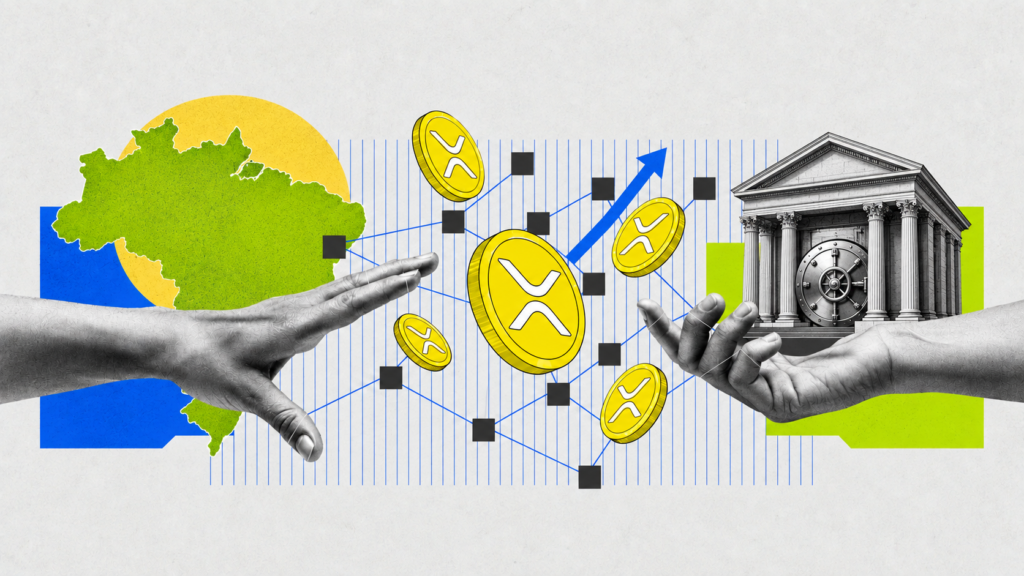
XRP bulls have branded the token’s latest price decline “lunacy” after a Ripple executive revealed that an upcoming Brazilian issuance could represent approximately $15 billion of assets on the XRPL.
Luke Judges, a senior director at Ripple, said the first issuance under Ripple’s program with Brazilian securities infrastructure provider CSD BR could take place before the end of 2026.
However, the token fell toward $1.48 on Oct. 1, extending the disconnect between Ripple’s institutional announcements and the token’s immediate performance.
The muted reaction arrives as analyst Dark Defender circulates an extraordinary long-term forecast placing XRP between $750 and $1,000.
Ripple Executive Reveals $15 Billion XRPL Target
Ripple and CSD BR announced their partnership on Sept. 29.
The first phase will place digital representations of BTG Pactual investment-fund shares on XRPL using its Multi-Purpose Token standard.
Judges subsequently revealed the potential size of the first issuance.
“Expect the first issuance under this program to deliver around $15bn of ‘represented’ mcap on XRPL,” he wrote.
The executive said the technology build had begun and that he would like to see the issuance completed before the end of the year.
However, he also warned that potential technical delays could disrupt that timetable.
Judges described the partnership as the first public integration of XRPL into core financial market infrastructure at this scale.
He added that XRPL is currently the only blockchain included in the technology stack and called the Brazilian market a potentially larger growth opportunity than XRPL’s previous institutional projects combined.
CSD BR operates registration and settlement infrastructure that holds more than R$22 trillion—approximately $4 trillion—in registered assets.
The initial deployment does not put that entire amount on XRPL.
Instead, CSD BR will begin by mirroring records for selected BTG Pactual fund shares.
If the first phase succeeds, the organization plans to consider trading and additional assets, including Brazilian real estate.
XRP Bulls Call Price Reaction ‘Lunacy’
Despite the announcement and the Judges’ additional $15 billion projection, XRP traded lower.
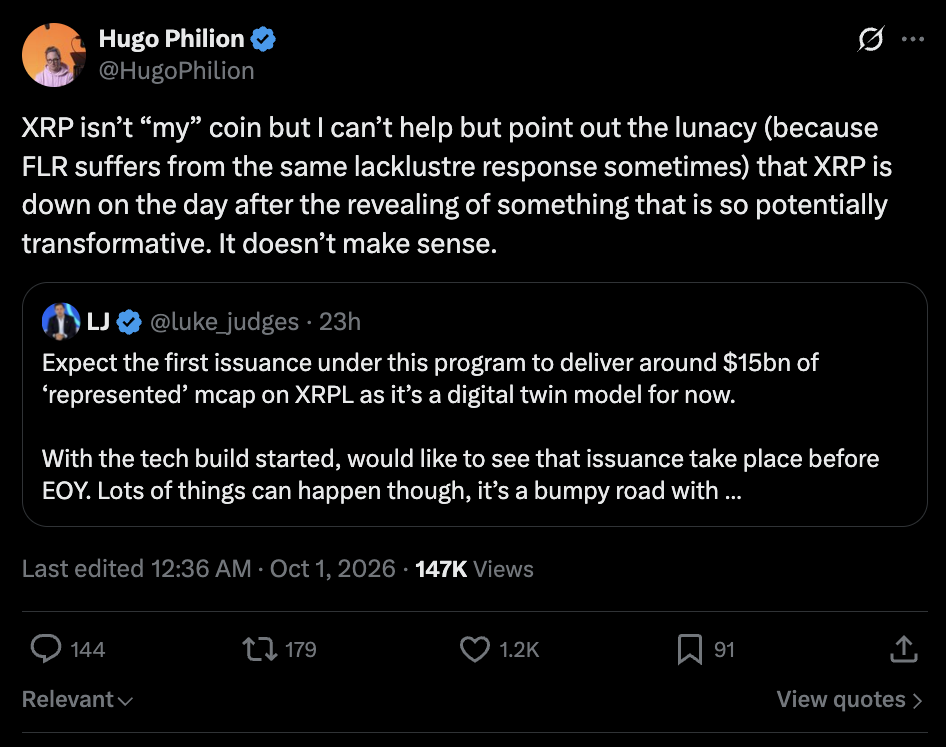
Flare co-founder and CEO Hugo Philion highlighted the apparent disconnect, even though he said XRP was not his preferred token.
“XRP isn’t ‘my’ coin but I can’t help but point out the lunacy,” Philion wrote.
He described the Brazilian project as potentially transformative and said XRP’s negative price reaction did not make sense.
Australian lawyer and prominent XRP commentator Bill Morgan went further, arguing that the token had failed to respond to both the CSD BR announcement and the reported approval of Evernorth’s merger vote.
“My rational response is to buy more $XRP,” Morgan said.
However, Ripple’s announcement of an XRPL project does not necessarily create immediate demand for XRP.
The Brazilian system will initially operate as a digital twin model, meaning blockchain records will mirror the assets maintained in CSD BR’s existing infrastructure.
Ripple has not said that CSD BR, BTG Pactual, or participating institutions must purchase substantial amounts of XRP to use the system.
Dark Defender Maps a Route Toward $1,000 XRP
The institutional development coincides with one of the market’s most extreme forecasts.
Pseudonymous analyst Dark Defender recently presented a long-term chart based on what he described as XRP’s largest-ever cup-and-handle pattern.
His projected levels include:
- $1.88
- $18.22
- $74.39
- $333.12
- $750–$1,000
“I see $750–$1,000 these days,” Dark Defender wrote.
The analyst suggested that even five-digit targets could emerge, though he did not provide a firm deadline for XRP to reach its highest levels.
His projection relies on long-term chart patterns, Fibonacci extensions and assumptions about tokenized assets and XRP’s future role as collateral.
What Would $1,000 Require?
Reaching $1,000 from approximately $1.48 would require XRP to rise by around 67,500%.
Based on a circulating supply of approximately 62.9 billion tokens, that price would produce a circulating market capitalization approaching $63 trillion.
That would make XRP worth several times more than the current combined value of the world’s largest publicly traded companies.
The $15 billion Brazilian issuance would represent only about 0.024% of the implied market value required to reach $1,000 per XRP.
Even that comparison overstates the direct relationship because represented assets are not automatically used to buy XRP.
For the Brazilian project to become a meaningful token catalyst, investors would need evidence that later phases create sustained settlement activity and institutional XRP holdings.
The information provided in this article is for informational purposes only. It is not intended to be, nor should it be construed as, financial advice. We do not make any warranties regarding the completeness, reliability, or accuracy of this information. All investments involve risk, and past performance does not guarantee future results. We recommend consulting a financial advisor before making any investment decisions.

Kurt Robson is a London-based reporter at CCN, specialising in the fast-moving worlds of crypto and emerging technology. He began his career covering local news in Cornwall after graduating from Falmouth University with First Class Honours in Journalism. There, he cut his teeth on everything from council meetings to missing swans.
He quickly rose through the ranks to become a frontline journalist at several of the UK’s leading national newspapers. Over the years, he has interviewed musicians and celebrities, reported from courtrooms and crime scenes, and secured multiple front-page exclusives.
Following the upheaval of the COVID-19 pandemic, Kurt shifted his focus to technology journalism—just ahead of the AI boom. With a natural curiosity and a trained eye for emerging trends, he has found a new rhythm in reporting on innovation.
At CCN, Kurt's work focuses on the cutting edge of crypto, blockchain, AI, and the evolving digital world. Drawing on his background in people-first reporting and his deep interest in disruptive tech, Kurt delivers stories that are insightful, entertaining, and human-centric.