Key Takeaways
Bitcoin’s latest correction has revived one of the market’s oldest questions: could the world’s largest cryptocurrency eventually crash back to $20,000?
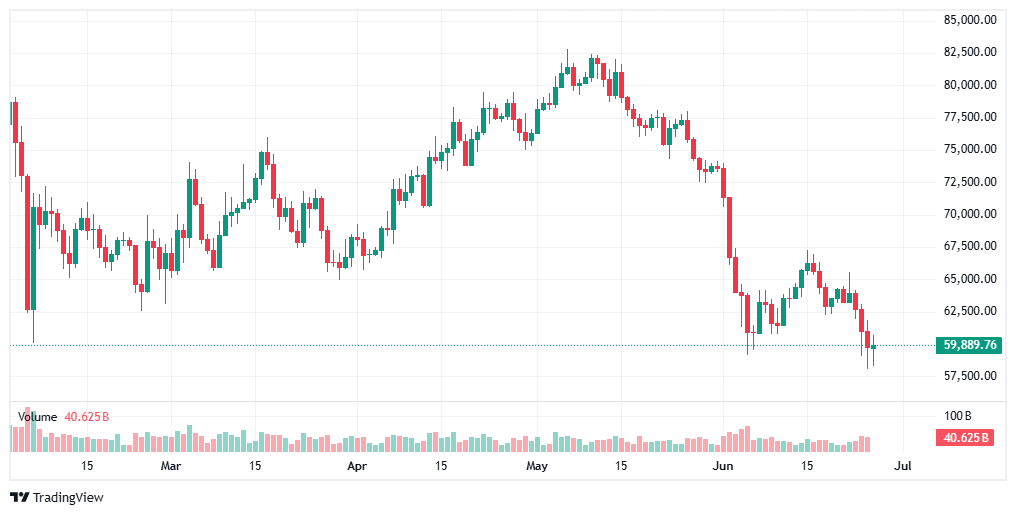
After falling sharply from its 2025 record high and revisiting price levels not seen in months, as it’s now below $60,000, investors are once again debating whether this is simply another cyclical pullback or the beginning of a much deeper bear market.
To explore the possibility, we asked two leading AI models, OpenAI’s ChatGPT and Anthropic’s Claude, what would have to happen for Bitcoin to revisit the $20,000 level.
While both agree that such a decline cannot be completely ruled out, they also argue it would require an extraordinary combination of negative events rather than a typical market correction.
+87
Bitcoin
Ethereum
Tether
Wrapped BNB
USD Coin
Solana
Ripple
Dogecoin
Cardano
Shiba Inu
Avalanche
TRON
Chainlink
Polygon Ecosystem Token
Polkadot
Wrapped Bitcoin
Litecoin
Dai
NEAR Protocol
Bitcoin Cash
Stellar
Cosmos
Filecoin
Ethereum Classic
Aptos
Hedera Hashgraph
Immutable
Optimism
Arbitrum
VeChain
The Sandbox
Decentraland
Axie Infinity
Injective Protocol
Render Token
The Graph
Maker
Aave
Chiliz
Helium
PAX Gold
Compound
Lido DAO Token
Sui
Lido Staked ETH
Bitget Token
Wrapped Ethereum
OKB
Uniswap
Pepe
Ondo
Mantle
First Digital USD
Kaspa
Jupiter
Worldcoin
PayPal USD
Bonk
Rocket Pool ETH
Flare
Tether Gold
Sei
JITO
JasmyCoin
PancakeSwap
Core
Floki Inu
Ethereum Name Service
SushiSwap
Kava.io
1inch Network
Tezos
Trust Wallet Token
Curve DAO Token
KuCoin Token
MultiversX
GateToken
Zcash
Basic Attention Token
Enjin Coin
Frax
Ethena USDe
Ethena Staked USDe
BlackRock USD Institutional Digital Liquidity Fund
Fasttoken
Algorand
Flow
Monero
XDC Network
Bittensor
Ethena
Artificial Superintelligence Alliance
+68
Bitcoin
Ethereum
Tether
Wrapped BNB
Solana
Ripple
Dogecoin
Cardano
Toncoin
Avalanche
TRON
Polkadot
Wrapped Bitcoin
Litecoin
NEAR Protocol
Bitcoin Cash
Stellar
Cosmos
Filecoin
Ethereum Classic
Hedera Hashgraph
Immutable
VeChain
The Sandbox
Render Token
The Graph
Maker
Aave
Chiliz
Helium
PAX Gold
Compound
Lido DAO Token
Sui
Lido Staked ETH
Bitget Token
Wrapped Ethereum
OKB
Uniswap
Pepe
Mantle
Bittensor
Kaspa
XDC Network
Artificial Superintelligence Alliance
Jupiter
Quant
Worldcoin
PayPal USD
Rocket Pool ETH
Flare
Tether Gold
Sei
JITO
JasmyCoin
PancakeSwap
Core
Floki Inu
Ethereum Name Service
Kava.io
1inch Network
Tezos
Trust Wallet Token
Curve DAO Token
Zcash
Basic Attention Token
Enjin Coin
Ethena USDe
USD Coin
Chainlink
Arbitrum
GateToken
IOTA
According to ChatGPT, a drop to $20,000 remains technically possible, but only under an extreme “worst-case scenario.”
The model argues that ordinary market volatility is unlikely to produce such a severe decline. Instead, several major catalysts would probably need to occur simultaneously.
Among them are a deep global recession or financial crisis that forces investors to liquidate risk assets, significant institutional selling driven by large ETF outflows and corporate treasury liquidations, and coordinated regulatory crackdowns across major economies.
ChatGPT also points to crypto-specific risks, including the collapse of a major exchange, stablecoin or institutional custodian, alongside a deterioration in market liquidity that could trigger cascading leveraged liquidations.

Despite outlining these risks, the AI believes today’s Bitcoin market is fundamentally different from previous cycles.
Spot Bitcoin ETFs have created a sizeable base of institutional investors, while public companies and investment funds collectively hold millions of BTC as long-term strategic assets.
The post-halving supply reduction also limits the number of new coins entering circulation each day, reinforcing Bitcoin’s scarcity.
Based on those factors, ChatGPT outlines three possible scenarios.
Its bullish case assumes institutional demand continues absorbing selling pressure, limiting corrections to roughly 20% to 35%. The base-case scenario envisions a traditional crypto bear market with a drawdown between 40% and 60% before recovery.
Only under an extreme combination of macroeconomic and crypto-specific shocks does the model see Bitcoin falling into the $20,000-$30,000 range.
Anthropic’s Claude reaches a similar conclusion, although it places greater emphasis on Bitcoin’s historical market cycles.
The model notes that Bitcoin is currently trading around $62,000 after retreating significantly from its all-time high near $126,000. Technical indicators remain weak, with bearish momentum dominating and the Relative Strength Index hovering near oversold territory.
Claude acknowledges that Bitcoin skeptic Peter Schiff continues to argue the cryptocurrency could eventually collapse below $20,000 if it loses support around $50,000.

However, the AI also points out that Schiff has repeatedly made similar predictions throughout Bitcoin’s history, while the asset has ultimately recovered to reach new all-time highs.
Instead of focusing on the most pessimistic forecasts, Claude examines previous bear markets.
Bitcoin lost approximately 87% after the 2017 cycle and around 78% during the 2022 bear market.
Recent cycles have produced progressively smaller percentage declines, leading some analysts to estimate that the current correction could result in a 70% to 76% drawdown from the 2025 peak.
Such a decline would place Bitcoin somewhere between roughly $30,000 and $38,000, still painful, but considerably above $20,000.
Although neither AI dismisses the possibility of an extreme crash, both conclude that Bitcoin’s market structure has evolved considerably since previous bear markets.
Institutional participation, the rapid growth of spot ETFs and a more mature trading infrastructure have created sources of demand that did not exist during earlier downturns.

Claude also notes that Bitcoin’s weekly RSI is approaching levels that have historically coincided with major cycle bottoms, suggesting selling momentum may be nearing exhaustion rather than accelerating indefinitely.
Meanwhile, ChatGPT argues that the post-halving supply dynamics continue to support Bitcoin’s long-term scarcity, even if short-term macroeconomic conditions remain challenging.
The two models ultimately arrive at a similar conclusion: a fall to $20,000 is possible in theory but represents a low-probability outcome requiring an exceptional convergence of macroeconomic stress, regulatory intervention and crypto-specific failures.
A correction toward the $30,000-$45,000 range, by contrast, appears far more plausible if the current bear market deepens.
Giuseppe Ciccomascolo began his career as an investigative journalist in Italy, where he contributed to both local and national newspapers, focusing on various financial sectors.
Upon relocating to London, he worked as an analyst for Fitch's CapitalStructure and later as a Senior Reporter for Alliance News. In 2017, Giuseppe transitioned to covering cryptocurrency-related news, producing documentaries and articles on Bitcoin and other emerging digital currencies. He also played a pivotal role in establishing the academy for a cryptocurrency exchange website. Crypto remained his primary area of interest throughout his tenure as a writer for ThirdFloor.
You’re All Set!
Thanks for signing up. We’ll be in touch soon with the latest insights.