Key Takeaways
- USDT’s market capitalization fell by $8.83 billion over the 60 days through Nov. 22, signaling weakening crypto liquidity.
- The continued decline in USDT’s liquidity indicators raises doubts about Bitcoin’s ability to sustain a recovery.
- Bitcoin remains vulnerable to lower lows despite potential short-term relief rallies.
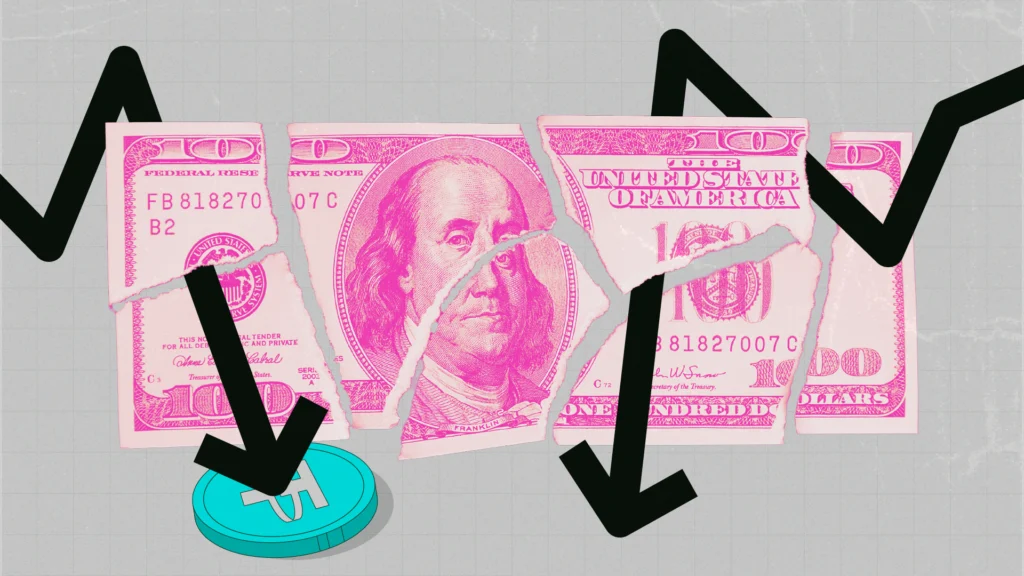
Tether’s USDT market capitalization has contracted by $8.83 billion over the past 60 days, raising concerns about whether Bitcoin can sustain a meaningful recovery amid weakening stablecoin liquidity.
According to crypto market analyst RugaResearch, the decline through Nov. 22 has coincided with a continued deterioration in the 30-day moving average of USDT’s 60-day market capitalization change, suggesting that liquidity conditions remain unfavorable for Bitcoin.
Although cryptocurrencies have recently experienced a relief rally, shrinking stablecoin supply could limit the sustainability of further gains, leaving Bitcoin increasingly dependent on fresh spot market demand and improving macroeconomic conditions.
“Continued weakness would leave room for lower lows, even if sharp rebounds interrupt the decline,” RugaResearch warned.
USDT Supply Contraction Signals Weakening Crypto Liquidity
Stablecoins play a fundamental role in cryptocurrency markets, providing traders and institutional investors with a means of transferring capital, managing exposure and purchasing digital assets without relying directly on traditional banking infrastructure.
As the largest stablecoin by market capitalization, USDT represents a significant source of potential purchasing power across centralized and decentralized trading platforms.
A contraction in its market capitalization can indicate that investors are redeeming stablecoins or reducing their exposure to the digital asset ecosystem, potentially limiting the capital available to support cryptocurrency prices.
“With its market cap $8.83B below its level 60 days earlier, I’m less confident that a price rebound can develop into a sustained recovery,” RugaResearch said.
The analyst added that spot demand would need to compensate for weaker USDT liquidity to support a lasting Bitcoin recovery.
However, declining USDT supply does not automatically translate into an equivalent reduction in Bitcoin demand. Investors can move capital into competing stablecoins, alternative financial instruments or other trading venues.
Nevertheless, persistent contraction remains a warning sign when accompanied by broader market weakness and deteriorating investor confidence.
Broader Stablecoin Market Faces Historic Contraction
The decline in USDT’s market capitalization comes amid a broader reduction in stablecoin supply across the cryptocurrency industry.
Earlier this month, data from Glassnode showed that major stablecoins had lost $14.2 billion in supply over 30 days, marking the largest contraction since the 2022 crypto bear market.
Meanwhile, CryptoQuant reported that USDT’s market capitalization had fallen by $6.6 billion over the 60 days through Nov. 7, more than twice the $3.2 billion contraction recorded over a comparable period following the collapse of FTX.
The latest figures from RugaResearch suggest that the deterioration has intensified since then.
Furthermore, a Nov. 20 report from HTX Research showed that aggregate stablecoin market capitalization stood at approximately $284.15 billion as of Nov. 18, down 5.33% over 30 days.
USDT and Circle’s USDC recorded monthly declines of 4.49% and 4.52%, respectively. This suggests that the liquidity contraction extends beyond Tether rather than simply reflecting competition between stablecoin issuers.
The simultaneous decline raises concerns about the availability of fresh capital to absorb selling pressure and support higher cryptocurrency valuations.
What Bitcoin Needs to Confirm a Lasting Recovery
RugaResearch identified several conditions that could strengthen confidence in a sustainable Bitcoin recovery. They begin with a stabilization in USDT’s 60-day market capitalization change.
The analyst would first want to see the indicator reverse its downward trajectory before gradually returning to positive territory, signaling renewed stablecoin supply expansion.
A recovery in the corresponding 30-day moving average would provide additional confirmation that improving liquidity conditions are more than temporary.
“Without a turn in USDT growth and a more supportive macro backdrop, I would find it hard to trust a durable BTC recovery,” RugaResearch said.
Nevertheless, Bitcoin does not necessarily need to wait for stablecoin supply growth to turn positive before establishing a market bottom.
Direct fiat purchases, institutional demand through spot Bitcoin exchange-traded funds (ETFs) and increased circulation of existing stablecoin balances could help offset weaker USDT issuance.
Investors should therefore monitor spot trading volumes, ETF flows and broader stablecoin supply alongside Bitcoin’s price action.
Until these indicators demonstrate sustained improvement, sharp price rebounds may reflect temporary changes in investor positioning rather than a fundamental recovery in market demand.
Top Trending Crypto Articles
The information provided in this article is for informational purposes only. It is not intended to be, nor should it be construed as, financial advice. We do not make any warranties regarding the completeness, reliability, or accuracy of this information. All investments involve risk, and past performance does not guarantee future results. We recommend consulting a financial advisor before making any investment decisions.

Giuseppe Ciccomascolo began his career as an investigative journalist in Italy, where he contributed to both local and national newspapers, focusing on various financial sectors.
Upon relocating to London, he worked as an analyst for Fitch's CapitalStructure and later as a Senior Reporter for Alliance News. In 2017, Giuseppe transitioned to covering cryptocurrency-related news, producing documentaries and articles on Bitcoin and other emerging digital currencies. He also played a pivotal role in establishing the academy for a cryptocurrency exchange website. Crypto remained his primary area of interest throughout his tenure as a writer for ThirdFloor.












 $387M Bitget Hack Trail Leads to Public Discords and a Launderer From the $292M Kelp DAO Exploit