$1B in fresh USDT hits the market just as Bitcoin and Ethereum plunge | Credit: Veronica Cestari
Share
Key Takeaways
USDT mint likely serves as a liquidity buffer, rather than a bullish catalyst.
The accumulation ratio at 57.63% indicates cautious buyer activity.
Rising stablecoin reserves reflect heightened volatility and fear
In the midst of a brutal market sell-off, Tether unexpectedly issued $1 billion in new USDT.
This development has sparked debate across the cryptocurrency industry.
The timing has drawn widespread attention, especially as liquidity evaporated from significant assets, including Bitcoin (BTC) and Ethereum (ETH).
Get These Top Crypto Casino Offers Now!
Sponsored
Disclosure
We sometimes use affiliate links in our content, when clicking on those we might receive a commission at no extra cost to you. By using this website you agree to our terms and conditions and privacy policy.
As the dust settles, traders are trying to understand what this mint means for market direction. Here is what on-chain analysis says about the development.
USDT Spike in Stablecoin Demand
As the market entered a deep sell-off, on-chain metrics showed a significant contraction in stablecoin liquidity.
Exchanges recorded some of the highest net outflows of USDT in months as traders fled to safety or attempted to reposition quickly. This aggressive movement strained liquidity pools, widening spreads.
According to Glassnode data, the USDT Holder Accumulation Ratio has climbed to 57.63%.
This metric measures the share of active holders increasing their balances versus those reducing them, focusing only on wallets that made a change.
Readings above 50% reflect net accumulation, meaning more crypto holders are buying than selling.
For example, a 75% ratio would indicate that three out of every four active holders are increasing their positions.
A rising accumulation ratio typically signals improving sentiment, expanding demand, and a growing active holder base. In contrast, lower readings point to distribution or profit-taking.
With the ratio now at 57.63%, the data leans toward bullish momentum among active market participants.
USDT Holder Accumulation Ratio | Credit: Glassnode
However, considering the bearish market-wide price action, it remains uncertain if cryptos will bounce back.
Should holders deploy this stablecoin to buy other assets, the price can rise. However, if it is the other way around, the market might slowly slide into a bear market.
Exchange Balances Reflect Market Stress
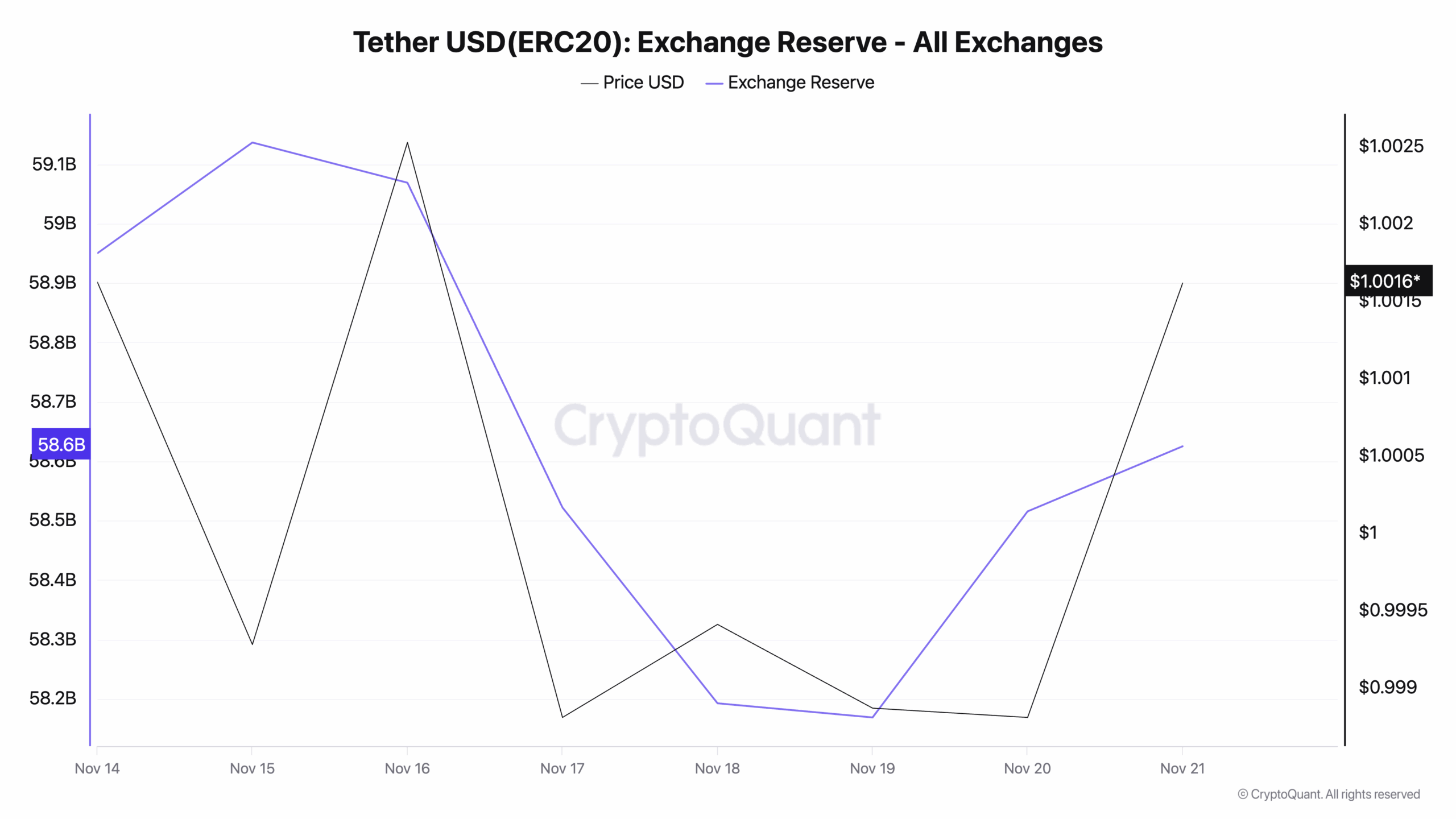
On-chain exchange data reveal that leading platforms, including Binance, OKX, and Bybit, experienced a pronounced increase in stablecoin reserves during the crash.
As the values continue to rise in reserve, it indicates higher selling pressure and has shown an opposite trend in price in general.
Hence, this implies that the market has not yet reached its bottom. As such, prices could continue to fall in the short term.
Due to this position, the Bitcoin price may not retest $100,000 soon. Also, it could be challenging for ETH to reclaim $3,000.
What This Means Going Forward
Overall, the on-chain data points to a clear conclusion: Tether’s $1 billion USDT mint is a liquidity-protective action, not a market-moving one.
It signals strong demand for stablecoins, heightened volatility, and aggressive repositioning by large investors, commonly referred to as whales. More importantly, it suggests the market is yet to prepare for a rebound.
However, once volatility subsides and liquidity conditions normalize, a dead cat bounce may occur.
Disclaimer:
The information provided in this article is for informational purposes only. It is not intended to be, nor should it be construed as, financial advice. We do not make any warranties regarding the completeness, reliability, or accuracy of this information. All investments involve risk, and past performance does not guarantee future results. We recommend consulting a financial advisor before making any investment decisions.
Victor Olanrewaju is a crypto analyst and reporter at CCN with deep roots in on-chain research and technical analysis. His crypto journey began in 2017, but it was the 2020 Uniswap airdrop that sparked a full-time pivot into the space.
With a foundation in copywriting, Victor honed his craft creating high-converting content for leading crypto brokers — most notably an XRP price prediction that ranked #1 on Google during the 2021 bull run.
He later joined AMBCrypto in 2022, where he combined storytelling with technical and on-chain analysis to cover key market narratives.
In 2024, he expanded his expertise at BeInCrypto, collaborating with analysts and using tools like Glassnode, Santiment, and IntoTheBlock to break down Bitcoin and altcoin trends.
At CCN, Victor covers the top cryptocurrencies, memecoins, macro shifts, blending real-time insights with deep-dive metrics.
He holds a Bachelor’s degree in Physics from the University of Ibadan, equipping him to simplify complex data for a wide audience. Follow his work or connect on LinkedIn or X.