Key Takeaways
- Uniswap is voting on proposals to activate protocol fees on selected v4 pools and expand fees to Robinhood Chain.
- Robinhood Chain processed more than $6 billion in Uniswap swap volume within 10 days of its July 1 launch.
- Collected fees would enter TokenJar contracts, where searchers exchange UNI for fee assets before the UNI is permanently burned.
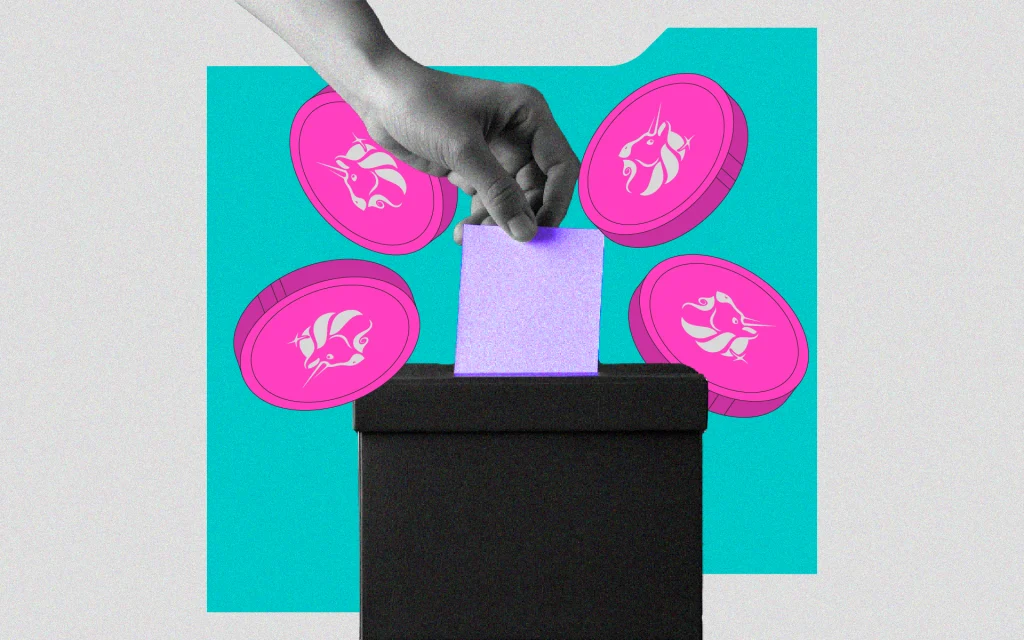
Uniswap governance is voting on two proposals that could substantially increase the amount of UNI removed from circulation by activating protocol fees on Uniswap v4 and extending the fee system to the rapidly growing Robinhood Chain.
Both measures entered their final on-chain voting stage on July 19 and are scheduled to run through July 26. One proposal would activate fees for selected v4 pools across several networks, while the other would introduce protocol fees for Uniswap v2 and v3 deployments on Robinhood Chain.
The votes build on the UNIfication overhaul approved in December 2025, which connected Uniswap’s protocol revenue to a UNI burn mechanism. If approved, the latest proposals would add new fee sources to that system, potentially accelerating the reduction of UNI’s circulating supply.
“Based on current volumes, especially Robinhood, we expect the impact on UNI burn to be substantial,” Uniswap founder Hayden Adams said.
Two Proposals Expand Uniswap’s Fee System
The first proposal, “Activate v4 Protocol Fees,” would introduce fees for selected Uniswap v4 pools on Ethereum, Arbitrum, Base, BNB Chain, Polygon, Optimism, and Robinhood Chain.
It covers static-fee pools, pools launched through continuous clearing auctions, and those using aggregator hooks.
A second v4 proposal is expected to address deployments on Celo, Soneium, World Chain, X Layer, and Zora, as Uniswap’s GovernorBravo contract limits the number of actions that can be included in a single governance proposal.
Implementing fees in v4 requires different infrastructure compared to earlier versions because v4 pools can support hooks and dynamic fee structures.
The proposal introduces a V4FeePolicy contract to calculate protocol charges and a V4FeeAdapter to implement governance decisions and collect proceeds.
The parallel Robinhood Chain proposal would turn on protocol fees for Uniswap v2 and v3 on the layer-2 network. Uniswap deployed v2, v3, and v4 when Robinhood Chain launched on July 1.
An earlier temperature check reportedly attracted approximately 13.9 million UNI votes, with around 93% supporting the activation of v4 fees. Although that ballot was not binding, the result indicates strong community support ahead of the final vote.
Robinhood Chain Volume Could Accelerate UNI Burns
Robinhood Chain’s early trading activity has increased the potential economic impact of the proposals.
According to governance documents, Uniswap deployments on the network processed more than $6 billion in cumulative swap volume by July 10, only 10 days after launch.
The chain reportedly reached $500 million in daily Uniswap volume within eight days, temporarily placing it behind only the Ethereum mainnet for daily activity. It also attracted more than $70 million in bridged Ether during its first week, while total value locked exceeded $106 million.
Some earlier governance discussions cited cumulative swaps of more than $1 billion, while independent reports placed the figure above $6 billion.
The discrepancy may reflect different methodologies, datasets or filters. Nevertheless, the available figures indicate that Robinhood Chain quickly became a significant source of Uniswap activity.
Even a relatively small protocol fee applied to billions of dollars in volume could generate meaningful revenue for the burn system.
The proposal would use a cross-chain governance structure similar to the one already deployed on Arbitrum, transmitting instructions from Ethereum to Robinhood Chain.
TokenJar Converts Protocol Revenue Into UNI Burns
Fees collected under both proposals would flow into Uniswap’s TokenJar contracts. Searchers can claim the accumulated fee assets by supplying an equivalent value of UNI. The TokenJar system then sends that UNI to a burn address.
For UNI collected on other networks, the system first bridges the tokens to Ethereum and then permanently destroys them.
Protocol fees are already active across Uniswap v2 and v3 pools on 11 networks. Proposal documents also recorded a one-day burn of 186,000 UNI last month, demonstrating how higher trading activity can translate into accelerated token destruction.
The changes may carry trade-offs for liquidity providers. Protocol fees redirect a portion of swap revenue that would otherwise remain with LPs, potentially reducing returns in affected pools. Higher effective costs could also encourage aggregators to route trades toward alternative venues.
The ultimate impact will depend on the fee rates, the pools selected, and how liquidity responds.
However, the proposals represent an important expansion of Uniswap’s value-capture strategy.
If both votes pass, v4 activity and Robinhood Chain’s rapidly growing volume will become new inputs for the UNI burn mechanism, more directly connecting Uniswap usage with the token’s supply dynamics.
Top Trending Crypto Articles
The information provided in this article is for informational purposes only. It is not intended to be, nor should it be construed as, financial advice. We do not make any warranties regarding the completeness, reliability, or accuracy of this information. All investments involve risk, and past performance does not guarantee future results. We recommend consulting a financial advisor before making any investment decisions.

Giuseppe Ciccomascolo began his career as an investigative journalist in Italy, where he contributed to both local and national newspapers, focusing on various financial sectors.
Upon relocating to London, he worked as an analyst for Fitch's CapitalStructure and later as a Senior Reporter for Alliance News. In 2017, Giuseppe transitioned to covering cryptocurrency-related news, producing documentaries and articles on Bitcoin and other emerging digital currencies. He also played a pivotal role in establishing the academy for a cryptocurrency exchange website. Crypto remained his primary area of interest throughout his tenure as a writer for ThirdFloor.