Key Takeaways
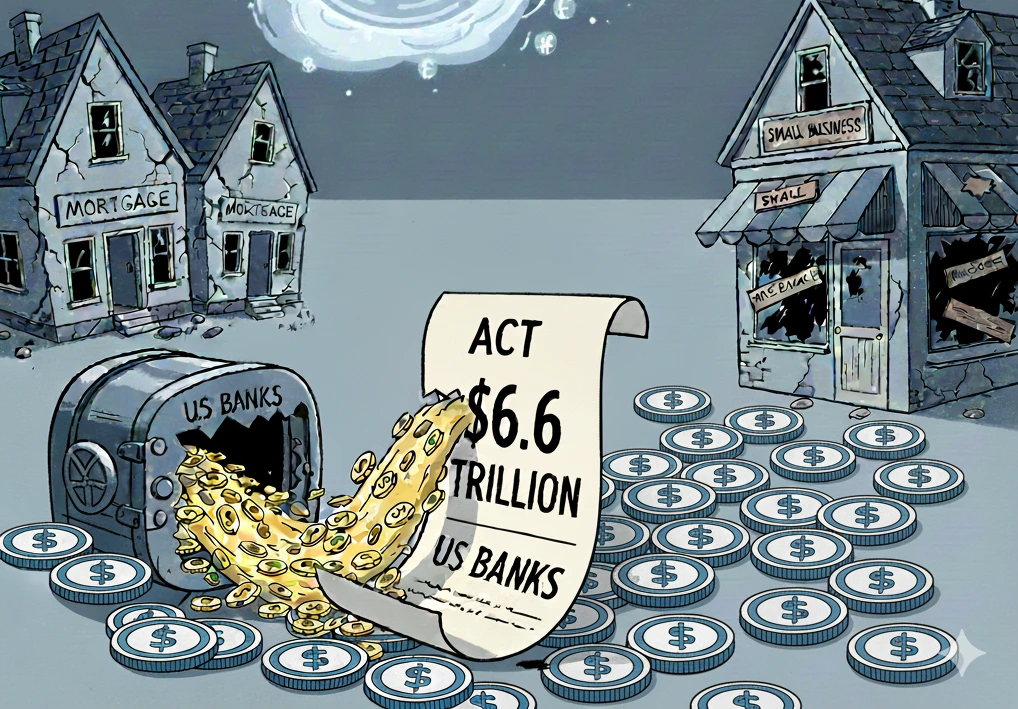
- Community banking groups say a loophole in the GENIUS Act could put $6.6 trillion at risk.
- Crypto executives and advocacy groups argue there is no evidence that stablecoins are harming banks.
- Future stablecoin growth could be at stake.
A coalition of banking groups has warned that a perceived stablecoin “loophole” in the GENIUS Act could put up to $6.6 trillion in U.S. bank deposits at risk, potentially undermining community lending that supports small businesses, homebuyers and local economies.
Crypto advocates, however, argue that the concerns are overstated and reflect an effort by incumbent banks to curb competition.
Some are labeling the push for changes to the law a “last-ditch effort” to block the growth of stablecoins.
What’s The Loophole?
The dispute centers on how regulators apply the GENIUS Act’s ban on interest and yield for stablecoin holders in practice.
GENIUS Act bars stablecoin issuers from paying interest, yield, or rewards on their tokens.
Lawmakers included the restriction to prevent stablecoins from competing directly with bank deposits.
Community banks argue that this safeguard is being weakened because some issuers are able to route economic benefits to token holders indirectly, rather than paying rewards directly.
$6.6 Trillion At Risk
In a letter sent to U.S. senators, the Bank Policy Institute (BPI) and a coalition of banking groups urged lawmakers to clarify that stablecoin issuers and their affiliates should also be prohibited from paying interest or rewards to tokenholders.
“We take deposits, facilitate secure payments, and lend to local businesses,” the letter said. “Our communities depend on us, and we depend on them.”
The groups warned that “allowing inducements like interest payments, yield, or rewards could incentivize customers to park their savings not in a bank, but in stablecoins.”
BPI’s letter stressed that without the prohibition, Treasury estimates suggest that “$6.6 trillion in bank deposits are at risk.”
The bankers said some companies have exploited “a perceived loophole” by indirectly funding payments to stablecoin holders through digital asset exchanges and other partners.
“With this activity, the exception swallows the rule,” the letter said, warning that if “billions are displaced from community bank lending, small businesses, farmers, students, and home buyers in towns like ours will suffer.”
Crypto Industry Rejects Warnings
Crypto executives and industry groups have pushed back strongly.
They say there is little evidence that stablecoins threaten the banking system and arguing that tightening the law would undermine competition.
On Tuesday, the Blockchain Association said the bankers’ letter amounted to “a last-ditch effort by Big Banks to block competition after Congress struck a careful, bipartisan deal.”
The group added that low-yield bank accounts primarily benefit “large incumbents,” while stablecoin rewards can offer greater benefits to everyday users.
“No new evidence. No new risks. Just incumbent pressure to shut out competition,” the Blockchain Association said.
Pro-crypto Politicians Push Back
Pro-crypto legal figures and policymakers have also warned that reopening the legislation could have broader economic and geopolitical consequences.
John Deaton, a pro-crypto lawyer, said that changing the law now would be “a national security trap.”
He added that it could push users toward foreign alternatives.
“The stakes are higher than ever because China officially began paying interest on the Digital Yuan (e-CNY) – making it a ‘yield-bearing’ competitor to the USD,” Deaton said.
Alexander Grieve, vice president of government affairs at crypto investment firm Paradigm, said rolling back elements of the GENIUS Act would “squander” recent progress.
Stablecoin Growth Under Threat?
The debate comes as the stablecoin market continues to expand rapidly, in part driven by the rewards practices now under scrutiny.
Led by Tether’s USDT and Circle’s USDC, the total market value of dollar-pegged tokens has climbed to about $317.8 billion.
Throughout that growth, incentive programs offered by platforms have played a significant role in attracting users and encouraging adoption.
Banking groups argue those incentives blur the line between payment tools and deposit-like products.
Crypto advocates, by contrast, view them as a legitimate and competitive feature of the market.
If lawmakers move to bar exchanges from offering rewards tied to stablecoin holdings, the sector’s growth trajectory could slow.
It could also raise questions about how much of the market’s current scale would persist without those incentives.
Top Trending Crypto Articles

Kurt Robson is a London-based reporter at CCN, specialising in the fast-moving worlds of crypto and emerging technology. He began his career covering local news in Cornwall after graduating from Falmouth University with First Class Honours in Journalism. There, he cut his teeth on everything from council meetings to missing swans.
He quickly rose through the ranks to become a frontline journalist at several of the UK’s leading national newspapers. Over the years, he has interviewed musicians and celebrities, reported from courtrooms and crime scenes, and secured multiple front-page exclusives.
Following the upheaval of the COVID-19 pandemic, Kurt shifted his focus to technology journalism—just ahead of the AI boom. With a natural curiosity and a trained eye for emerging trends, he has found a new rhythm in reporting on innovation.
At CCN, Kurt's work focuses on the cutting edge of crypto, blockchain, AI, and the evolving digital world. Drawing on his background in people-first reporting and his deep interest in disruptive tech, Kurt delivers stories that are insightful, entertaining, and human-centric.