Pre-IPO perpetual contracts have captured recent headlines as traders flock to synthetic exposure of private decacorns like SpaceX and OpenAI. Yet, these early-stage assets represent just the leading edge of a much broader structural shift.
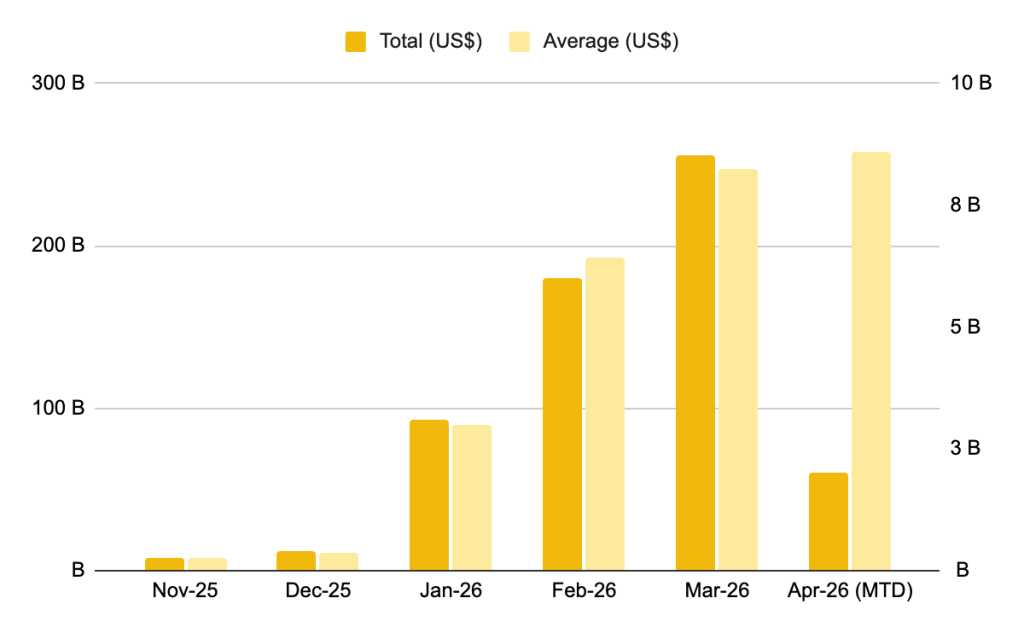
The private equity market is valued at roughly $13 trillion globally, but the true expansion lies in equity perpetuals tracking public stocks and real-world assets. Perpetuals linked to traditional finance surged to $8.6 billion in daily trading volume by March.
This metric indicates a fundamental change in how global participants access traditional assets—moving away from dated futures and legacy brokerages toward continuous crypto-native infrastructure.
The Accelerating Convergence of DeFi and CeFi
Centralized and decentralized venues are racing to capture this emerging market. Platforms across the industry recognize that trading traditional equities via digital asset rails solves long-standing frictions around settlement speed and continuous pricing.
Shunyet Jan, Head of Spot and Derivatives Business at Binance, notes, “The momentum we saw in the first days of this category launch is a strong signal that users are looking for new ways to access major market narratives through crypto-native products
“Reaching more than $280 million in cumulative trading volume within five days of our first listing gives us confidence in both the appeal of Pre-IPO perpetuals and our broader strategy to evolve Binance into a financial super app. As we democratize access to a wider range of financial opportunities, that vision is clearly resonating with users.,” Jan continued.
Capital allocators are already placing sizable bets on this transition. Variational recently secured$50 million in funding with a clear thesis: real-world asset perpetuals will soon become the biggest contract class in decentralized finance, eventually surpassing Bitcoin and Ethereum combined.
Scaling Institutional-Grade Infrastructure
Handling multi-trillion-dollar asset classes needs infrastructure that’s capable of processing high-frequency data without faltering. And the industry’s technical architecture is rapidly maturing to handle this new influx of equity trading volume.
On the decentralized side, platforms like Ostium are offering equity perpetuals powered directly by institutional Nasdaq data feeds. The exchange has already processed over$50 billion in cumulative volume, proving that blockchain-based order books can support serious retail and institutional activity. These instruments are also proving their worth in price discovery. Recently, Cerebras perpetuals matched the stock’s Nasdaq open almost perfectly without a single investment bank involved.
While DeFi builds resilient permissionless structures, centralized platforms continue to lead in raw execution efficiency and consistent liquidity. Centralized matching engines can process millions of orders with sub-millisecond latency. It prevents the slippage often seen in thinner on-chain markets. This dual-track maturation ensures that traders have viable options—whether they prioritize self-custody and transparent settlement or deep market depth and high-speed execution.
Binance’s Rapid Expansion into Traditional Assets
When deep liquidity meets new asset classes, adoption happens quickly. Data from 2026 illustrates how fast traditional asset derivatives can scale on established crypto rails. After launching equities perpetuals in January, Binance saw volume in the category multiply roughly 15x, expanding from $563 million during its launch week to approximately $8.5 billion.
Source: Binance Research, as of April 8, 2026 (https://www.binance.com/en/research/analysis/weekly-market-commentary-2026-04-09)
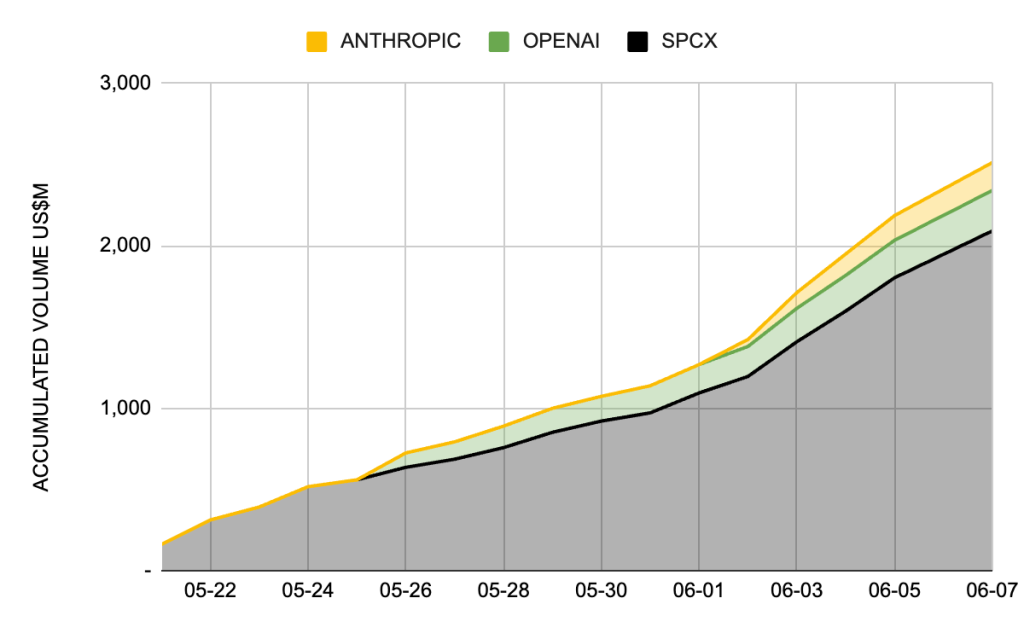
Pre-IPO perpetuals followed a similar growth trajectory. Before Binance entered the space, Pre-IPO activity existed at a modest $20 million per day across other venues. Within the first five days of launching its own category, Binance recorded over $280 million in cumulative volume. The platform captured more than 60% of the category’s market share within days.
The demand is highly concentrated, with SPACEX-linked contracts accounting for 79%, followed by OPENAI at 11% and ANTHROPIC at 9.5%. Instruments tracking anticipated valuations for these startups fit naturally into the broader expansion of combining crypto-native rails with traditional market exposure.
Source: Binance Research, as of June 7, 2026 (https://www.binance.com/en/research/analysis/primary-markets-meet-onchain-access)
The Regulatory Pathway Forward
Regulatory clarity often acts as the final catalyst for structural market shifts. Recent actions by the Commodity Futures Trading Commission suggest that US regulatory frameworks are beginning to accommodate perpetual futures, marking a meaningful shift after years of offshore dominance.
The CFTC recently approved the first regulated US Bitcoin perpetual on Kalshi and provided no-action guidance enabling a Coinbase affiliate to route clients to global perpetual markets. These developments point toward a more compliant pathway for synthetic asset trading. Reducing offshore friction brings institutional capital off the sidelines and accelerates the integration of traditional equities into digital asset infrastructure.
The Universal Access Layer for Global Assets
Perpetual contracts are actively transitioning from a niche cryptocurrency tool into a broader access layer for an expanding range of global assets. The mechanics that made digital asset trading highly efficient—continuous pricing, zero expiration dates, and unified margin—are proving equally effective for commodities, public equities, and pre-IPO startups.
The market is moving beyond isolated cryptocurrency speculation. Future market resilience will increasingly depend on platforms that can support continuous liquidity across diverse asset classes. Institutional data providers and decentralized protocols, as well as centralized exchanges, all build toward this shared architecture. And that’s why digital asset rails are quietly absorbing the broader financial system.
With over half a decade of experience commentating on the cryptocurrency market and even more as a trader and investor, Jay has developed a robust knowledge base that enables him to dive deep into the inner workings of crypto platforms and the broader market to deliver unique, user-focused insight.
Jay's work has spanned public relations firms, crypto projects, affiliate sites, and news outlets.