Key Takeaways
- Binance Research says illicit crypto activity remained below 1% of total on-chain volume in 2025.
- Criminal flows still exceeded $150 billion as the crypto market expanded rapidly.
- North Korea’s Lazarus Group stole a record $2 billion, while exchanges ramped up tracing and freezes.
Crypto has spent years dealing with one major reputation problem: the idea that digital assets are mostly used by criminals.
A new report highlighted by Binance Research pushes back against that idea.
According to the report, illicit activity made up less than 1% of total on-chain crypto transaction volume in 2025.
That number has stayed surprisingly low, even as the crypto industry has grown into a multi-trillion-dollar market.
This doesn’t mean crypto crime is going away. Not even close.
As the market grows, even a small percentage still adds up to significant sums.
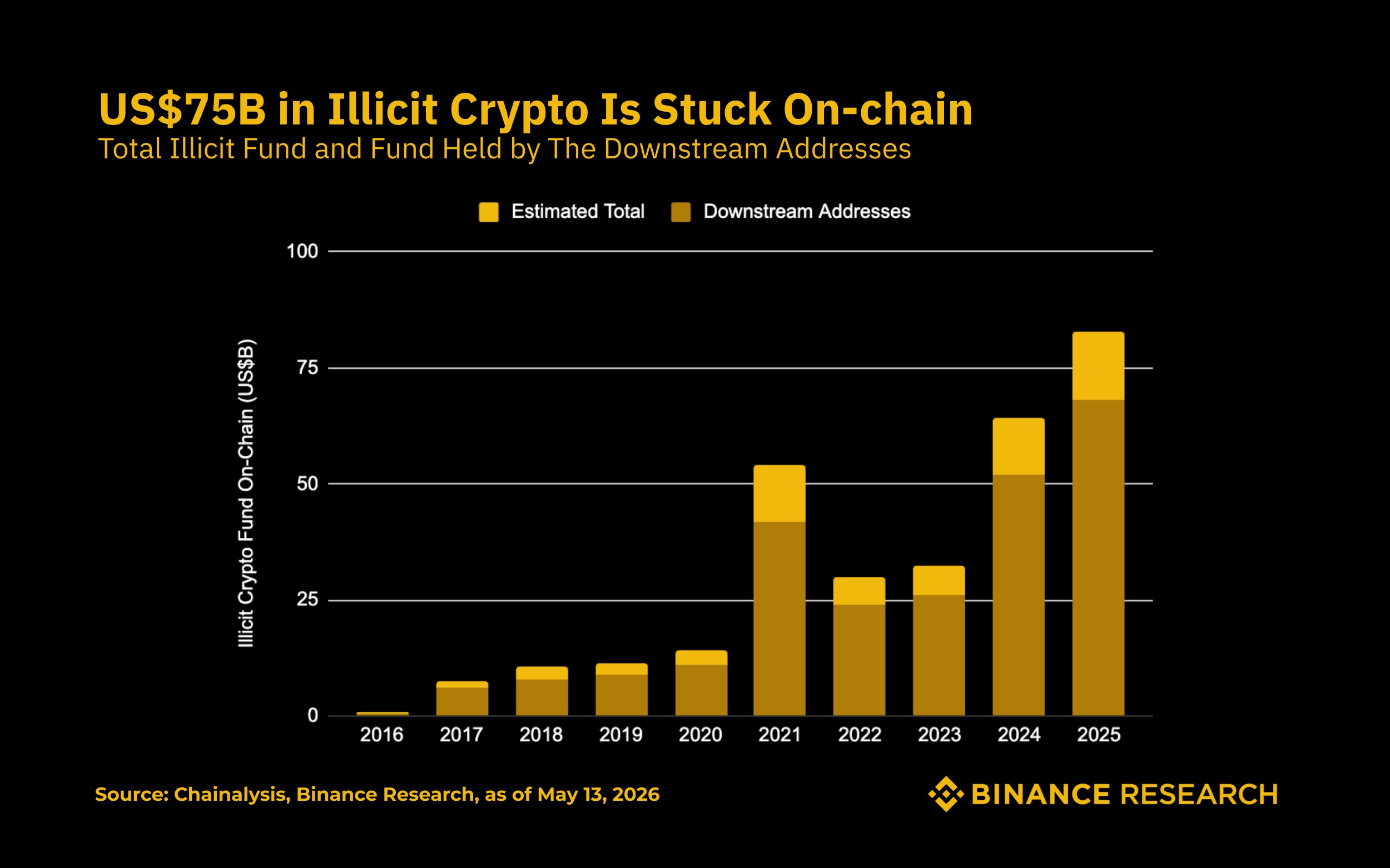
Chainalysis estimates that illicit wallets received more than $154 billion in crypto during 2025, while total on-chain illicit balances climbed above $75 billion.
As the overall market grows into a multi-trillion-dollar ecosystem, even a tiny percentage now translates into massive sums.
Chainalysis estimates illicit wallets received more than $154 billion in crypto during 2025, while total illicit balances on-chain climbed past $75 billion.
The report ultimately paints a more complex picture: crypto crime remains a serious issue.
However, the overwhelming majority of blockchain activity is now tied to legitimate trading, payments, stablecoins, DeFi and institutional adoption.
Crypto Crime Is Rising — But Crypto Is Growing Faster
The report, released in May 2026 using Chainalysis data, sends a pretty clear message: illegal crypto activity still makes up less than 1% of all on-chain transactions.
Binance Research says scams, hacks, ransomware payments, and sanctioned-entity flows still account for only a small part of the overall crypto economy.
The report also points out an important point. Blockchain transparency actually makes large-scale money laundering difficult.
Crypto mixers, which criminals once relied on heavily, now have limited processing capacity.
According to the report, laundering $1 billion in stolen crypto could take more than 100 days.
The report also says more than 80% of illicit funds have already moved into “downstream addresses.”
These are wallets that receive stolen or tainted funds but are not directly controlled by criminals themselves.
Still, every blockchain transfer leaves a permanent record behind.
The chart above shows illicit balances rising steadily since 2016, with a sharp jump after 2020 and a peak near $83 billion in 2025 when downstream wallets are included.
But the overall takeaway is simple: most crypto activity today is legitimate.
Binance Research credits stronger KYT monitoring tools, stablecoin freezes, and closer cooperation between exchanges and law enforcement for making it harder to move stolen funds around.
How 2025 Compares to Earlier Years
The share of crypto linked to illegal activity has actually stayed fairly stable over the years.
Binance Research says illicit transactions remained below 1% of total volume in 2025, similar to earlier Chainalysis estimates that ranged between 0.14% and 0.34%.
What changed was the size of the market itself.
Illicit balances on-chain jumped more than 28% year-over-year to over $75 billion.
This is mainly because the overall crypto ecosystem has become much larger.
For comparison, illicit balances were estimated at around $58.6 billion in 2024.
At the same time, total on-chain activity exploded thanks to ETFs, stablecoins, institutional adoption, and growing global interest in crypto.
That means the percentage tied to crime stayed small, even though the dollar amounts increased.
TRM Labs reported similar findings, estimating illicit crypto activity at around 1.2% in 2025, down from 1.3% the year before.
Together, the reports suggest that the old idea that crypto is mostly used by criminals no longer fits reality.
Why “Less Than 1%” Still Matters
The percentage sounds small, but the actual numbers are massive.
Chainalysis and TRM Labs estimate illicit crypto inflows reached between $154 billion and $158 billion in 2025 alone.
That’s because the crypto market has grown significantly.
Billions of dollars now move across blockchain networks every single day.
A decade ago, crypto was still a niche industry. Today, it’s a global financial market.
Criminals are using the same infrastructure as regular traders and investors, but the industry itself is growing much faster than illegal activity.
Still, more than $75 billion in illicit funds sitting on-chain is a serious problem that regulators, exchanges, and security firms continue to monitor closely.
Lazarus Group Remains a Huge Threat
North Korea’s Lazarus Group is still one of the biggest names in crypto crime.
In 2025 alone, the hacking group reportedly stole a record $2.02 billion in crypto, up 51% from the previous year.
Its total crypto thefts have now crossed $6.75 billion.
The group was linked to roughly 76% of major service hacks during the year.
Lazarus has also become more advanced.
Recent attacks involved malware hidden inside multisig signing systems, social engineering scams, and complex laundering methods using mixers and blockchain bridges.
The group was also reportedly connected to several major hacks in early 2026, including a nine-figure exploit targeting KelpDAO.
These hacks are believed to help fund North Korea’s weapons programs, which is why crypto theft has become more than just a financial issue.
Even so, blockchain tracking tools continue improving.
The report says many stolen funds eventually become frozen, flagged, or difficult to move.
Exchanges and Security Firms Are Catching Up
The crypto industry is responding quickly.
Exchanges like Binance, along with blockchain analytics firms such as Chainalysis and TRM Labs, are building better tools to track suspicious transactions in real time.
Modern KYT systems can flag risky wallet activity almost instantly, while stablecoin issuers and exchanges have frozen hundreds of millions of dollars tied to illicit activity.
Law enforcement cooperation has also increased significantly.
Joint efforts between exchanges, analytics firms, and regulators helped seize record amounts of stolen crypto during 2025.
Ironically, blockchain transparency — once criticized by many — is now becoming one of crypto’s biggest advantages.
Every transaction leaves behind a visible trail that investigators can follow.
Companies are also investing heavily in AI-powered monitoring and cross-chain tracing tools to deal with increasingly advanced attacks.
Criminals are still adapting, but security systems are improving even faster.
Overall, Binance Research’s findings point to a crypto market that is becoming more mature.
Crime remains a serious issue, but it still represents a very small share of total blockchain activity despite the industry’s rapid growth.
The billions stolen by groups like Lazarus show why the industry still needs strong security and regulation.
But growing transparency and better tracking tools are also making crypto much harder for criminals to abuse at scale.
Top Trending Crypto Articles

Prashant Jha is a seasoned crypto journalist based in Delhi, India, with a Bachelor’s Degree in Computer Science Engineering. Passionate about the evolving world of blockchain and cryptocurrencies, he has been a dedicated voice in the industry since 2018. Prashant’s expertise lies in regulatory reporting, where he unravels complex legal and financial developments with clarity and precision. Before joining CCN in 2024, he honed his craft at Cointelegraph, establishing himself as a trusted name in crypto journalism.
His coverage spans major industry events, including the high-profile collapses of FTX, Three Arrows Capital (3AC), and LUNA, offering readers insightful analyses of their regulatory and market implications. Prashant’s technical background enables him to bridge the gap between intricate blockchain technology and its real-world applications, making his work accessible to novices and experts.
Beyond his professional pursuits, Prashant is an avid music enthusiast, often exploring diverse genres to unwind. A sports lover, he has a particular passion for cricket and frequently engages in discussions about the game. His multifaceted interests and sharp journalistic instincts make him a valuable contributor to CCN, where he continues shaping the crypto landscape's narrative.