OKX and ICE’s tokenized U.S. stocks generate $8.9 million in trading volume, but two wallets account for 99.85%, raising doubts over investor demand. | Credit: CCN.com
Share
Key Takeaways
OKX and ICE launched tokenized US stocks, generating $8.9 million in trading volume during the first three days.
Two wallets linked to liquidity pools accounted for 99.85% of trading volume, raising questions about organic investor demand.
The launch comes as the broader tokenized real-world asset market reaches $31.1 billion in onchain assets under management.
Cryptocurrency exchange OKX and Intercontinental Exchange (ICE) have launched tokenized US stocks, marking another step toward integrating traditional financial markets with blockchain-based trading infrastructure.
However, early trading data from blockchain analytics platform Dune suggests that organic investor demand remains limited, despite an encouraging increase in headline trading volumes.
The tokenized equities generated $8.9 million in trading volume during their first three days, with activity on the third day nearly doubling that of the second.
Yet, two wallets associated with the trading pools’ liquidity accounted for 99.9% of total volume, raising questions about the depth of genuine market participation.
The launch also faced resistance from traditional corporations, with 67 companies opting out of the initiative, including all members of the Magnificent Seven technology stocks.
Try Our Recommended Crypto Exchanges
Sponsored
Disclosure
We sometimes use affiliate links in our content, when clicking on those we might receive a commission at no extra cost to you. By using this website you agree to our terms and conditions and privacy policy.
Tokenized Stock Launch Faces Resistance From Major Companies
The partnership between OKX and ICE reflects growing interest among established financial institutions and cryptocurrency platforms in bringing traditional securities onto blockchain networks.
Tokenized stocks offer digital exposure to publicly traded companies while potentially enabling around-the-clock trading, programmable transactions and greater integration with decentralized finance (DeFi) applications.
However, corporate participation remains a significant obstacle to broader adoption.
According to Dune, 67 companies opted out of the initiative, including Apple, Microsoft, Alphabet, Amazon, Nvidia, Meta Platforms and Tesla.
. @okx and ICE launched tokenized US stocks. 67 companies opted out, Mag 7 included. The 6 live are all crypto or crypto-friendly.
$8.9M traded in 3 days, and day 3 nearly doubled day 2. But 99.85% came from two wallets tied to the pools' liquidity.
The absence of these companies limits investors’ access to some of the largest and most actively traded equities in traditional financial markets.
Meanwhile, the six stocks available at launch belong exclusively to cryptocurrency-related or crypto-friendly companies, highlighting the initiative’s initially narrow market reach.
Although tokenization promises to expand access to traditional financial assets, the limited selection suggests that bridging conventional equity markets and blockchain infrastructure remains challenging.
Broader participation from established corporations could prove important in attracting investors beyond the existing cryptocurrency community.
Two Wallets Dominate $8.9 Million in Trading Volume
While initial trading figures point to accelerating activity, a closer examination of blockchain transactions reveals a highly concentrated market.
The tokenized stocks recorded $8.9 million in cumulative trading volume over their first three days, with daily activity increasing significantly.
However, Dune identified two wallets linked to the trading pools’ liquidity that collectively accounted for 99.85% of transactions by volume.
Based on the reported figures, approximately $8.89 million originated from these two wallets, leaving just $13,350 attributable to other addresses.
The concentration suggests that headline trading volumes may primarily reflect liquidity provision and related trading activity rather than widespread independent investor demand.
Liquidity providers play an essential role in emerging blockchain markets, facilitating transactions and helping reduce price slippage. Their dominance during a product’s early stages does not necessarily indicate market manipulation.
Nevertheless, distinguishing liquidity-related activity from organic trading remains essential when assessing adoption.
Growth in unique traders, independent wallet activity and secondary market participation could provide more meaningful indicators of the initiative’s long-term viability than aggregate trading volumes alone.
Tokenized Equities Enter a $31 Billion RWA Market
The launch comes amid continued expansion across the real-world asset (RWA) tokenization sector, which increasingly encompasses traditional financial instruments.
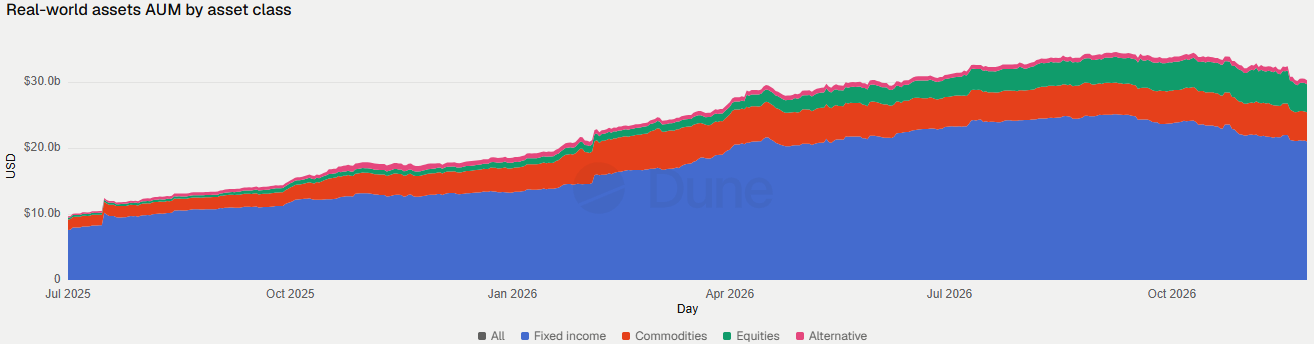
Dune’s RWA dataset currently tracks $31.1 billion in onchain assets under management across 2,345 registered products, 8,501 tokens and 150 issuers.
The dataset also covers 114 tokenization platforms operating across 28 jurisdictions.
Secondary market trading volume reached $6.8 billion over the past 30 days, while approximately $1.4 billion in tokenized assets serves as collateral within DeFi applications.
Real-world assets AuM by asset class. | Credit: Dune
Fixed-income products remain the dominant segment, accounting for $21 billion in onchain assets under management and a reported 69.3% share of the market.
Leading products include Ondo U.S. Dollar Yield, with $2.39 billion in assets, Circle’s USYC, with $2.02 billion, and Spiko’s Amundi Overnight Swap Fund, with $1.96 billion.
While tokenized equities represent another potential growth opportunity, the OKX and ICE launch highlights the distinction between technological availability and genuine market adoption.
The initiative’s longer-term success could depend on expanding its selection of securities, diversifying liquidity sources and attracting independent investors capable of sustaining trading activity beyond the initial launch period.
Disclaimer:
The information provided in this article is for informational purposes only. It is not intended to be, nor should it be construed as, financial advice. We do not make any warranties regarding the completeness, reliability, or accuracy of this information. All investments involve risk, and past performance does not guarantee future results. We recommend consulting a financial advisor before making any investment decisions.
Giuseppe Ciccomascolo began his career as an investigative journalist in Italy, where he contributed to both local and national newspapers, focusing on various financial sectors.
Upon relocating to London, he worked as an analyst for Fitch's CapitalStructure and later as a Senior Reporter for Alliance News. In 2017, Giuseppe transitioned to covering cryptocurrency-related news, producing documentaries and articles on Bitcoin and other emerging digital currencies. He also played a pivotal role in establishing the academy for a cryptocurrency exchange website. Crypto remained his primary area of interest throughout his tenure as a writer for ThirdFloor.













 $230B Fixed-Income Giant Enters Aave Collateral Debate With Tokenized Fund