Manuel Aráoz warned that AI-powered coding agents have made DeFi fundamentally unsafe.
Aráoz said he has advised friends and family to exit even major DeFi protocols, including Aave, MakerDAO, and Compound.
The debate comes amid a sharp rise in DeFi exploit losses.
A growing debate over the role of AI in crypto security erupted this week after leading security developer Manuel Aráoz warned that decentralized finance may no longer be safe for investors.
Aráoz argued that AI-powered coding agents are dramatically shifting the balance between attackers and defenders in crypto markets.
His comments come as DeFi hacks have surged over the past year, wiping out billions across protocols and lending platforms.
Try Our Recommended Crypto Exchanges
Sponsored
Disclosure
We sometimes use affiliate links in our content, when clicking on those we might receive a commission at no extra cost to you. By using this website you agree to our terms and conditions and privacy policy.
Manuel Aráoz Says AI Has Changed The Security Equation
In a post on X, Aráoz wrote: “PSA: I now consider all of DeFi unsafe.”
He added that coding agents are “superhuman at finding vulnerabilities, and smart contract security is too asymmetric.”
Aráoz explained that defenders need to fix every bug while “attackers need just one exploit to steal funds.”
The remarks sparked immediate debate across crypto circles as Aráoz is one of the sector’s best-known security figures.
PSA: I now consider *all* of DeFi unsafe.
Coding agents are superhuman at finding vulnerabilities, and smart contract security is too asymmetric: defenders need to fix every bug while attackers need just one exploit to steal funds.
One X user noted: “Seeing Manuel saying this is no joke.”
Aráoz, co-founder of OpenZeppelin and Decentraland, has created tooling and audit frameworks widely used across DeFi.
It comes as AI advances continue to spark fear across the crypto community.
Aráoz also escalated his warning, revealing that he had already advised people close to him to reduce their exposure to decentralized finance entirely.
“I’ve been privately advising friends and family to exit all DeFi positions, including low-risk ‘blue chips’ like Aave, MakerDAO & Compound.”
The statement rattled parts of the crypto community because the protocols he named are considered among the most established lending systems in the industry.
Aave Founder and Crypto Users Push Back
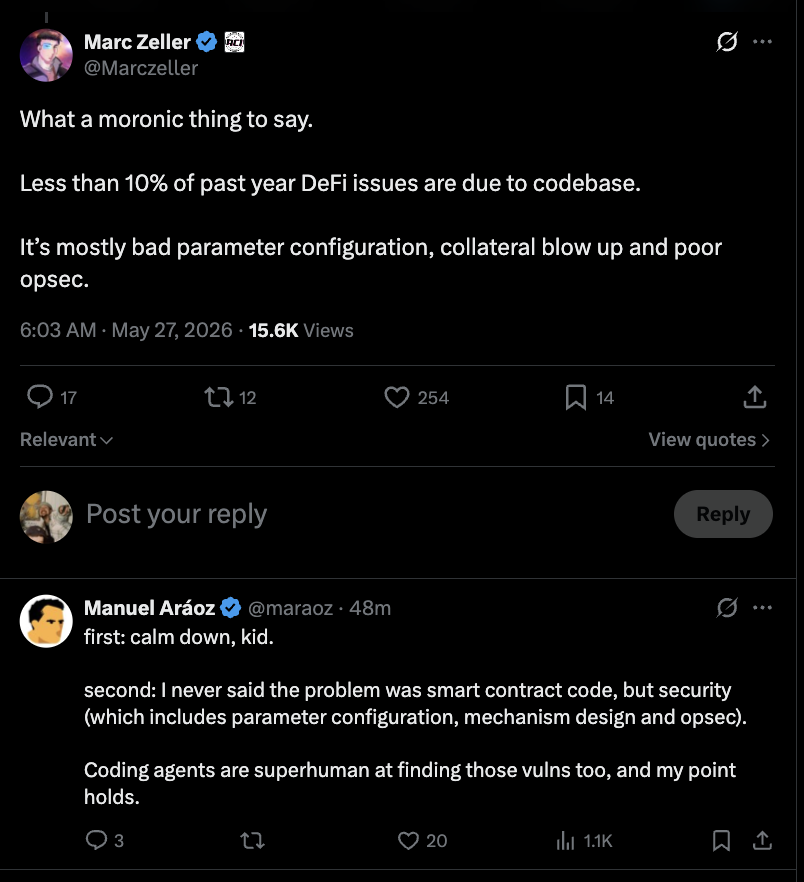
The comments quickly triggered backlash from several prominent DeFi figures, including Marc Zeller, founder of the Aave Chan Initiative and a leading contributor within the Aave ecosystem.
Zeller dismissed the warning outright, writing: “What a moronic thing to say.”
He added: “Less than 10% of past year DeFi issues are due to codebase.”
According to Zeller, most recent failures have instead been tied to: “bad parameter configuration, collateral blow up and poor opsec.”
“First: calm down, kid,” Aráoz responded.
Aave foundr Marc Zeller fired back | Source: X (@Marczeller)
He clarified that his concerns extended beyond coding errors alone.
“Second: I never said the problem was smart contract code, but security (which includes parameter configuration, mechanism design and opsec).”
He added that coding agents are “superhuman” at finding vulnerabilities as well.
In a separate post, Zeller claimed most DeFi issues are due to “pure incompetence… but it’s easier to blame AI.”
He said that AI would ultimately be positive and improve overall on-chain safety.
Other crypto users also challenged Aráoz’s position, arguing that AI-related security risks are not unique to decentralized finance.
One X user wrote: “By the same token, aren’t custodians also in the same risk category?”
The user questioned that if AI was as good as was being made out, the existential threat would also put exchanges such as BitGo and Coinbase at risk.
DeFi Hack Losses Have Surged Following Major Exploits
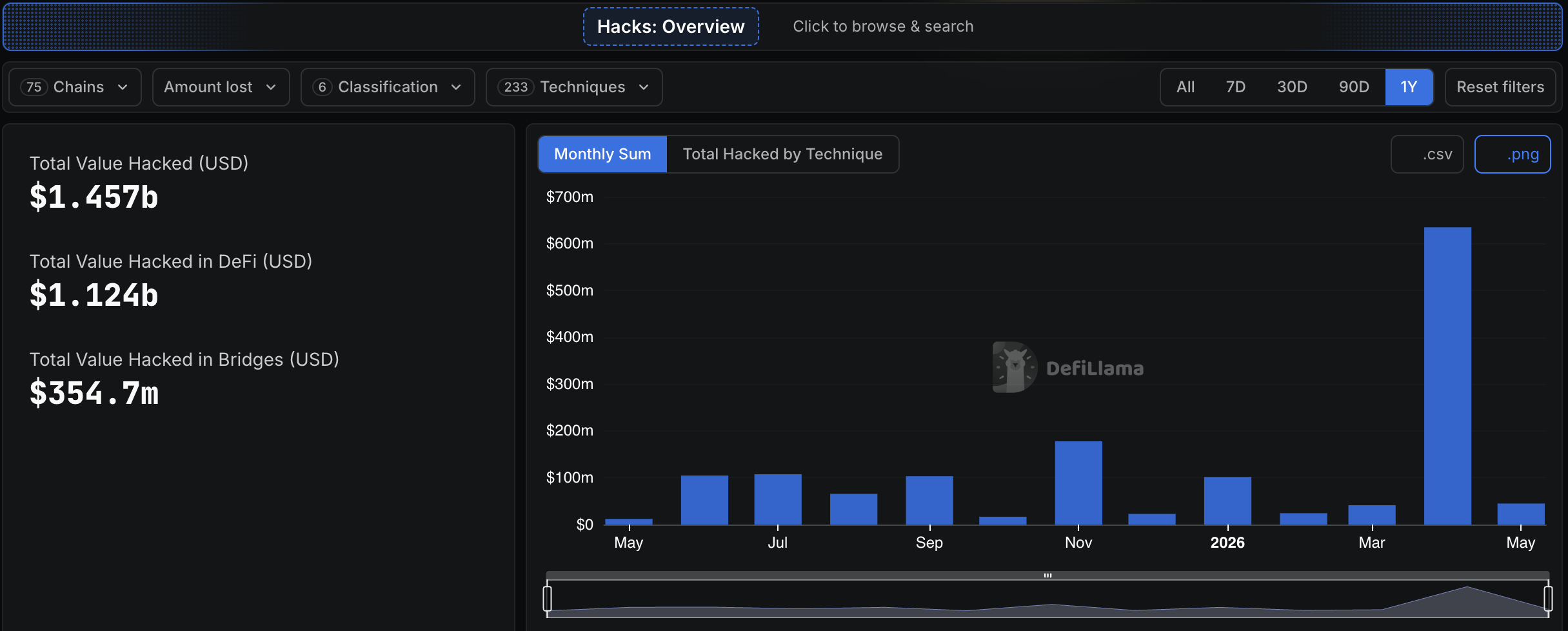
The debate comes as DeFi hack losses have climbed sharply over the past 12 months.
According to DefiLlama data, over $1.1 billion has been lost to DeFi-related exploits during the past year alone.
One of the largest incidents occurred in April, when attackers exploited KelpDAO infrastructure in an attack that ultimately created major losses across the wider DeFi ecosystem.
The breach involved roughly 116,500 rsETH tied to KelpDAO’s LayerZero-linked bridge infrastructure.
The stolen assets were later used as collateral inside Aave before attackers borrowed against them, leaving the lending protocol exposed to significant bad debt.
The incident became one of the biggest DeFi security events of 2026.
Aave Has Struggled To Recover Since The Exploit
The fallout has been especially visible on Aave.
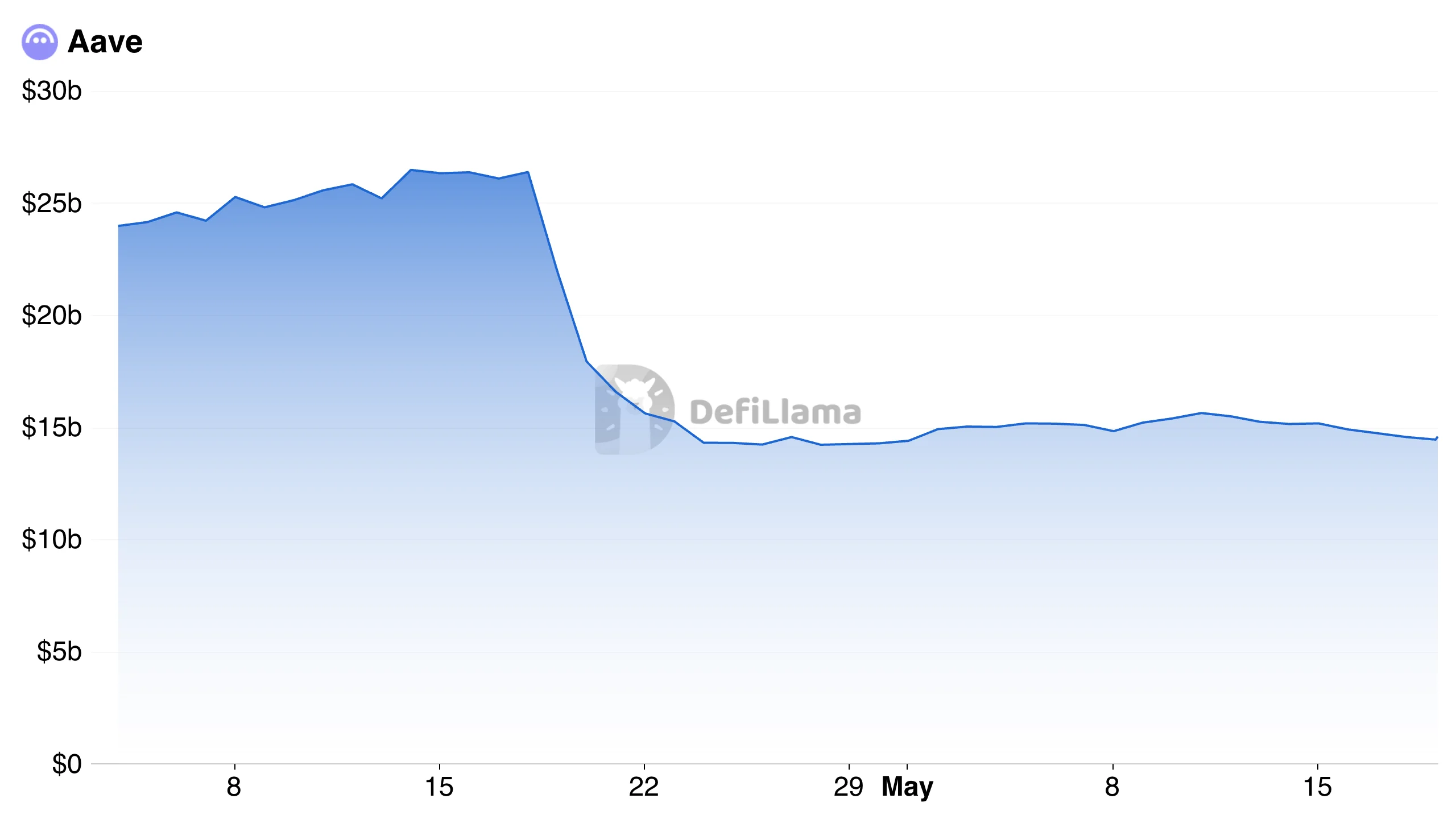
Aave’s total value locked has fallen sharply since the April exploit, dropping from roughly $26.4 billion to around $14.6 billion within weeks.
Data from AaveScan also shows that both supplied assets and outstanding borrows have declined significantly, signaling that users have continued to pull liquidity from the platform.
Aave Total Value Locked | Credit: DefiLlama
Borrow demand has also weakened. This suggests traders are reducing leverage rather than reopening positions after the exploit, said CCN analyst Abiodun Oladokun.
User activity has also deteriorated.
Weekly active addresses spiked immediately after the incident as users unwound positions, but participation has since fallen to its lowest level since 2024.
Kurt Robson is a London-based reporter at CCN, specialising in the fast-moving worlds of crypto and emerging technology. He began his career covering local news in Cornwall after graduating from Falmouth University with First Class Honours in Journalism. There, he cut his teeth on everything from council meetings to missing swans.
He quickly rose through the ranks to become a frontline journalist at several of the UK’s leading national newspapers. Over the years, he has interviewed musicians and celebrities, reported from courtrooms and crime scenes, and secured multiple front-page exclusives.
Following the upheaval of the COVID-19 pandemic, Kurt shifted his focus to technology journalism—just ahead of the AI boom. With a natural curiosity and a trained eye for emerging trends, he has found a new rhythm in reporting on innovation.
At CCN, Kurt's work focuses on the cutting edge of crypto, blockchain, AI, and the evolving digital world. Drawing on his background in people-first reporting and his deep interest in disruptive tech, Kurt delivers stories that are insightful, entertaining, and human-centric.