Monero not impacted by exchange delistings. Credit: Photo by Wolfram Steinberg/picture alliance via Getty Images.
Share
Key Takeaways
Monero remains resilient despite widespread delistings on major exchanges.
On-chain transactions and daily network activity have stayed consistent.
Darknet marketplaces increasingly favor Monero as the exclusive payment method.
Monero (XMR), the privacy-focused token that made headlines for hitting new all-time highs earlier this year, continues to demonstrate resilience amid exchange delistings and regulatory pressures.
A recent analysis report from blockchain intelligence firm TRM Labs indicates that Monero’s usage is growing, particularly in darknet markets, and that the asset has maintained a strong network footprint.
Try Our Recommended Crypto Exchanges
Sponsored
Disclosure
We sometimes use affiliate links in our content, when clicking on those we might receive a commission at no extra cost to you. By using this website you agree to our terms and conditions and privacy policy.
Over the past year, Monero faced one of the heaviest waves of delistings in its history.
Reports show that 73 exchanges removed the asset in 2025 alone, including Binance, Coinbase, Kraken, Huobi, OKX, and Bitstamp.
Exchanges either eliminated XMR trading pairs entirely or restricted them in key regions subject to regulatory oversight.
For instance, Kraken halted Monero services for customers in the European Economic Area at the end of October 2024, citing updated regulations.
Other regions, such as Canada and parts of Asia, followed the trend, building on privacy coin bans enacted years earlier.
Japan, South Korea, and Australia led the way, highlighting concerns over Monero’s built-in anonymity features.
As a result, trading has largely shifted to smaller offshore exchanges and decentralized swap services.
Users seeking XMR often rely on DeFi platforms for atomic swaps or peer-to-peer networks rather than conventional spot markets on centralized exchanges.
Monero’s ledger uses stealth addresses to conceal recipient details, ring signatures to mix coins, and confidential transactions to hide amounts.
These features maintain user privacy by default, distinguishing them from transparent blockchains like Bitcoin or Ethereum.
Even as European, Middle Eastern, and other regulators consider additional restrictions, Monero’s activity demonstrates that the token is weathering delistings better than expected.
On-Chain Metrics Highlight Darknet Adoption
The TRM Labs report underscores Monero’s expanding presence in darknet marketplaces.
In 2025, 48% of new darknet platforms accepted only XMR.
This marks a noticeable increase in market share and indicates strong demand for Western-focused sites.
Monero is also the preferred currency for some ransomware operations.
However, most ransom payments still flow through Bitcoin due to its higher liquidity and easier conversion paths, despite leaving a permanent public record.
Key insights from TRM Labs include:
48% of new darknet markets in 2025 are XMR-exclusive.
Most ransomware payments continue in BTC due to liquidity considerations.
14–15% of Monero network peers exhibit non-standard behavior.
An excerpt from the report states:
“The combination of steady on-chain usage and a growing share of XMR-only darknet markets suggests that Monero continues to fill a specific demand for privacy that has not diminished as traceability across other assets has improved.”
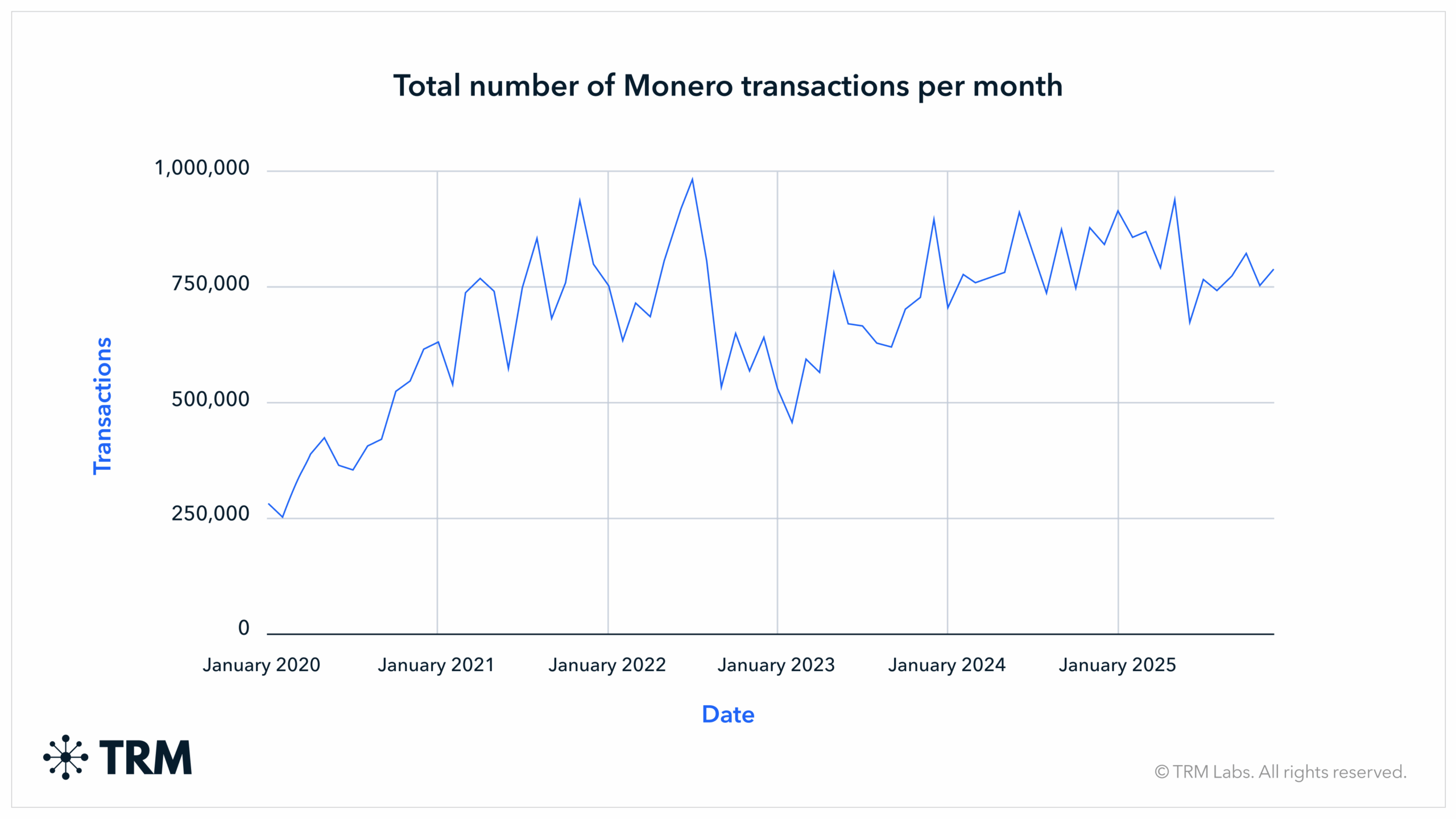
TRM Labs data tracking monthly transaction counts from 2020 onwards shows an early rise in usage, followed by a plateau through 2024 and 2025.
XMR transaction count. Credit: TRM Labs.
Monero’s core protocol continues to evolve.
Recent upgrades have improved ring size and transaction efficiency, while community funding supports ongoing development.
This ensures that the project remains active even as major exchange support declines.
Trading volumes in 2024–2025 exceeded averages from 2020–2021, reflecting steady demand rather than short-term hype.
The token has carved out a durable niche where privacy remains the defining feature.
Demand for XMR Persists
While Monero’s mainstream accessibility has narrowed due to regulatory pressure and exchange delistings, the underlying demand for privacy persists.
Elevated transaction counts, growing darknet adoption, and steady network operation indicate that Monero is maintaining its role as a leading privacy cryptocurrency.
Prashant Jha is a seasoned crypto journalist based in Delhi, India, with a Bachelor’s Degree in Computer Science Engineering. Passionate about the evolving world of blockchain and cryptocurrencies, he has been a dedicated voice in the industry since 2018. Prashant’s expertise lies in regulatory reporting, where he unravels complex legal and financial developments with clarity and precision. Before joining CCN in 2024, he honed his craft at Cointelegraph, establishing himself as a trusted name in crypto journalism.
His coverage spans major industry events, including the high-profile collapses of FTX, Three Arrows Capital (3AC), and LUNA, offering readers insightful analyses of their regulatory and market implications. Prashant’s technical background enables him to bridge the gap between intricate blockchain technology and its real-world applications, making his work accessible to novices and experts.
Beyond his professional pursuits, Prashant is an avid music enthusiast, often exploring diverse genres to unwind. A sports lover, he has a particular passion for cricket and frequently engages in discussions about the game. His multifaceted interests and sharp journalistic instincts make him a valuable contributor to CCN, where he continues shaping the crypto landscape's narrative.











 Monero (XMR) Price Forecast: 57% Bear Market Drawdown Puts $1,000 Target at Risk