We asked ChatGPT, Gemini, Claude, and Grok to predict Bitcoin's price in July. Here's where each AI model expects BTC to trade by month-end. | Credit: CCN.com
Share
Key Takeaways
HIVE’s Nvidia A40 GPUs in Paraguay matched the performance observed on newer H100 systems for their large-language-model pretraining research.
Researchers based in New York successfully trained AI models using GPUs located more than 5,000 miles away in Paraguay.
The research provides an important proof point for HIVE’s planned 100-MW AI and high-performance computing campus in Paraguay.
Cryptocurrency miner and digital infrastructure company HIVE Digital Technologies said a research project conducted with Columbia University found that its older-generation Nvidia A40 graphics processors in Paraguay delivered performance comparable to Nvidia’s flagship H100 chips for a specific artificial intelligence training workload, underscoring the growing importance of software optimization in AI computing.
The study, conducted by researchers from Columbia University’s Department of Industrial Engineering and Operations Research, involved training large language models remotely on HIVE’s GPU cluster in Asuncion, Paraguay, while the research team operated from New York.
The findings have been submitted to the Neural Information Processing Systems (NeurIPS) conference, one of the world’s leading academic gatherings for machine learning and artificial intelligence research.
Columbia University researchers in New York ran live AI training on HIVE GPUs in Paraguay.
5,000 miles away.
The results earned a spot in one of the most competitive AI research conferences on earth.
— HIVE Digital Technologies (@HIVEDigitalTech) June 23, 2026
According to the researchers, the team spent two months optimizing code for HIVE’s A40 processors and testing neural network pretraining workloads involving language models with up to 1.4 billion parameters. After adjusting for each platform’s raw hardware capabilities, the performance achieved on the A40 systems matched that observed on Nvidia’s more advanced H100 processors.
“In our use case of pretraining LLMs of up to 1.4B parameters, our results match those of H100s after normalizing for each hardware’s raw performance,” a Columbia researcher said.
The researchers said the work focused on developing and analyzing new optimization techniques for neural network pretraining, a critical stage in building large language models.
Intercontinental AI Training Demonstrated
The project represents an early demonstration of what HIVE describes as intercontinental AI training, with computing resources located more than 5,000 miles (8,000 km) from the researchers using them.
The successful deployment suggests AI developers may be able to access compute resources globally without significant performance penalties, potentially broadening the range of locations suitable for advanced AI infrastructure.
“This proof-of-concept is an important step in HIVE’s mission to help bring advanced AI computing infrastructure to Paraguay,” HIVE Executive Chairman and co-founder Frank Holmes said.
Holmes added that the experiment showed high-performance computing does not need to be concentrated exclusively in traditional technology hubs, particularly as demand for AI infrastructure accelerates worldwide.
Paraguay Becomes Strategic AI Hub
The research also provides a benchmark for HIVE’s planned expansion in Paraguay, where the company is developing a 100-megawatt substation in Yguazu to support a future AI and high-performance computing campus.
Civil construction on the substation has been completed, with energization expected later this year. HIVE plans to begin construction of a Tier III data center in late 2026, targeting commercial operations in the second half of 2027.
Paraguay has increasingly attracted attention from data center operators and Bitcoin miners because of its abundant hydroelectric power, much of it generated by the Itaipu Dam, one of the world’s largest hydroelectric facilities.
“The greatest natural resource for AI isn’t oil or lithium. It’s renewable electricity. HIVE has been pioneering how to transform hydro power into intelligence from Canada to Sweden to Paraguay,” Holmes told CCN.
Bitcoin Miner Expands Beyond Crypto
HIVE built its business as a Bitcoin miner powered largely by renewable energy, operating facilities across Canada, Sweden, and Paraguay. Like many mining companies facing increased competition and volatile cryptocurrency markets, HIVE has expanded into high-performance computing and AI services to diversify its revenue streams.
The company’s strategy mirrors a broader industry trend as Bitcoin miners seek to capitalize on booming demand for AI infrastructure. Investors have increasingly rewarded companies capable of repurposing power-rich data centers and GPU assets for artificial intelligence workloads.
While Nvidia’s H100 remains the gold standard for AI training, the Columbia research highlights how software and algorithmic improvements can significantly improve the efficiency of older hardware, potentially lowering the cost of AI development.
HIVE Shares Surge as Investors Embrace AI Expansion
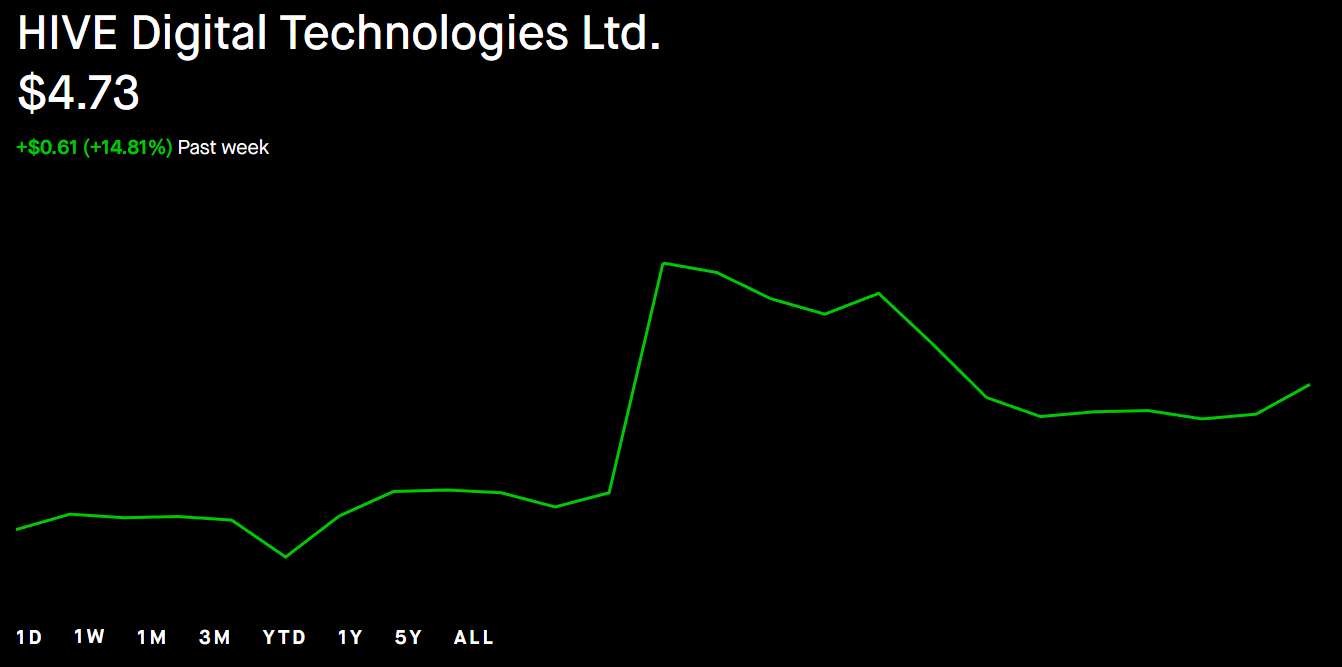
HIVE Digital Technologies shares surged more than 22% on June 22, briefly trading above $7 on Nasdaq, after the company unveiled new results highlighting the capabilities of its Paraguay-based AI infrastructure.
The June 22 surge to above $7 needs to be read against where the stock has been.
HIVE’s 52-week range runs from a low of $1.60 to a high of $10.96, with the average price over the trailing 52 weeks sitting around $3.10 according to Macrotrends data. The stock delivered roughly 89% year-on-year gains over the past year, though it remains well off its all-time high of $28.00 recorded in November 2021. The average daily trading volume is approximately 5.3 million shares.
On the fundamentals, HIVE reported fiscal year 2026 revenue of $297.79 million, up 158% from $115.28 million in the prior year, driven by a fourfold jump in Bitcoin mining capacity and the early contribution of its AI infrastructure business. The company recorded a net loss of $148.45 million for the same period, partly due to depreciation on a rapidly expanding asset base.
HIVE reported fiscal 2026 revenue of $297.8 million, up 158% year-over-year, while its BUZZ HPC division nearly doubled revenue to $19.5 million and grew contracted annual recurring revenue to $35 million, underscoring the growing contribution of its AI business.
The company also announced the acquisition of a 32 MW data center in Boden, Sweden, deepening what it described as an eight-year community partnership in northern Sweden.
Riley raised its price target on HIVE to $8 from $5 following the Q4 earnings report, keeping a Buy rating. Rosenblatt raised its target to $5.50 from $5, also maintaining a Buy. Northland Securities similarly reiterated a Buy rating.
What the Market Is Pricing
HIVE is structurally positioned between two volatile sectors: Bitcoin mining, which generates near-term cash flow but is hostage to BTC price cycles, and AI infrastructure, which carries heavy upfront capital costs against longer-term contracted revenue.
The Columbia validation matters because it answers a specific question: can older GPU hardware in an emerging-market jurisdiction compete on performance with the latest Nvidia silicon?
If the NeurIPS submission is accepted, that answer becomes peer-reviewed rather than proprietary.
The stock’s move on June 22 suggests the market is beginning to price the AI infrastructure thesis more seriously.
Whether the share price holds above $7 will depend on how quickly the Paraguay substation comes online and whether the BUZZ HPC contracted revenue converts into reported EBITDA.
Growing Importance of Power in the AI Race
The findings arrive as access to electricity has emerged as one of the biggest constraints on AI expansion. Technology companies, cloud providers, and AI developers are racing to secure power supplies for increasingly energy-intensive computing workloads.
That trend has fueled growing convergence between Bitcoin mining operators, renewable-energy developers, and AI infrastructure providers, all competing for locations with abundant, low-cost electricity.
For HIVE, the Columbia project offers more than academic validation. It provides an early proof point that its Paraguay operations could evolve from a Bitcoin mining base into a globally connected AI computing platform, positioning the company to participate in one of the fastest-growing segments of the technology industry.
Disclaimer:
The information provided in this article is for informational purposes only. It is not intended to be, nor should it be construed as, financial advice. We do not make any warranties regarding the completeness, reliability, or accuracy of this information. All investments involve risk, and past performance does not guarantee future results. We recommend consulting a financial advisor before making any investment decisions.
Dr. Guneet Kaur is a senior editor at CCN.com and a Science Fellow at Exponential Science. She is a fintech and blockchain expert with extensive experience in digital finance education, blockchain ecosystems, and cryptocurrency markets. She has worked with global media such as Cointelegraph, as well as education and blockchain platforms, to design and lead strategic content and learning initiatives. As an educator and assessor for top-tier executive programs, she bridges real-world fintech trends with academic insight.
Dr. Kaur is also a published researcher and peer reviewer across fintech and data science journals, including Financial Innovation Journal and International Journal of Big Data Intelligence and Applications. Her work spans data-driven analysis, Web3 innovation, and technical content development. With a strong foundation in both industry and academia, she translates complex financial technologies into practical applications, empowering learners, professionals, and institutions across the rapidly evolving digital finance landscape.