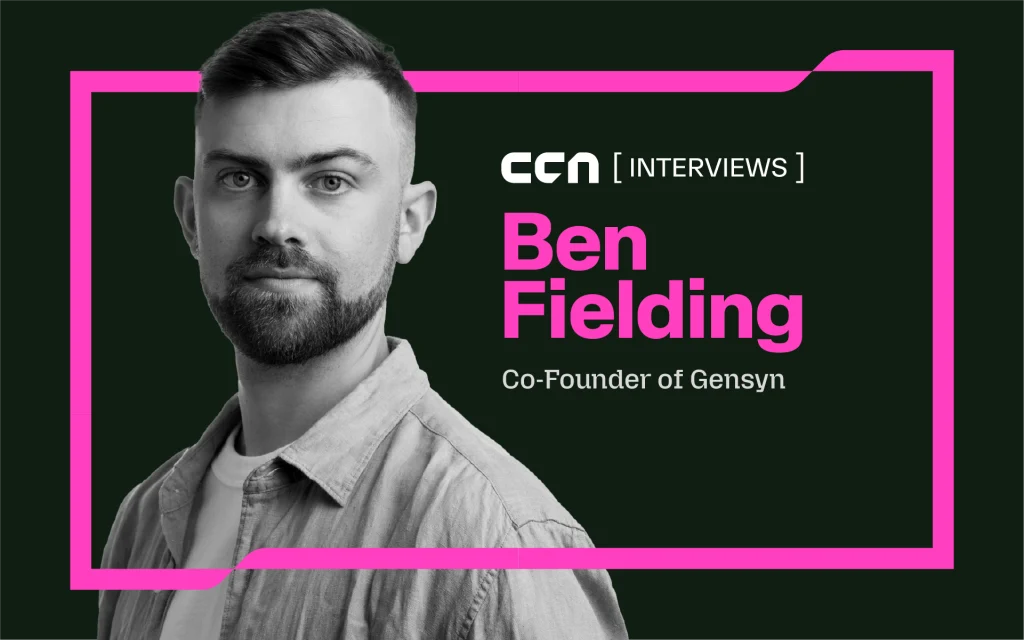
Ben Fielding explains why AI won’t be owned by one company, how cryptographic verification builds trust, and what a machine economy looks like. | Credit: CCN.com
Share
The frustration of a researcher unable to access GPUs became one of the more ambitious bets in decentralized AI. CCN’s Giuseppe Ciccomascolo spoke with Ben Fielding, co-founder of Gensyn, shortly after its mainnet launch to explore why trustless compute matters and what comes next.
Unlike most infrastructure companies that begin with a market gap, Gensyn started with a dead end. Fielding, then a machine learning researcher working on neural architecture search, found that while the algorithms existed, access to the required hardware did not.
That bottleneck, shared by researchers globally, evolved into Gensyn, a layer-2 protocol aggregating global GPU supply for verifiable, cost-efficient machine learning. The project has raised over $50 million, led by a16z crypto, and launched mainnet on April 22, 2026.
Recently, Genysn, launched Delphi, a layer-2 application, and the world’s first decentralised information market platform that allows creators to build and monetise their own markets, without platform gatekeepers taking a cut.
Building Around GPU Constraints Instead of Waiting for Access
Fielding describes the original frustration with the clarity of someone who has explained it many times but still feels it.
“Without them, I was unable to progress, and with them I would be able to, but I couldn’t get my hands on them,” he says, speaking of GPU access during his academic years.
The second realization arrived alongside the first. The techniques he was using, particularly neural architecture search, could be made embarrassingly parallel. You did not need all the GPUs in one data center, connected by hyperfast interconnects. You could use them scattered across the world, running almost entirely separate tasks, all contributing to the same objective.
That combination, constrained supply and a technical path around centralization, pointed toward a different kind of infrastructure entirely.
The path to blockchain came later, and not without friction. Fielding and his co-founder spent their careers in machine learning, not crypto. They had absorbed the same skepticism about the industry that most people outside it carry. But the deeper they went into the technology, the harder it became to dismiss.
“We realized that actually this is the solution,” he says. “It’s the way to do it.”
What Blockchain Actually Solves
The obvious question, which Fielding has clearly heard many times, is what blockchain provides that a conventional peer-to-peer compute network cannot.
His answer is precise: programmatic trust.
Traditional trust between parties runs through contracts, courts and human arbitration systems. Those systems work, but they are built for human timescales. As digital systems move faster, the human layer becomes the bottleneck.
“The more you start digitizing things, the more that the human world trust system becomes the bottleneck on everything else,” he says.
Crypto resolves this by allowing parties to sign programmatic contracts that settle almost instantaneously, with no human intermediary involved. For the financial system, that is the obvious application. For Gensyn, it is the mechanism that allows someone with spare GPU capacity to rent it to someone training a machine learning model, without either party needing to trust the other in any conventional sense.
Decentralized AI, in Gensyn’s framing, requires three things that have not previously existed together: peer-to-peer communication between machines, persistent on-chain identity so reputation accumulates, and cryptographic verification so computation can be trusted
How Gensyn Ensures Different Machines Produce Identical AI Results
Connecting GPUs was always the easier half of the problem. The harder half is proving that the work was actually done correctly.
Gensyn spent years on this. Fielding describes the core challenge simply: if one node processes a computation and another node needs to verify it, they must be able to compare results at the bit level. If the outputs are not identical, you cannot build any reliable system on top.
Most projects, he argues, skip this step.
“A lot of them will implement the game theoretic system, but they won’t implement the ground truth,” he says. “If you can’t achieve a final point of truth, your game theoretic system just collapses.”
Gensyn’s answer is what it calls the Reproducible Execution Environment, or REE. It is a compiler that ensures a machine learning model executed on any number of different devices produces exactly identical results. From that foundation, you can then build graduated verification systems: spot-check ten percent of a computation for speed, rerun sixty percent for higher assurance, or build a full zero-knowledge proof when absolute certainty is required.
Gensyn built REE as an optional verifiable settlement layer, allowing users to choose their required level of computational certainty.
Without bitwise reproducibility underneath, none of those options are available.
RLSwarm, Delphi and the Distinction Between Demo and Product
When RLSwarm went viral earlier this year, it demonstrated something genuinely striking: machine learning models distributed across the internet, improving collectively through shared outputs. Fielding was deliberate in calling it a demonstration, not a product.
The reason matters.
“It’s very easy in crypto to build something where people will do it because they think they’re going to be rewarded in the future,” he says. “That isn’t a sustainable business.”
RLSwarm had no clear individual value proposition. People joined because the collective output was interesting, or because they anticipated future rewards. That, in Fielding’s view, is exactly the kind of artificial engagement that has undermined most crypto networks.
Delphi is the product. It is a permissionless, AI-settled information markets platform where anyone can create a market on any topic, from bitcoin price targets to sports outcomes to geopolitical events, with AI models handling settlement rather than traditional oracles.
One sports market on testnet drew more than 87,000 traders and recorded 4.88 million dollars in volume. An Oscars market attracted more than 45,000 traders.
The buy-and-burn mechanic built into Delphi is also, Fielding makes clear, a statement of intent. Seventy percent of protocol revenue is permanently burned, with 29% returned to the Community Treasury and one percent paid to the executor who triggers the vault, tying the token’s value directly to real network activity.
“We saw that the mechanisms were fully available to us and we were able to do it from day one,” he says. “Why wouldn’t we do it from day one?”
Why Hyperscalers Cannot Offer Verifiable AI Training
Gensyn is not primarily pitching cheaper compute. Fielding is careful about this.
The cost argument against Amazon, Azure and the hyperscalers has narrowed as centralized cloud prices have come down. That was never the real thesis anyway. The real argument is about something the hyperscalers structurally cannot offer: openness.
“There’s a reason they train these huge models inside their own data centers,” Fielding says. “It gives them control over the model. They are the only ones who know how the model has been trained, what’s within the model weights.”
He goes further. He describes how a sufficiently motivated actor could, during training, ensure that a model answers a specific future question in a specific way, imperceptibly, without users ever detecting it. Whether that happens in practice is not the point. The point is that the architecture makes it possible, and there is no way for anyone outside the data center to audit against it.
Gensyn’s network allows models to be trained entirely in the open, with the REE providing proof that the training happened as specified. Anyone can audit it. Anyone can participate in it.
The analogy Fielding uses is SETI at home, the distributed computing project that let millions of people donate processing power to the search for extraterrestrial intelligence. The same structure, applied to machine learning, would allow a genuinely open alternative to the models trained in closed data centers. That alternative does not currently exist.
Fielding Envisions a Global Network of Autonomous AI Economies
Fielding’s long-term vision for Gensyn is the most ambitious part of the conversation, and also the most carefully reasoned.
He describes a concept he calls the world model, which is actually two concepts merged together.
The first is the economic world model: in a sufficiently open free market, the trades and assets within it begin to approximate the beliefs and desires of every participant. This is the logic behind prediction markets and why they tend to be accurate.
The second is the machine learning world model: a general-purpose model that can compress information from the environment into its weights and generate predictions about the world.
Most companies chasing the second concept, he argues, are doing it wrong. They raise billions, retreat into data centers, and try to build a single model that captures everything. Gensyn’s thesis is that you combine the two concepts and let them train each other.
Delphi is the financial world model layer. The machine learning infrastructure is the other side.
“It isn’t one big model that sits in a data center,” he says. “It’s actually millions, billions, theoretically infinite models that exist across the world, run by anyone, owned by anyone, trading within truly open financial markets.”
In Gensyn’s framing, the network provides the foundational infrastructure AI systems need to operate at scale: compute, data and information exchange, all accessible through open digital markets where both humans and machines can participate.
The machines, in this vision, do not just participate in the markets. They become the primary actors within them, buying information, selling information, improving continuously, without waiting for a human to instruct them.
“At that point,” Fielding says, “you have this system where machine learning is no longer constrained by humans doing something.”
Disclaimer:
The information provided in this article is for informational purposes only. It is not intended to be, nor should it be construed as, financial advice. We do not make any warranties regarding the completeness, reliability, or accuracy of this information. All investments involve risk, and past performance does not guarantee future results. We recommend consulting a financial advisor before making any investment decisions.
Giuseppe Ciccomascolo began his career as an investigative journalist in Italy, where he contributed to both local and national newspapers, focusing on various financial sectors.
Upon relocating to London, he worked as an analyst for Fitch's CapitalStructure and later as a Senior Reporter for Alliance News. In 2017, Giuseppe transitioned to covering cryptocurrency-related news, producing documentaries and articles on Bitcoin and other emerging digital currencies. He also played a pivotal role in establishing the academy for a cryptocurrency exchange website. Crypto remained his primary area of interest throughout his tenure as a writer for ThirdFloor.


 Easy
Easy