Ethereum sentiment turns bullish as Bitcoin and XRP traders grow fearful. Santiment explains why pessimism could favor a recovery. | Credit: CCN.com
Share
Key Takeaways
Ethereum’s bullish-to-bearish comment ratio reached 2.05, signaling strong crowd enthusiasm.
Bitcoin and XRP sentiment turned negative, with ratios of 0.82 and 0.92, respectively.
Santiment suggests Bitcoin and XRP’s fearful sentiment could support a recovery if buying demand returns.
Ethereum is attracting a wave of bullish social commentary, while Bitcoin and XRP traders are growing increasingly fearful, exposing a sharp divide in cryptocurrency sentiment following recent price declines.
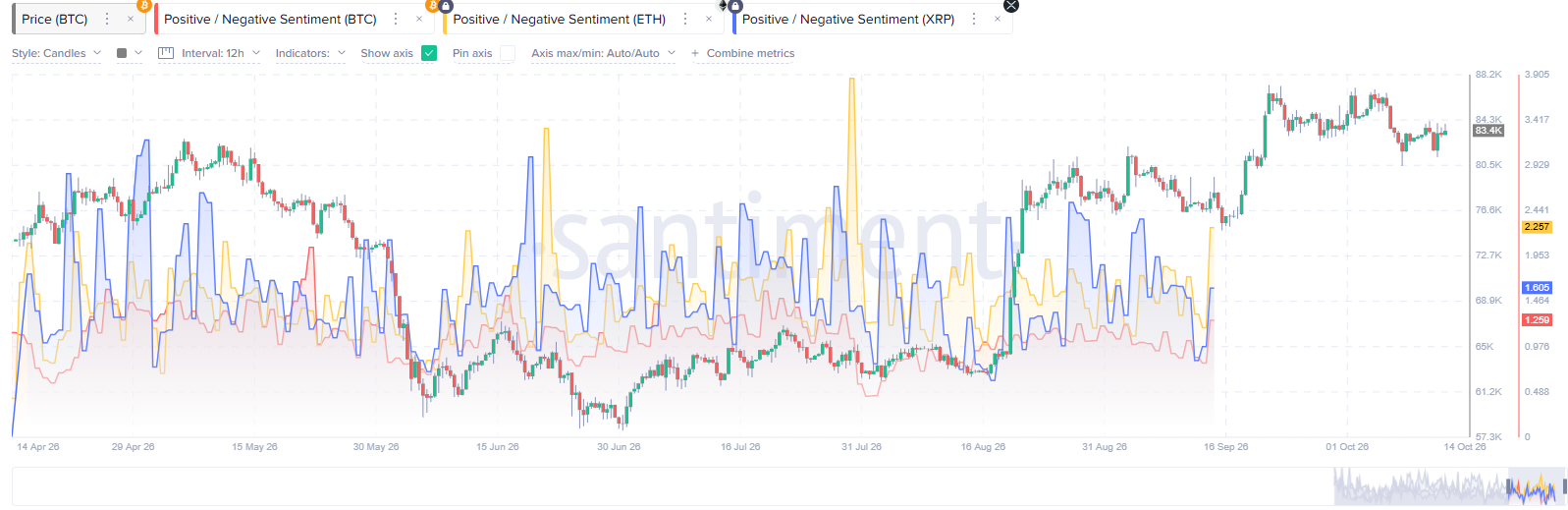
Santiment showed Ether generating 2.05 bullish comments for every bearish one across X, Reddit, and Telegram. Bitcoin’s ratio stood at 0.82, while XRP registered 0.92, meaning negative commentary outweighed positive discussion for both assets.
The divergence puts Ethereum firmly in fear-of-missing-out territory. However, the crowd’s favorite does not necessarily have the strongest recovery prospects.
Santiment’s contrarian interpretation suggests subdued expectations around Bitcoin and XRP could become an advantage if buying demand returns.
Try Our Recommended Crypto Exchanges
Sponsored
Disclosure
We sometimes use affiliate links in our content, when clicking on those we might receive a commission at no extra cost to you. By using this website you agree to our terms and conditions and privacy policy.
Ethereum’s improving mood reflects traders’ focus on its rebound above support, staking demand, and expectations surrounding future network improvements.
With more than twice as many bullish comments as bearish ones, ETH stands apart from its larger rival, XRP. The reading captures enthusiasm among tracked social discussions, although it does not establish that investment capital is rotating into Ethereum.
Fresh exchange-traded fund data provides a more nuanced picture.
🚨 Ethereum FOMO Surges While Bitcoin And XRP Turn Fearful
🔥 Ethereum is suddenly the crowd favorite. Across X, Reddit, and Telegram, $ETH has 2.05 bullish comments for every bearish one, putting sentiment firmly into FOMO territory as traders focus on its rebound above key… pic.twitter.com/p1rj8AETvD
Farside Investors’ figures show US spot Ethereum ETFs attracted $24.8 million on October 13, ending ten consecutive trading sessions of net withdrawals. Fidelity’s FETH brought in $8.1 million, while Grayscale’s ETH added $16.7 million.
That improvement followed $85.4 million in outflows on Oct. 12, including $75.1 million from BlackRock’s ETHA. Across the ten-session withdrawal streak, aggregate redemptions reached approximately $782.8 million, based on Farside’s daily totals.
The positive session offers an early sign that demand for funds may be stabilizing. Its size, however, remains modest compared with the preceding withdrawals, leaving Ethereum’s bullish social narrative dependent on further buying support.
Bitcoin and XRP Traders Retreat Into Fear
Bitcoin’s sentiment deteriorated after repeated rejection near $87,000 and a retreat toward $81,000. Long liquidations and macroeconomic pressure added to the nervousness surrounding the largest cryptocurrency.
Its 0.82 ratio translates into roughly 82 bullish comments for every 100 bearish ones. That indicates a negative balance of discussion, although the measure alone cannot establish how many traders have sold or how aggressively they are positioned.
Top cap positive/negative sentiment comparison. | Credit: Santiment
XRP faces a similar confidence problem. The token’s weekly decline exceeded 9%, while attempts to reclaim the $1.40 area struggled to gain traction. Its bullish-to-bearish comment ratio slipped below parity to 0.92.
Leveraged long positions added vulnerability during the pullback. When prices fall far enough to trigger liquidations, exchanges forcibly close those positions, potentially accelerating selling and reinforcing pessimism.
For both assets, the immediate challenge is whether recovering prices can attract sustained demand after the recent setbacks.
Why Fear Could Favor the Next Recovery
Santiment’s central argument is contrarian: Bitcoin and XRP’s fearful crowds could offer a healthier starting point for a rebound than Ethereum’s enthusiastic following, provided prices begin recovering.
The reasoning centers on expectations. When bullish conviction becomes widespread, some of the anticipated buying may have already occurred. Disappointing price action can then prompt crowded optimistic positions to unwind.
Bitcoin's fear and greed index read 64 a week ago, 57 yesterday, 62 today. Three different numbers, same zone for 22 straight days.
Fear can create the opposite conditions. Investors who have reduced exposure may return if prices stabilize, while improving conditions can force bearish traders to reassess.
Neither outcome follows automatically from a sentiment reading. Social commentary measures expressed opinion; it does not directly quantify available capital, order-book liquidity, or future purchases.
Ethereum’s renewed ETF inflows therefore matter as a separate demand indicator. Whether those inflows persist and whether Bitcoin and XRP regain lost price levels will help determine if the sentiment divide signals an approaching reversal or simply reflects different reactions to market stress.
Disclaimer:
The information provided in this article is for informational purposes only. It is not intended to be, nor should it be construed as, financial advice. We do not make any warranties regarding the completeness, reliability, or accuracy of this information. All investments involve risk, and past performance does not guarantee future results. We recommend consulting a financial advisor before making any investment decisions.
Giuseppe Ciccomascolo began his career as an investigative journalist in Italy, where he contributed to both local and national newspapers, focusing on various financial sectors.
Upon relocating to London, he worked as an analyst for Fitch's CapitalStructure and later as a Senior Reporter for Alliance News. In 2017, Giuseppe transitioned to covering cryptocurrency-related news, producing documentaries and articles on Bitcoin and other emerging digital currencies. He also played a pivotal role in establishing the academy for a cryptocurrency exchange website. Crypto remained his primary area of interest throughout his tenure as a writer for ThirdFloor.













 Tame Your Crypto FOMO, Q4 Is a Bullish Season for Bitcoin