Crypto payment card volumes are hitting record highs, but weak compliance infrastructure could cause many crypto neobanks to fail. | Credit: CCN.com
Share
Key Takeaways
Crypto exchanges are evolving beyond digital assets, with CryptoQuant CEO Ki Young Ju arguing they are becoming RWA exchanges.
On Binance’s USDT-margined perpetual futures market, metals, crude oil and stocks now rank ahead of most altcoins by average trading volume.
Tokenization is emerging as a major growth driver, with exchanges expanding offerings of tokenized equities, private credit and other traditional financial products.
The line separating cryptocurrency exchanges from traditional financial markets is becoming increasingly blurred, according to CryptoQuant founder and CEO Ki Young Ju.
As demand grows for tokenized stocks, commodities, and other real-world assets (RWAs), Ju believes crypto trading platforms are evolving into broader multi-asset marketplaces rather than venues dedicated solely to digital currencies.
His comments come as major exchanges continue expanding their tokenized asset offerings and institutional investors show increasing interest in blockchain-based versions of traditional financial products.
From gold and crude oil to equities and government bonds, real-world assets are becoming one of the fastest-growing segments of the crypto industry.
Try Our Recommended Crypto Exchanges
Sponsored
Disclosure
We sometimes use affiliate links in our content, when clicking on those we might receive a commission at no extra cost to you. By using this website you agree to our terms and conditions and privacy policy.
According to the CryptoQuant CEO, average trading volume for single-asset perpetual contracts now ranks metals, crude oil and stocks ahead of altcoins outside the top 10 cryptocurrencies by market capitalization.
The shift suggests traders are increasingly using crypto exchanges to gain exposure to traditional financial markets without leaving blockchain-based trading infrastructure.
“Crypto exchanges are evolving into RWA exchanges,” Ju wrote, arguing that digital asset platforms are no longer limited to native cryptocurrencies but are rapidly expanding into tokenized versions of conventional financial instruments.
The trend reflects broader changes across the industry as exchanges seek new revenue streams beyond volatile crypto trading volumes.
Instead of competing primarily on the number of token listings, many platforms are racing to offer tokenized equities, commodities, Treasury products, private credit and money market funds.
The development also aligns with growing institutional demand for regulated, yield-generating assets that can be traded around the clock using stablecoins as settlement rails.
Tokenization Is Becoming Crypto’s Next Growth Engine
Ju’s comments mirror one of the strongest themes in digital assets throughout 2026: the rapid expansion of tokenized real-world assets.
Major exchanges have accelerated efforts to bring traditional assets on-chain. Kraken expanded its tokenized equities business through its xStocks initiative, while several platforms now offer access to tokenized US Treasury bills, private credit products and money market funds.
Rather than relying solely on speculative cryptocurrency trading, exchanges increasingly view RWAs as a way to attract traditional investors and diversify their business models.
Bloomberg just used on-chain oil prices as the reference for their iran risk coverage.
The broader financial industry is moving in the same direction.
Banks, asset managers and market infrastructure providers are investing heavily in tokenization to improve settlement efficiency, reduce costs and enable fractional ownership of assets that have traditionally been difficult to access.
Stablecoins have become a key component of this ecosystem, providing the settlement layer for tokenized assets while blockchain networks such as Ethereum and Solana compete to become the infrastructure powering tokenized finance.
The result is a gradual transformation of crypto exchanges into platforms capable of supporting both digital-native assets and traditional financial instruments.
24/7 Markets Could Give Blockchain a Competitive Advantage
Unlike commodity and equity markets, which generally follow fixed trading hours and close on weekends, blockchain-based trading platforms remain open 24 hours a day, seven days a week.
That advantage became particularly visible during recent geopolitical tensions involving Iran, when traditional commodity exchanges were closed while on-chain markets continued repricing oil, gold and silver contracts in real time.
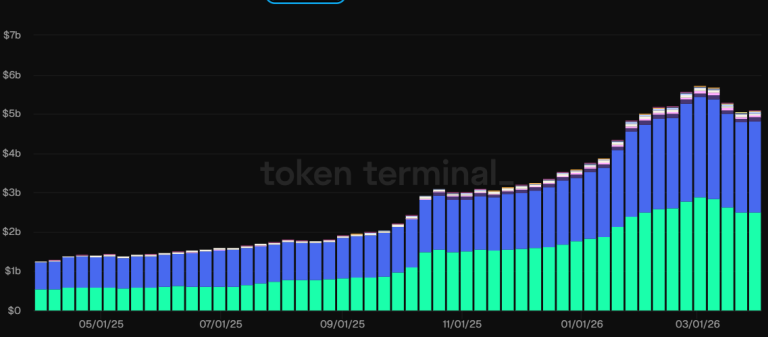
Tokenized commodity markets grew from $1.9 billion in early 2025 to $7.13 billion by February 2026. | Credit: Token Terminal
According to industry reports, decentralized exchange Hyperliquid saw significant trading activity in commodity perpetual contracts during the market disruption, with Bloomberg reportedly indicating on-chain oil prices as a live indicator of market sentiment while traditional futures markets remained shut.
CryptoQuant’s latest market outlook suggests the transition toward RWAs represents a structural shift rather than a temporary trend.
In the short term, the firm remains neutral on the crypto market, noting that capital flowing into tokenized assets does not necessarily translate into higher demand for cryptocurrencies themselves.
Rising Bitcoin dominance and weak appetite for altcoins continue to weigh on the broader digital asset market.
Over the longer term, however, CryptoQuant sees the expansion of RWAs as a positive development. By broadening the product range available on crypto exchanges and making blockchain infrastructure more attractive to institutional investors, tokenization could significantly expand the industry’s addressable market.
Giuseppe Ciccomascolo began his career as an investigative journalist in Italy, where he contributed to both local and national newspapers, focusing on various financial sectors.
Upon relocating to London, he worked as an analyst for Fitch's CapitalStructure and later as a Senior Reporter for Alliance News. In 2017, Giuseppe transitioned to covering cryptocurrency-related news, producing documentaries and articles on Bitcoin and other emerging digital currencies. He also played a pivotal role in establishing the academy for a cryptocurrency exchange website. Crypto remained his primary area of interest throughout his tenure as a writer for ThirdFloor.