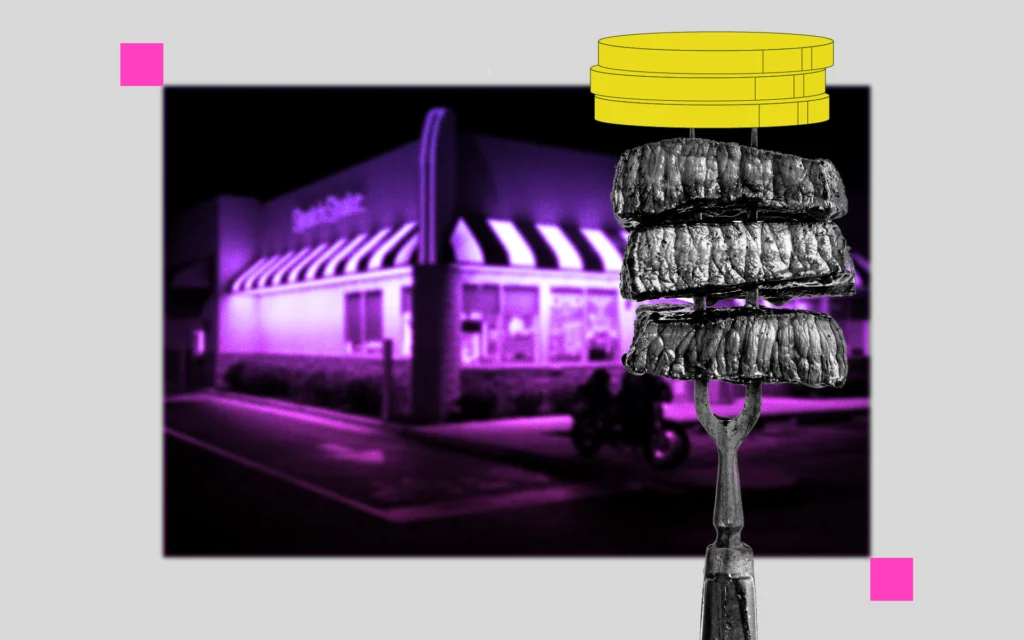
Bitcoin and steak. A match made in heaven? | Credit: CCN.
Share
Key Takeaways
Steak ‘n Shake adopted Bitcoin in May 2025, attracting ~2M new customers and boosting same-store sales dramatically.
All BTC payments flow into their Strategic Bitcoin Reserve, cutting fees by ~50% while funding operations and growth.
Eateries increasingly accept crypto to lower costs, reach younger crowds, and gain a marketing edge as mainstream retail adoption surges.
In a move that turned heads across the restaurant world, Steak ‘n Shake’s Bitcoin strategy is now delivering measurable results — and the latest figures are hard to ignore.
Speaking at Bitcoin 2026, executive Michael Boes said the chain has added roughly 2 million new customers since launching BTC payments in May 2025, while achieving the highest same-store sales growth in the restaurant industry.
The company also revealed that using Bitcoin has cut payment processing costs by around 50%, a shift that could translate into millions in annual savings if adopted at scale.
Sponsored
Disclosure
We sometimes use affiliate links in our content, when clicking on those we might receive a commission at no extra cost to you. By using this website you agree to our terms and conditions and privacy policy.
Steak ‘n Shake began accepting Bitcoin on May 16, 2025, rolling it out across hundreds of US locations, with additional international sites where regulations allow.
Customers pay using the Lightning Network, enabling near-instant, low-cost transactions via QR codes — removing the delays and fees associated with card payments.
Within months, the impact was visible. Same-store sales climbed more than 10%, reaching 11% in Q2 and 15% in Q3, according to company figures.
Boes directly attributed the growth to Bitcoin adoption.
“The math is simple for us. When we use Bitcoin, we save 50% on processing fees versus a traditional credit card user,” he said.
“To put it more simply, if every credit card user used Bitcoin, we would save roughly $6 million annually, which is huge for our bottom line.”
Customer traffic also surged, with more than 2 million new diners — both cash and crypto users — visiting over the following year.
The momentum was amplified by social media buzz and widespread media coverage, drawing in curious first-time customers and converting many into repeat visitors.
All BTC payments flow directly into the company’s Strategic Bitcoin Reserve (SBR).
Healthier Food, New Pay Models
Boes also tied Bitcoin adoption directly to improvements in food quality and employee compensation.
The cost savings and additional revenue driven by Bitcoin have allowed the company to reinvest heavily into its menu, the exec said.
Over the past year, the chain has upgraded its ingredients and processes, including shifting to beef tallow fries, using higher-quality dairy, and removing microwaves across locations.
“A healthy currency within a healthy company is delivering healthier food options at great prices. It’s simple,” he said.
The Bitcoin push is also extending into how the company pays its workforce.
According to Boes, Steak ‘n Shake is already positioning itself as a leader in wages, but is now going further by integrating Bitcoin into compensation.
Employees are set to receive Bitcoin-linked bonuses, while Boes himself said he plans to become one of the first restaurant industry executives to accept BTC as part of his pay package.
He added that the move could help set a precedent for new compensation models across the sector.
Beyond staff, the company is also expanding Bitcoin’s role across its business model. Franchisees will be able to pay fees using BTC, further embedding the cryptocurrency into Steak ‘n Shake’s operations.
Why Eateries Are Flocking to Crypto Payments
Restaurants have long faced razor-thin margins, high card fees, and delayed settlement periods.
Meanwhile, payment processors such as BitPay and Lightning connectors often charge 1% or less, with payments settling almost instantly with significantly lower fraud risk because transactions are borderless.
For operators, this is also serving as an attractor for a younger audience.
Studies have found that Millennials and Gen Z are more likely to prefer locations that accept it, while tourists like the convenience of not having to switch currencies.
While critics point to volatility concerns, many eateries and businesses convert BTC to cash instantly or, like Steak ‘n Shake, keep it as a treasury asset.
The result is lower expenses, additional revenue streams, and a contemporary brand image in a competitive business.
Bitcoin Eating Through The Mainstream
For years, Bitcoin acceptance by big retail felt rare.
Early movers like Overstock, back in 2014, or Newegg saw niche uptake, but everyday usage stayed low, often under 1% of transactions.
That is changing quickly in 2025-2026, according to a PayPal poll, which found that 40% of US shops currently accept crypto.
Large enterprises with more than $500 million in revenue are leading the way with 50% adoption.
Food businesses, including Chipotle, Burger King, and Subway, now accept Bitcoin through processors.
Luxury brands such as Gucci and Balenciaga have also introduced crypto in select outlets.
As more restaurants and stores join in, driven by genuine discounts and younger clientele, it’s becoming increasingly clear every day that Bitcoin is no longer operating in niche circles.
Prashant Jha is a seasoned crypto journalist based in Delhi, India, with a Bachelor’s Degree in Computer Science Engineering. Passionate about the evolving world of blockchain and cryptocurrencies, he has been a dedicated voice in the industry since 2018. Prashant’s expertise lies in regulatory reporting, where he unravels complex legal and financial developments with clarity and precision. Before joining CCN in 2024, he honed his craft at Cointelegraph, establishing himself as a trusted name in crypto journalism.
His coverage spans major industry events, including the high-profile collapses of FTX, Three Arrows Capital (3AC), and LUNA, offering readers insightful analyses of their regulatory and market implications. Prashant’s technical background enables him to bridge the gap between intricate blockchain technology and its real-world applications, making his work accessible to novices and experts.
Beyond his professional pursuits, Prashant is an avid music enthusiast, often exploring diverse genres to unwind. A sports lover, he has a particular passion for cricket and frequently engages in discussions about the game. His multifaceted interests and sharp journalistic instincts make him a valuable contributor to CCN, where he continues shaping the crypto landscape's narrative.