Key Takeaways
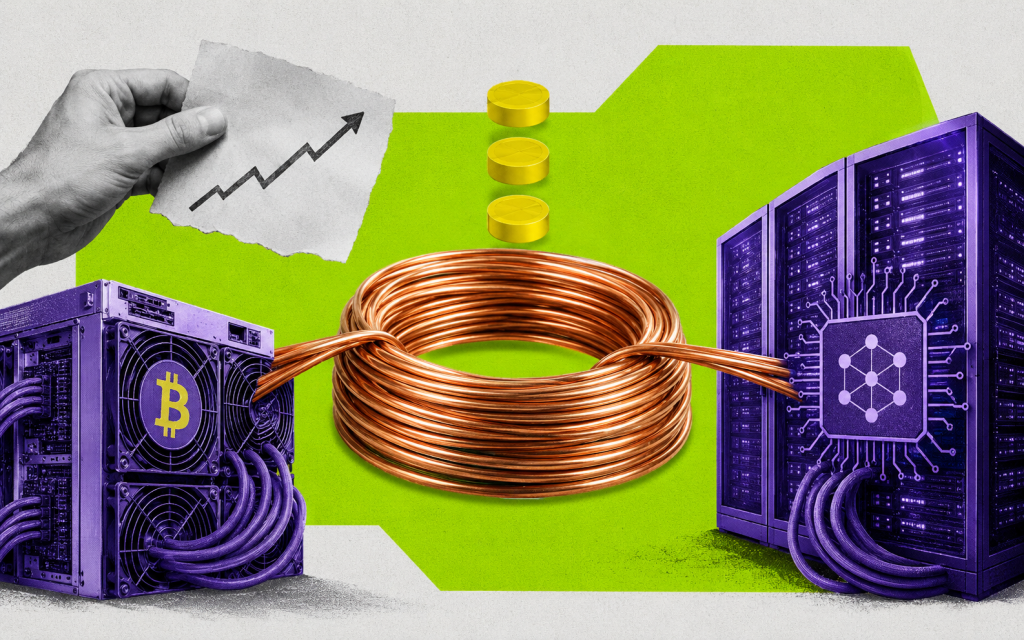
Copper’s steepest supply squeeze since 2021 is sending a warning across two electricity-hungry industries: Bitcoin mining and artificial intelligence.
The London Metal Exchange’s cash copper contract traded as much as $478 per ton above the three-month contract on Monday. Such backwardation signals that buyers are paying unusually high premiums for immediately available metal.
The move followed a $370-per-ton front-month premium on Friday and came as LME inventories declined for a 42nd consecutive day, the longest withdrawal streak since 2014. Stockpiles fell to 204,975 tons, with almost half already earmarked for removal.
Copper prices have consequently gained nearly 16% this year, with the three-month contract reaching $14,360.50 per ton and approaching January’s record of $14,527.50.
+53
Bitcoin
Bitcoin Cash
Dogecoin
Ethereum
Litecoin
TRON
Tether
Ripple
Build'N'Build
Cardano
Toncoin
1inch Network
Aave
Algorand
Aptos
Arbitrum
Cosmos
Avalanche
Axie Infinity
Basic Attention Token
Chiliz
Compound
Curve DAO Token
Dai
Polkadot
Ethereum Name Service
Frax
The Graph
Immutable
Injective Protocol
Kava.io
Lido DAO Token
Chainlink
Decentraland
Polygon Matic
Maker
Mantle
NEAR Protocol
Optimism
PAX Gold
Pepe
Quant
Render Token
The Sandbox
Shiba Inu
Solana
Sui
SushiSwap
Uniswap
USD Coin
Wrapped Bitcoin
Wrapped Ethereum
Worldcoin
Tether Gold
Stellar
Monero
Tezos
Zcash
+7
Bitcoin Cash
Bitcoin
Ethereum
Litecoin
Tether
Ripple
Dogecoin
Cardano
Build'N'Build
TRON
USD Coin
Solana
+7
Tether
Bitcoin
Ethereum
USD Coin
TRON
Litecoin
Dogecoin
Ripple
Bitcoin Cash
Solana
Polygon Matic
Build'N'Build
The squeeze reflects both falling production and a geographic scramble for available copper.
Expectations that the United States could impose tariffs on refined copper have lifted American prices above LME benchmarks.
That gap creates an arbitrage opportunity, encouraging traders and producers to redirect metal toward the US instead of delivering it into LME warehouses.
The result is an increasingly severe shortage of exchange-deliverable copper elsewhere, particularly in Europe.
The copper market is facing a severe supply squeeze:
The LME’s front-month copper spread surged to a $370 per ton premium on Friday, the widest one-month spread since the 2021 supply squeeze.
This means traders are paying a historic premium for copper available in the near term… pic.twitter.com/SzwIHGTKNp
— The Kobeissi Letter (@KobeissiLetter) August 15, 2026
Production has also disappointed. Jefferies’ latest tracker, covering miners responsible for roughly 55% of global supply, showed second-quarter output falling 3.9% year over year to 3.113 million tons.
Ivanhoe Mines recorded a 43% decline following disruption at Kamoa-Kakula, while Newmont’s production dropped 53% amid lower ore grades. Freeport-McMoRan, Antofagasta and BHP also reported declines.
Jefferies expects the copper market to record a 442,000-ton deficit in 2026, widening to 782,000 tons by 2030.
Bitcoin mining does not consume copper directly as fuel, but its expansion depends on copper-intensive electrical infrastructure.
Mining facilities require transformers, substations, transmission connections, switchgear, cooling equipment and extensive power cabling. Rising copper prices can therefore increase the capital cost of building new mines or expanding existing sites.
#Copper, #Gold & #Critical #Minerals Breakout
1/7
Copper set a fresh #COMEX record. September touched $6.7140/lb ($14,802/t) before easing. The #LME cash-to-September spread hit $370 — the widest one-month contango/squeeze since 2021. The curve is backwardated out to 2027.2/7… pic.twitter.com/eVrQTIgAn9
— Gryphon Investment Advisors (@GryphonIAB) August 17, 2026
The pressure would be particularly significant for miners already contending with volatile Bitcoin prices, rising network difficulty and shrinking margins after successive block-reward halvings.
Higher infrastructure costs could delay projects and favor large operators capable of signing long-term supply contracts.
Copper scarcity may also intensify competition for grid connections. Miners increasingly seek locations with abundant power, but new generation and transmission capacity cannot be added without substantial quantities of conductive metal.
Existing mining sites with secured electricity and completed infrastructure could consequently become more valuable.
The AI boom presents a similar, but potentially larger, challenge.
Hyperscale data centers require copper across power distribution systems, cooling infrastructure, backup generation and grid connections. The International Energy Agency expects data-center electricity consumption to rise sharply as companies deploy increasingly powerful AI models.
That buildout is occurring alongside growing copper requirements from renewable energy, electric vehicles and conventional grid modernization. Jefferies expects grid-related copper demand to expand by 5% annually through 2030, while EV demand grows by 9.6%.
Bitcoin miners and AI operators are also competing for some of the same sites, energy contracts and electrical equipment. A prolonged copper deficit could increase construction costs for both industries while slowing the arrival of new power capacity.
Jefferies forecasts average copper prices of $13,380 per ton in 2026, rising to $17,637 by 2030.
The present squeeze may ease if tariff expectations change or inventories return to LME warehouses.
However, declining ore grades and repeated operational setbacks suggest the broader constraint is structural. For Bitcoin miners and AI developers, copper is becoming another critical bottleneck in the race for computing power.
Giuseppe Ciccomascolo began his career as an investigative journalist in Italy, where he contributed to both local and national newspapers, focusing on various financial sectors.
Upon relocating to London, he worked as an analyst for Fitch's CapitalStructure and later as a Senior Reporter for Alliance News. In 2017, Giuseppe transitioned to covering cryptocurrency-related news, producing documentaries and articles on Bitcoin and other emerging digital currencies. He also played a pivotal role in establishing the academy for a cryptocurrency exchange website. Crypto remained his primary area of interest throughout his tenure as a writer for ThirdFloor.
You’re All Set!
Thanks for signing up. We’ll be in touch soon with the latest insights.