The Coldcard security breach triggered a 210,000 BTC shift from long-term wallets as holders moved funds to safer custody arrangements. | Credit: CCN.com
Share
Key Takeaways
Roughly 210,000 BTC moved out of long-term holder wallets following the Coldcard security breach.
Long-term holder supply dropped from nearly 15 million BTC to approximately 14.7 million BTC.
The activity likely reflects users transferring funds to safer wallets or regulated custodians, rather than widespread selling.
Approximately 210,000 Bitcoin has moved out of long-term holders’ wallets following the Coldcard security breach, resulting in the largest weekly decline in long-held BTC supply since December 2024.
Glassnode data shows long-term holder supply falling from nearly 15 million BTC to about 14.7 million BTC over the past week.
However, the movement may reflect a large-scale migration of custody rather than conventional selling or a broader loss of investor confidence.
Bitcoin was trading near $64,000 during the activity, approximately 50% below its October record high.
Get These Top Crypto Casino Offers Now!
Sponsored
Disclosure
We sometimes use affiliate links in our content, when clicking on those we might receive a commission at no extra cost to you. By using this website you agree to our terms and conditions and privacy policy.
The Coldcard breach involved weak randomness in affected firmware, which allowed attackers to reconstruct some users’ recovery phrases and gain access to vulnerable wallets.
The flaw reportedly originated in firmware released in March 2021. Because wallet recovery keys generated with the affected software may already be compromised, installing an updated version alone cannot secure those funds.
A five-year-old Coldcard firmware bug let attackers drain thousands of wallets, with loss estimates still being revised upward. The headline is the theft. The on-chain story is what everyone else did.
— Santiment Intelligence (@SantimentData) August 7, 2026
Coldcard advised affected users to generate entirely new wallets and transfer their Bitcoin immediately
The response appears to have triggered a sharp increase in blockchain activity, with holders moving assets to new addresses or alternative custody arrangements.
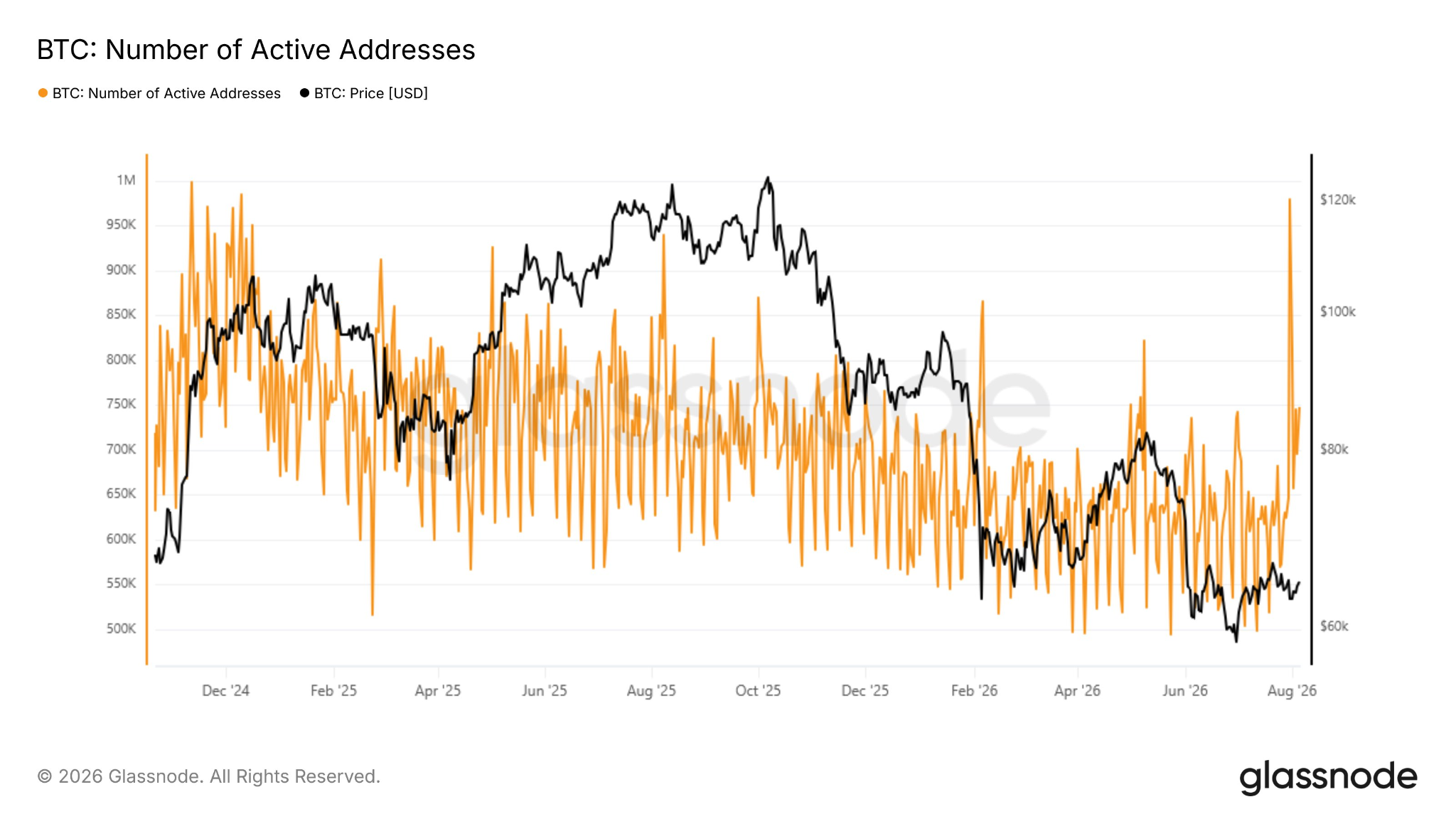
The number of active Bitcoin addresses rose to approximately 980,000 per day, its highest level since December 2024, according to Glassnode.
The analytics firm characterized the surge as an operational security response rather than evidence of improving market conviction.
Long-Term Holder Supply Records Sharp Drop
Glassnode classifies Bitcoin as long-term holder supply when it has remained dormant for around 155 days. Investors in this group are often viewed as experienced holders because they tend to retain assets through short-term volatility.
Historically, large declines in long-term holder supply have occurred near strong markets, as investors distribute coins and take profits. Similar movements were recorded around the market peaks of March 2021, March 2024 and December 2024.
Number of BTC active addresses. | Credit: Glassnode
The latest decline differs because it occurred while Bitcoin was trading near recent lows.
That context supports the view that users are reorganizing custody rather than selling heavily into the market.
Estimates of losses from the exploit vary. Glassnode linked the initial activity to the theft of 594 BTC, worth about $38 million at the time. Galaxy Research estimated confirmed losses above 1,596 BTC, with potential losses exceeding $130 million.
ETF Inflows Point to Custody Migration
Some Coldcard users may be moving Bitcoin into newly generated self-custody wallets, while others could be turning to regulated custodians or exchange-traded funds.
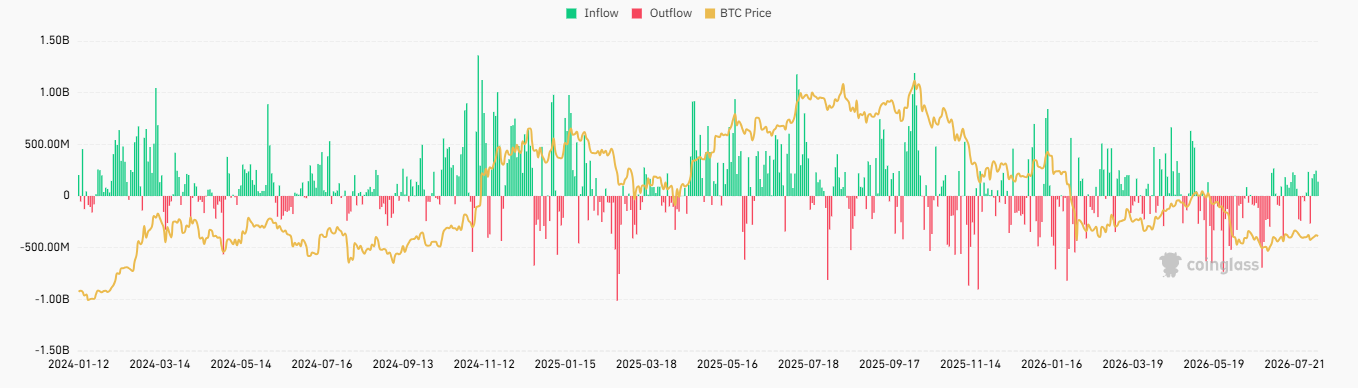
US spot Bitcoin ETFs attracted roughly $754 million over the past week, with BlackRock’s iShares Bitcoin Trust accounting for most of those inflows.
Total Bitcoin spot ETF net inflow. | Credit: CoinGlass
While that does not establish a direct connection to Coldcard transfers, it supports the possibility of changing custody preferences.
The episode highlights an important distinction in blockchain analysis: coins moving onchain do not necessarily represent sales.
In this case, the 210,000 BTC shift may primarily show long-term holders responding to a security threat while preserving their exposure to Bitcoin.
Disclaimer:
The information provided in this article is for informational purposes only. It is not intended to be, nor should it be construed as, financial advice. We do not make any warranties regarding the completeness, reliability, or accuracy of this information. All investments involve risk, and past performance does not guarantee future results. We recommend consulting a financial advisor before making any investment decisions.
Giuseppe Ciccomascolo began his career as an investigative journalist in Italy, where he contributed to both local and national newspapers, focusing on various financial sectors.
Upon relocating to London, he worked as an analyst for Fitch's CapitalStructure and later as a Senior Reporter for Alliance News. In 2017, Giuseppe transitioned to covering cryptocurrency-related news, producing documentaries and articles on Bitcoin and other emerging digital currencies. He also played a pivotal role in establishing the academy for a cryptocurrency exchange website. Crypto remained his primary area of interest throughout his tenure as a writer for ThirdFloor.