Key Takeaways
- The Senate voted 49–50 against advancing the CLARITY Act, leaving the crypto industry reeling from defeat.
- However, Ripple’s CEO has remained positive about the firm’s momentum despite failure.
- Coinbase CEO Brian Armstrong pointed to the CFTC’s ability to continue pushing new rules without the bill.
- Chairman Michael Selig previously said he would instruct staff to prepare alternative rules using the agency’s existing authority.
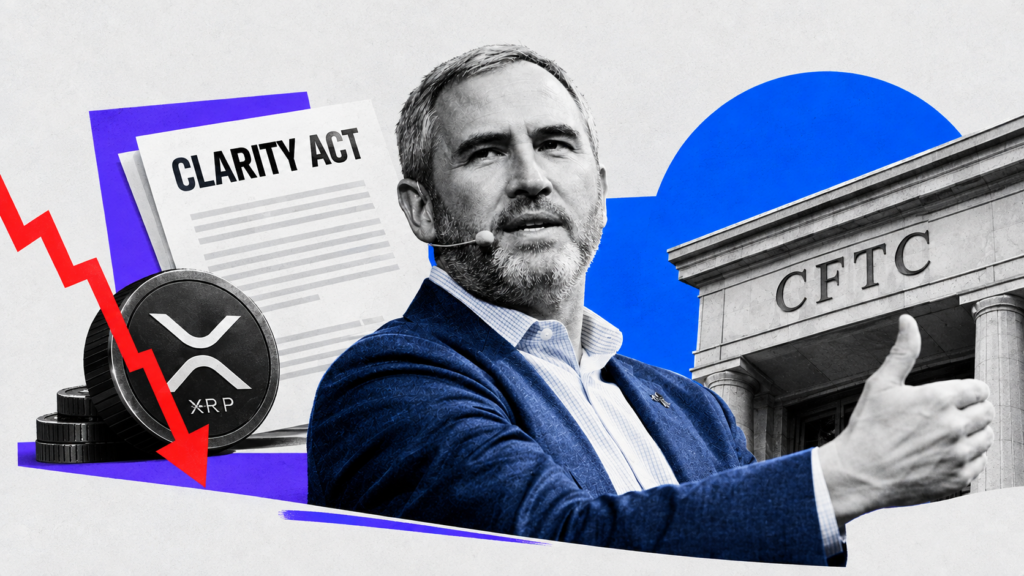
XRP plunged nearly 12% from Tuesday’s intraday high after the US Senate failed to advance the CLARITY Act, triggering a major selloff across crypto assets.
However, Ripple insists the vote does not alter XRP’s existing momentum in the industry.
It came as others pointed to Commodity Futures Trading Commission Chairman Michael Selig’s claim that he had instructed staff to prepare alternative crypto-market rules if Congress failed to act.
CLARITY Act Falls 11 Votes Short
The Senate rejected a motion to advance the CLARITY Act by 49 votes to 50 on Tuesday, falling short of the 60 senators needed to move the legislation forward, according to the official Senate record.
The defeat represents a major setback for the crypto industry’s long-running efforts to establish a lasting division of responsibilities between the SEC and the CFTC.
Although Senators blocked consideration of the legislation, the bill remains technically alive, with little time and an uncertain path forward ahead of the midterm elections.
Democratic opposition focused heavily on ethics and national security.
Senator Elissa Slotkin said the bill’s protections against public officials profiting from crypto were “simply too thin.”
She also raised concerns about money laundering and whether the CFTC possessed sufficient staffing to implement the proposed regime.
“The ethics provisions in this bill are simply too thin,” she wrote on X.
Adding: “President Trump, his children, and his Cabinet are making billions of dollars in the crypto space, , in part from bilking everyday Americans out of their hard-earned money.”
Those objections reflected the wider Democratic position that the bill did not adequately address the Trump family’s financial exposure to the crypto industry.
Three Republicans—Susan Collins, Josh Hawley, and Jerry Moran—also voted against advancing it.
Garlinghouse’s CLARITY Act Response: “This One Stings”
Ripple CEO Brad Garlinghouse acknowledged the scale of the defeat, saying his team had given “everything” to move the bill across the finish line.
“This one stings,” he said, claiming the failure fell with politics taking precedence over policy.
He called for a post-mortem on how a bill backed by much of the industry collapsed.
However, he said the failed vote does not change Ripple’s legal footing, international presence, customer base, or business momentum.
“Ripple’s business has never been stronger — real demand across traditional finance and the digital asset ecosystem,” he wrote.
Adding: “A missed vote in Washington doesn’t change our momentum, our global footprint, or our customers.”
In its formal response, Ripple said its operations remained strong across payments and institutional markets.
The company also stressed that it would continue participating in SEC and CFTC rulemaking despite the legislative setback.
XRP’s Legal Status Did Not Disappear
Ripple Chief Legal Officer Stuart Alderoty argued that XRP stands on “settled ground.”
A 2023 federal court ruling found that XRP, considered by itself, was not an investment contract.
The decision also found that Ripple’s programmatic exchange sales did not constitute securities transactions, although certain contractual sales to institutional investors did.
XRP’s regulatory footing strengthened further in March 2026 when a joint SEC–CFTC interpretation explicitly included it among examples of digital commodities.
The agencies said XRP and several other tokens derived their value primarily from functioning crypto networks rather than from investors relying on others’ essential managerial efforts.
“SEC Chairman Atkins and a CFTC Chairman Selig understand these markets,” Alderoty said. “We expect future rulemaking from both agencies to continue to set out clear rules of the road.”
Analyst Maps XRP’s Route From $6.19 to $17
The failure comes as market analyst EGRAG Crypto mapped a long-term XRP target zone between $6.19 and $8.07.
His extended scenario reaches $11.45, above $13, and potentially $17 if the token completes its current macro-wave structure.
From XRP’s price near $1.29, the highest target would represent gains of more than 1,200%.
The prediction is back in focus after Garlinghouse’s response: if XRP already possesses the legal clarity the wider industry was seeking, can the token recover without the CLARITY Act?
EGRAG’s forecast uses Elliott Wave structure and Fibonacci extensions to project XRP’s next major cycle.
The analyst identified $8.07 as the first long-term target zone for a potential fifth macro wave. That would already translate into gains of around 525% from XRP’s current price.
If momentum accelerates beyond that zone, the technical extensions rise considerably:
- $11.45
- Above $13
- An extreme target near $17
The $17 scenario would put XRP more than 1,200% above its current price.
Selig’s CFTC “Plan B” CLARITY Act
Attention has now turned to Selig and the CFTC.
In August, Selig said he had directed staff to explore crypto-market rules that could be introduced under the agency’s existing authority if the CLARITY Act stalled.
The proposal could allow registered firms, and potentially currently unregistered crypto exchanges, to operate as a type of designated contract market.
Selig also instructed staff to engage with developers of onchain financial protocols to determine how they could operate legally in the United States.
“If Congress will not” deliver a market structure, the CFTC would attempt to do so, Selig said in his original agency remarks.
Brian Armstrong, Coinbase CEO, said that the CLARITY Act was “coming to crypto regardless.”
“The SEC and CFTC have the tools they need to create clear rules under existing authority, and I expect will begin working on this in earnest,” he wrote on X.
However, while the CFTC can create some new rules, it cannot give itself complete jurisdiction over every non-security crypto spot market.
The Government Accountability Office has previously identified the absence of a federal regulator over non-security crypto spot trading as a major oversight gap.
Agency rules are also inherently more vulnerable than legislation, meaning they can be challenged in court and reversed by a future administration.
XRP Risks Falling to $1.20
XRP fell 7.95% to $1.29 over 24 hours, according to CoinMarketCap.
That was much worse than the total crypto market’s 1.83% decline and Bitcoin’s 1.48% drop.
The decline also pushed XRP below important technical levels, including its 200-day moving average near $1.355.
CoinMarketCap also said this breakdown likely triggered stop losses and made buyers reluctant to enter the market.
The key support level is now $1.25. If XRP holds above it, analysts see a possible rebound toward $1.34.
If $1.25 fails, XRP could fall to $1.20.
“The path of least resistance remains down until key resistance is reclaimed,” CoinMarketCap said.
The next major catalyst is the Federal Reserve’s September 16 interest-rate decision.
A hawkish result could put more pressure on XRP, while a dovish signal could support a relief rally.
The information provided in this article is for informational purposes only. It is not intended to be, nor should it be construed as, financial advice. We do not make any warranties regarding the completeness, reliability, or accuracy of this information. All investments involve risk, and past performance does not guarantee future results. We recommend consulting a financial advisor before making any investment decisions.

Kurt Robson is a London-based reporter at CCN, specialising in the fast-moving worlds of crypto and emerging technology. He began his career covering local news in Cornwall after graduating from Falmouth University with First Class Honours in Journalism. There, he cut his teeth on everything from council meetings to missing swans.
He quickly rose through the ranks to become a frontline journalist at several of the UK’s leading national newspapers. Over the years, he has interviewed musicians and celebrities, reported from courtrooms and crime scenes, and secured multiple front-page exclusives.
Following the upheaval of the COVID-19 pandemic, Kurt shifted his focus to technology journalism—just ahead of the AI boom. With a natural curiosity and a trained eye for emerging trends, he has found a new rhythm in reporting on innovation.
At CCN, Kurt's work focuses on the cutting edge of crypto, blockchain, AI, and the evolving digital world. Drawing on his background in people-first reporting and his deep interest in disruptive tech, Kurt delivers stories that are insightful, entertaining, and human-centric.