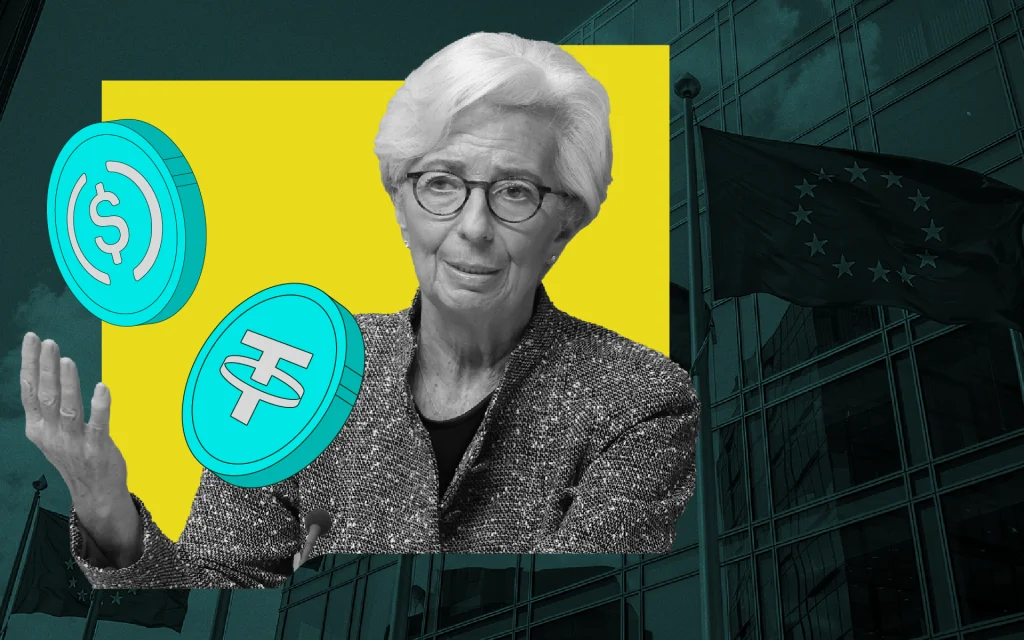
ECB's Lagarde says tokenized finance can't scale without central bank, adding that stablecoins could fragment EU digital financial ecosystem. | Credit: CCN.com
Share
Key Takeaways
ECB President Christine Lagarde warned that tokenized finance cannot scale without central bank money.
Lagarde argued that private stablecoins lack the trust and flexibility needed for institutional adoption.
The ECB believes central bank money is the only universally trusted and risk-free settlement asset, making it essential for large-scale tokenized financial markets.
European Central Bank (ECB) President Christine Lagarde has delivered a clear message to the digital asset industry: tokenized finance will not achieve mainstream adoption in Europe unless it is built on central bank money rather than private stablecoins.
Speaking at an ECB conference in Frankfurt, Lagarde argued that while tokenization and distributed ledger technology (DLT) offer significant benefits for financial markets, they require a risk-free settlement asset to scale beyond pilot projects and isolated ecosystems.
Her comments underscore a growing divergence between Europe’s vision for digital finance and the global stablecoin market, which remains overwhelmingly dominated by US dollar-backed tokens.ù
Try Our Recommended Crypto Exchanges
Sponsored
Disclosure
We sometimes use affiliate links in our content, when clicking on those we might receive a commission at no extra cost to you. By using this website you agree to our terms and conditions and privacy policy.
Lagarde Questions Stablecoins’ Role in Europe’s Digital Economy
At the center of Lagarde’s argument is the belief that stablecoins cannot provide the trust, liquidity, and flexibility needed to support large-scale tokenized financial markets.
According to the ECB president, market participants have repeatedly indicated that they are reluctant to issue digital assets at scale unless those assets can be settled in central bank money.
While stablecoins can facilitate transactions, Lagarde argued that they remain private claims backed by reserves, making them fundamentally different from central bank money, which is considered the safest and most universally accepted settlement asset.
Digitalisation is reshaping how financial markets operate, says President Christine @Lagarde.
For Europe, this is above all an opportunity to deepen integration, strengthen autonomy and anchor innovation in trusted public money across markets and payments.
“A token that is backed euro-for-euro can never do that,” Lagarde said, referring to the ability of central bank money to expand and contract according to market liquidity needs.
Lagarde also highlighted the concentration of the global stablecoin market, noting that approximately 98% of stablecoins in circulation are denominated in US dollars.
Tether and Circle alone account for nearly 90% of the market, reinforcing concerns among European policymakers about reliance on foreign-controlled digital payment infrastructure.
In a notable shift, Lagarde suggested that promoting euro-denominated stablecoins may not be the most effective path forward for Europe.
Instead, the ECB appears increasingly focused on building public digital infrastructure capable of directly supporting tokenized finance.
ECB Advances Pontes and Appia to Support Tokenized Markets
To support its vision, the ECB is developing two major initiatives designed to integrate central bank money into tokenized financial ecosystems.
The first is the Pontos project, which will enable wholesale distributed ledger settlements linked to TARGET, the Eurosystem’s large-value payment infrastructure.
During its testing phase, Pontes processed 50 transactions across 9 jurisdictions, settling approximately 1.6 billion euros. The project is expected to become operational by September 2026.
The second initiative, known as Appia, is a broader roadmap to create a unified European ecosystem for tokenized finance by 2028. The project seeks to establish common standards and interoperable infrastructure that can connect tokenized networks across the continent.
Lagarde warned that without such systems, tokenized markets risk becoming fragmented into isolated “private islands” that fail to achieve the scale and efficiency promised by blockchain technology.
By enabling settlement in central bank money, the ECB hopes to create a trusted foundation that encourages institutions to issue and trade tokenized assets more broadly.
Digital Euro and Sovereignty Become Strategic Priorities
Lagarde’s remarks also tie into Europe’s broader efforts to strengthen financial sovereignty in an increasingly digital world.
The ECB president argued that Europe remains overly dependent on foreign payment networks, with international card schemes accounting for more than 60% of card payments across the euro area. Thirteen of the bloc’s 21 member countries lack a domestic card scheme entirely.
Against this backdrop, the ECB continues to champion the digital euro as a way to preserve public access to central bank money while creating a pan-European payment system.
Unlike private stablecoins, the digital euro would carry legal tender status and be universally accepted throughout the European Union.
Lagarde also highlighted ongoing efforts to improve cross-border payments by linking Europe’s TIPS instant payment network to international systems, including India’s UPI and Southeast Asia’s Nexus network.
For investors and digital asset firms, the message is increasingly clear: while stablecoins may continue to play a role in global crypto markets, Europe’s long-term tokenization strategy is being built around central bank money, sovereign infrastructure, and the digital euro.
Giuseppe Ciccomascolo began his career as an investigative journalist in Italy, where he contributed to both local and national newspapers, focusing on various financial sectors.
Upon relocating to London, he worked as an analyst for Fitch's CapitalStructure and later as a Senior Reporter for Alliance News. In 2017, Giuseppe transitioned to covering cryptocurrency-related news, producing documentaries and articles on Bitcoin and other emerging digital currencies. He also played a pivotal role in establishing the academy for a cryptocurrency exchange website. Crypto remained his primary area of interest throughout his tenure as a writer for ThirdFloor.