Boris Johnson has attacked Bitcoin — the crypto industry isn't happy. | Source: CCN
Share
Key Takeaways
Former U.K. Prime Minister Boris Johnson said he has long suspected Bitcoin is a Ponzi scheme.
Bitcoin supporters push back strongly.
Debate over Bitcoin’s legitimacy resurfaces.
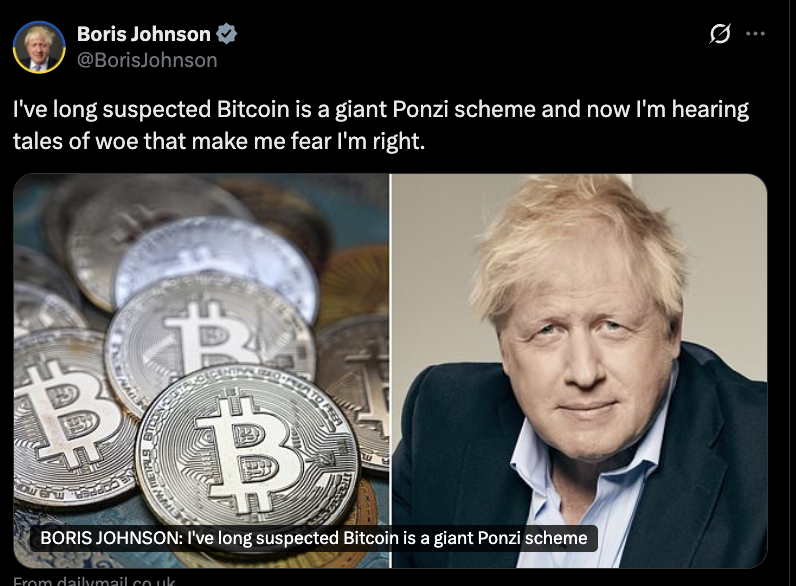
Former British Prime Minister Boris Johnson has sparked outrage throughout the crypto community after describing Bitcoin as a “giant Ponzi scheme.”
Johnson’s remarks, made in his Daily Mail column, prompted responses from high-profile Bitcoin supporters including Strategy executive chairman Michael Saylor, Eric Trump, Samson Mow and former U.K. chancellor Kwasi Kwarteng.
Try Our Recommended Crypto Exchanges
Sponsored
Disclosure
We sometimes use affiliate links in our content, when clicking on those we might receive a commission at no extra cost to you. By using this website you agree to our terms and conditions and privacy policy.
“I’ve long suspected Bitcoin is a giant Ponzi scheme and now I’m hearing tales of woe that make me fear I’m right,” he said.
In the subsequent article, Johnson described a conversation with a fellow churchgoer who had fallen into financial difficulties after investing in what he believed to be a Bitcoin opportunity.
Boris Johnson slammed Bitcoin in a Daily Mail column | Source: X (@BorisJohnson)
According to Johnson, the man was introduced to an investment in a pub where he was told he could double a £500 payment.
Instead, after years of attempting to retrieve funds and paying additional fees, he had lost about £20,000.
Johnson suggested the episode reflected a wider pattern of scams exploiting public interest in crypto.
He argued that such schemes depend on a steady stream of new investors and warned that increasing reports of losses among ordinary people could erode confidence in the sector.
Johnson Questions Bitcoin’s Intrinsic Value
Beyond the alleged scams, Johnson used the column to question the underlying value of Bitcoin itself.
He contrasted the crypto with assets such as Gold and even collectible Pokémon cards, which he said have recognizable demand and cultural appeal.
Bitcoin, by comparison, he described as essentially “a string of numbers stored in a series of computers,” asking who ultimately controls or backs it.
Johnson invoked historical examples of currency credibility, noting that Roman coins derived their value from the authority of the state.
Modern fiat currencies, he wrote, similarly depend on governments’ credibility.
Bitcoin advocates argue that its decentralized design is its strength, as it prevents governments from manipulating the money supply.
Johnson, however, said the absence of a central authority also means there is no one to hold accountable if things go wrong.
Bitcoin Supporters Push Back
Bitcoin advocates took to social media to reject Johnson’s characterization.
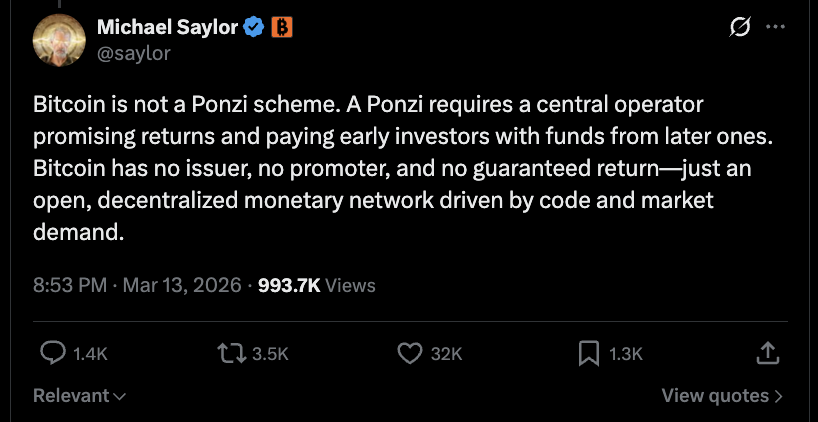
Michael Saylor, executive chairman of Strategy and one of Bitcoin’s most prominent corporate backers, wrote on X:
“Bitcoin is not a Ponzi scheme,” he wrote. “A Ponzi requires a central operator promising returns and paying early investors with funds from later ones.”
Michael Saylor pushed back on Boris Johnson’s comments | Source: X (@saylor)
Adding: “Bitcoin has no issuer, no promoter, and no guaranteed return—just an open, decentralized monetary network driven by code and market demand.”
Samson Mow, a longtime Bitcoin promoter who has repeatedly predicted the crypto could reach $1 million, responded more bluntly.
“Still time to delete this,” he wrote.
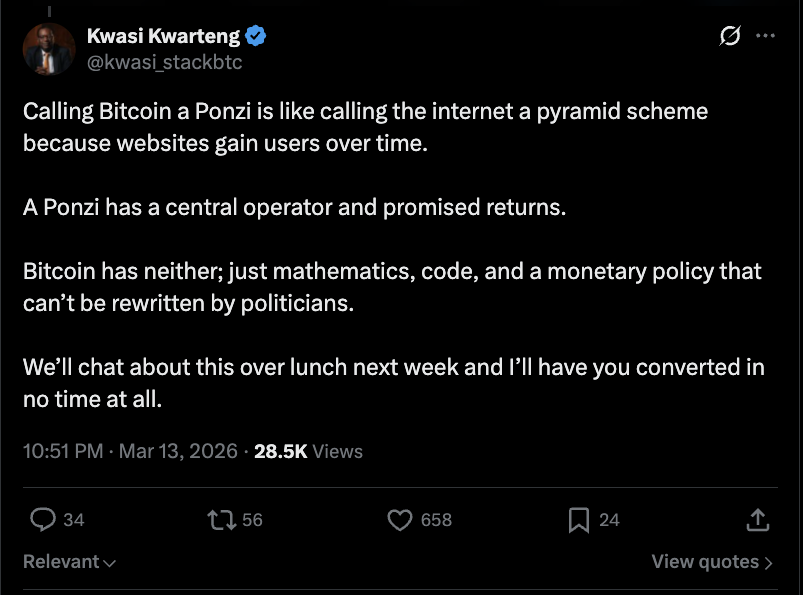
Former U.K. Chancellor Kwasi Kwarteng, who recently launched a Bitcoin mining firm, comparing the network growth to the expansion of the internet.
“Calling Bitcoin a Ponzi is like calling the internet a pyramid scheme because websites gain users over time,” he wrote.
Kwasi Kwarteng, an ally of Boris Johnson, also pushed back | Source: X (@kwasi_stackbtc)
“A Ponzi has a central operator and promised returns. Bitcoin has neither; just mathematics, code, and a monetary policy that can’t be rewritten by politicians.”
Kwarteng added that he would attempt to persuade Johnson of Bitcoin’s merits “over lunch next week.”
The comments from Johnson have reignited the long-running debate between economists and regulators over whether Bitcoin resembles a pyramid scheme.
A classic Ponzi scheme involves a central organizer who promises high returns and pays early investors using funds from new participants.
Usually, the structure collapses once new investment slows.
Bitcoin differs in that it has no central issuer and does not promise returns. Instead, its price fluctuates based on supply, demand and market sentiment.
X’s community notes also pushed back on Boris Johnson’s article. | Source: X (@BorisJohnson)
Critics argue Bitcoin’s value relies heavily on continued belief among investors and the expectation that new buyers will enter the market — characteristics they say can resemble speculative bubbles.
However, supporters counter that Bitcoin functions more like a decentralized digital commodity with a fixed supply of 21 million coins, secured by cryptography and a global network of computers.
This is backed up by regulators worldwide who mostly classify Bitcoin as a digital asset rather than a fraudulent scheme.
Kurt Robson is a London-based reporter at CCN, specialising in the fast-moving worlds of crypto and emerging technology. He began his career covering local news in Cornwall after graduating from Falmouth University with First Class Honours in Journalism. There, he cut his teeth on everything from council meetings to missing swans.
He quickly rose through the ranks to become a frontline journalist at several of the UK’s leading national newspapers. Over the years, he has interviewed musicians and celebrities, reported from courtrooms and crime scenes, and secured multiple front-page exclusives.
Following the upheaval of the COVID-19 pandemic, Kurt shifted his focus to technology journalism—just ahead of the AI boom. With a natural curiosity and a trained eye for emerging trends, he has found a new rhythm in reporting on innovation.
At CCN, Kurt's work focuses on the cutting edge of crypto, blockchain, AI, and the evolving digital world. Drawing on his background in people-first reporting and his deep interest in disruptive tech, Kurt delivers stories that are insightful, entertaining, and human-centric.