Key Takeaways
- Nigel Farage has invested £215,000 for a 6.3% stake in Stack BTC.
- The investment reinforces Reform’s growing ties with the digital asset sector.
- Farage’s crypto alignment mirrors a wider trend among populist political figures.
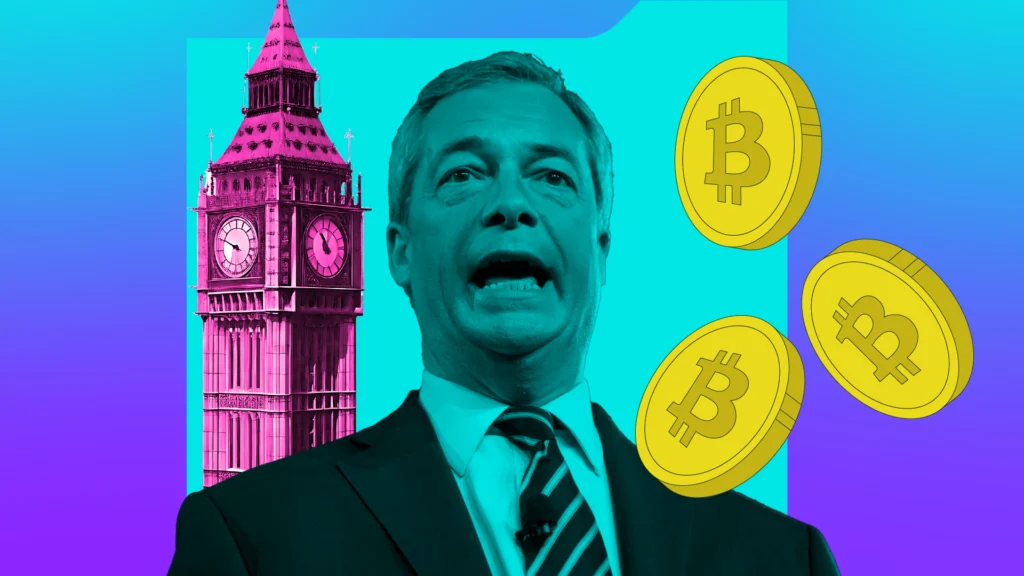
Nigel Farage has invested £215,000 in a Bitcoin-focused investment company chaired by former U.K. chancellor Kwasi Kwarteng, marking one of the most direct financial ties yet between a senior British politician and the crypto industry.
The move aligns the Reform leader more closely with a sector he has publicly championed for several years, and comes as the party seeks to win over pro-crypto voters in the country.
It also echoes a broader trend among populist political figures — especially Donald Trump, a political ally Farage has repeatedly sought to align himself with — who have embraced crypto as part of their political messaging.
Farage’s Investment In A Bitcoin Reserves Company
On Monday, The Guardian reported that Farage had purchased a 6.3% stake in Kwarteng’s crypto firm Stack BTC through his media company, Thorn In The Side Ltd.
The company aims to accumulate Bitcoin by acquiring businesses whose profits it can reinvest into the cryptocurrency.
Stack BTC currently holds 21 Bitcoin — worth just over £1 million — while the company itself has a market valuation of about £6.45 million.
Shares in the company surged roughly 67% after the investment news, although they remain below levels seen before the firm announced its Bitcoin-focused strategy in late 2025.
This deepens Reform’s links with the crypto sector, coming shortly after it was reported that the party had received significant financial backing from crypto entrepreneur Christopher Harborne.
Harborne is reported to have donated approximately £12 million to the party.
The crypto millionaire is also reported to have links to the private jet used for Farage’s controversial Chagos stunt — in which he was denied entry to a Chagos Islands military base.
Farage’s Longstanding Pro-Crypto Stance
Farage has positioned himself as one of the U.K.’s most outspoken supporters of Bitcoin and the crypto industry.
He has frequently argued that crypto represents a tool for financial freedom and a counterbalance to centralized monetary systems.
His views hardened following his highly publicized experience of being “debanked” in 2023, when the closure of his bank accounts became a national political controversy.
Farage has said the episode convinced him that individuals should have greater control over their own finances.
At the Zebu Live conference in London, CCN reported that Farage described crypto as “the ultimate freedom in the 21st century” and said the experience reinforced his belief that decentralized assets could serve as a form of protection against financial censorship.
He has also strongly opposed the creation of a U.K. central bank digital currency (CBDC), arguing that a government-issued digital pound could allow authorities to monitor and potentially control personal spending.
Farage warned that CBDCs could become part of a broader system of digital identity and financial surveillance, saying he would “rather go to prison” than live under such a system.
Parallels With Donald Trump’s Crypto Pivot
Farage’s increasing engagement with the crypto industry mirrors a broader trend among populist and conservative political figures, most notably in the U.S.
U.S. President Donald Trump — once a critic of Bitcoin — has increasingly embraced the sector in recent years, pledging during the 2024 campaign to support crypto innovation and oppose restrictive regulation.
Trump has also received substantial backing from crypto investors and has promised to make the U.S. a global hub for digital assets.
The Trump family has launched a series of crypto-related projects and tokens, many of which have caused political backlash due to concerns of insider trading and conflicts of interest.
In January 2025, shortly before his second inauguration, Trump launched an official memecoin tied to his personal brand.
The token quickly surged amid intense speculation, celebrity endorsements and political enthusiasm, briefly reaching an all-time high of around $74–$75 per token and pushing its market capitalization above $27 billion.
However, like many memecoins driven largely by hype, the token declined sharply.
By late 2025, it was trading around $4.80–$5.00, representing a drop of more than 90% from its peak.
Political analysts say Farage’s positioning could reflect a similar strategy — appealing to libertarian-leaning voters and technology entrepreneurs.
However, not everyone in the U.K. is a fan of the attempted friendship, with Praful Nargund writing for The Independent:
“The public has noticed his buddy-buddy act with the Americans – and they do not particularly like it.”
He cited data from the Good Growth Foundation, which he directs, indicating that voters’ top choice for “the worst thing” about Farage was his closeness to Donald Trump.
What Farage’s Bitcoin Investment Means For Britain
But U.S. comparisons aside, Farage’s investment could help bring greater political attention to Britain’s crypto sector at a time when the government is still shaping its regulatory framework.
The U.K. has sought to position itself as a global digital asset hub, but the industry has also faced regulatory uncertainty and debates over issues such as consumer protections, stablecoin oversight and anti-money laundering rules.
If pro-crypto policies gain greater traction among political figures, it could lead to renewed discussions about how Britain competes with jurisdictions such as the U.S., the E.U. and the rest of the world.
Supporters of the industry say clearer regulation and political backing could encourage innovation.
Mohamed Ezeldin, Head of Tokenomics at Animoca Brands, told CCN last year that “the U.S. has always been a leader in this space, again, for better or worse.”
“We’re not faring too well as the U.K. right now,” Ezeldin added.
“We’re getting battered and bruised, absolutely, for sure.”

Kurt Robson is a London-based reporter at CCN, specialising in the fast-moving worlds of crypto and emerging technology. He began his career covering local news in Cornwall after graduating from Falmouth University with First Class Honours in Journalism. There, he cut his teeth on everything from council meetings to missing swans.
He quickly rose through the ranks to become a frontline journalist at several of the UK’s leading national newspapers. Over the years, he has interviewed musicians and celebrities, reported from courtrooms and crime scenes, and secured multiple front-page exclusives.
Following the upheaval of the COVID-19 pandemic, Kurt shifted his focus to technology journalism—just ahead of the AI boom. With a natural curiosity and a trained eye for emerging trends, he has found a new rhythm in reporting on innovation.
At CCN, Kurt's work focuses on the cutting edge of crypto, blockchain, AI, and the evolving digital world. Drawing on his background in people-first reporting and his deep interest in disruptive tech, Kurt delivers stories that are insightful, entertaining, and human-centric.