Goldman Sachs, Wells Fargo and Morgan Stanley target tokenization growth as wallets lending tokenized private credit surge 1,618%. | Credit: CCN.com
Share
Key Takeaways
Goldman Sachs, Wells Fargo, and Morgan Stanley see tokenization as a growth opportunity across trading, payments, and wealth management.
Wallets lending tokenized private credit grew 1,618% during Chainalysis’s reporting period, highlighting demand for collateral-based liquidity.
Tokenization can let investors borrow against illiquid holdings without selling them.
Goldman Sachs, Wells Fargo, and Morgan Stanley are making a clearer business case for tokenization, describing opportunities in payments, trading, and wealth management during their third-quarter earnings calls.
The divergence suggests blockchain infrastructure can offer particular value when it makes difficult-to-sell assets usable as collateral.
The banks’ enthusiasm nevertheless comes with a qualification. Executives described the activity as small, and their comments did not establish tokenization as a material contributor to earnings.
Our Top Crypto Sports Betting Partners:
Sponsored
Disclosure
We sometimes use affiliate links in our content, when clicking on those we might receive a commission at no extra cost to you. By using this website you agree to our terms and conditions and privacy policy.
The 1,618% Jump Reveals Where Tokenization Adds Value
Private credit presents a practical problem for investors: earning income from a loan does not necessarily mean being able to sell the position quickly.
Tokenization can create another route to liquidity. Where lending arrangements accept the tokenized position as collateral, holders can borrow against it rather than find a buyer.
Chainalysis reported that private credit accounted for 77% of the value lent against tokenized real-world assets during its reporting period. Treasury holders, by contrast, already have established financing channels in conventional markets.
ICYMI…Goldman, Wells Fargo and Morgan Stanley all brought up tokenization on their Q3 earnings calls:
– @WellsFargo: tokenized deposits already settling some crossborder payments in 2 minutes or less – @GoldmanSachs: David Solomon compared it to the shift to electronic trading…
That difference offers a more specific explanation for adoption than the promise of putting financial assets on a blockchain.
However, the 1,618% figure measures growth in wallets, rather than lending dollars, individual investors, or bank revenue. It also does not establish that the three banks drove the increase.
The commercial implication is narrower: investors may pay for infrastructure that lets existing holdings serve additional financial purposes. Tokenization can improve collateral access without necessarily creating an active secondary market.
Wells Fargo Turns the Payments Pitch Into Production
Wells Fargo offered the most concrete operating example.
Chief Financial Officer Michael Santomassimo said tokenized-deposit payments were reaching beneficiaries’ accounts within two minutes, compared with processes that previously took one or two days.
He emphasized that the service was already in production, although volumes remained small.
For the bank, faster payments could support international expansion without requiring an overseas branch network comparable to those of its largest global competitors.
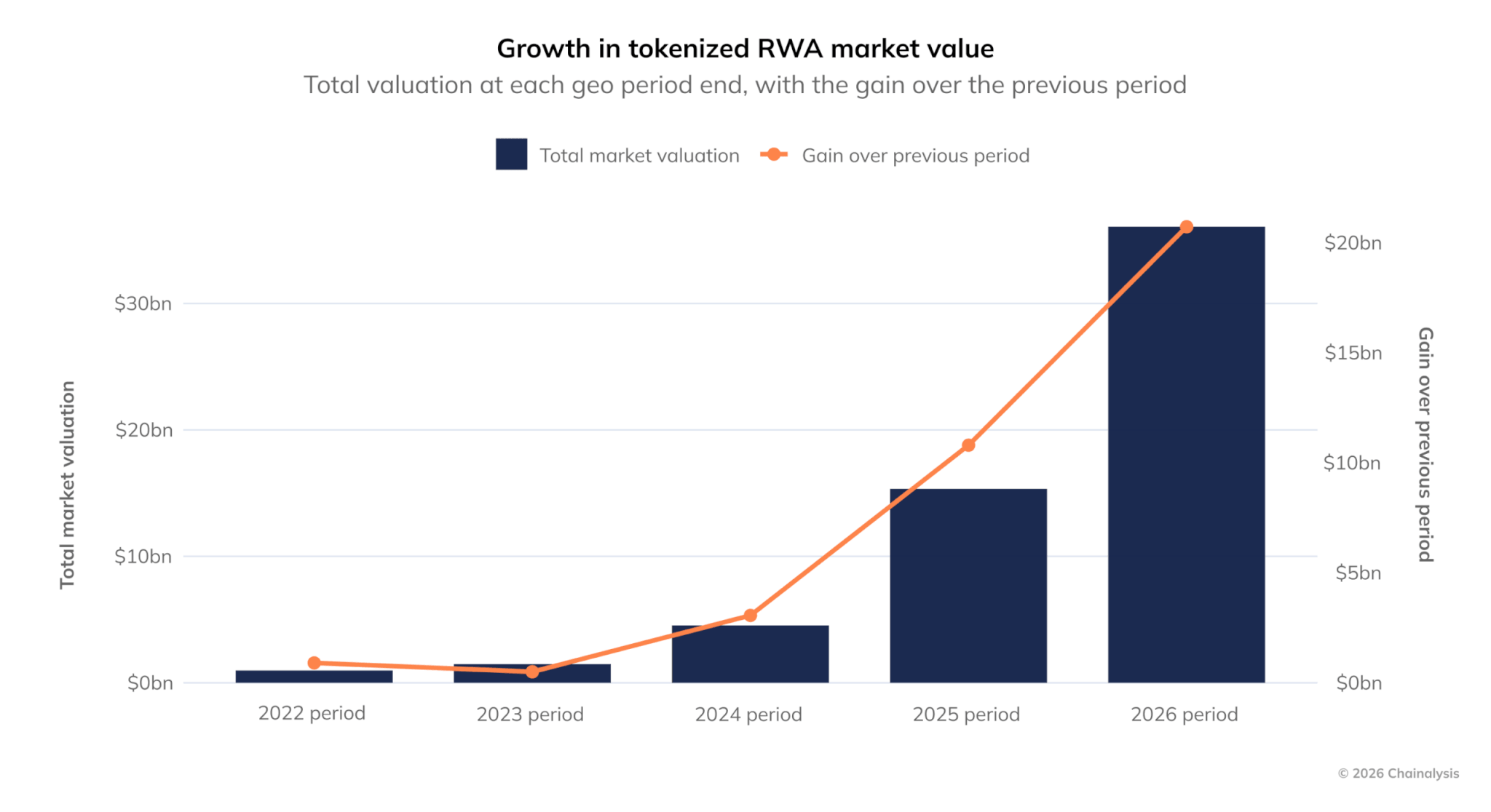
Tokenized real-world assets grew by 135% to $36.07B in the period ending Q2 2026. | Credit: Chainalysis
Wells Fargo’s August launch announcement provides additional detail. The service uses its proprietary blockchain platform, initially supports a limited dollar-to-pound corridor, and is scheduled to expand to more clients, countries, and currencies during 2027.
Clients also do not need to adopt a separate interface. Wells Fargo said eligible payments would automatically use tokenized deposits, which improved speed, timing, and flexibility.
That approach makes the technology part of the bank’s existing offering, with customer value measured through payment performance.
Goldman and Morgan Stanley Target Existing Revenue Streams
Goldman Sachs CEO David Solomon compared tokenization with the transition toward electronic equities trading, which ultimately expanded opportunities for the bank.
He said technological developments could bring additional products, activity, clients, and distribution channels. Goldman has built its GS DAP platform and worked on tokenized bonds, money market funds and real estate, while participating in DTCC’s tokenization initiative. Solomon nevertheless characterized current activity as small.
Morgan Stanley’s emphasis was on advice. CFO Sharon Yeshaya argued that making assets easier to move would leave clients needing guidance on managing them.
Private credit is hard to sell. Tokenization can give holders a way to borrow against it.
The number of wallets lending tokenized private credit grew 1,618% in the 2026 reporting period. The number lending tokenized Treasuries fell 23%.
Together, these strategies point toward familiar businesses gaining new capabilities: moving money, financing holdings, and advising investors.
The next test is whether that utility produces sustained transaction volumes and recurring fees. The private-credit wallet surge supports the case for useful collateral infrastructure, but banks still need to demonstrate how much business it can generate.
Disclaimer:
The information provided in this article is for informational purposes only. It is not intended to be, nor should it be construed as, financial advice. We do not make any warranties regarding the completeness, reliability, or accuracy of this information. All investments involve risk, and past performance does not guarantee future results. We recommend consulting a financial advisor before making any investment decisions.
Giuseppe Ciccomascolo began his career as an investigative journalist in Italy, where he contributed to both local and national newspapers, focusing on various financial sectors.
Upon relocating to London, he worked as an analyst for Fitch's CapitalStructure and later as a Senior Reporter for Alliance News. In 2017, Giuseppe transitioned to covering cryptocurrency-related news, producing documentaries and articles on Bitcoin and other emerging digital currencies. He also played a pivotal role in establishing the academy for a cryptocurrency exchange website. Crypto remained his primary area of interest throughout his tenure as a writer for ThirdFloor.