Learn how to buy, send, and use tGBP on Coinbase. A guide to getting started with the GBP-backed stablecoin and bringing the British Pound onchain. | Credit: CCN.com
Share
Key Takeaways
Listing on Coinbase makes pound-denominated stablecoin accessible globally, with full functionality across buying, selling, sending, and converting.
The market has surpassed $300B with trillions in transaction volume, signaling a shift from trading tools to core payment infrastructure.
tGBP eliminates the need for GBP-to-USD conversions, enabling direct settlement, transfers, and trading in native currency.
While backed 1:1 and issued by FCA-registered BCP Technologies, real-world usage, liquidity depth, and regulatory clarity will shape long-term impact.
Starting April 22, 2026, Coinbase began offering tGBP, a GBP-backed stablecoin, to users in the UK and other supported regions through the Coinbase app and Coinbase Exchange.
Coinbase says users in supported regions can buy, sell, convert, send, and receive tGBP.
The launch comes at a time when stablecoins are rapidly scaling beyond crypto trading into mainstream financial infrastructure.
The global stablecoin market has surpassed $300 billion in market capitalization, with projections reaching $2 trillion in the coming years, while over $30 trillion in transactions were settled in 2025 alone.
As digital payments evolve, stablecoins are increasingly seen as a default method for moving money globally and locally.
Coinbase positions tGBP as part of a broader shift toward locally denominated stablecoins, enabling users to transact in their native currency while accessing global on-chain ecosystems.
We're bringing the UK onchain, and the British Pound to the world.
tGBP is now listed and available to use on Coinbase.
Our first listed GBP-backed stablecoin – ensuring the UK's position in the future of finance.
tGBP is a British pound–denominated stablecoin launched by BCP Technologies in June 2025, becoming one of the first GBP-backed stablecoins issued by a UK Financial Conduct Authority (FCA)-registered crypto firm.
The launch followed testing in the FCA regulatory sandbox, positioning tGBP as a regulated, compliant entry into the stablecoin market.
Notably, tGBP is designed to maintain a 1:1 value with sterling, with backing tied to cash and short-dated UK government securities or other reserve assets depending on the disclosure source.
Initially, tGBP was made available through BCP’s own platform (BCP Markets), providing direct access to a GBP-pegged digital asset. Over time, it expanded to major exchanges, reflecting growing demand for local currency stablecoins.
Today, tGBP is available on multiple platforms:
Coinbase: Listed globally in April 2026, enabling buy, sell, send, and receive functionality
Kraken: Listed in 2025 as one of the first major exchange integrations
BCP markets: Original issuance and primary access platform
tGBP also operates across multiple blockchain networks, including Ethereum, BNB Chain, Avalanche, Polygon, and Solana, enabling broader accessibility across both centralized and decentralized ecosystems.
This multi-exchange, multi-chain expansion highlights how tGBP has evolved from a regulated UK pilot to a globally accessible GBP-denominated stablecoin, bridging traditional finance and on-chain infrastructure.
Why tGBP Listing Matters
For years, stablecoins have been dominated by dollar-based assets. Coinbase is framing tGBP as part of a broader push toward locally denominated stablecoins, arguing that local-currency digital money can reduce friction for users who would otherwise need to move in and out of USD-pegged tokens.
That matters in the UK, where a GBP-native option can make it easier to hold and transfer on-chain value without taking on unnecessary foreign-exchange conversion steps.
The timing also matters, as stablecoins are growing, but the headline numbers need context. BCG wrote that stablecoin market capitalization exceeded $307 billion as of December 2025.
McKinsey noted that reported annual stablecoin transaction volumes are often cited at up to roughly $35 trillion, but cautioned that most of that activity is not the same thing as real-world end-user payments.
McKinsey’s own estimate put actual annualized payment activity at about $390 billion at current usage rates.
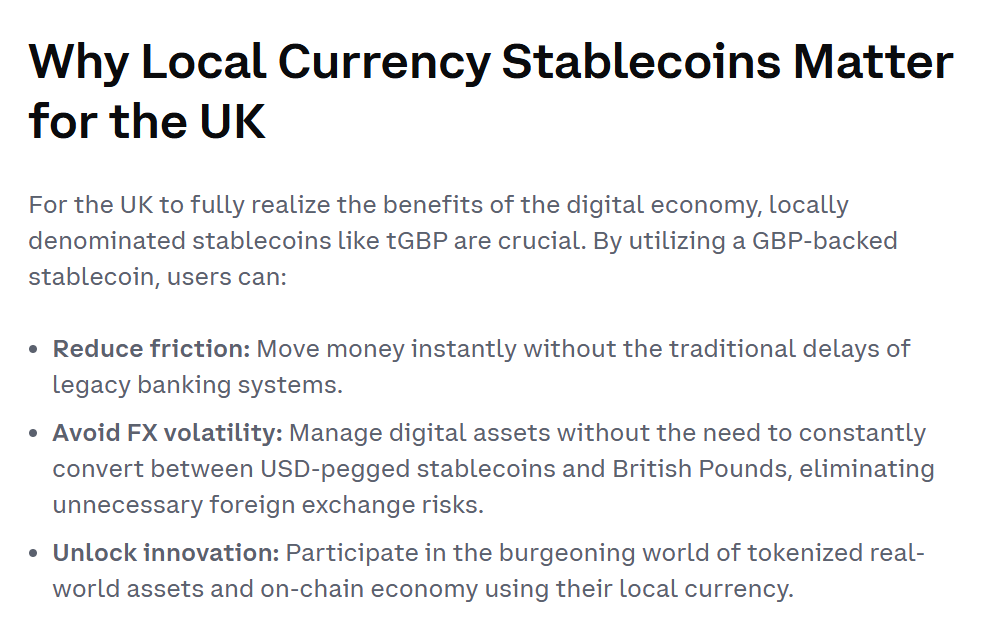
Importance of GBP-backed stablecoins. | Source: Coinbase
So the case for tGBP is not just ‘stablecoins are huge.’ It is that stablecoins are becoming useful financial infrastructure, especially where users want faster money movement, programmable transfers, and easier settlement within digital asset ecosystems.
Coinbase explicitly argues that GBP stablecoins can reduce payment friction, avoid repeated GBP/USD conversions, and help users participate in tokenized real-world asset and on-chain markets using local currency.
Why a GBP Stablecoin May Be Useful
A GBP-backed stablecoin can be appealing for three practical reasons:
First, it can simplify transfers. Stablecoins can move on the blockchain rails continuously, rather than depending entirely on legacy banking cutoffs and operating hours. Coinbase presents this as one of the main reasons for expanding access to local-currency stablecoins.
Second, it can reduce FX friction. UK-based users who prefer to operate in pounds may not want to hold dollar stablecoins just to access on-chain activity. Coinbase specifically highlights avoiding constant conversion between USD-pegged stablecoins and GBP.
Third, it can make new on-chain use cases more natural. RWA.xyz describes tGBP as a pound-pegged stablecoin intended for on-chain GBP payments, programmable settlement, and exposure to GBP-linked tokenized assets.
How To Get Started With tGBP on Coinbase
Getting started with tGBP on Coinbase is simple and designed for both new and experienced users. With support for buying, selling, converting, sending, and receiving, tGBP allows seamless access to the British Pound in an on-chain format. Once access is available in supported regions, users can quickly move from holding GBP in traditional form to using it within digital asset ecosystems.
1. Check Whether Your Region Is Supported
Coinbase says tGBP is available to users in the UK and other supported regions. That wording matters: availability is not described as universal across jurisdictions, so the first step is to confirm access in your account.
2. Sign in to Coinbase
Use the Coinbase app or Coinbase Exchange, since Coinbase says tGBP support is live on those products.
3. Find the tGBP Market or Asset Page
Once signed in, search for tGBP within Coinbase. Coinbase’s launch language indicates users can buy, sell, convert, send, and receive the asset where supported.
4. Fund Your Account
To buy tGBP, you will typically need either a cash balance or another eligible asset to convert. Coinbase’s help materials for selling and converting crypto show that balances can be moved between crypto and local-currency balances, depending on the feature and region.
5. Buy or Convert Into tGBP
If tGBP is enabled in your account, you should be able to either buy it directly or convert another supported balance into it, using the buy/sell/convert flow Coinbase references in its tGBP launch announcement.
6. Send or Receive Carefully
Coinbase’s receiving guidance warns users to confirm that incoming funds are sent on a network Coinbase supports for that asset, because funds sent on the wrong network may not be recoverable.
That is especially important for stablecoins, which often exist across multiple networks.
Benefits of Using GBP Onchain
Using GBP in on-chain form through tGBP unlocks practical advantages for both individuals and businesses. Instead of relying on traditional financial rails or converting into foreign-denominated stablecoins, users can operate directly in their local currency within digital ecosystems.
Faster transactions: Move money quickly without banking hours or delays
Reduced FX exposure: Avoid repeated GBP to USD conversions and related costs
Global accessibility: Send and receive GBP across borders with ease
Programmable payments: Enable automation through smart contracts and on-chain tools
Seamless integration: Participate in trading, DeFi, and tokenized assets using GBP
Consistency in value: Maintain exposure to the British Pound while interacting on-chain
GBP on-chain bridges traditional finance and digital infrastructure, making everyday financial activity more efficient and accessible.
What To Watch Before Using tGBP
tGBP may be designed to track £1, but using any stablecoin still requires some care. Reserve structure, redemption mechanics, supported networks, and regional availability all matter.
The FCA sandbox reference and BCP’s registration status may give users more confidence than an unregistered issuer, but that does not mean the product is risk-free. Coinbase also includes high-risk investment warnings on its blog pages, even alongside product launches.
It is also worth separating “stablecoin growth” from “payment adoption.” BCG and McKinsey both describe a rapidly growing stablecoin market, but McKinsey is explicit that raw on-chain transfer volumes can overstate real payment usage because they include trading, internal routing, and automated activity.
Comparative Approach to Local Currency Stablecoins
Different regions are converging on stablecoins as regulated financial infrastructure, but their approaches reflect distinct priorities around financial stability, innovation, and monetary sovereignty.
In the UK, policymakers aim to position the country as a global crypto hub while still refining detailed rules, often balancing innovation with caution around systemic risk.
In contrast, the European Union has introduced a comprehensive framework under MiCA, enabling euro-backed stablecoins such as EURC (Circle) and EURS (Stasis) to operate under strict reserve, licensing, and transparency requirements.
In the Asia-Pacific region, Singapore stands out for its clear regulatory regime from the Monetary Authority of Singapore, which supports stablecoins like XSGD (issued by StraitsX), which are fully backed and compliant with national rules.
Australia takes a more flexible approach, regulating stablecoins under existing financial laws, with AUDD (issued by AUDC Pty Ltd) as a key example of a fully collateralized, AUD-pegged digital asset.
Across all regions, a consistent trend is emerging: stablecoins are expected to be fully backed, redeemable 1:1 with fiat currency, and subject to increasing regulatory oversight.
At the same time, non-USD stablecoins, including GBP, EUR, AUD, and SGD variants, still represent a small share of the global market, which remains dominated by dollar-pegged assets.
Global Comparison of Local Currency Stablecoin Approaches
Region
Example Stablecoins
Issuer
Regulatory Approach
Market Stage
UK
tGBP
BCP Technologies
Developing (FCA-led)
Early-stage
EU
EURC, EURS
Circle, Stasis
MiCA framework
Regulated, growing
Singapore
XSGD
StraitsX
MAS-regulated framework
Advanced, structured
Australia
AUDD
AUDC Pty Ltd (Novatti)
Existing financial law (ASIC)
Emerging, pilot-driven
Coinbase Strategy Signals Shift Toward Local Currency Stablecoins
Coinbase is treating tGBP as more than just another listing. Its April 22 post argues that local-currency stablecoins are important if the UK wants to strengthen its role in digital finance, and it ties tGBP to a broader international strategy around locally denominated stablecoins. Coinbase also points to BCP Technologies’ FCA registration and participation in the sandbox as signs of regulatory engagement.
That does not automatically make tGBP the defining future of UK payments. But it does make it one of the clearest current examples of a sterling-native stablecoin moving from niche infrastructure into a mainstream consumer platform.
For anyone in a supported region who wants to experiment with holding, transferring, or using on-chain pounds, Coinbase’s tGBP listing is the most straightforward place to begin.
FAQs
What is tGBP?
tGBP is a British pound–pegged stablecoin issued by BCP Technologies, designed to maintain a 1:1 value with GBP and backed by fiat reserves and short-term government securities.
Where can tGBP be used or traded?
tGBP is available on platforms including Coinbase, Kraken, and BCP Markets, with support for buying, selling, sending, and receiving.
Why use tGBP instead of USD stablecoins?
tGBP allows UK users to transact directly in GBP, avoiding foreign exchange conversions and reducing exposure to USD volatility.
Is tGBP risk-free?
No. While designed to be stable and fully backed, risks remain around reserves, regulation, platform usage, and market adoption. Users should review details before using.
Disclaimer:
The information provided in this article is for informational purposes only. It is not intended to be, nor should it be construed as, financial advice. We do not make any warranties regarding the completeness, reliability, or accuracy of this information. All investments involve risk, and past performance does not guarantee future results. We recommend consulting a financial advisor before making any investment decisions.
Onkar Singh has three years of experience as a digital finance content creator. Throughout his career, he has collaborated with various DeFi projects and crypto media outlets. In his leisure time, he enjoys fitness activities at the gym and watching movies across different genres. Balancing his professional and personal interests, Onkar continues to contribute to the digital finance landscape while pursuing his hobbies.


 Easy
Easy