Australia advances a crypto regulatory framework as ASIC warns that AI tools and finfluencers are influencing Gen Z crypto investing. | Credit: Getty Images.
Share
Key Takeaways
An Australian Senate committee has backed a proposed crypto regulatory framework that would bring digital asset platforms and tokenized custody providers under existing financial-services law.
ASIC said 63% of Gen Z Australians use social media for financial information and 18% use AI platforms.
Australia is moving ahead with a new crypto regulatory framework as the country’s corporate regulator warns that AI tools and finfluencers are shaping how young people invest in digital assets.
On Mar.16, an Australian Senate committee reported on the Corporations Amendment (Digital Assets Framework) Bill 2025.
The committee proposed to update the country’s digital-asset rules by folding major crypto intermediaries into existing financial-services law.
Parliament referred the bill to the Senate Economics Legislation Committee on Feb. 5, 2026.
According to the Australian Parliament’s bill summary, the proposal would define digital tokens, digital asset platforms and tokenized custody platforms.
It would also give ASIC and the minister powers to regulate those platforms.
A parliamentary bills digest said digital asset platforms and tokenized custody platforms would be treated as financial products, unless they are managed investments, and would face financial-services obligations including licensing and consumer protection requirements.
Try Our Recommended Crypto Exchanges
Sponsored
Disclosure
We sometimes use affiliate links in our content, when clicking on those we might receive a commission at no extra cost to you. By using this website you agree to our terms and conditions and privacy policy.
The regulatory push came the same day ASIC warned that young Australians are increasingly relying on social media and AI when making financial decisions.
In a Mar. 16 media release, the regulator said 63% of Gen Z respondents use social media for financial information and guidance, while 18% use AI platforms.
ASIC said trust levels were also high. More than half of Gen Z respondents said they somewhat or completely trust financial information on social media, and 64% said they trust AI services.
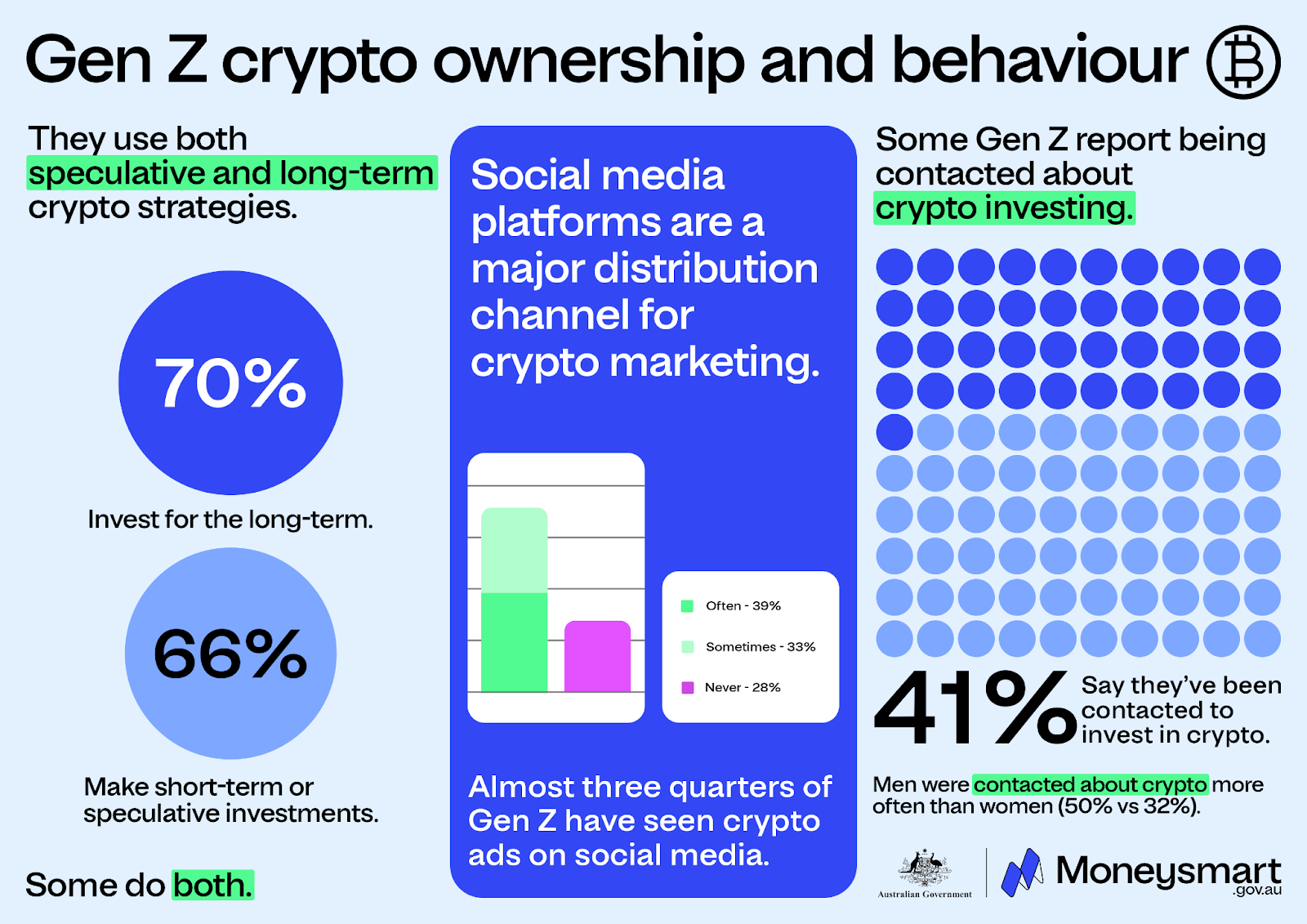
Crypto featured prominently in the data. ASIC said 23% of Gen Z Australians own crypto, and 29% of those crypto holders trade based on social media and influencer content.
Breakdown of Australian Gen Z crypto activity. Source: ASIC
Speaking to the Australian Financial Review, ASIC commissioner Alan Kirkland said the regulator has also been monitoring social-media marketing designed to drive people into investments, including crypto, and warned that some of that activity leads consumers toward scams.
The comment lines up with ASIC’s broader findings that social media is a major distribution channel for crypto promotion among Gen Z Australians.
Crypto Oversight Expands Beyond Platforms
The two developments show authorities in Australia tightening oversight both on the infrastructure side of crypto and on the online channels shaping retail behavior.
Regulators are now also examining how crypto is promoted, recommended and discussed across social media and AI-driven tools.
Australia’s proposed framework is meant to bring more legal clarity to the sector while closing regulatory gaps and strengthening market safeguards.
At the same time, ASIC is warning that younger investors are making riskier decisions in digital environments they increasingly trust.
Bill Still Faces Further Steps
Australian Parliament records show the bill is still before the Senate.
The committee report moves the proposal forward, but several legislative steps remain before the framework could become law.
The latest development still marks progress for a proposal that would bring crypto platforms more directly under Australia’s financial-services rules.
It also reinforces a broader pattern: regulators are scrutinizing both the structure of the crypto market and the digital channels that drive retail participation.